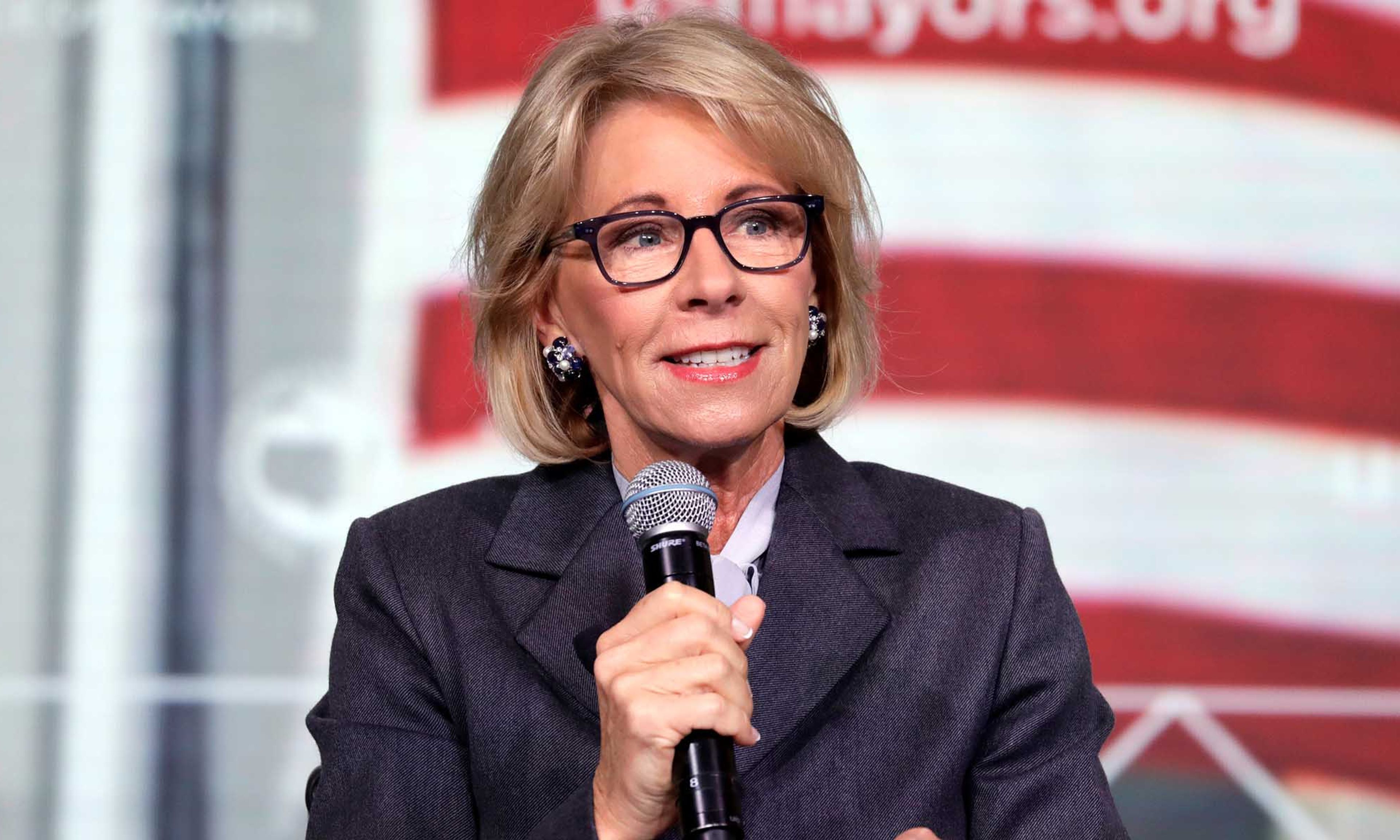
I’ll confess that when I opened Betsy DeVos’s new book, Hostages No More, I had entirely forgotten just how contentious was her confirmation process. It’s a testament to the erratic chaos of the Trump administration — and the constant, breathless media coverage that was its dance partner for four years — that major events such as this, the first time a vice president was called upon to break a tie for a cabinet nomination, were relegated to the dustbin of memory.
I am glad I was reminded of it, however, and that it was Mrs. DeVos herself doing the reminding. DeVos was treated damnably unfairly by the media and Senate Democrats, who dutifully took their script from teachers’-union bosses and performed it with gusto. DeVos, it should be said, did not perform altogether well in the hearings, something she readily admits in Hostages No More. She explains that she “became uncharacteristically cautious” through the preparation process leading up to the hearing and that she “hadn’t yet mastered [the] ability” to ably answer complex questions in ten-second sound bites. She concedes that her much-derided answer to Senator Chris Murphy of Connecticut about whether guns should be allowed in schools, in which she cited the potential need of some school districts to use firearms to defend against native wildlife such as grizzly bears, “is one of the things I might do differently if I had to do it all over again.”
All this was clear to us television observers of the hearing; much more interesting — juicy, even — is the context DeVos offers as to why, in her opinion, the hearing went the way it did. Perhaps some of you will remember (not I; forgot this one, too) the comedy of errors that was the Trump-team transition, an environment of “self-created chaos” in the words of the secretary. DeVos’s confirmation fight is a clear example of what happens when the necessary details and inherited experience of quotidian political operations are ignored: Basically, it doesn’t go well, and it looks as if no one has any idea what they’re doing. DeVos recounts how the transition team — that is, the second team, put together on the fly after Trump fired Chris Christie and his team, also put together on the fly — was a constantly changing cast of characters who, through either a time crunch or inexperience, coached her “to stick to generalities and not commit to any specific policies.” The Trump team, at the same time, relentlessly enforced a rule against nominees’ speaking publicly in the weeks before their hearings. While this would typically be sound policy, the Trump team pushed little to no positive messaging about DeVos’s nomination in the face of unending Democratic and teachers’-union attacks, allowing public opinion to sour against her.
This story, while by no means the most important one, is representative of much of Hostages No More, which is two parts memoir and one part education manifesto. The early chapters recount DeVos’s personal history — her upbringing in Holland, Mich., her early-adult and college days, her meeting her husband, Dick DeVos, and their many years spent doing charitable work. Before her nomination, DeVos spent 30 years advocating education freedom, in both her native Michigan and in states and localities nationwide, through organizations including the American Federation for Children (AFC), which she founded with Dick. (DeVos also served on many charitable and nonprofit boards, including that of the American Enterprise Institute, where I used to work as a researcher in education-policy studies.)
DeVos laments early in the book that she lacks a “way with words.” Nevertheless, she is able to usefully and succinctly recount a great many experiences from her four years as secretary of education, stitching together illustrative real-world examples to better shape the reader’s understanding of her overall message of education reform. Her largest undertakings in office all receive attention, from the Trump administration’s reform of Title IX regulations on sexual assault to higher-education-oversight efforts, to cleaning house at the department, to the failed push for securing school-choice funding in the Covid-relief package. For an author discussing so many policies, regulations, and systems that are inherently in the weeds, she exercises an impressive restraint when it comes to statistics and jargon. What data are included manage to give emphatic weight to the arguments they accompany rather than reading like a page from the Federal Register — a rarity for any once-bureaucrat.
It’s the vignettes, the little background snippets and “this is how I saw it” moments, that give the book life. It was none other than Jeb Bush, it turns out, who probed DeVos regarding her potential interest in serving as education secretary; he then connected her with Vice President Mike Pence, who eventually sold her to Trump. As someone working in education policy throughout her tenure, and who covered the Department of Education and DeVos’s office extensively, I found this greater exposure to her personality refreshing. There is genuine (more than warranted) bite, for instance, in each of the handful of instances in which Senator Elizabeth Warren makes an appearance. Even in her discussion of Senator Cory Booker, who was formerly a longtime ally of school choice and friend to DeVos and the AFC before kowtowing to union pressure and opposing her nomination, there is not the same chilly matter-of-factness.
Several moments are even funny. A particular highlight concerns the doomed push for school-choice funding in the 2020 Covid-relief bill: “All 53 Republican senators voted yes — except Rand Paul of Kentucky, but his vote had nothing to do with school choice, which he supports, and everything to do with who Rand Paul is generally,” DeVos writes.
Yet her purpose in writing lies less in the memoir and more in the message — that of education freedom. This phrasing has been adopted by much of the right-wing education-reform coalition in the past two years, taking the traditional place of “school choice.” As I explained recently for the Washington Examiner magazine, this change represents a shift not simply of sloganeering but of teleology:
For one thing, education freedom, as DeVos notes in her book, better captures the breadth and depth of mission than does school choice, a term that is not only conceptually bounded to the entity of the schoolhouse but in popular understanding comes to mean “charter schools” and little else. More to the point, however, education freedom better represents the very idea, the animating vision undergirding this reform movement. Chartering is just an authorizing policy vehicle; education savings accounts, vouchers, and scholarship grants are all just funding certifications — it’s freedom, in and through your education, that’s the whole bag. Education freedom is the purpose and the destination.
It is to this purpose that DeVos expressly commits the final third of her book, building from the groundwork of policy experiences related in the preceding pages. And it is here, at the exhortation, that Hostages No More comes up a bit short. For as much as I support DeVos’s program, the message marshaled to sell it is more soapbox than substance.
As was her wont as secretary, DeVos is fond of playing the Silicon Valley gadfly. “Education freedom is disruptive,” she writes. “It is way past time to dismantle the system itself” (emphases mine). DeVos is correct when she notes that, right now, millions of Americans are newly looking for alternatives to an education system they know failed them over the past two-plus years. What is far more questionable is whether this message is the way to reach them. The majority of parents still report that they are satisfied with their child’s school, even as they lament the state of the education system more broadly. For many, local schools remain centers of the community, institutions building and disseminating connective cultural capital. Will they hear a call for greater parental freedom and educator accountability, or will they hear a declaration of war?
Moreover, such overreaching rhetoric about “dismantling” belies the education shibboleths that DeVos, and many others in our coalition, still maintain. Education freedom “broadens the categories in which most Americans are used to thinking about education,” she writes, yet her case for charter schools is built almost entirely on standardized-test-score comparisons between charters and traditional public schools. What if parents and children wish to choose the school with the superior band program, or with opportunities for high-level football competition, over the charter school that has slightly higher average math scores? Would we dismantle this option in pursuit of generalized freedom? If we wish to truly disrupt education’s most vicious circles, why not begin with dismantling higher education? Perhaps now that the movement has adopted the mantle of education freedom rather than school choice, we might finally have an honest discussion about how a surfeit of choice at the higher-education level has undermined our entire educative project.
If it is to be new modes and orders, then let’s have it out. In the meantime, let’s remember to include a little order, a little restraint on our pathway to freedom.










Comments