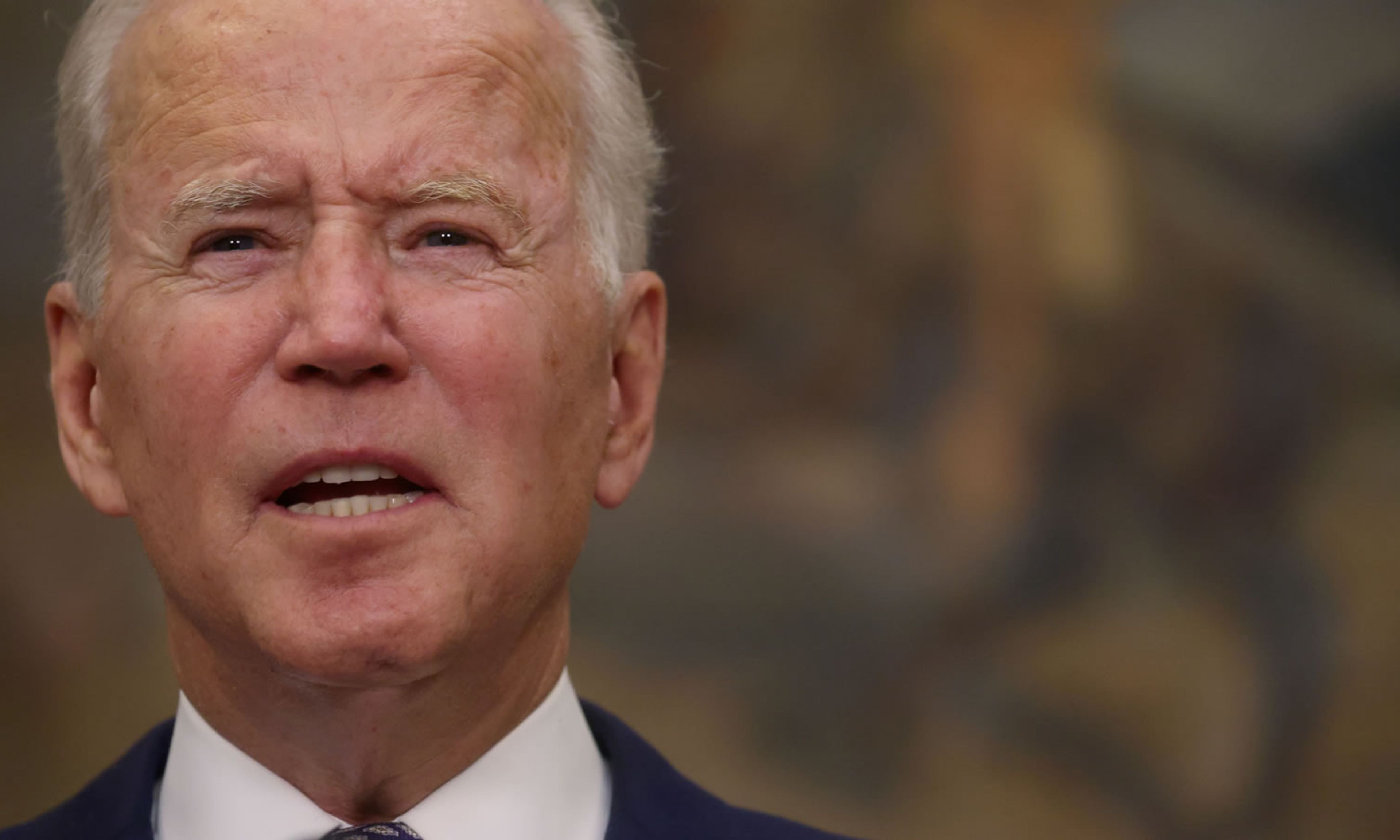
In August, Joe Biden had three jobs. He botched them all.
Step back for a moment — far away from our usual partisan mêlée — and consider the role that our constitution accords to the president of the United States. It’s pretty simple, all told. Per Article II, the president exists to “take Care that the Law be faithfully executed”; to “preserve, protect and defend the Constitution”; and to serve as the “Commander-in-Chief of the armed forces.” And beyond that? Well, beyond that, he’s not supposed to do a great deal. Yes, presidents also play a role in the appointment of judges and cabinet officials. Yes, presidents are required to sign legislation. And, yes, presidents help to negotiate treaties. But those are just as much congressional as executive functions. In their core capacity, presidents have just three things to do. And, in the space of the last month, President Biden has failed at every one.
This, of course, is not to say that President Biden has been truant. Au contraire: At times, Biden has proven himself as capable of using the bully pulpit as anyone else who has occupied his office. Instead, it is to suggest that, just seven months into his first term, our 46th chief executive is at very real risk of becoming a cautionary tale about the dangers posed by our upside-down political system. In the areas that don’t concern him in the slightest — say, the decisions of a given school board in Natrona County, Wyo. — Biden is engaged, combative, and near impossible to shut up. And in the areas over which he has a global monopoly on responsibility — say, a foreign-policy crisis that was the direct result of his own poor decision-making — he is impotent, shifty, and conspicuously elsewhere. As Biden claims, the buck often stops with him. Trouble is, it’s the wrong buck.
When, in mid August, Kabul fell into heartbreak and chaos, observers from around the world asked how President Biden and his team could have so badly screwed up the plan. But when one examines the behavior of this White House, the answer becomes perfectly obvious. Having set the withdrawal dates himself back in April, Biden was aware of what needed to be done — and when. He just didn’t care about doing it as much as he cared about doing other things. Let the record show that, as the Taliban were marching across Afghanistan, our president was busy contriving a preposterous interpretation of the 1964 Civil Rights Act in the hope that he might be able to force every child in the United States to wear a cloth mask at school; he was instructing the Centers for Disease Control and Prevention to continue its micromanagement of the American rental-property sector — despite knowing that its doing so was unconstitutional; he was feuding stupidly with the governors of Florida, Texas, Arizona, and Iowa; he was canceling hundreds of thousands of student loans; and he was gearing up to spend yet another $3.5 trillion that we don’t have, on things that we don’t need, in an economy that can’t bear it.
“Why isn’t Joe Biden doing his job?” they asked. The question isn’t quite right. He was doing his job — as he sees it. It’s just not the job that is described in our constitution.
As for Congress? It seems to have developed precisely the opposite problem: to wit, that its members prefer playing shadow president to serving as the engaged and jealous legislators that the American system of government assumes that they want to be. On no topic of late has this been more obvious than Afghanistan. For nigh on two decades now, America’s lawmakers have been reluctant to debate the fundamental foreign-policy questions that their branch has been explicitly charged with deciding — among them, whether the United States should be at war, for what purposes the United States should be at war, and by what terms the United States should be at war. And yet, now that that debate is over, and we are discussing only the execution of war — now, that is, that we are contending with the parts of the equation that are constitutionally left to the president — every senator and his dog seem desperate to share their own exquisitely detailed plans. If only they poured the same level of attention into their own jobs.
James Madison’s Constitution is predicated upon the idea that, when power is carefully allocated within separate and mutually antagonistic branches, “ambition must be made to counteract ambition.” Alas, over time that ambition has atrophied beyond recognition — especially in Congress, whose members increasingly seem to regard themselves as mere lobbyists for the judicious use of executive power. Last month, the Supreme Court ruled that the Biden administration’s extension of a Trump-era eviction moratorium “exceeded its existing statutory authority,” and made clear that if the White House wished to renew the program once again, “clear and specific congressional authorization (via new legislation) would be necessary.” In response, President Biden said that he intended to continue it anyway. In a functioning system, Biden’s usurpation would have spurred those whose “authority” he was “exceeding” into sustained, outraged action. Instead, it spurred them to . . . well, dance. In statements, both the Senate majority leader and the speaker of the House of Representatives applauded the president for usurping their power — in particular, Nancy Pelosi expressed “extraordinary relief” following “the leadership of President Biden” — and, worse, they lambasted those within Congress who had decided not to play along with the ruse. With friends like these . . .
The result of all this is a federal government that has become so sprawling and so indulgent that it now lacks the time, money, and focus that are necessary to fulfill its most basic missions. In 2020, Washington, D.C., spent $1,557,083 to walk lizards on a treadmill; it spent $4,575,431 to see what happened when alcoholic rats were sprayed with bobcat urine; and it spent $36,831,620 to study why stress turns hair gray. And yet, last month, when thousands of American citizens were stranded in Afghanistan because the Biden administration didn’t think to get them out before removing the U.S. military, the federal government’s first instinct was to ask the evacuees to open their checkbooks. Per Politico, the State Department tried to charge Americans up to $2,000 for the privilege of being removed from a war zone — and, when challenged, explained that the law demanded it.
Which, if true, makes the law an ass. Or, more accurately, makes asses of those who have been tasked with writing, interpreting, and enforcing the law, but who have decided to do none of those things with any care or precision.
Somewhere out there, in the wilds of Afghanistan, a desperate American is shouting “Civis Americanus sum” into the ether, while scanning the skies for choppers. Back in the United States, meanwhile, the people who have spent their lives seeking control of the most powerful offices in the land are busy checking their iPhones, clucking on television, and thinking: “That’s not my department — but if it were, I’m sure I would do it perfectly.”







Comments