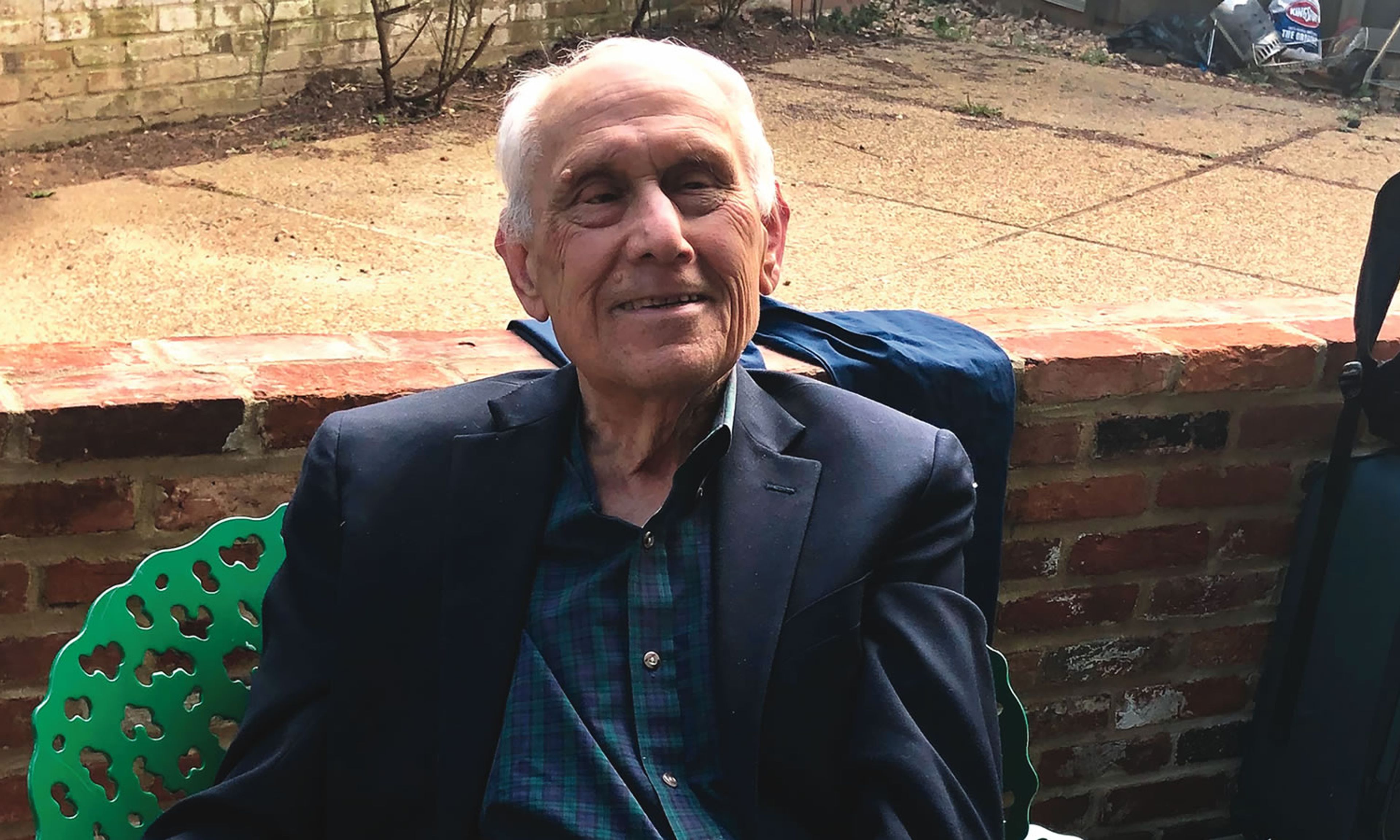
When Donald Kagan passed away in the first week of August, his admirers felt a sense of loss, but also a sense of gratitude — for the life lived. Kagan was a great scholar, a great educator, and a great guy. The mere mention of his name brings a smile — and stories. Here’s one.
The first time I met him, he said he liked my music criticism but had a complaint: “You’re too nice to modern composers.” I said, “That would come as a surprise to them.” He threw back his head and laughed. He had me at hello, so to speak — at that laugh.
He was a classical historian, a historian of Greece. He knew plenty about Rome, but Greece was his real love. As a young professor, he taught at Cornell, but he left in 1969, after the university administration capitulated to student militants. Others leaving included Allan Bloom, Walter Berns, and Allan Sindler — a golden roster. Kagan taught the rest of his career at Yale. For three years, he was dean of the college. He retired in 2013.
Six years later, I went to see him at his home outside Washington, D.C. It was a beautiful spring day and we sat on his patio. To be in that guy’s company — as thousands of his students can attest — was a joy and an education.
He was born in 1932, in Lithuania. He came to America with his mother and his sister when he was two. (His father had passed away.) I asked him what his life would have been like if the family had stayed in Lithuania. “Death,” he answered, immediately. “They killed all the Jews they could get their hands on.”
The family lived in Brooklyn, N.Y. — the neighborhood of Brownsville, specifically. Brownsville was a working-class slum, in Kagan’s description. It was composed primarily of Jewish immigrants from Eastern Europe.
From the seventh grade through ninth grade, Kagan and other immigrant kids went to a school that was 50 percent white — not that Jews were considered “white” by everybody — and 50 percent black. There was not a lot of fighting, said Kagan. The two groups kept mainly to themselves — except in sports, where they mingled.
“Basketball was the religion of Brownsville,” said Kagan. He was devoted to it, and so was most everybody else. There was a star player, Ziggy Banks (“Ziggy” for “Siegmund”). He went on to play in the Garden, said Kagan — Madison Square Garden, in Manhattan, the big time.
Everyone in Brownsville was dirt-poor. There was no money, at all. But those kids were the luckiest in the world, said Kagan. Immensely privileged. Because the adults revered education. And that was the kids’ ticket out.
Talking with me on his patio, Kagan was eloquent on education (as on everything else). “You would be terribly handicapped if you were not educated,” he said. “People can take advantage of you if you’re ignorant.” Education “is self-defense. It’s like carrying a gun.”
Don Kagan went to — where else? — Brooklyn College. He planned to be a high-school history teacher. History majors were required to take Western civilization and then a variety of courses, covering many periods and places. They would not let you be an ignoramus, said Kagan. These days, if you’re an ignoramus, no problem.
And how did he come to be a classical historian? This, Kagan said, tells us something about “the role of chance in our lives.”
There were many courses to choose from, after you took Western civ. Where to begin? Don Kagan thought he would go in order: from the ancient world on up. He consulted some upperclassmen — savvy types. Should he dive in with Greece and Rome? “Um, you might want to wait a year or two,” they said. “Maybe she’ll be retired by then.”
Who was “she”? Meta Elizabeth Schutz, “a maiden lady in her 60s,” as Kagan put it to me. She was formidable, no-nonsense — kind of a battle-axe. Anyway, Kagan, undaunted, signed up.
“The first thing I noticed was that the room was too big for the number of students in it. And that squared with what I’d heard about her.” Not many were undaunted. Not many were cut out for “Miss Schutz,” as Kagan still called her, almost 70 years later.
She had no desire to be your friend. She wasn’t there to cuddle you. She was a severe, exacting teacher. She would not wait for you to raise your hand. She would call on you. And you’d better have the answer.
One young woman began her answer tentatively, saying, “Well . . .” Miss Schutz interjected, “It is not well!” (Think of “well” as the “like” of its time.)
Young Don Kagan resolved to be ready for this lady. She would not show him up. He studied and studied. And when she at last called on him, he gave the right answer, in kind of a tough-guy tone. Miss Schutz said, simply, “Yes” — then moved on to the next student.
She did not celebrate Kagan’s answer. She did not pat him on the back. She expected you to know. That was normal. And if you didn’t know — that was abnormal. She treated her students — those poor immigrant kids — as if they were products of Choate and Groton, now studying at Princeton. In this, she did them an inestimable favor.
Long story short, Kagan grew to appreciate Meta Elizabeth Schutz a great deal. And he determined, then and there — that very semester — to be a classical historian.
When he was a professor, did he, too, call on students, without waiting for them to raise their hand? No. “I wasn’t man enough to be Meta Schutz.” But he had his own methods.
My friend Eric Simpson — formerly an editor at The New Criterion — studied classics at Yale. He was one of the last to “major in Kagan,” as he says. One day, a class was discussing a large influx of people into Attica — an influx that was causing social unrest. Kagan asked, “So, where are all these people coming from?” There was an awkward silence. Eric hazarded, “Megara?” Kagan smiled impishly and said, “Eric, you don’t know where Megara is, do you?” Busted. (The answer turned out to be Thrace.)
In politics, Kagan was a conservative, of the kind that rooted for President Reagan. He was a great believer in military preparedness — deterrence. There was a lot of “Truman Democrat” in him, as he said. (Reagan had been a Truman Democrat, too.) “They call me a conservative,” said Kagan. “They used to call me a liberal. I haven’t changed my views at all.” He never did, fundamentally.
Definitions of “conservative” and “liberal” are always slippery, but I asked Kagan to take a crack at the job. The first thing a conservative is, he said, is not a liberal. “That’s not nothing!” And the mood of a conservative is apt to be: Above all, do no harm. Don’t make things worse.
A liberal is likely to have a program; a conservative is likely to have none. A liberal wakes up with twelve things he wants to do to change the world; a conservative is likely to say, “Have a nice day.” The conservative knows that the world could stand a lot of improvement — but he is wary of piling on more difficulties, in an effort to bring about the improvement.
Of course, there are times when you have to fight — when you have to make changes and right wrongs. But try to pick worthy battles.
As radicalism, extremism, and intolerance pervaded American campuses, Kagan was a beacon: a beacon for students — and for fellow faculty members, I’m sure — who wanted a saner, fairer, more education-oriented environment. When he retired, lots of Yalies, and others, felt they had lost a champion. But he had set an example for successor champions.
Eric Simpson asked Kagan how he felt about retiring. Few could have loved teaching — and the campus life generally — more. Eric recalls the following: “He shook his head and smiled the most calm, contented smile I’ve ever seen, on anyone, and said, ‘I want to spend my last years with my boys.’ I really don’t think I’ve ever seen anyone else look so serene. And I take a lot of solace in knowing that he did exactly that.”
Kagan and his wife, Myrna, were married for 62 years. She passed away in 2017. Their two sons are Robert and Frederick, both well-known historians.
Sitting on his patio, winding up our conversation, I asked Kagan to name a few of his favorite ancients. He said his answers would not surprise me. His favorites would be Greek, and they would relate to politics. The Romans were country clods who knew how to kill people, he cracked. But, ah, the Greeks! They knew politics! “And politics is important to me.”
The first name: Pericles. “More than any other individual you can think of,” said Kagan, “Pericles is responsible for the development and success and influence of Greece.” Talk about influence: “When a kid takes my course on ancient Greece, he’s learning American history, in a certain sense.”
And then? Thucydides. “If you ask people who invented history, they’ll say Herodotus, and they’ll be right.” But Thucydides influences us “more directly and fully.” He was “filled with wisdom and understanding,” handing down “useful, real knowledge, mostly in the realm of politics,” rather than military affairs.
In talking about Pericles and Thucydides, said Kagan — and stopping with those two — “I don’t want to be unfair to the other guys I love, back in that world, but I’m runnin’ low.”
One more question: Favorite basketball player? Apart from Brownsville’s Ziggy Banks? Kagan named Dave DeBusschere, who played both in the NBA and in Major League Baseball. In basketball alone, he had “multiple skills,” said Kagan. He could play inside, like a center, and he could play outside, like a guard. Plus, he was “incredibly physical,” before basketball became even more so. “It wasn’t so much that he was trying to kill you. He just wasn’t going to let you stop him.”
At this, Kagan laughed that terrific laugh of his.
To be in his company was indeed a joy and an education, as I said earlier. Also, if the phrase “a gentleman and a scholar” was invented for anybody, it was for Donald Kagan. I thought of him as a prince — a scholar-prince — via Brooklyn. The last words he said to me — wrote to me — were “Long may you wave.” I said the same back to him. And I bet he will be waving — shining, flourishing — on and on.










Comments