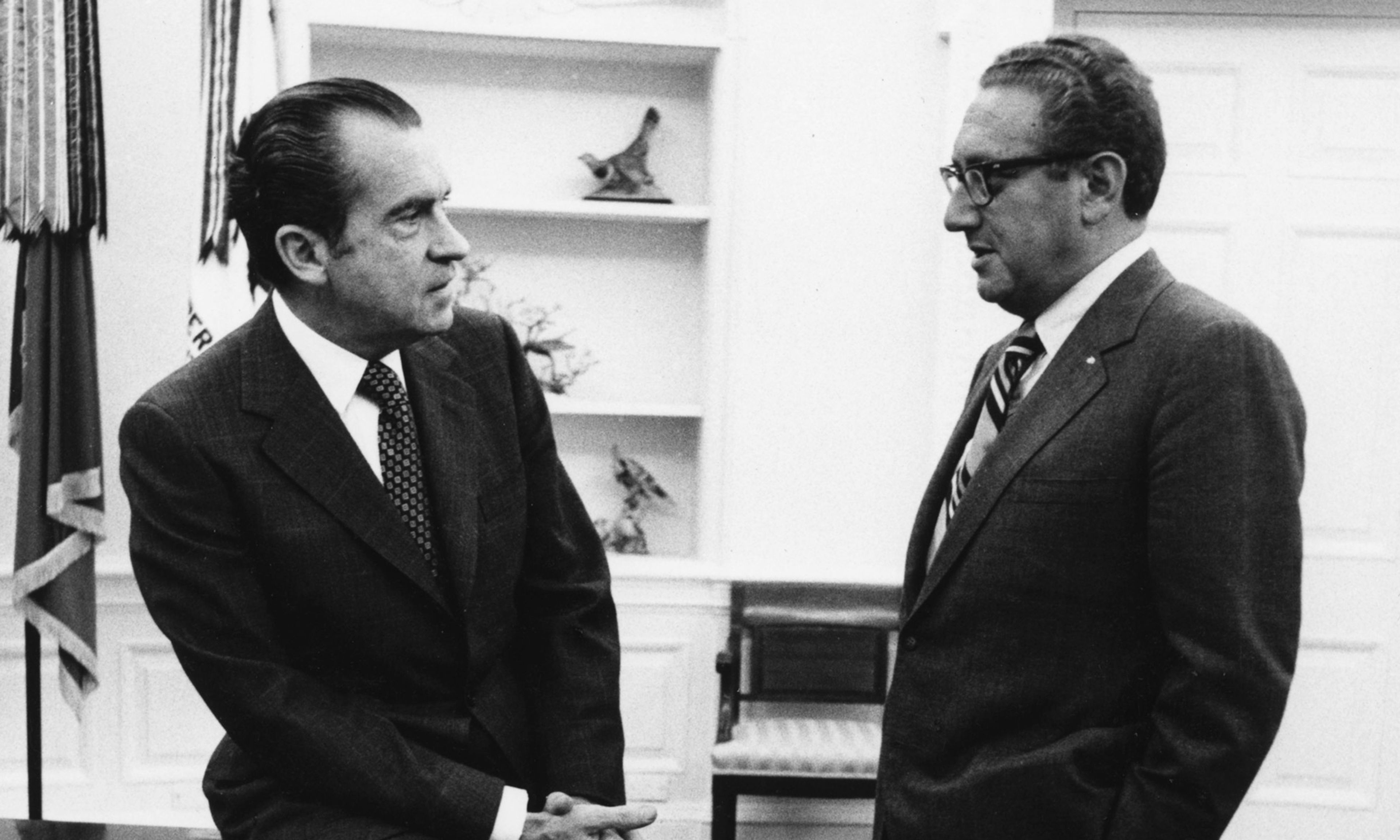
In this book, a distinguished British historian sails amiably and skillfully into deep waters. (I should disclose that both the author and the subject have been friends of mine for many years, though my relations with Dr. Kissinger have been dormant recently.) The book highlights the year 1973, but is not confined to it.
Watergate resonates throughout, like the ominous theme from Jaws, but the question of whether Richard Nixon was guilty of crimes — or, as he endlessly repeated, of “mistakes unworthy of a president” but not of illegalities — is not definitively addressed. The author deals gently with the ferocious controversy. On one side of it are those who hold that Nixon was a uniquely sleazy president, a morally bankrupt and even evil man. Usually, the same people believe that Nixon’s failure to throw in the towel in Vietnam led to another 30,000 needless American combat deaths, in a quest for a spurious “decent interval” to avoid direct American defeat. The other side generally holds that Watergate was a media smear job — that Nixon was guilty of a bungle, but probably did not commit crimes.
It is possible that Nixon authorized payments to the Watergate defendants in exchange for perjured testimony, but it is not clear that he did so. He did authorize asking the director of the CIA, Richard Helms, and his deputy, Vernon Walters, about whether they would ask the FBI to stay out of the Watergate investigation because some of the Cubans involved could lead investigators back into CIA matters such as the Bay of Pigs fiasco of 1961; Helms and Walters said they would do nothing without a direct presidential order, and Nixon did nothing further. This is not grounds for removing a president from office, though it does appear to satisfy Sir Alistair Horne that Nixon behaved unconstitutionally.
On Vietnam, the case could be made that it was a lost war when Nixon came into office in 1969, and that he retrieved it to the point that he brought a satisfactory end in sight. When President Johnson offered a joint complete withdrawal in October 1966, he was conceding defeat; the decent interval would have been the six months or so before the North renewed its invasion of the South, as the U.S. would not have reinserted ground forces. Ho Chi Minh insisted on defeating the U.S. itself, which would have been a mighty turning point in the worldwide Communist struggle. Nixon prevented this: He managed to withdraw U.S. ground forces while preserving an anti-Communist government in Saigon. When the North Vietnamese and Viet Cong launched their great offensive in March 1972, between Nixon’s momentous visits to China and the USSR, the South Vietnamese defeated them, without assistance from U.S. ground forces, though with massive U.S. air support. This was the basis of the theory that Saigon might survive, as long as the U.S. was prepared to enforce the peace agreement with air power. But congressional Democrats rejected the Kennedy-Johnson policy that had plunged the country into Vietnam, used their congressional majorities to cut off all aid to South Vietnam and Cambodia, and doomed the Indochinese non-Communists to a horrible fate, a future of Killing Fields and Boat People. The Democrats then seized on Watergate to destroy the president who had almost saved the war they had entered and mismanaged. Horne discusses these events vividly.
It has become a truism that both Vietnam and Watergate were triumphs of the truth-seeking press. To some extent, this is actually true, but a reexamination reveals terribly destructive biases on both issues, undoubtedly stoked by poor official press relations and Nixon’s uncharacteristically maladroit Watergate defense strategy. (He had been, and became again, a great survivor.)
As the principal players of Watergate and Vietnam die or grow old, these two issues defy the efforts of propagators of the conventional wisdom to maintain their imposed consensus. Horne manages both issues very effectively, and seems to agree with his subject’s responses to them. Henry Kissinger has straddled on Watergate; he had nothing to do with it and is quoted here as saying that he didn’t think Nixon knew much about it either. Beyond that, Kissinger covers it in the majestic, dissimulative cloak of the imagery of Greek tragedy: Nixon was destroyed by a flaw in his own character, and brought down most of his entourage with him. Of course, there is some truth to this too. But Nixon didn’t bring himself down: He was character-assassinated, by — in large measure — people friendly with Kissinger.
On Vietnam, Kissinger has oscillated for 40 years between supporting a “decent interval” strategy and believing in Nixon’s “peace with honor.” He didn’t want to be altogether identified with an unsuccessful policy, as Nixon’s Vietnam policy turned out to be, so the “decent interval” idea had its appeal. But — as this book reveals — he also feels, as keenly and bitterly as Nixon did, the betrayal of the cause by the Democrats and the media. He toiled demiurgically for the war’s end without a disaster, and his anger is real and earned.
There is not the slightest doubt that Kissinger was a great statesman, that he is a remarkable personality — a star for four decades, an eminent academic, and surpassed as a 20th-century political memoirist, if at all, only by Winston Churchill and Charles de Gaulle (who were, after all, the personifying saviors of great nations). It is strange that Horne concludes his book with the assertion that Henry Kissinger is not one of Thomas Paine’s “sunshine patriots,” when in fact no sane person would suggest otherwise. (The claims of the demented Left that he committed war crimes against Cambodia or Chile are bunk.)
Horne glides over the wiretaps of subordinates, which Kissinger has tried to blame on J. Edgar Hoover (whose death Horne mistakenly places a year later than it actually occurred). Kissinger ended up claiming to William Safire with unpersuasive jocularity that he had given him the opportunity to clear himself of suspicion. The wiretaps, as well as Kissinger’s habit of urging the most muscular policy on the president and then phoning Nixon’s most vociferous enemies in the media and telling them that he was saving the world from the “madman” president, durably tarnished his credibility. Nixon would have disposed of anyone less immensely talented who cavorted, as Kissinger did, with the president’s accusers (and then denied that he had done so).
Those who think Watergate was grossly overblown and a disastrous assault on the presidency, and who think Vietnam was scuttled by self-hating liberal hypocrites, look on Kissinger with ambivalence. Those of the opposite school are also divided about him. Kissinger has sincere compassion for the victims of the grinding wheels of history; he tends to take his distance from the beleaguered — including Nixon — during their ordeals, but volubly regrets their gruesome ends. As a geopolitical realist, Kissinger somewhat shortchanged the Wilsonian idealists who are necessary in the achievement of a foreign-policy consensus in the U.S. While maintaining his relations with Nixon’s more respectable liberal enemies, he tried to keep up relations with Nixon and his imperishable followers.
It has been an agile Metternichian straddle, but it hasn’t succeeded. Reagan’s surging and righteous America wasn’t the seedy, cynical, polyglot empire of Metternich, and — unlike Bush, Haig, Shultz, and Weinberger, who went on to greater offices — Kissinger did not make the cut and never really returned to government.
Ronald Reagan, who took over the Republicans and led them to the greatest victories in their history, did not trust him. He thought Kissinger too pessimistic, too impressed with the USSR, and unreliable; he said once, to this reviewer, that Kissinger “wasn’t loyal to Dick.” His successor, George H. W. Bush, who had worked for Kissinger at the U.N. and in China, did not ask for his services either.
George Shultz and James Baker were very capable secretaries of state, but Henry Kissinger, who served only 40 months in that role, was an immense talent consigned to the sidelines as the U.S. rolled in the Cold War to the greatest and most bloodless strategic victory in the history of the nation-state, with the implosion of the Soviet Communist threat. His presence for at least part of those twelve years would have accelerated that process and would have made the era of the sole superpower more successful than it has been. The premature end of Henry Kissinger’s public career was not the least damage done by the Watergate debacle.
Horne is right that Nixon is the U.S. president who commands the most interest today. This is because he mobilized an army of awkward, struggling, ordinary millions of people who identified with him and who never deserted him, are there yet; and because he redirected the puritanical conscience of America that had been roused by his enemies to slay him, and set it gnawing at the thought that he had been unjustly treated. This was why people wanted him to confess and apologize (as David Frost famously asked him to do) — not so that they could forgive him, but to reassure themselves that they had been right to bring him down at all. Richard Nixon would not let them off so lightly. Nor should he have.
Watergate doomed Indochina, as Horne and Kissinger make clear, and destroyed one of the most successful U.S. presidencies: Apart from the foreign-policy successes with China, Vietnam (for a while), the USSR, and the Arabs, there was also the end of the riots and assassinations of the Johnson era, the end of conscription and school segregation, a declining crime rate, the founding of the Environmental Protection Agency, and rising prosperity.
These events are presented gracefully and fairly here. Sir Alistair’s book has some eccentricities, such as the association of Kissinger’s ineffectual predecessor as secretary of state, William Pierce Rogers, to the forgotten and unrelated Pres. Franklin Pierce (1853–57), and some slippages in the footnotes. But it is a rewarding read from an eminent historian making a fine debut as an author in American history.












Comments