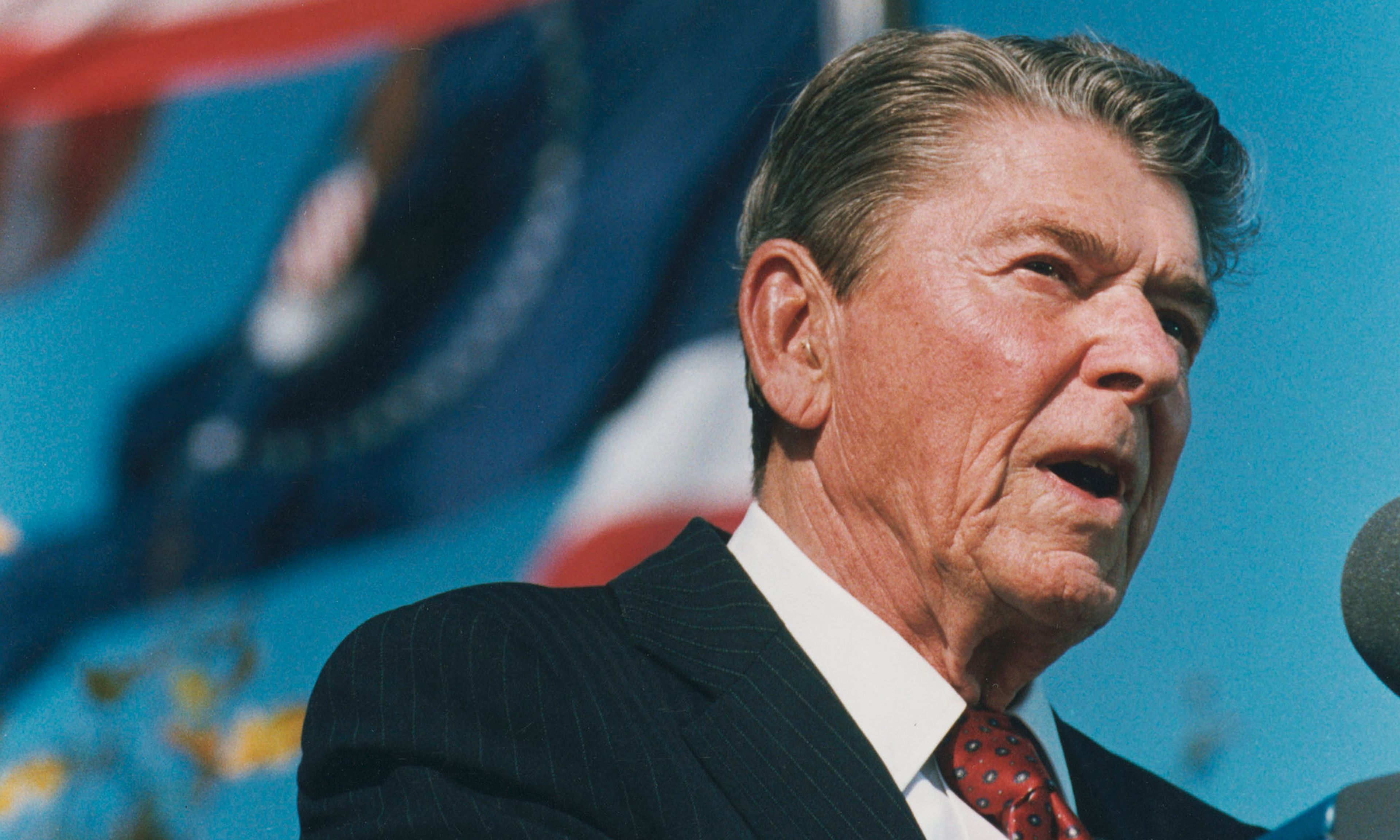
On Nov. 3, 1964, Barry Goldwater suffered a landslide defeat. It followed a presidential campaign in which the notorious “Daisy commercial” showed an adorable little girl, seconds before she is vaporized by a nuclear explosion, while Lyndon Johnson intoned, “We must either love each other, or we must die.” On Nov. 9, 1989, the Berlin Wall was breached. One reason the world avoided global annihilation despite not establishing universal love is that, in the intervening 25 years and 6 days, Ronald Reagan became a politician, a governor, Goldwater’s successor as the leader of the conservative movement, and a two-term president.
With the publication of The Conservative Counterrevolution, Steven Hayward completes The Age of Reagan, his compelling examination of this remarkable quarter century. In 2001 Hayward, a scholar affiliated with both the American Enterprise Institute and the Pacific Research Institute, published this study’s first volume, The Fall of the Old Liberal Order, 1964–1980. Reagan was offstage during long stretches of that book, which Hayward described as “one part biography, one part narrative chronicle, and one part political analysis.” By contrast, the narration and analysis have a single focal point in Counterrevolution, since Reagan’s biography and America’s history became completely intertwined during the 1980s.
Every conservative should read, and ponder, The Age of Reagan. Although much has changed since, and because of, Reagan’s presidency, the fundamental questions Americans confront about how to preserve our experiment in self-government are the same ones Reagan grappled with. It would be a shame, however — but no surprise — if only conservatives read Hayward’s provocative and sweeping assessment. Readers can, in fact, choose an Age of Reagan that suits their politics. Conservatives will gravitate to Hayward’s, while liberals can buy the single-volume one by Princeton’s Sean Wilentz, published in 2008.
Both writers are working from a template laid down by the late Arthur Schlesinger Jr., who from 1957 to 1960 published three volumes of The Age of Roosevelt, which he never completed. (The title of Hayward’s first volume is a reworking of Schlesinger’s first, The Crisis of the Old Order, while Wilentz’s book is dedicated to Schlesinger’s memory.) For starters, an age can “belong” to an American president only if the list of measures that are politically possible and impossible changes dramatically and durably because of how he governed. Even presidents who win reelection, but work within a predecessor’s framework, don’t qualify; there’ll be no one to write or read The Age of Eisenhower, Clinton, or Bush.
Schlesinger’s example is cautionary, as well. His Age of Roosevelt is a 1,700-page valentine to FDR. That’s not the problem, however. The problem, as Thomas B. Silver established in Coolidge and the Historians, is that Schlesinger followed the evidence wherever it led . . . as long as it led where he wanted to go. When it didn’t, Schlesinger had no discernible compunction about selecting or shading the evidence to support his preselected thesis.
There is never any doubt that Hayward is a conservative and Wilentz a liberal, but both hold themselves to higher standards of intellectual honesty than Schlesinger. Wilentz, despite many criticisms of Reagan, concludes, “His success in helping finally to end the Cold War is one of the greatest achievements by any president of the United States — and arguably the greatest single presidential achievement since 1945.” Hayward, despite clear admiration for Reagan, does not shrink from criticizing him strongly. He says, for example, that Reagan’s initial appointments to the most important foreign- and domestic-policy posts in his administration, Alexander Haig as secretary of state and David Stockman as director of the Office of Management and Budget, were both huge blunders, going so far as to call Stockman the “Robert McNamara of the Reagan administration.” (This is no small disparagement. In The Fall of the Old Liberal Order, Hayward approvingly quotes a military historian who labeled McNamara “the most disastrous American public servant of the 20th century,” one who combined “a know-it-all arrogance with a capacity for monumental misjudgment and a dearth of moral courage worthy of Albert Speer.”)
Nor does Hayward mince words about the Iran-Contra scandal — it must “dominate any serious evaluation of the Reagan administration” — or Reagan’s responsibility for leading his administration “down a path to dishonor.” He calls the Reagan policy on Nicaragua “incoherent,” because the administration never decided, or made clear, whether it intended merely to democratize or ultimately to overthrow the Sandinista regime. The detached management style that served Reagan well when the right personnel were in place engendered chaotic ineptitude when they weren’t. Yet Reagan’s “reluctance to fire people who deserved it” allowed a bad situation to become a debacle, according to Hayward. He also says that Reagan was “misled by his potent imagination” into believing that negotiating with Iran through an intermediary, rather than directly, somehow inoculated the administration from accusations that it had traded arms for hostages. Though frequently, perhaps too frequently and defensively, insisting that Reagan’s firm principles and command of the details that mattered meant that the “typical condescension” toward him was “wide of the mark,” Hayward gently raises the question of whether the Alzheimer’s disease that Reagan publicly disclosed in November 1994 had begun to affect him, and his job performance, as much as a decade earlier.
Hayward reserves his strongest and most detailed criticism for Reagan’s 1984 “morning in America” reelection campaign. The decision to run a “defensive” and “generic” campaign was a “mistake of historic proportions,” even “one of the greatest lost opportunities in American politics.” With inflation broken, the economy surging, and Democrats in disarray, Reagan was in a strong position to make the election a choice between parties with irreconcilable principles. A tactically and intellectually coordinated GOP campaign that sought to “shatter and humiliate” the Democrats, in the words of Charles Kesler, could have decisively shaped American politics for more than a generation, as FDR’s victory in 1936 had done. Instead, says Hayward, Reagan’s “feckless” emphasis on America’s “renewed sense of optimism” squandered the chance not just to defeat but to delegitimize the opposition party.
Reagan suffered some of the consequences of this political failure in his second term. Despite the fact that he carried 49 states against Walter Mondale, his party had a net loss of two Senate seats in 1984, reducing its majority to 53–47. Seven Democratic incumbents won in states where Reagan received more than 60 percent of the popular vote. Jay Rockefeller and Al Gore won two additional open seats in states Reagan carried with 55 and 59 percent of the vote, respectively. A campaign as focused and effective as the one that saw the GOP pick up twelve seats in 1980 could certainly have reversed some of these results. Had it done so, the 1986 elections might not have delivered the Senate back to the Democrats. A Republican Senate for Reagan’s entire eight years in office would have expedited rather than prolonged the examination of Iran-Contra and placed Robert Bork on the Supreme Court.
Republicans did better in the 1984 House elections, in the limited sense that they gained 16 seats, leaving Democrats with a still-comfortable 253–182 majority. In fact, after 1981–82, when it was possible to find 26 or more “boll weevil” Democrats to join the 192 Republicans in the House to pass some of Reagan’s biggest proposals, Democrats never had less than 58 percent of the seats in the House for the duration of Reagan’s presidency. In 1984, an astonishing 189 congressional districts gave more votes to Reagan than to Mondale while simultaneously electing a Democrat to the House. (Exactly one, Manhattan’s “silk-stocking district,” gave majorities to both Mondale and a Republican congressional candidate. He, Bill Green, was defeated by Carolyn Maloney eight years later, and the district has been Democratic ever since.)
Hayward is at pains to demonstrate that “Reagan never made a serious or sustained case against the Democratic Congress [in 1984], never argued that he couldn’t govern unless the Democratic Congress was turned out.” Democrats added to their huge congressional gains in 1930 and 1932 with smaller but significant increases in 1934 and 1936 because Roosevelt did not shrink from characterizing Republicans as an illegitimate fringe that had forfeited the right to be entrusted with government. In 1936 he invited “nominal Republicans who find their conscience cannot be squared with the groping and the failure of their party leaders to join hands with us.” By contrast, says Hayward, Reagan made a “trans-partisan appeal” in 1984 that “left open the possibility of a reformed Democratic Party being worthy of returning home at some future date.” Hayward endorses Sidney Blumenthal’s judgment that Reagan “ran for reelection as the true heir of Roosevelt.”
This unilateral political disarmament came at a time when Democrats had shown themselves to be deeply unserious about national security. The party, which formulated the containment doctrine as a resolute, sober alternative to “rolling back” Communism, had been traumatized by Vietnam into the belief that America was the reckless world power that most needed to be contained. Hayward reminds us of the stupidity that resulted from reducing statecraft to social work by quoting prominent Democrats extensively and accurately — which is to say, cruelly. No parents of a convicted felon ever sounded more broken-hearted and bewildered than Walter Mondale did after the USSR’s delinquency in the 1970s had helped make him an ex-vice president in 1981: “I cannot understand — it just baffles me — why the Soviets these last few years have behaved as they have. Why did they have to build up all those arms? Why did they have to go into Afghanistan? Why can’t they relax just a little bit about Eastern Europe? Why do they try every door to see if it is locked? Maybe we have made some mistakes with them.” In his keynote address to the 1984 Democratic convention, Mario Cuomo improved on LBJ’s excessively rigorous and insufficiently maudlin Daisy commercial by revealing that “peace is better than war because life is better than death.”
Liberalism means never having to say you’re sorry. For eight years President Reagan insisted that Communism was thuggery, and that resisting it was both noble and imperative. For eight years liberal politicians and writers scorned Reagan’s “primitive” and “simplistic” rhetoric and gratuitously provocative strategy. An academic expert asserted that Reagan’s “Sovietphobia” was a “pathological rather than a healthy response” to the USSR. One Democratic congressman couldn’t see any difference between the U.S. military action in Grenada and the imposition of martial law in Poland, while another declared it indistinguishable from Pearl Harbor. Mondale said it undermined our ability to “effectively criticize” the Soviet invasion of Afghanistan.
Somehow, despite ignoring the avalanche of advice from his self-anointed moral and intellectual superiors, Reagan neither lit the fuse to a nuclear war nor nullified his own critiques of Soviet tyranny. (Hayward shows at several places that the easiest way to distinguish attacks on Reagan by his Democratic opponents from Pravda editorials was that the former were usually less reflective and more turgid.) The first reaction to the fall of the Berlin Wall, and then the Soviet Union, from those whose expertise had been mocked by those events, was that Reagan had merely been fortunate enough to be in office when “time had proved Communism was an economic, political, and moral disaster,” in Arthur Schlesinger’s words. This disaster, however, would have come as a surprise to the readers instructed by Schlesinger, after his trip to Russia in 1982, to disregard America’s right-wing cranks, “who think the Soviet Union is on the verge of economic and social collapse, ready with one small push to go over the brink.” The contradiction was easily resolved; the problem, according to Schlesinger’s characteristically scrupulous obituary of the former president, was that Reagan “had no capacity for analysis and no command of detail.”
Alternatively, liberals ascribed the end of the Cold War to Mikhail Gorbachev’s saintly quest to transform Russia into a wider, flatter Switzerland. Strobe Talbott’s 5,000-word Time magazine article declaring Gorbachev the “man of the decade” mentioned Reagan once. This line of argument, too, proved untenable. Talbott did bring himself to say, elsewhere, that Reagan’s refusal to euphemize the Soviet Union’s tyranny and aggression was “not wrong.” Few of his peers ventured even that far down the road, however, since doing so would have moved them intolerably close to having to say that Reagan was right.
The wiser course was to change the subject. During the Clinton years some liberals were incautious enough to speak nostalgically about the Cold War, longing for its morally stark dichotomy rather than the murky, enervating challenges confronting America after 1991. That talk died down after Charles Krauthammer pointed out, in 1999, that this wistfulness about the clear choices prior to 1991 was always voiced by people who had made the wrong choices — on Nicaragua, missile defense, El Salvador, Grenada, the deployment of Pershing missiles in Western Europe — “nearly every anti-Communist foreign-policy initiative,” in other words, “that helped to win the Cold War.”
Liberals have another reason to change the subject. Hayward shares, and deftly explicates, Reagan’s belief that opposing Communism abroad and opposing the welfare and regulatory state at home were, in fact, the same fight, the one to protect inherently tenuous liberty from vastly ambitious and, thus, vastly dangerous government. Reagan, says Hayward, insisted on “tracing a linkage between the corruption of Soviet Communism and the weakness of domestic liberalism.” That link, according to the first volume of The Age of Reagan, was “liberalism’s lack of a limiting principle.” Its absence has rendered modern American politics a contest between the adherents of limited and of unlimited government. As Hayward explains: “The premise of the administrative state is that our public problems are complicated, with ‘no easy answers,’ whose remedy requires sophisticated legislation and extensive bureaucratic management. Anyone who says otherwise (like Ronald Reagan) is a ‘simpleton.’ But the creed of the administrative state makes the idea of citizen self-government seem quaint or obsolete, and it causes our government to be remote and esoteric to average citizens.”
Last year, Sean Wilentz wrote: “It should be clear that mistakes and overreaching have hampered liberalism’s evolution.” That proposition is clear. What’s not clear, confirming the lack of a limiting principle, is what liberalism thinks its overreaching has reached over — what constraints, if any, on the government’s capacity and legitimate authority to diagnose and remedy social problems liberals are prepared to acknowledge and respect.
“Tear down this wall,” Reagan said in Berlin in 1987. Two years later, the Communists tore it down. Eliminate the U.S. Department of Education, the Republicans said in their 1980 platform. Two years — and eight years, and 29 years — later, it had only grown larger. “Reagan was more successful in rolling back the Soviet empire than he was in rolling back the domestic government empire,” writes Hayward, “chiefly because the latter is a harder problem” (emphasis in the original). It is, twice over, a startling assessment — first, because the Soviet menace seemed, for long decades, like a immutable fact that could never melt away; second, because it is indeed indisputable that the seemingly less audacious goal of curbing the size and influence of the federal establishment proved much tougher.
There was a joyous, incredulous celebration as the Berlin Wall was hacked into souvenirs. There was no comparably cathartic bonfire of the inanities as rescinded regulations were torn from the Federal Register and defunded government agencies shut down. Hayward’s concluding judgment on Reagan’s domestic record is that he did less than he hoped and promised, but much more than people expected: He lost the game, but covered the point spread.
It’s not clear whether that will be good enough — good enough, in particular, to prevent the Age of Reagan from being a parenthesis, 28 years long at the most, within the Age of Roosevelt, which needs to endure barely two more decades in order to enter its second century. As a presidential candidate, Barack Obama said that Reagan “changed the trajectory of America” in a way that Richard Nixon and Bill Clinton didn’t. Obama clearly intends to change it back, to succeed where Clinton failed, and resume FDR’s transformation of a republic that secures our natural rights into a state that perpetually augments our governmentally determined and conferred entitlements. During Obama’s Hundred Days exhilarated liberals and despondent conservatives watched to see whether the economic crisis would allow Obama to de-Reaganize America, completely and at once.
That undertaking looks more difficult than it did six months ago; Obama’s defeat is by no means assured, but his success will not be swift and easy. Wilentz and Hayward agree that Reagan left one speed bump in Obama’s path: “Never, in our lifetimes,” according to Wilentz, are we going to see top marginal income-tax rates of 70 percent again, something that “if you stood looking to the future in 1980, would have been amazing.” Obama turned this impediment into an obstacle course with his repeated, categorical promise in 2008 to lower taxes for families making less than $200,000, and raise them only on those with an income above $250,000. As the liberal journalist Matthew Yglesias recently argued, this commitment “reinforces rather than debunks the Right’s fundamental view of the tax question — that public services aren’t worth paying for — and merely suggests that the correct answer is to get someone else to pay for them.” Yet the fact that a politician as discerning as Obama conceded such a big point argues that he plausibly believed his election required it.
Hayward explains liberalism’s reaction to Reagan by tracking the evolving opinions of the journalist Richard Reeves. In 1979, Reeves wrote a long magazine article, “Why Reagan Won’t Make It.” In 1985, Reeves’s book The Reagan Detour assured readers that “ideas and issues . . . will inevitably bring liberalism and the Democrats back into fashion and power — sooner rather than later.” By 1999, Reeves wrote, “Reagan, in fact, is still running the country.” And in 2006, Reeves published President Reagan: The Triumph of Imagination.
It would be hard to argue, with Al Franken the 60th Democratic senator and the Obama administration containing more czars than a Russian mausoleum, that Reagan is running the country today. The question Reagan posed in the 1964 speech that launched his political career is whether we are still running it ourselves, “whether we believe in our capacity for self-government or whether we abandon the American revolution and confess that a little intellectual elite in a far-distant capitol can plan our lives for us better than we can plan them ourselves.” Whether the Age of Reagan turns out to be a triumph or a detour will play a large role in settling that question. History will have to address that fundamental issue before historians as gifted as Steven Hayward can assess it.












Comments