If you know anything about Quentin Tarantino’s Inglourious Basterds, you probably know that it features a team of Jewish-American commandos who parachute into Occupied France circa 1942, under the command of a hillbilly lieutenant played by Brad Pitt, and set about killing, scalping, and mutilating every Nazi unlucky enough to cross their paths.
You probably also know that this decidedly ahistorical conceit has made the movie somewhat controversial. For every Lawrence Bender — the film’s producer, who pronounced Inglourious Basterds a “Jewish wet dream” — there’s a Daniel Mendelsohn, the literary critic and frequent excavator of the Holocaust who took to the pages of Newsweek to denounce Tarantino for turning Jews into “carbon copies of Nazis” and inviting audiences to cheer on their SS-style atrocities.
What you may not realize is how relatively small a role the band of Nazi-hunting Jewish “Basterds” play in the film that bears their name. The movie, more than a decade in the making, has been sold as Tarantino’s “bunch-of-guys-on-a-mission . . . Dirty Dozen or Where Eagles Dare or Guns of Navarone kind of thing” (to quote the director himself, describing an early version of the script), but it isn’t really anything of the sort. The classic “guys on a mission” script zeroes in on a single platoon, following them from the training camp to the completion of their mission and lending each member of the unit just enough individuality that we’re slightly sorry to see him die. Whereas in Tarantino’s script, the story of the “Basterds” intersects and overlaps with several other plotlines, and the narrative zigs and zags between them, never resting on a single set of characters for very long.
And that’s good news for the movie. The Jews-on-a-mission plot is Tarantino at his grossest and most callow, featuring the same mix of gore, camp, and wafer-thin characterization that he brought to a kind of negative perfection in Kill Bill. Pitt’s twanging, bloodthirsty Lt. Aldo Raine is an entertaining cartoon, but his Jewish merry men don’t even rise to the level of caricature: They’re ciphers with scalping knives, extras from a torture-porn remake of last winter’s Defiance. (Appropriately, the most distinctive commando — one Donnie Donowitz, a.k.a. the “Bear Jew,” known for beating Wehrmacht officers to a pulp with a Louisville Slugger — is played by Tarantino’s pal Eli Roth, the bloodthirsty hack behind the Hostel movies.)
But the rest of Inglourious Basterds is Tarantino at his best. Characters duel with crackling, immersive dialogue before they duel with weapons; unknown and underrated actors deliver revelatory performances; pitch-perfect musical choices sew the tapestry together. Yes, it’s yet another exercise in pulp fiction — the title of Tarantino’s most famous movie could be slapped on every film he’s made — and another sign that those of us who hope for a grown-up masterpiece from the 46-year-old director are probably doomed to perpetual disappointment. But pulp can have its pleasures, and this film has plenty of them.
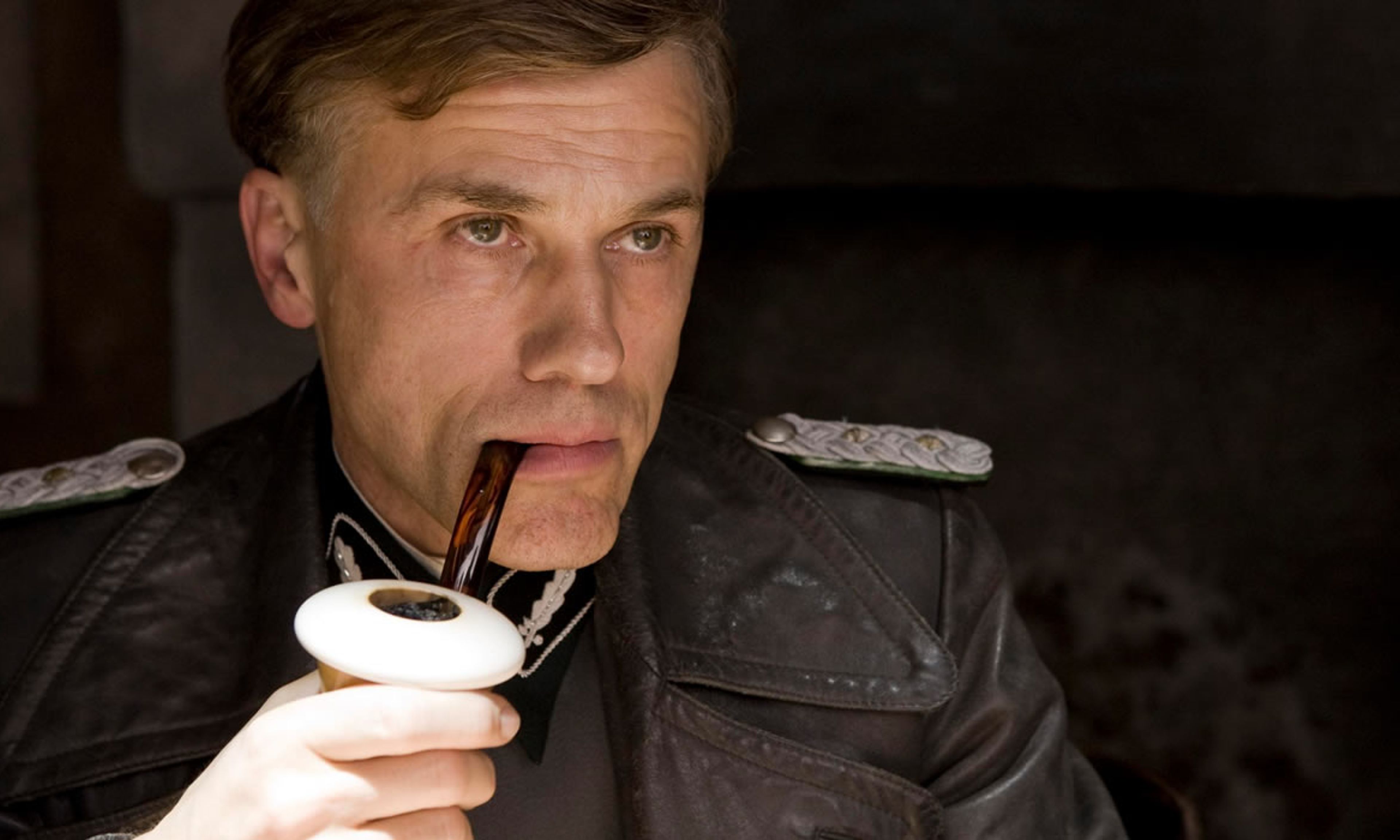
Start with the performance — delicate, menacing, multifarious, and show-stealing — from Christoph Waltz, a heretofore obscure German TV thespian who plays the Gestapo colonel Hans Landa. Pitt’s name gets top billing, but Waltz’s Landa owns the movie. From the very first scene, a terrifyingly polite bilingual interrogation of a French farmer who’s concealing Jews beneath his floorboards, it’s clear that he’s the most transfixing bad guy you’ll see onscreen this year.
Only one of the fugitive Jews escapes that farmhouse alive. Her name is Shosanna Dreyfus (Mélanie Laurent), and four years later she’s made her way to Paris, taken over the management of a movie house, and caught the eye of the young German war hero and cinephile Fredrick Zoller (Daniel Brühl), who’s playing himself in a propaganda film produced by Joseph Goebbels (Sylvester Groth). Zoller persuades Goebbels to hold the premiere at Shosanna’s theater, which sets in motion not one but two plans to assassinate the various Nazi dignitaries who will be attending — a group that includes none other than Adolf Hitler.
One plot is masterminded by British intelligence, which sends the stiff-upper-lipped Lt. Archie Hicox (Michael Fassbender), a film critic turned intelligence officer, to rendezvous in France with Pitt’s Basterds and a German double agent, the actress Bridget von Hammersmark (Diane Kruger), and then infiltrate the premiere with guns and dynamite. The other is masterminded by Shosanna herself, with an assist from her black projectionist (and lover): It involves a stock of highly flammable nitrate film, an extra reel inserted into Goebbels’s beloved movie, and a deadly, theater-consuming blaze. And both face a potentially deadly antagonist — the ubiquitous Col. Hans Landa, of course, who’s been put in charge of security for the premiere.
Along the way to this movieland climax, Tarantino manages to make his dialogue sing in four different languages. He coaxes fine performances out of almost everybody — with particularly high marks for Fassbender and Kruger, who’s considerably more plausible as a German film star than she was as Helen of Troy. And he stages three set-pieces that should be required viewing for directors of suspense: the opening interrogation, a subsequent encounter between Shosanna and the Nazi elite (Landa included) at a swanky Paris restaurant, and a tour de force in a basement tavern, where Hicox and von Hammersmark get stuck drinking and playing cards with an inconveniently inquisitive SS officer.
As for whether the many pleasures of this counterfactual fantasia are sufficient to justify enduring the interludes of sophomoric and debasing violence, well, I’m still wrestling with that one. But it’s clear that where the wildly talented, permanently adolescent Quentin Tarantino is concerned, we’re unlikely ever to get the one without the other.












Comments