Have we lost the art of making fine public spaces? The very question is fraught, and not just because it risks insulting the architects, planners, and landscapers who make those spaces. It goes against the idea of progress itself. It affronts our pride to think that we are no longer capable of making spaces as noble as the National Mall, as dynamic as Rockefeller Center, or as exquisitely intimate as Philadelphia’s Rittenhouse Square. And yet throughout history art forms have died. We no longer paint on vellum or weave intricate battle scenes into tapestries, yet both were once significant forms of art. It is hard to know which prospect is worse — that we are no longer capable of making beautiful public spaces, or that we no longer desire them.
Technically speaking, the public space is not quite dead; we still pour extravagant resources into their making. Hudson Yards — at present, New York City’s most swaggering real-estate development — set aside fully 50 percent of its site as public space, and garnished it with fountains, trees, and flower beds. It even commissioned a work of monumental sculpture, that towering and baffling honeycomb of stairs known as “Vessel.” And we still dignify our public spaces with those traditional bearers of civic meaning: columns, statuary, and the formal axis. All three are at play in the just-completed Eisenhower Memorial, in Washington, D.C., which is the work of Frank Gehry, by no means a classicist.
Whatever one thinks of these contemporary spaces and others like them, few would call them “beautiful,” not even their own authors. The official website for the Eisenhower Memorial speaks of “Gehry’s unique vision,” while Hudson Yards prides itself on offering “an immersive and varied horticultural experience.” “Immersive” happens to be a particularly fashionable term of praise at the moment, suggesting a deeper, more engaging level of experience than merely to look at something. The change in language marks a change in aesthetic values, and it helps us understand what has happened to our public spaces since World War II. For there should be no question that something has gone badly wrong.
At first glance, the monumental public spaces of the post-war era do not differ significantly from their predecessors. The Empire State Plaza in Albany, for example, is remarkably similar in composition to the National Mall: A monumental cube of a building launches a mighty axis that runs between two walls of buildings to culminate in a colossal capitol building. There is even the same reflecting pool and profusion of smaller memorials. And yet the Mall in Washington is commonly regarded as America’s noblest civic space, while the plaza in Albany is seen as a monstrous failure, vicious in its inhospitality. The same landscape devices are at play in both, and yet they are wielded to very different effect. One can make such a comparison in almost any American town, and it is between public spaces of pre-war and post-war vintage; or, to put it more accurately, between public spaces that follow the ideals of the City Beautiful movement and those that do not.
The remarkable fact is not that we have lost the art of public space but that we ever had it at all. Well into the 19th century, American town-planning was chiefly a business operation. One could hardly expect otherwise in a colonial culture whose first act was the platting of undeveloped land into commercial real estate. Generous, well-ordered public space was to be found only in towns laid out by religious separatists, such as Puritan New Haven and Quaker Philadelphia. But then, the formal public square was a latecomer to Anglo-American culture. Shakespeare never saw one, unless he visited Italy: It is a product of the Italian Renaissance and did not appear in England until 1631, with London’s Covent Garden. It took root earlier in France, which explains why we find it in French colonial cities such as New Orleans, and in the elaborate array of civic plazas in Washington, which was designed by a Frenchman.
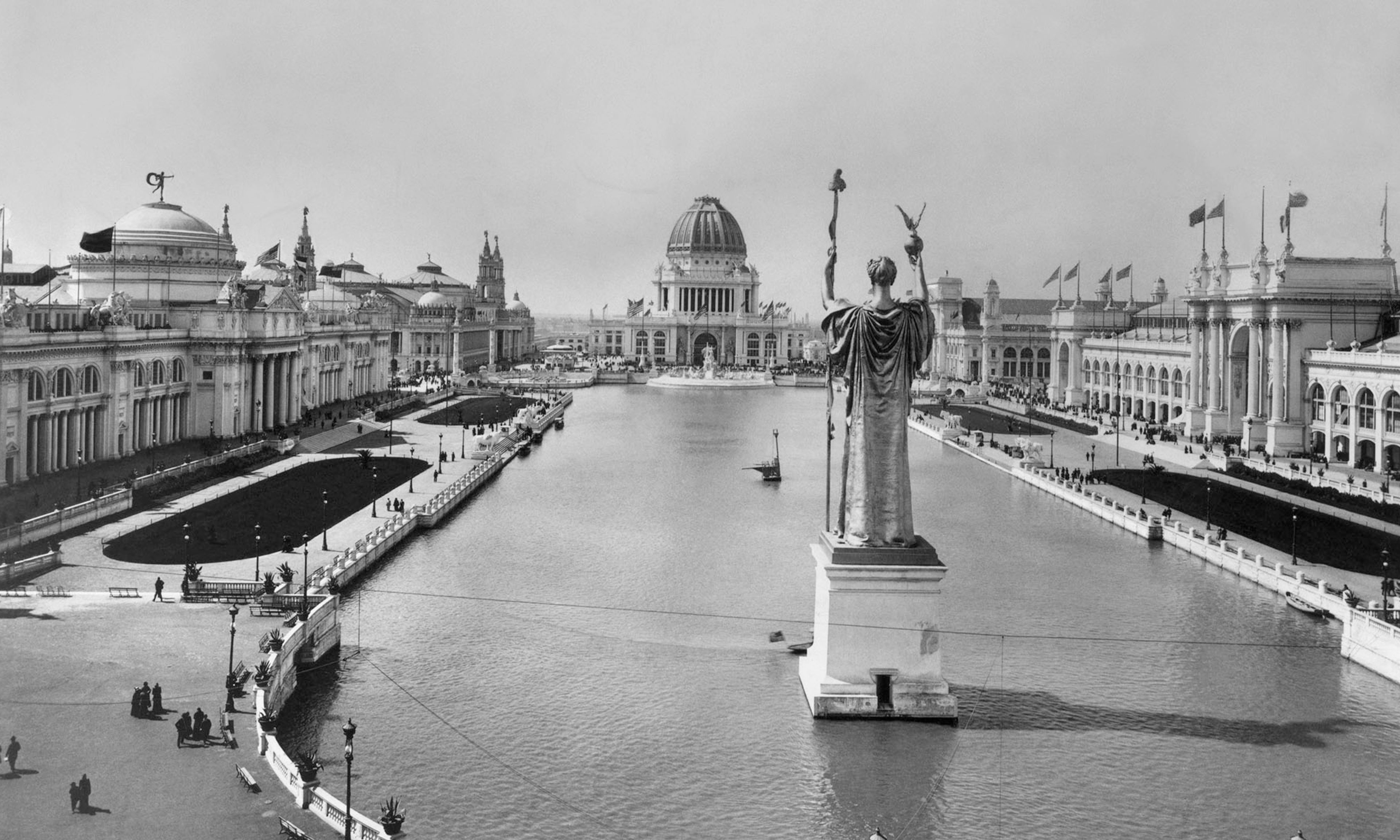
All this changed in 1893, when America embraced the City Beautiful movement virtually overnight. It proposed a single but immensely appealing idea: that the city itself might be a work of art. The movement was launched in the most spectacular fashion possible with Chicago’s Columbian Exposition. Here America’s leading architects created a harmonious ensemble of buildings, grouped around a monumental axis and unified in scale and character. The space between these buildings was embellished with fountains, sculpture, and a central lagoon, which made it a graceful and dignified stage for public life, rich in the quality that the ancients called “decorum.”
The City Beautiful movement would shape American town-planning for the next half century. The National Mall was its most conspicuous success, but there is scarcely a state capitol or town hall built in these years that does not bear its stamp. This was the long afternoon of the Classical Revival, when America shook off Victorian originality and turned again to classical antiquity for inspiration. For this there was good reason. Ancient Greece provided the model not just for the formal public square but for democracy itself. Under the shelter of the colonnaded Greek stoa, ideas as well as goods were exchanged. In civic spaces of classical character there was the happiest resonance between form and content.
That such a vital and visually satisfying tradition, one far more deeply rooted than most architectural fads, could die seems inconceivable. Yet die it did, and largely because of modernism. In the war-shocked Europe of the 1920s, the making of replicas of classical buildings and plazas seemed an escapist indulgence. Instead, architecture should confront the urgent demands of the present, by practical and not aesthetic means. This was the doctrine of functionalism, which presented itself as the architecture of reason, and its most influential thinker in terms of city planning was Le Corbusier, the Swiss-French architect. By the mid 1920s modernism had achieved its definitive form, and it swiftly expunged classicism, root and branch, from triumphal arches and equestrian statues down to the last column, pedestal, and baluster.
But this was only modernism’s most visible legacy. More subtle, and important, was the new kind of space that it envisioned. Formal order, according to the classical tradition, is achieved by clear boundaries and a system of axes and cross-axes. The principal axis leads from less important to more important spaces, to come to rest at some ultimate point of repose. In a public square, that axis might culminate at a central fountain or sculpture, or, in a monumental building, at a throne or an altar. But after World War I, modernists abolished the axis, as well as a good many thrones and altars, and replaced it with the idea of flowing space. Paths of movement were to be efficient and functional, without any ceremonial hierarchy, suggesting freedom of motion in any direction. Where the public square was once a kind of bounded outdoor room, it was now a mere incident along boundless space. This boundlessness was only an aspiration, of course, for the modern city enforces its own bounds, if only by default. In the end, lanes of speeding traffic would perform the space-defining duty that marble balustrades once had.
It is not sufficiently appreciated how much the sense of disorientation one feels in contemporary public spaces is due to their formlessness and lack of spatial order. Instead their psychological oppressiveness is often blamed, quite unfairly, on a lack of greenery. Some of the world’s loveliest squares have not so much as a blade of grass, such as the stately Josefsplatz in Vienna or Bernini’s stupendous St. Peter’s Square in Rome. And yet they are not bleak in the slightest, unlike Albany’s Empire State Plaza, which is well lined with trees but feels as desolate as the lunar surface. So too does Boston’s City Hall Plaza, and current plans to add a hundred trees and the inevitable “iconic water feature” are hardly likely to change this.
This is not to say that modern architects were incapable of making beautiful public spaces. New York City alone proves they could. The plaza that Ludwig Mies van der Rohe slid before his Seagram Building is as exquisitely proportioned and detailed as any from the Italian Renaissance. And Louis I. Kahn’s posthumously built memorial to Franklin Delano Roosevelt, on the island named for the president, achieves a fine tragic dignity that is rare in any era, its incised inscriptions of FDR’s “Four Freedoms” serving as a permanent reproach to the United Nations building across the East River. But they are the work of architects, schooled in the older tradition, who knew the value of good proportions, restraint, and tactile experience. Those lessons had been passed on from generation to generation as a living tradition, but that tradition was cut short by the Great Depression. After 1929, construction practically collapsed, with the majority of architects thrown out of work, sometimes for a decade or more. And the kind of work they later found, such as designing wartime housing, was not the sort to maintain the culture that had brought the City Beautiful movement to such a pitch of quality and general competence. After all, if all orchestras stopped performing for a decade, one could hardly expect the violins to sound quite the same afterwards.
None of this passed unnoticed. In 1961 Jane Jacobs, that keen observer of city life, published The Death and Life of Great American Cities, which called attention to one of the cardinal failures of modern urbanism. By enforcing strict zoning, and by consigning business, industry, culture, and recreation to different quarters of the city, planners were destroying the vitality of street life. Instead of drawing a vibrant and ever-changing variety of pedestrians throughout the day — office workers, shoppers, people out for lunch or a drink, moviegoers, and so forth — the zone with a single function had a depressingly monotonous street life, and only at certain times. And without a rich street life, the public spaces of a city atrophy.
Jacobs’s impressionistic account was bolstered by William H. Whyte, the brilliant social theorist who brought analytical rigor to the study of public space. Instead of blindly accepting the claims of city planners and critics, who could fawn over a calamity such as Boston’s City Hall Plaza, Whyte decided to observe what people actually do. He simply pointed his camera and watched. The results, published in The Social Life of Small Urban Spaces (1980), were surprising but should not have been. People have a catlike sensitivity to the small-scale features of their environment: They demand a sense of shelter and enclosure, a good viewing perch, and a variety of kinds of space. They also value features that architects generally disregard, such as moveable chairs, which are enormously popular (and enormously loathed by property managers).
Jacobs and Whyte inadvertently pointed out a second reason for the failure of the beautiful public space: Not only had architects stopped making them, but the public had stopped demanding them. The City Beautiful movement came into being at a time when there were no automobiles, air-conditioning, or even radios. A public square in an American city of 1900 served essentially the same function as the Athenian agora had at the time of Pericles, as the place where citizens met one another in the open air. Life indoors became increasingly agreeable, and even more sociable, if only vicariously. As this happened, the citizen-pedestrian began to disappear. Already by the 1930s, street lamps were redesigned to accommodate the automobile, by providing a tunnel of continuous light instead of being gauged to the needs of the strolling pedestrian. In short, the well-made town square was no longer what it had been since the dawn of urbanism ten millennia ago: the indispensable instrument of public life.
Once clean and attractive public spaces were no longer seen as essential, they soon became less clean and attractive. After 1961, San Francisco no longer enforced vagrancy laws, and with predictable results; in 1972, in Papachristou v. City of Jacksonville, the U.S. Supreme Court overturned vagrancy laws at the national level. At the same time, the process of deinstitutionalization — the discharge of unwell patients from mental asylums — had begun in earnest. In 1955, some 559,000 people were institutionalized; by 1994 it was 72,000. Meanwhile, in 1975, the Supreme Court declared in O’Connor v. Donaldson that a person could be confined against his will only if it could be proven that he was a danger to himself or others. In practice, as the law was interpreted, that danger had to be immediate; even a schizophrenic who was unable to feed or shelter himself was not regarded as a danger to himself. These two Supreme Court decisions, working in tandem, had a dire effect on the uses of our town squares and civic plazas. It is unimaginable that we would have so casually permitted them to become inhospitable had we still felt them to be essential.
The insights of Jacobs and Whyte have long since been endorsed by architects and planners, even as the urbanism of Le Corbusier has been discredited in the most emphatic way possible — in plain sight, as countless social-housing blocks inspired by his theories have been dynamited. In the last two generations, following decades of urban flight, there has been a great return to the city, and a concerted attempt by cities to make themselves physically and socially attractive once more. Baltimore’s Inner Harbor, with its Camden Yards, Boston’s Faneuil Hall Marketplace, New Orleans’s Piazza d’Italia — each was intended as a contemporary counterpart to the great urban squares of the past. And although they met with varying degrees of success, none achieved anything like the decorum of the great public squares of the past, or even tried to. Even a public square that deliberately quoted the form of a classical Roman plaza, as did Charles Moore’s Piazza d’Italia, was not so much an affectionate re-creation as an ironic parody.
The truth is, the legacy of modernism still works against the making of beautiful public space. Especially damaging is the insistence on originality, the belief that to make a public space and public art was to express yourself personally. The idea would have been absurd to the artists of the City Beautiful movement. For them, a civic plaza was the collective statement of a community, not the private statement of an individual. For that reason, the movement’s formal repertoire was limited to a few conventional devices: arches and columns, equestrian statues and fountains. One adapted and inflected these forms but rarely invented new ones. Modern critics belittled these forms as platitudes, without recognizing that much of our social life is conducted by means of conventional courtesies: terms such as “please” and “thank you” are gestures that make life more graceful, or even bearable.
When we try to think of a fresh and original way to express a conventional courtesy, such as “I’m sorry for your loss,” we usually fall flat on our face. And so it is when we try to find a substitute for the conventional forms of public art. A revealing example is Tilted Arc (1981), a characteristically aggressive sculpture by Richard Serra. A single slash of rusted Cor-Ten steel, twelve feet high and 120 feet in length, it cut across the plaza in front of New York’s Jacob Javits Federal Building, forcing every user of the building to take a long detour around it. Unlike classical sculpture, which often commented in allegorical terms on the building it prefaced, Tilted Arc challenged its context. For Serra, “works which are built within the contextual frame of governmental, corporate, educational and religious institutions run the risk of being read as tokens of those institutions.” His sculpture certainly united the public, if not in the way he imagined; despised by everyone who worked in the building, from janitors to judges, it was carted off a few years later, to the indignation of the art world. (In its place today is an inoffensive fountain.)
A gesture of defiance toward the institution that you are meant to honor would have been unthinkable in the heyday of the City Beautiful movement. The spaces they made were well-ordered unities in which the part reinforces the order of the whole. The conventional fixtures of the traditional public square — balustrades, low steps, stone benches, piers, and curbs — were gauged and proportioned according to their place in the whole, with the same ineffable sense of rightness one hears in a perfectly scored piece of music. It is the harmonious coordination that one misses in today’s public spaces, whose collaborating designers often have different agendas — with planners stressing circulation and ease of maintenance, sculptors aspiring to personal creativity, and landscape architects pursuing environmental sustainability.
With no single overriding aesthetic vision, the resulting spaces cannot help but be fragmented and disjointed. We see this in the playgrounds, natural gardens, hardscape plazas, and so forth that meander through our public squares like so many unrelated attractions strewn through an amusement park. Perhaps the worst offender in this regard is Chicago’s Millennium Park, whose different features were funded independently by individual donors, making it less a unified design like New York’s Union Square than a series of discrete naming opportunities.
The late Roger Scruton, a philosopher of, among other things, aesthetics, liked to say that beauty matters, and not just because it gives us pleasure. Our lives will have their full share of suffering and tragedy, and the pursuit of beauty — the determination to refine and perfect what we make so that it becomes an image of the world itself, an ordered unity — “shows human life to be worthwhile.” But to create such an ordered unity, you need to believe that the universe has order and meaning. At a minimum you have to act as if you do.












Comments