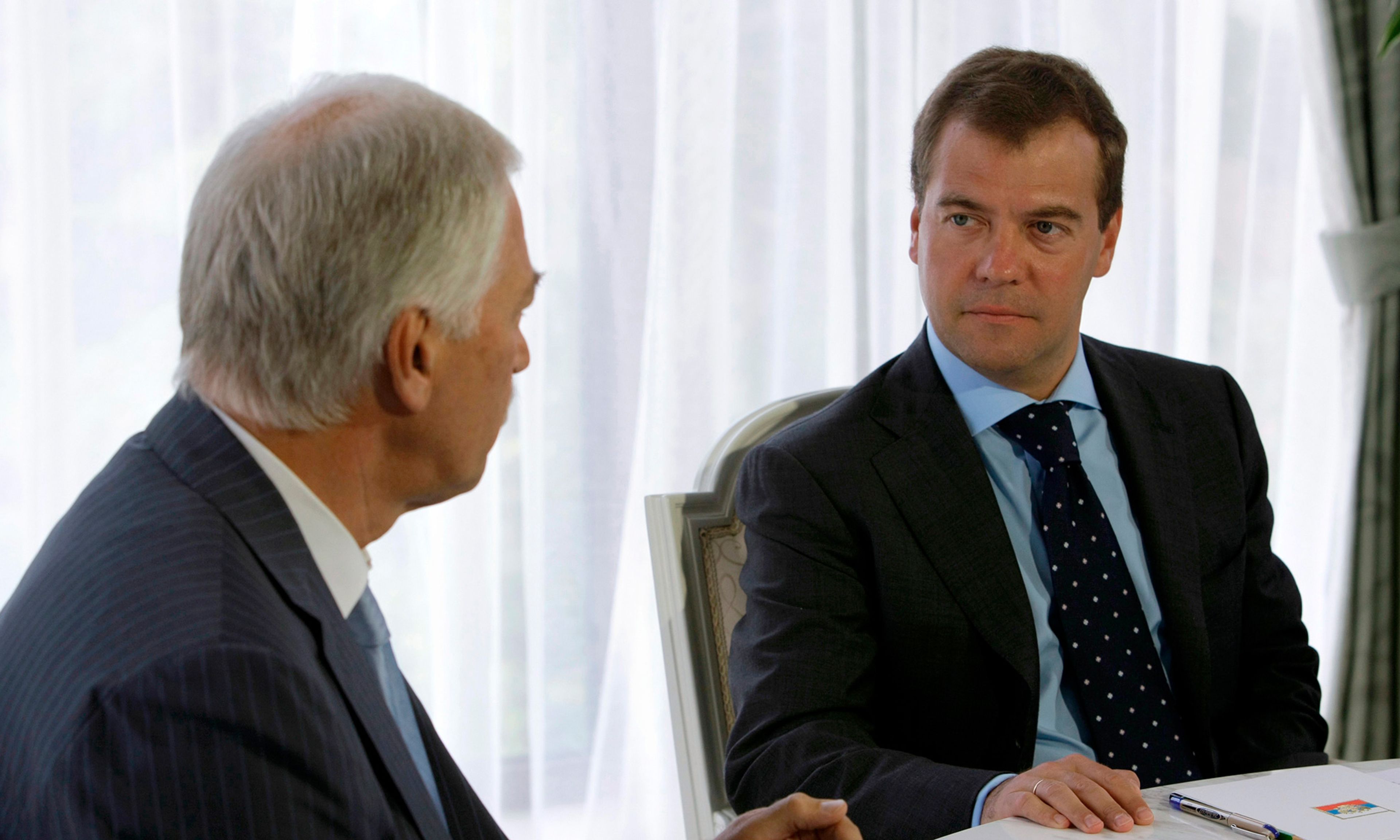
Clad in a black jacket over an open-necked black shirt, speaking directly into the camera against the backdrop of a summer coastline, Russian president Dmitry Medvedev looked every inch the Moscow mafioso out on a hot date. This was not an inappropriate “look” given that his script — a video open letter to the Ukrainian president, Viktor Yushchenko — was a series of velvet menaces. Officially he was justifying Russia’s decision not to send its ambassador to Kiev; between the lines he urged Ukrainians to vote against Yushchenko in next year’s January election; under the smoothness he seemed to be hinting at altogether nastier possibilities if his overtures were rejected.
Medvedev’s tone ranged from apparent frankness — “The tension in Ukraine–Russia relations is getting off the scale” — to the veiled threat: “Fraternal peoples cannot be severed; we have the same historical and spiritual heritage.” And, finally, there came the less veiled threat: “I’m convinced that the multifaceted connections between Russia and Ukraine will return, but on a qualitatively new level — a strategic-partnership level. And that time is not far off.”
In between, he argued that Ukraine was guilty of a series of offenses, from illegally supplying arms to Georgia, to harming Russian gas sales by concluding an energy deal with the European Union, to falsifying history in order to suggest that World War II was a conflict between the two totalitarian systems of Nazism and Soviet Communism. The range of Ukraine’s supposed offenses — military, political, economic, religious, cultural, historiographical — is vast. All of the accusations either have to do with perfectly legitimate activities or have no foundation in fact. Together they depict a Ukraine straining for every kind of conflict with Russia — a picture that, as well as being false, is plainly at variance with Ukraine’s national interests. So they inadvertently reveal a Russia straining for every kind of conflict with Ukraine.
The least practical charge, Medvedev’s denunciation of “pseudo-historical investigations,” may be the most significant one. The desire of Ukrainians to present an accurate history of Stalin’s deliberate starvation of their parents and grandparents undermines both the simplistic “fraternal peoples” theme of Medvedev’s history lesson and the Soviet legitimacy that the Putin-Medvedev regime has been seeking to restore. Medvedev could not even bring himself to state accurately the most damaging historical accusation made by Ukrainians. Along with Poles, Belarusians, and almost all historians outside Russia, most of them know that in the first two years of the 1939–45 war there was not a conflict between Nazi and Soviet totalitarianisms but an outright alliance between them. Since the 70th anniversary of the Nazi-Soviet pact falls on August 23, the Kremlin is currently anxious to discourage correct historical interpretations or even memories of this. It is too close to home in every sense.
Medvedev’s bullying tone, list of grievances, and veiled threats were all too redolent of the world of the 1930s. They were redolent too, however, of the world last year — the protection of separatists, a border incident, the military maneuvers ending just as a nearby conflict unexpectedly began, the iron fist, and finally the Russian annexation of Georgia and South Ossetia. At the time, pundits said that the Russo–Georgian war was less important in its own right than as a warning to Ukraine. Was that warning now being fulfilled? Was Medvedev’s speech a more urgent version of it? And does it presage a more active Russian stance of military intervention abroad?
Some in Moscow certainly thought so. Alexander Dugin of the nationalist think tank Eurasia Movement predicted that Russia was preparing to de-recognize Ukrainian territorial integrity: “An armed conflict may soon begin in Crimea and Eastern Ukraine that will result in these territories’ becoming a Russian protectorate.” Well, possibly. According to recent opinion polls, the Russian public is growing increasingly hostile to Ukraine — the rejected-lover syndrome visible in Medvedev’s talk. In this nationalist mood, Russian opinion might quite like a forced Russo-Ukrainian marriage.
Also, the Kremlin has just introduced legislation into the Duma (certain to be passed) that enables the president to send troops abroad to “defend Russian soldiers and citizens, fight piracy, and defend foreign nations against threats.” This looks more like a domestic political tidying-up to clarify who in government has the power to order troop movements than a move to intimidate neighbors. As several pundits have pointed out, it tacitly admits that last year’s invasion of Georgia was illegal. Nonetheless it clears the constitutional decks for actions such as an invasion of Ukraine. Neighbors therefore have to take it seriously.
But that leaves open the question of whether such an invasion would be likely to succeed. Writing in the Jamestown Foundation’s Eurasia Daily Monitor, the respected Russian military commentator Pavel Felgenhauer is pretty skeptical all round: “The Russian military at present is clearly not ready to take on an offensive ‘liberation’ campaign deep within Ukraine. The Ukrainian armed forces are ineffective, but the territory of the possible theater of conflict is vast and densely populated, requiring a massive deployment of well-prepared troops. Russia needs at least three more years of radical military modernization and some rearmament, before it may contemplate a Crimea and Ukraine mission.” After the unexpected mauling that its forces got at the hands of the small Georgian army, Russia is unlikely to take needless risks. In the meantime, however, Russia may continue to wage economic- and political-destabilization campaigns against Ukraine, Georgia, and other parts of the post-Soviet space on which its paranoia alights — with the potential military threat hovering in the background.
If so, how is Ukraine likely to withstand such a war of nerves? First reactions have been mixed. For the government, Yushchenko gave a reasoned but firm response to Medvedev, rejecting his velvet threats point by point. But the president is politically weak. He is running a poor third behind the two neck-and-neck frontrunners, Prime Minister Yulia Tymoshenko and opposition leader Viktor Yanukovich. Both would be more acceptable to Moscow than Yushchenko — Yanukovich more than Tymoshenko. Neither in practice would want to return to being under the Kremlin’s thumb. And though Ukraine is divided between a pro-European west and a pro-Russian east, both halves have gotten used to being independent. Recent opinion polls suggest that though many Ukrainians are unaware of Medvedev’s speech, those who are aware of it regard his keeping home the Russian ambassador to be an “unfriendly” act. So a few more speeches by Medvedev would help Tymoshenko and maybe, just maybe, even tip the election towards Yushchenko. In either event Ukraine would probably continue to be a bone in Moscow’s throat.
For as long as Russia felt unable to use force — at least three years in the above calculation — the Moscow–Kiev battle would be waged mainly over economics and, in particular, over the European Union’s policy towards both countries. Should closer EU-Russia economic cooperation go ahead? Should Russia be admitted to the EU’s Eastern Partnership, which is designed to protect Ukraine and other post-Soviet Eastern countries outside the Union?
Europe itself is bitterly though quietly divided over how to deal with these questions. In July, a stratospherically distinguished group of Central and East European statesmen, including Lech Walesa and Vaclav Havel, sent their own open letter to the Obama administration appealing for stronger U.S. intervention in European affairs — in effect because Western Europe alone could not be relied upon to defend democracy, national sovereignty, and the maintenance of a common Atlantic defense.
These pro-American leaders were unsparingly realistic in their description of Russian policy: “Russia is back as a revisionist power pursuing a 19th-century agenda with 21st-century tactics and methods. . . . It asserts a privileged position in determining our security choices. It uses overt and covert means of economic warfare, ranging from energy blockades and politically motivated investments to bribery and media manipulation in order to advance its interests and to challenge the transatlantic orientation of Central and Eastern Europe.” They warned against “too narrow an understanding of Western interests” leading to wrong concessions to Russia. They specifically cited the Russo–Georgian war as an occasion on which “many countries were deeply disturbed to see the Atlantic alliance stand by as Russia violated the core principles of the Helsinki Final Act, the Charter of Paris, and the territorial integrity of a country that was a member of NATO’s Partnership for Peace and the Euroatlantic Partnership Council — all in the name of defending a sphere of influence on its borders.”
But as they conceded, not all Europeans shared their anxieties. Most Western European states — partly excluding Britain, Sweden, and Holland — place a higher value on friendly relations and trade with Russia than on defending the West and Western values. And though it was France’s President Sarkozy who negotiated the indulgent deal with Russia over Georgia, it is Germany that dominates the making of EU policy towards Russia. And in Germany there is a surprising degree of all-party agreement in favor of a strong economic and political Russo-German “strategic partnership.”
Only a few days after the East European leaders issued their open letter to President Obama, former chancellor Gerhard Schroeder, a Social Democrat now employed by Russia’s Gazprom, issued his own appeal that the U.S. “not allow itself to be influenced” by them. One month later, days after the Medvedev video letter, current Christian Democratic chancellor Angela Merkel announced a series of economic deals after a summit with the Russian leader — but remained silent on Ukraine and related issues. (She raised the human-rights violations in Chechnya on which Medvedev himself has called for tougher investigations.) Merkel had made plain earlier that Germany would oppose NATO membership for Georgia and Ukraine. Much establishment and business opinion in Germany now favors a further “deepening” of the economic relationship between the EU and Russia. And if Germany persuades its EU partners to go down this road, it is likely to be at the expense of Ukraine and Russia’s other in-between neighbors — even if it does make good business sense and offer the diplomatic equivalent of a quiet life.
Medvedev’s speech confirms the fears of East European leaders. Russia increasingly ignores international, legal, and moral norms. And such a state is unpredictable.










Comments