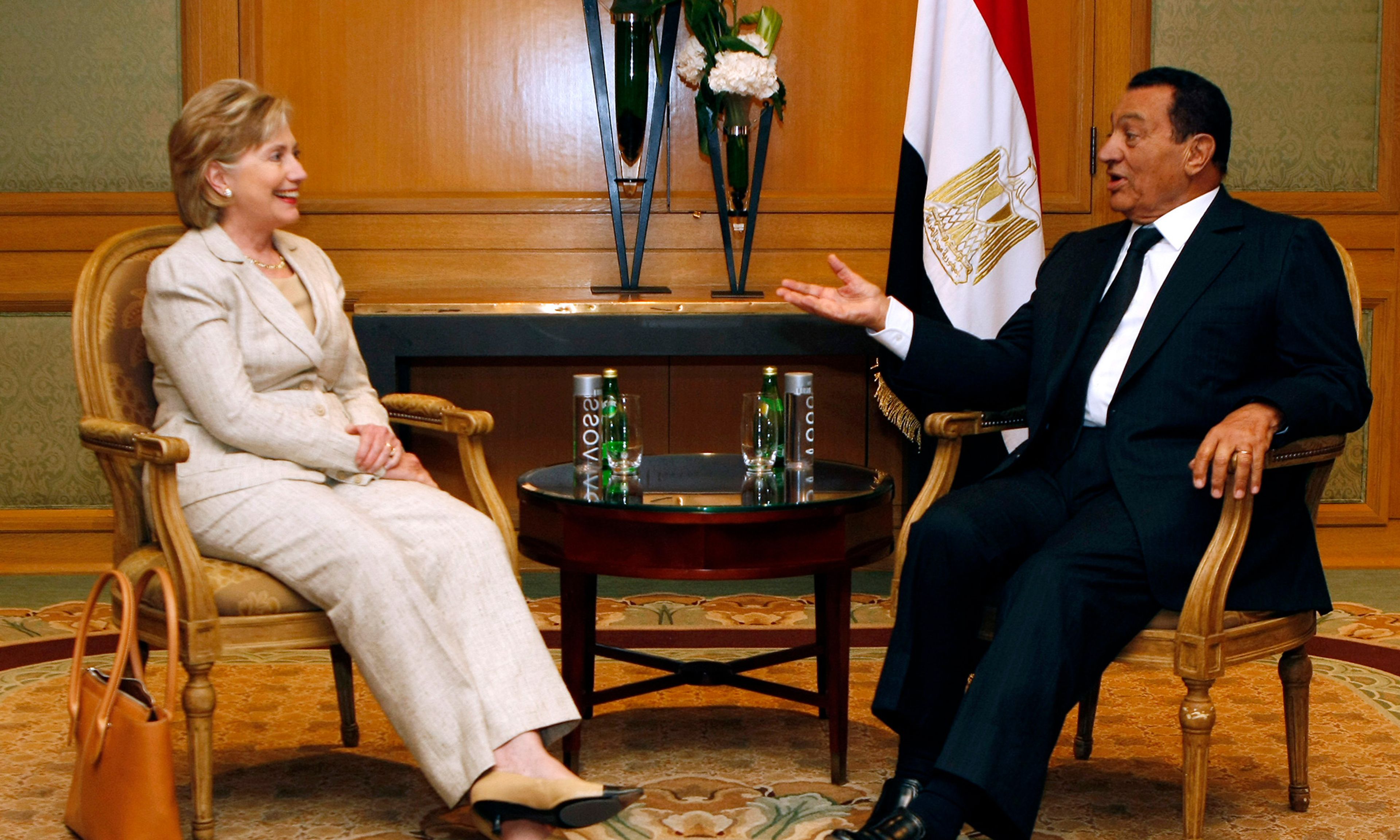
Hillary Clinton’s eleven-day trip through Africa was an odd affair. The proximate reason for it was that Obama’s election awakened wholly unrealistic expectations throughout Africa that the new president would make African affairs one of his priorities. Then, en route from the G-8 summit, Obama visited Ghana to pat that country on the head for having emerged as a democracy. This created considerable jealousies in other African countries that felt they had a better claim on his attention — Kenya because the Obamas hail from there, South Africa because it is the continent’s most developed state, Nigeria because it is the most populous, and so on.
So Hillary followed up by visiting not only these three but also Angola, because it sells oil to the United States; the Democratic Republic of Congo (DRC), because it is rich in raw materials and also provides a lesson about everything that’s wrong with Africa; Liberia, because of its historical ties to America and because in Ellen Johnson-Sirleaf it has Africa’s only female president; and Cape Verde, because it was on the way.
Just before Clinton landed in Kenya, that country’s prime minister, Raila Odinga, said he hoped he wouldn’t have to endure another lecture on corruption and misgovernance and how the continent’s leaders really must brush up their act. He was doubtless disappointed, as Clinton launched into just that sort of temperance-rally sermon at every stop. How seriously, one wonders, would Americans take a foreign politician who swung through their country in a day or two, telling anyone who would listen that, really, the U.S. ought to get its act together on health care?
But it was quickly clear that this was all the secretary of state had to offer. She preached homilies about governance, warned that American investors are put off by countries in which the president takes 10 percent of every deal, preached freer trade between Africa and the U.S., and expressed shock that no one had been charged for all the killings that followed the last elections in Kenya. She also delivered a speech against sexual abuse in the DRC, a nation that has been in a perpetual state of civil war and disorder for more than 40 years, where every possible crime and atrocity has been committed, where some 4 million have died in the violence of the last 20 years alone — and where an indignant little speech about sexual abuse has as much impact as tut-tutting about lynching would have had in the 19th century South. But what really got Clinton’s attention was the Congolese student who asked her about Bill’s thinking on such-and-such. Mrs. Clinton’s indignation emerged: Was someone treating her like Tammy Wynette again? She furiously reminded her questioner that she, not her husband, is secretary of state. We never got to hear what Bill thinks.
One might have been reminded of Mark Twain’s Innocents Abroad during Secretary Clinton’s tour. She came with all the predictable reflexes of a pert, politically correct, late-20th-century feminist, and she exhibited them at every turn. That was amusing enough, but no less hilarious were the polite applause and smiling embraces she received from the African elite, often the very ones guilty of everything she was preaching against. In Angola she praised the regime for having brought peace to the shattered country after so many years of civil war, astonishing Angolans who remembered only too well that the U.S. had backed the regime’s opponents in that war. She also made predictable remarks about wanting to see greater transparency in the disposition of the country’s oil wealth, lamenting that it is concentrated among a small elite against a backdrop of mass poverty. These remarks will have been water off a duck’s back to the Angolan kleptocrats, who are used to hearing and ignoring such homilies and confident that their oil makes them desirable partners, no matter their conduct.
Clinton seemed almost angry when journalists asked her questions about power politics. Was she responding to China’s increasing presence on the continent? Not at all; she had no reflections to offer on China’s diplomacy. (The germane comparison for most African leaders is of course that the Chinese have no interest in reading them lectures on human rights or good governance.) Was she talking to local leaders about where the U.S. could site the military headquarters of its Africa Command? The very suggestion shocked her. Was she trying to push African leaders into a stronger stance against Zimbabwe’s Robert Mugabe? By no means — and when she got to South Africa, the pivotal state when it comes to influencing Zimbabwe, no formal meeting had been arranged with the new president, Jacob Zuma. In the end, it was agreed that Zuma — who, as is his wont, had been happily counting his cattle in his village of Nkandla — would fly down to Durban, there to meet with Clinton for half an hour in the airport lounge. She emerged from this meeting full of praise for the wise counsel and advice she had received.
There were quickly rumors that Zuma would indeed be taking a tougher line on Zimbabwe, and that there had been a fresh start in U.S.–South African relations after the frostiness that characterized them during the presidency of Zuma’s predecessor Thabo Mbeki. Whether this is actually so remains to be seen. The anti-American instincts of the ruling African National Congress run deep. And Africa watchers have often seen leaders emerge delighted from a meeting with the genial Zuma and say how friendly and supportive he was, only later to realize that they had been gladhanded and that Zuma had evaded any and all binding commitments. Still, the U.S. is now working harmoniously with the South African government to combat AIDS, something unimaginable under Mbeki.
In South Africa as in Cape Verde, Clinton praised democratic initiatives and said, “America has much to learn” from these countries. One wonders how her old New York constituents would react to the notion that they had much to learn from Cape Verde: from where? At the end of her trip, Clinton enthused about the energy of many ordinary Africans she’d met and their tireless commitment to partying. There were, she said, even some evenings when she had not got to bed by 10 p.m. New Yorkers would perhaps have something irreverent to say about that, too.
One wonders what Clinton really made of it all. No previous secretary of state has given such a generous commitment of time, and so early on, to Africa. This alone has kept alive the extravagant expectations many Africans have of the Obama administration. Yet as the problems in the Middle East, Iran, North Korea, and China crowd in, it will be a surprise if America’s priorities really change at all.











Comments