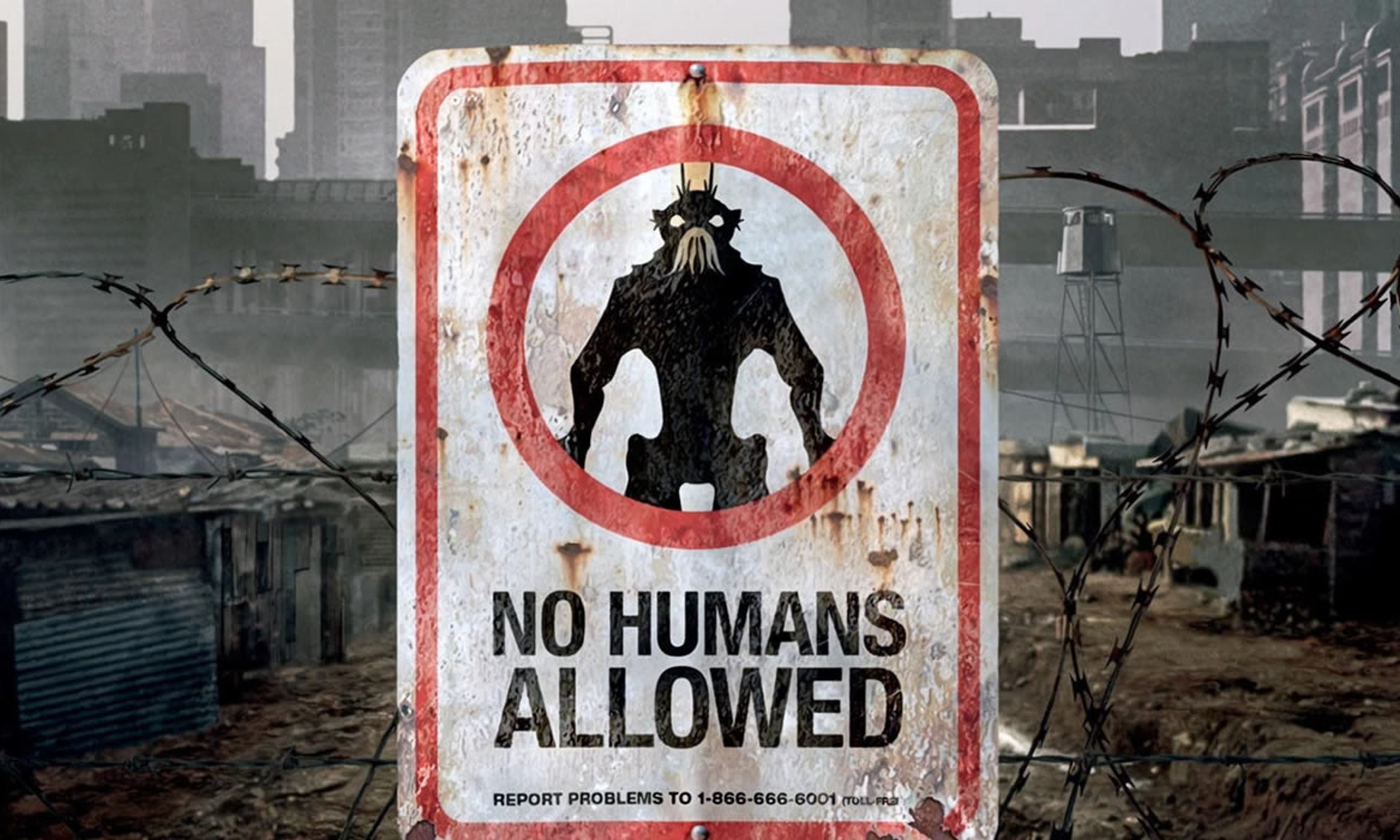
The next time you read about the money that’s been poured away bringing some lame, unnecessary science-fiction spectacular to life — the $200 million that Michael Bay spent making the Transformers sequel, say, or the similarly lavish figure wasted on the stupid, superfluous Terminator: Salvation — it’s worth pausing for a moment and pondering how many times over Neill Blomkamp could have made District 9 for the same amount of cash. Five times? Six times? Seven?
Blomkamp, an Afrikaner and a protégé of Peter Jackson, is responsible for the most impressive science-fiction film you’ll see this year — or in many years, for that matter. Almost as remarkably, he’s responsible for pulling it off on a budget of roughly $30 million, which is about how much money Jackson spent on orc makeup for Return of the King. It’s enough to make you wonder what kind of movies we might get if the studios instituted a “Blomkamp rule” for their summer blockbusters, and held them all to $30 million worth of sets, star power, and special effects.
What the young South African has produced with his money is a gritty, high-concept twist on the alien-invasion movie. A succession of talking-head interviews, interspliced with news-channel footage, sets up the premise: Twenty years ago, an immense spaceship appeared in the skies above Johannesburg and hung there in baleful silence until we drilled our way inside. What we found, instead of benign light-bringers or malevolent invaders, was a helpless mass of insect-ish bipeds, filthy and starving: the worker class of an alien species, whose superiors had either perished or abandoned them.
Two decades on, the spaceship is still there, hanging like a vast moon over Jo-burg, its origin still unknown and many of its secrets still locked. But its passengers — a million strong, and breeding apace — have been transferred to a sprawling refugee camp called District 9, where they subsist on cat food and rubber and coexist uneasily with the human population around them. Frustrated by rising crime and interspecies friction, the South African government decides to transfer them to a new, more distant camp, and contracts that difficult job out to an armed corporation called Multi-National United (MNU), which resembles a cross between the U.N. (complete with white helmets instead of blue), Blackwater Worldwide, and the James Bond movies’ SPECTRE.
MNU, in turn, places the operation in the hands of Wikus van der Merwe (the unknown, fantastic Sharlto Copley), the son-in-law of one of the corporation’s higher-ups. Ferret-faced and ingratiating, Wikus has the soul of a middle manager and the callousness of an East German bureaucrat. He mugs for the camera amid gunfire, postures like Michael Scott on The Office while the aliens are evicted from their makeshift homes, and tugs apart a nest of unborn “prawns” (as humans call them) with a gruesome bonhomie.
As you might expect, Wikus’s comeuppance is waiting for him in one of District 9’s shanties, where a close encounter with an alien technology makes him a person of interest for MNU’s weapons division, then a target for his father-in-law’s security forces, and finally an unlikely ally for a savvy prawn dubbed “Christopher Johnson,” who has a plan to get his species home. By the time the mad Nigerian gangsters and the giant robotic war machines show up, you’ll have almost forgotten that the movie started out as an apartheid allegory narrated by a group of PBS-style social scientists. Which is why the allegory doesn’t weigh the movie down: Machine-gun fire, it turns out, is the best way to rescue a politically themed story from heavy-handedness.
What really makes the movie so engrossing, though, is the texture of the world that Blomkamp has brought to life: the look of the aliens, with intelligent eyes buried in squirming mandibles; the vivid squalor of their shantytowns; and the confidence with which the movie moves back and forth between faux-documentary sequences and straightforward storytelling, borrowing the mood of Cloverfield and The Blair Witch Project without being imprisoned by their form.
The whole thing is impressive enough to make you forgive the various weaknesses of the script, which has its share of holes and lazy shortcuts, and which deals only superficially, if at all, with many of the bigger questions it raises — not only who the aliens are and what they’re doing here, but how 20 years of sharing a planet with extraterrestrials has changed the world beyond the movie’s Johannesburg horizons.
Some of these holes could presumably have been filled, and some of the broader questions answered, if Blomkamp had been granted more than $30 million to work with. As it stands, District 9 ends evocatively but somewhat unsatisfactorily — with the spacecraft doors left wide open for a sequel. Such a sequel, if it happens, will presumably come equipped with a much more substantial budget.
But of course the cost-conscious guerrilla filmmaking on display in District 9 is part of what makes the movie such a kick. And even if it’s flawless — and follow-ups almost never are — a hypothetical District 10 won’t have the frisson of discovery that comes with entering a clever sub-creation for the first time. This time, Neil Blomkamp snuck up on us. In the future, neither he nor we will be so lucky.
But I still can’t wait to see what he does next.












Comments