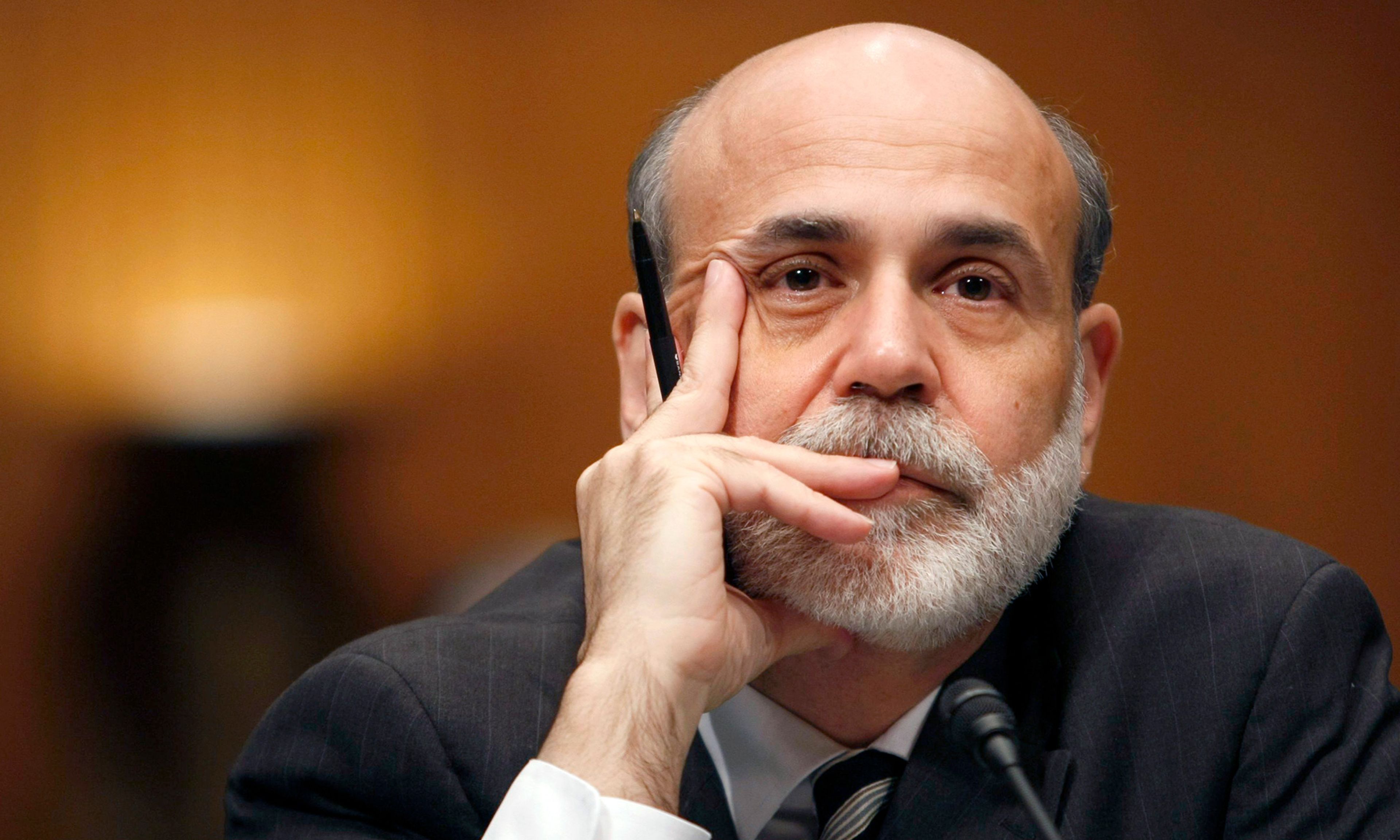
David Wessel’s new volume on the Federal Reserve’s response to the financial crisis is the sort of book that Bob Woodward usually writes about U.S. presidents: a character-driven, sometimes novelistic, You Are There account of highly driven, high-performing, high-testosterone men who stay up late eating ham sandwiches during world-shaking crises. It analyzes the choices they made and the creeds that led them to those choices.
At the heart of this story are the “Four Musketeers,” Federal Reserve chairman Ben Bernanke and his three-man brain trust: Kevin Warsh, the wunderkind investment banker who was the youngest Fed governor in history; Treasury veteran Tim Geithner, who ran the powerful New York Fed; and Don Kohn, Alan Greenspan’s understudy. Bernanke is a lifelong scholar of the Great Depression. Geithner was one of Treasury’s point men handling the serial Asian and Latin American financial crises in the 1990s. Kohn had been the Fed’s director of monetary affairs and, having risen through the ranks under Paul Volcker and Greenspan, commanded vast knowledge of the institution’s subtle relationship with the markets and the world economy. Warsh had been a hugely successful Wall Street player and had worked on the Bush administration’s efforts to reform Fannie Mae and Freddie Mac, the government-backed mortgage giants at the center of the crisis.
Nor did the four men’s academic background leave much to be desired: Bernanke has an economics doctorate from MIT and chaired the economics department at Princeton; Kohn has a Ph.D. in economics from Michigan, Geithner a master’s in the field from Johns Hopkins; Warsh had abandoned his economics Ph.D. studies at Stanford to attend Harvard Law School.
Given a blank sheet of paper and a mandate to write down the names of four people who might guide the nation through a great financial upheaval involving subprime mortgages, related securities, investment banks, and the broader financial markets, a wise man might have chosen these four. So why did they so often give the impression that they didn’t know what they were doing?
Or maybe a better question is one posed by Wessel: Did Bernanke keep his promise to Milton Friedman? Bernanke, at an event honoring the great economist, had famously declared: “Regarding the Great Depression — you’re right, we did it. We’re very sorry. But, thanks to you, we won’t do it again.” In that earlier case, the Fed had severely tightened credit, and thus turned a recession into a depression. As of this writing, we haven’t entered a new Great Depression. But that seems a low bar to clear. Are we to declare victory in Bernanke’s War on those grounds alone?
Wessel’s answer to these questions is not entirely satisfactory. In his telling, the Fed’s mission is twofold: First comes the substance, the actions and policies of the Fed, and then comes the theater, the institution’s sometimes ham-fisted attempts to communicate its strategy and intentions to the markets. Wessel is generous, perhaps overly generous, to the Four Musketeers on the substance question, and the strongest criticism he has to offer is that, in retrospect, it appears that they could have been faster and stronger in their reaction. “But there is another side to the what-if game,” he writes. “What if Ben Bernanke had not been a student of the Great Depression? What if he had not resolved to do whatever it takes to prevent a second Great Depression? What if he had been timid or cowed by the resistance inside the Fed? Those questions are easier to answer: The economy would have been even worse than it is now, and this book would have been an account of how the Fed had dithered and delayed, as an earlier generation of central bankers had.” Reasonably strong on the policy, then, in Wessel’s judgment, but often clumsy on the theater, misjudging how investors and financial institutions at home and abroad would react to the many skirmishes and engagements undertaken by General Bernanke’s brigades.
Wessel is an economics editor at the Wall Street Journal, and his understanding of the issues at hand is, as one might expect, broad and deep — truly impressive. It is also entirely conventional. His history of the Great Panic inevitably introduces the question of whether effective regulation of the financial markets is possible, but he engages with that question in only the lightest and most oblique manner. Consider that many of the more exotic financial instruments that have played a role in this crisis exist in no small part as a reaction to preceding regulatory conditions.
For instance, credit-default swaps were created as a substitute for conventional bond insurance, and grew to be preferred to conventional forms of insurance because they were not subject to the same regulation and attendant costs. The bond-ratings cartel, a federally chartered oligopoly that put its collective stamp of approval on a lot of subprime slime, exists only because of federal regulation. Capital is fungible, and financial innovation will always move faster than financial regulation — and innovation will always react to regulation; dump rocks in the river, the water will flow around them. Rather than ask whether Bernanke kept his promise to Friedman, might we not instead ask whether it was even plausible for him to make such a promise in the first instance?
Though Wessel’s very fine reporting suggests this question repeatedly, he does not quite tackle it. Instead, he writes sentences such as these: “Bernanke and Geithner simply never imagined that things could get so bad, that the crises they would confront would be so much larger than the worst of those that Greenspan had imagined. . . . To the officials overseeing the economy and many others, a crisis as big and broad as the Great Panic simply wasn’t considered a plausible scenario — and they weren’t preparing for anything this large.” If we cannot rely upon a man who is both chairman of the Federal Reserve and a scholar of the Great Depression to imagine the scope of a great financial crisis, whom might we rely upon to do so? The question sinks like a rock beneath the thrillingly choppy waters of Wessel’s narrative.
Nonetheless, Wessel’s story is an interesting and critically important one, told with great skill and wit. In Fed We Trust contains much that will be of interest to guys with Bloomberg terminals on their desks but also is well within the reach of the well-informed citizen at large. Financial terms and concepts are deftly explained in passing in a way that neither condescends to the general reader nor punishes him for not having had his nose buried in the eight-point type at the back of the Financial Times for the past decade. The story is full of fascinating anecdotes. One of the best: When he was being considered for the Fed job, Bernanke was brought into Vice President Cheney’s office for a 90-minute interview. One of the questions: What would you do if the CEO of Citigroup telephoned and said his bank was in trouble? It wasn’t long afterward that Bernanke had to answer that question non-theoretically. (His real-world solution: Buy it.)
The Fed has long been a despised fixation among those on the fringes of U.S. politics. It has more mythology surrounding it than does Mount Olympus. Wessel’s account of its creation and early days is a brilliant history-in-miniature of central banking in the United States, covering J. P. Morgan’s freelance bailout of the banking system during the Panic of 1907, and touching on the ideas of Walter Bagehot, the intellectual godfather of central banking, with lucid prose combining brevity with eye-catching detail. Like bad blood, the stink of politics hangs over the Fed’s birth, a fact that shows itself in sometimes amusing ways. Among the three men Woodrow Wilson appointed to draw up the boundaries of the Federal Reserve banks was, of all people, the secretary of agriculture — then as now, the farm lobby always got its say. Likewise, the Federal Reserve System’s infrastructure has not evolved with American demographics, which is why there are two Fed banks in Missouri alone but only two in the west, in Dallas and in San Francisco. There are no Federal Reserve banks in the nation’s second- and fourth-largest cities (Los Angeles and Houston) but former powers such as Richmond and Kansas City host them.
Wessel headlines the creation of the Fed “Alexander Hamilton Prevails — Ultimately,” but also notes: “The host of politically expedient compromises created a flawed institution.” How flawed? The Fed helped turn a normal recession into the Great Depression through interest-rate hikes in 1928 and 1929. That costly error resulted from “a misguided attack on speculation in the stock market.” I’d keep that phrase “misguided attack on speculation” handy as the solons in Congress prepare to draw and quarter short-sellers or whichever class of investors draws the short straw in the villain-of-the-day lottery.
If the Fed is, as Wessel argues, effectively the fourth branch of government, what does its constitution look like? It looks like the stock chart of Citigroup. Wessel uses a narrative device, “Bernanke’s Dashboard,” to check in, from time to time, with the data that grounded the Fed chairman’s decisions. On Bernanke’s Dashboard: the Dow Jones Industrial Average, the market capitalization of Citigroup, the price of oil, the unemployment rate, the Fed funds rate, and the Financial Stress Indicator. Between Aug. 7, 2007, and Dec. 11, 2008, Citigroup lost 81.5 percent of its value and unemployment went up 2.1 percentage points. Oil fell by 40 percent and the DJIA by 35 percent. Sobering stuff — but worth the cost of all that was done to contain the damage? Wessel cannot answer the question; it is unanswerable.
The greatest service Wessel performs here is that his readers very likely will close the book with less confidence in our federal institutions than they had when they opened it. That is a good thing, because, on the evidence, these institutions should not inspire all that much confidence. The financial crisis and the government reaction (and overreaction) to it is a story that is critical to understanding the current state of political affairs. Citizens have a duty to understand it; Wessel’s In Fed We Trust is a useful and enjoyable way to discharge that duty.






Comments