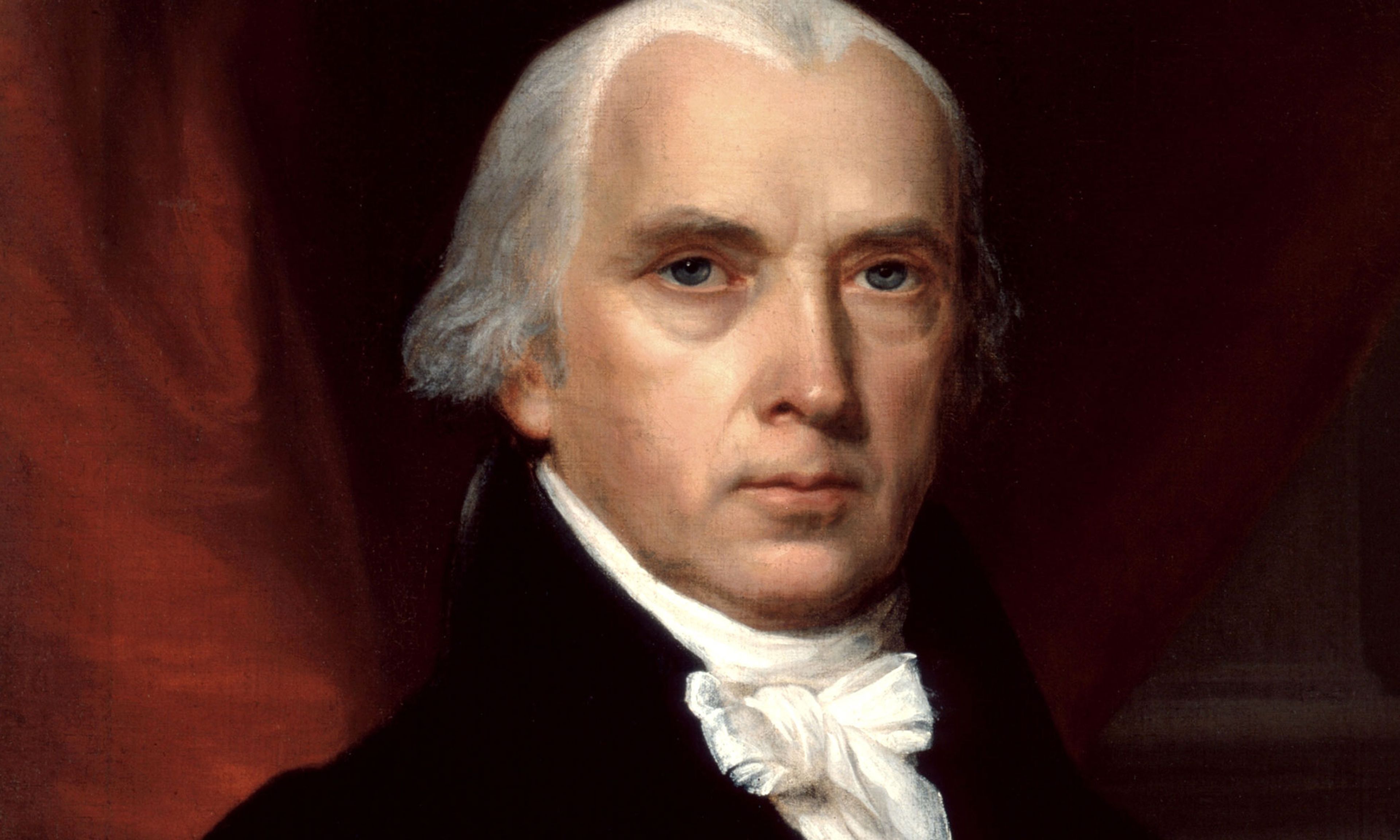
Many myths surround and obfuscate the American Founding. One is that the Founders and the Constitution they created had a peculiarly modern and atomistic view of society. According to this myth, the Founders concerned themselves not with the formation of citizens engaged in a common enterprise, but with institutions that played individuals and interest groups off against one another in order to prevent the dominance of one or another faction. Another myth, invented and perpetuated by progressives, suggests that the Founders (and Madison in particular) were guilty of anti-democratic elitism. And still another relies on the more positive but still distorting label of aristocracy.
Colleen Sheehan’s bold new book provides a corrective to the many myths of the Founding. It portrays James Madison, the father of the Constitution, as a man deeply concerned with the ideas of civic virtue, citizen character, and common purpose, albeit in the service of the truly republican principles of the Declaration of Independence. The book is about what Sheehan calls “the unbroken chain of ideas” that led from the Declaration to the Constitution and beyond.
Madison was well aware that even the cleverest institutional mechanisms are no substitute for the primary check on government: respectable public opinion. The spirit of a regime — that which gives force and direction to its fixed constitutional principle — is manifested and communicated in such opinion. The distinction between sound and unsound opinion runs throughout the founding debates and is evidenced in the structure of the Constitution itself, and Sheehan shows how consistently it runs through the thought and writings of Madison. Madison “understood his work at the Constitutional Convention of 1787, in the ratification debates, and in the 1790s to be in the service of establishing and vindicating the cause of popular government in America.”
The central idea that animated Madison did not change between his contributions to The Federalist and his theoretical and party-press writings of the 1790s. That idea was the authority of the people and the sovereignty of informed public opinion. And so in Madison we see clearly the extent to which America is based on far more than the pursuit of self- or class interest. In Madison’s thought, writes Sheehan, we see “the idea of America.”
Even as Madison took issue with the policies and constitutional vision of the Federalists of the 1790s, he never took issue with The Federalist. The importance of maintaining the cool and deliberate sense of the community as a governing force unites Madison’s thoughts and actions into a coherent whole. He saw men such as Adams and Hamilton trying to deny this popular sense, with their respective emphases on political balancing and commercial competition supported by national power. Sheehan points out that, unlike Jefferson, Madison rejected the idea of human perfectibility and the inevitability of progress in human knowledge. And yet he was not pessimistic about man’s capacity for self-government: If respectable collective opinion were allowed to operate, a free people would be able to control their government and themselves. Madison’s perceived theoretical and political shifts from the 1780s to the 1790s were simply the result of his thinking and rethinking the ways in which the reason of the public could be kept at the forefront of American politics.
Sheehan draws our attention to the important role of the French Enlightenment in Madison’s political thought, particularly as it concerned the reign of public opinion in the modern age. This interest led Madison in the 1790s to an important and pointed critique of Montesquieu, as overemphasizing the British idea of class balancing in ensuring moderate government. For Madison, public opinion is not only sovereign, but the primary source of stability in a republican regime. Sheehan skillfully leads the reader through Madison’s understanding of a host of French thinkers whose names are unlikely to be familiar to American readers today.
For Madison, America’s constitutional safeguards to prevent the concentration of power were to be viewed not as undermining the sovereignty of public opinion, but as shaping and strengthening it as a ruling force. Far from seeking to thwart public opinion, Madison’s political thought relied on an elevated conception of what public opinion can and must be in a republican regime. As Federalist 10 emphasized the control of factious opinions based on partial and partisan interests, so Federalist 14 encouraged the communication of non-factious ideas — and the formation of constitutional majorities — throughout the large republic. The clashing of rival interests is never enough to preserve a republican regime — a fact that, four score and seven years after the Founding, was tragically clear to Americans.
A genuine and effective public opinion must rule, and for this conditions must be just right. These conditions include effective transportation routes, free circulation of newspapers, and the flow of ideas between citizens and representatives. Continuous dialogue and deliberation are essential to the construction of proper public opinion. Madison, Sheehan writes, sought “not to depoliticize and anesthetize the opinions and mores of the citizens and replace the expression of different views of justice with shrewd mechanical arrangements, but to provide an environment in which the various views of justice can be expressed, enhanced, and harmonized.”
The republic must be large enough to prevent the easy formation of a majority faction. At the same time, it must in effect be contracted by the technologies and institutions of modernity. For Madison, newspapers in particular would serve as vehicles for the transmission of enlightened opinion to citizens, resulting in the refinement and enlargement of public views. As Sheehan’s Madison would have it, “Circulating print media serve to communicate the ideas of the educated and patriotic members of society to people at large.”
Put another way, Madison never doubted the fundamental natural truth revealed to the modern mind — that all men are created equal, and that consent to government is therefore a requirement of justice. Sheehan points us to the “debt of protection” we owe to the rights of all other citizens, and to which Madison referred in his essay titled “Property,” which appeared in the National Gazette in 1792. This is a debt that (in Sheehan’s formulation) “simultaneously dictates the right of a people to govern themselves and their moral obligation to govern according to a standard of right higher than mere human will.”
Natural rights are in principle self-limiting, but the trick is to turn the principle into practice. The maintenance of the natural justice explicit in natural-rights theory requires a political understanding and practice that goes deeper than modern political mechanics. A spirit — a certain kind of citizenry — must be carefully and continuously cultivated, and this depends on understanding the uniquely modern phenomenon of public opinion and its supports. Like Tocqueville after him, Madison understood that the mores of the people are largely determinative of the nature of a regime, and that the democratic age opens up new possibilities and perils.
One of the great insights of this book is therefore that Madison and America itself are at once more modern, and more ancient, than they are traditionally thought to be. Never giving an inch on the truth of natural rights and the utility of the modern, Madison nevertheless transcends the low but none-too-solid foundations of modernity. The classical project, from Madison’s point of view, is the formation of a genuine community of republican citizens. He therefore deals squarely with the problem of political culture and citizen virtue, and the conditions of their maintenance.
It must be noted that this high view of Madisonian constitutionalism raises questions Sheehan does not answer. She claims that “majority opinion in a republican polity is constantly in the process of constructing itself within an intellectual, moral, and psychological milieu larger than itself.” This self-construction demands truly great things from the people because it is civic education without, so to speak, an educator. The people, in order to remain republican, must in large measure be autodidacts. This assumes much, including the existence of an “educated and patriotic” class of men in the press. Nowadays, this class is increasingly one or the other. And the spirit of the polity is itself in doubt (to say the least). What, in short, might Madison think of the regime he did so much to create, and of the efficacy of his ideas concerning its preservation? Sheehan does not set foot in this territory.
This is a serious book that reminds us of the deep debt of gratitude we owe to our Founders, and to Madison in particular. But our debt is not just to the living and the dead. It is to those as yet unborn, a fact of which our Founders were preternaturally aware. Each generation must dedicate itself anew to the terms of our great American compact so that our posterity may enjoy it unsullied, and indeed purified. In this age of doubt, we have great need for works like Sheehan’s — books that are at once scholarly and patriotic.











Comments