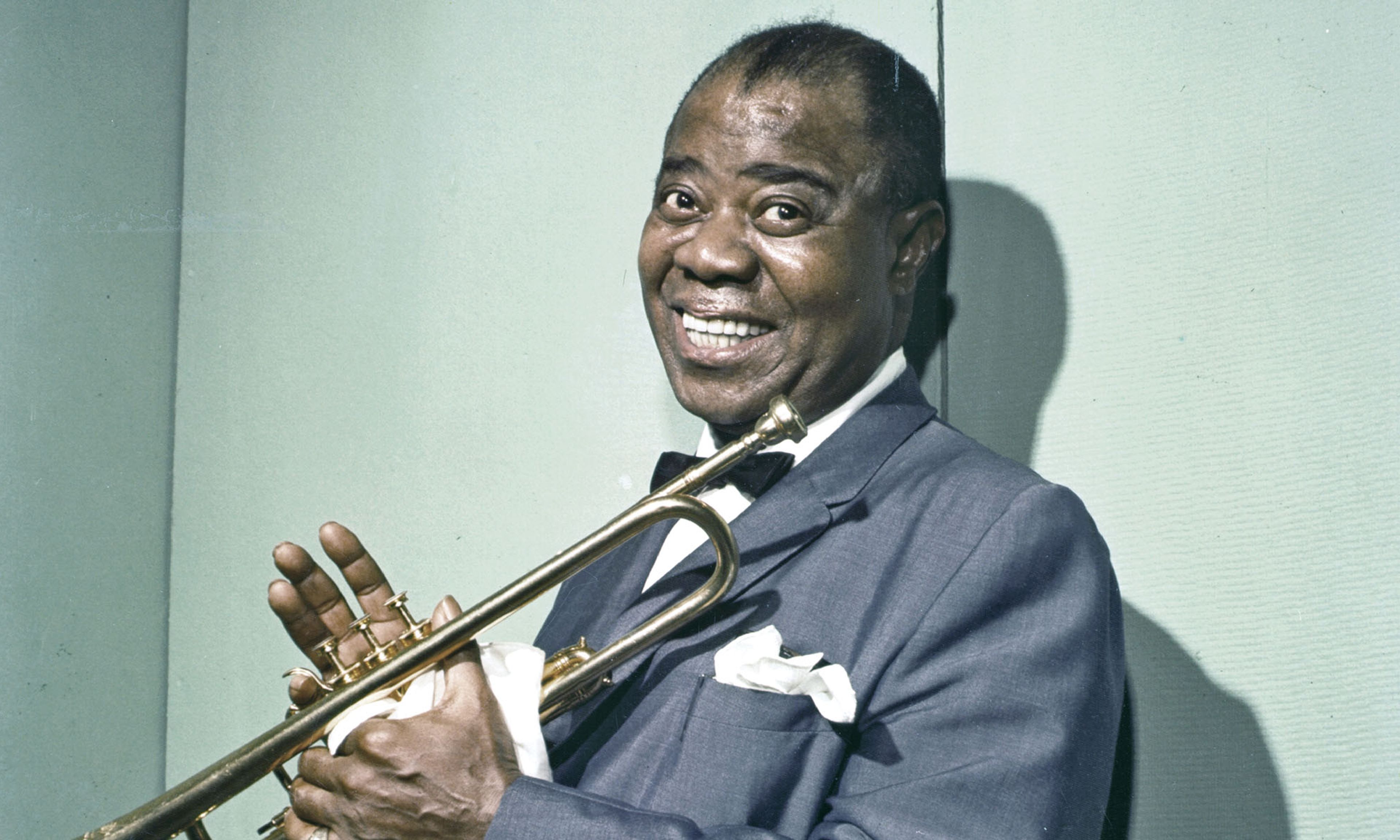
When I spent some weeks in a hospital years ago, Terry Teachout gave me a cassette (this dates it) of jazz favorites. My favorite became Louis Armstrong’s recording of “When You’re Smiling.” It is the all-American song.
The lyrics are a cheer-up sentiment, straight from a drugstore card rack. Smile, and the whole world smiles with you. Laugh, and the sun comes shining through. But, conversely, when you’re crying, you bring on the rain. So smile instead. The song ends with a variant of the first couplet.
Two things take these thoughts beyond — far beyond — Hallmark. The first is the music to which they are set. The tune seems as simple as the words — it outlines triads, or moves stepwise. Nothing could be plainer. But look again. If you play “When You’re Smiling” in C major — all white keys on a piano — you see that it touches F-sharp, B-flat, G-sharp, and C-sharp. The harmony adds a D-sharp — so all the black keys are present and accounted for. This doesn’t make it Schoenberg (even though it uses twelve tones), but the 16-bar stroll from C back to C passes, however quickly, through brambles. The sun comes shining through. Through what? Clouds.
Armstrong’s performance makes this as obvious as fireworks. He played the song throughout his career; what Terry gave me was his first, 1929 recording. The tempo is fox-trot. He sings, there is a saxophone break, then he plays.
I played trumpet in middle and high school, so I know the difficulty of what follows. But anyone can hear it. Armstrong is stretching his instrument to the limits. He got the idea from a trumpeter he had heard at Roseland, the New York City ballroom, who played everything an octave higher than it was written. We have an eye- (and ear-) witness description of Armstrong applying this technique to the song the year his record came out. “He really got into playing ‘When You’re Smiling.’ He had a great big Turkish towel around his neck, and perspiration was coming out like rain water. When he got to the last eight bars, he was getting stronger and stronger.” Afterwards a stunned fellow trumpeter asked to inspect his horn, thinking he had used a trick instrument, maybe a piccolo trumpet in disguise, moonlighting from Messiah. He hadn’t. He was determined to hit those notes, and he did. Fearlessly? Hardly that — he wasn’t a moron, he knew the risks. But he applied himself confidently, and made a joyful noise. Call it heroic optimism.
I suppose there are what might be called cynical libertarians, who believe people are so wretched that no person or persons should be allowed to rule; better then to let everyone go to hell in his own way. Americans, whether because we are the chosen people (John Winthrop, 1630), the almost-chosen people (Abraham Lincoln, 1861), or the choosing people (me, now), think most of us are fit most of the time to pursue happiness. Keep on smiling.











Comments