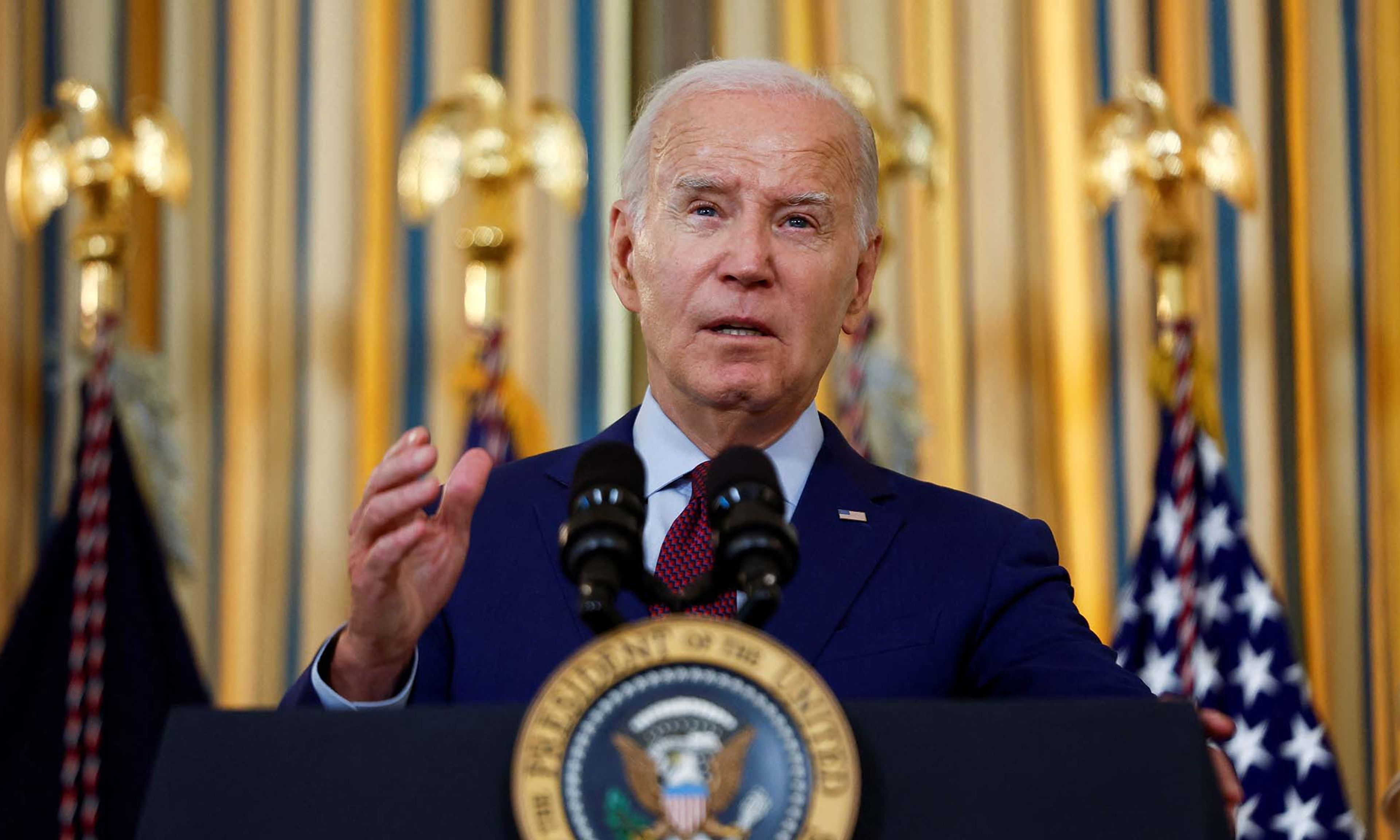
In 2020, candidate Joe Biden promised that the core concern of his administration would be the struggle between democracy and autocracy. Three years later, evidence that he has prioritized the promotion of democracy remains elusive. The administration’s defenders have only its assistance to Ukraine to boast about, and they are wrong to brag. First, the administration’s policy toward Ukraine is in defense of sovereignty, not democracy. In his speech two days after the Battle of Kyiv started, the president condemned Russia not for its undermining of Ukrainian democracy but for its “flagrant violation of international law” by invading “sovereign Ukrainian territory.” Note that, while Russia has been a totalitarian regime for the entirety of the Biden presidency, the policy of Russian isolation began only in reaction to the Russian attempt to redraw its map. Second, in February 2022, the president reportedly advised his Ukrainian counterpart to flee, prompting the fateful, historic response by President Volodymyr Zelensky: “I need ammunition, not a ride.” It is in spite of Biden, not because of him, that Ukrainian democracy survived that eventful winter.
In its appointments, too, the Biden administration has not put its money where its mouth is — or where it was in 2020. Its nominee for the position of assistant secretary of state for democracy, human rights, and labor withdrew her nomination in January without a Senate hearing, but the president has not nominated a replacement, and the position has been empty for the entirety of his term thus far. In a telling episode, the president’s national-security adviser, Jake Sullivan, publicly said that the erosion of democracy in India was not on the agenda during Prime Minister Narendra Modi’s visit. The administration has no pro-democracy accomplishments to show off, either; therefore, one can understandably conclude that the administration has little interest in democracy and human rights. I used to share this view, but I have come to the conclusion that the situation is much more dire than I initially thought. They care, but they have a terrible plan, and they are proud of it.
Secretary of State Antony Blinken was the keynote speaker at the annual Freedom House gala in Washington, D.C., in May, and his remarks were as illustrative as they were disappointing. His first sentence, after the mandatory pleasantries, was powerful: “When this organization was founded eight decades ago, the specter of Nazism loomed over Europe.” He continued: “In the rise of Hitler, the men and women of Freedom House saw a threat not only to freedom on the continent but to life and liberty everywhere. And so they threw their full weight behind pushing President Roosevelt to enter World War II to join the fight against fascism.”
The secretary soon moved on to the core argument of his speech: “And of course, one of the most rapidly evolving challenges — not a surprise to anyone here — is technology, both in the affirmative pursuit of human rights but also in further enabling repression.” Here began the trouble: Blinken boasted that his agency’s patches in the digital arena will advance the reach of freedom. The fixes, however, are marginal at best, and the administration has failed to focus on the more important issue: the ability of oppressive states to use violence against dissenters.
Iran saw last year’s greatest freedom movement in size and intensity, and Freedom House honored it at the gala. Indisputably, there is a state–civilian technological imbalance that favors the Islamist regime occupying Iran. During a previous round of revolutionary protests in Iran, in 2019, the government shut down the internet for two weeks, successfully ending the protests. Again in 2022–23, the government disrupted internet connections, though to a lesser extent. This tactic certainly helped suppress the protests, but it was not the key tool the mullahs used.
Social scientist Max Weber famously observed that a state is an entity that has a monopoly on violence within a territory. The government in Iran succeeded in putting down the protests by using physical violence, proving Weber’s point. In recent years, as over the course of history, we have seen anti-tyranny dissent fail over and over not because there is a gap in technology between civilians and the state but because there is a gap in the capacity for violence — i.e., a power gap.
The recent example that best illustrates this point is Syria. In 2020, Blinken acknowledged that the Syria policy of the administration of President Barack Obama, which he played a key role in crafting, had ended in catastrophe: “We failed to prevent a horrific loss of life. We failed to prevent massive displacement of people internally in Syria and, of course, externally as refugees. And it’s something that I will take with me for the rest of my days.” That catastrophe was the failure of Syria’s democracy movement. But it wasn’t world-class digital technology wielded by Bashar al-Assad’s regime that crushed the protesters. It was the government’s hard power: It had more and better bullets and bombs than the Syrian people did. The only way to prevent that catastrophe would have been to make Assad leave office peacefully, by threatening to create the conditions that would make his violent overthrow certain — and enforcing that threat if he refused.
Technology, of course, plays a role, and it can narrow the power gap. First and foremost, ensuring that peoples in oppressed countries have access to communications technology helps spread dissent. But surveillance technology can then suppress that dissent, as Blinken noted in his Freedom House speech. Totalitarian regimes such as those in Iran and China are cooperating with one another to increase their capacity to monitor their people and crack down on protests; preventing them from using surveillance tools would do the cause of freedom much good. But “crack down on protests” is the operative part of the previous sentence, which points to a blind spot in Blinken’s argument for restricting and shaping the use of surveillance technology globally. The problem with surveillance technology, as with all other technologies, is that it enhances the state’s ability to use violence to smother dissent; so technology is only a secondary challenge, while power and politics remain the core issue.
The senior national-security officials in the Biden administration are not far-left progressives. The far-left influence is visible, but technocrats still dominate most key positions. Like all technocrats, they compartmentalize problems, and too often they find answers mostly in technology, not politics. It is therefore no surprise that filling the political position of assistant secretary for human rights, democracy, and labor is not a priority for the administration; the administration does not believe that these are fundamentally political issues. But technology is subordinate to politics, a nuance lost on the administration. In other words, technology is a tool the state can use to manage its use of violence, but it is in the service of violence. For the Biden administration, however, technology and raw-power politics are separate planes, at best, and, at worst, technology has made politics obscure.
If the administration is serious about promoting freedom worldwide, then it should begin with a better understanding of politics. In particular, it should try to understand the structures and ideologies of totalitarian regimes. Above all, it must appreciate that, for those regimes, power is the basic logic and the only means of influence. For the dissenters and freedom-seekers in such a place, technology is valuable only insofar as it can maximize their power to defend themselves against the regime’s use of bullets, imprisonment, and torture.
Too often, American politicians use the language of hope and ideas to excuse their timid support for freedom movements. It is silly to believe that the superiority of certain ideas and the hope that they will catch on are sufficient to secure their triumph. Historian Robert Kagan observes, “The better idea doesn’t have to win just because it is a better idea. It requires great powers to champion it.” When the most powerful country in the world refuses to use its muscle, it gives tyrants a privilege they don’t deserve — the privilege of a merely rhetorical fight against the free world, on equal terms with it. The U.S. government should also, therefore, use indirect force against tyrants by empowering their subjects.
The administration of President Ronald Reagan understood this point. And because it did, it triggered the greatest expansion of freedom around the world in history. The prior White House, President Jimmy Carter’s, had made a point of putting human rights at the top of its foreign-policy priorities, but it had no receipts to show other than lectures. Michael Green, a historian of U.S. foreign policy in Asia, explains the difference between the administrations of Presidents Carter and Reagan in their approaches to Asian countries allied with the United States:
What Reagan did was to fuse interests and ideals; to focus on strengthening the institutions of freedom rather than just weakening the hold of authoritarian leaders; to ensure that allies were better governed at home so that they would be more resilient against imperialism from abroad; and to stay on the right side of history. Carter’s strong credentials on human rights did not sway authoritarian leaders in Asia — Reagan’s strong credentials on national security did.
When dealing with adversaries, however, Reagan focused on human rights as well as national security. His administration’s political objective for the Cold War was to exploit the existing rot within communist regimes. Technology was a means to this end — most famously for our purpose here, smuggling Xerox and fax machines into Poland, providing Solidarity activists with intelligence, and broadcasting Voice of America and Radio Free Europe/Radio Liberty. But all these were meant to advance the specific political objective of undermining totalitarian regimes.
The enactment of these policies was logistically easier at the time. In recent decades, the United States government has dialed back its human-intelligence operations. We have fewer spies and informants, so we have less capacity for covert operations abroad. The Biden administration has largely failed, for instance, in its attempt to smuggle Starlink modems into Iran. The misguided decision to dissolve the U.S. Information Agency has also complicated the ability of successive U.S. administrations to broadcast a coherent political message to their foreign audiences, while the low budget for current government broadcasting has resulted in unappealing programs of shockingly low production quality. In other words, even when there is a useful technology, the lack of presidential leadership prevents it from accomplishing much.
The administration must get serious about the promotion of human rights and democracy. It is undeniably true that a free China, Russia, and Iran will not pose existential threats to the United States or its allies. But realizing such goals will require strong political will beginning with the president, who sets the tone for his entire administration. Again, there is a lesson to learn from Reagan.
In the early 1980s, the new president believed that his predecessor’s emphasis on human rights had undermined U.S. interests. Reagan’s second secretary of state, George Shultz, strongly disagreed, but the key to his department’s success in promoting human rights and democracy was, first and foremost, changing the president’s mind. Thereafter he implemented the president’s new policy. In other words, the administration’s foreign policy was successful largely because the president became personally and politically invested in the policy and the cause.
Beyond presidential will, the current administration needs to push for liberalization among nations. This includes, yes, providing oppressed peoples with necessary technologies and denying surveillance tools to their oppressors. But the United States must also assist those people with the funds and matériel they need to overcome their rulers. This is their fight, but if they lose it, it will become ours. The U.S. military is in Syria today because the Obama administration refused to help that nation’s democracy movement.
Finally, the administration ought to work with Congress to restore tools that the United States gave up in the post–Cold War era, most notably, a well-funded U.S. Information Agency and the revival of human intelligence and covert operations. Without the ability to conduct information and covert operations, the government has only limited means of helping freedom-minded people in totalitarian societies effect change — economic sanctions and the use of military force. The former are often ineffective, and the latter is often imprudent.
But the first step for the Biden administration is to stop fooling itself that digital technology is at the core of the fight for American values. As long as tyrants have the bullets and the resolve to shoot at their defenseless subjects, no digital technology will be enough to win people’s freedom, because the triumph of freedom is never inevitable. The arc of history does not bend toward justice; it bends toward the most potent force. It is imperative that just forces push hardest.











Comments