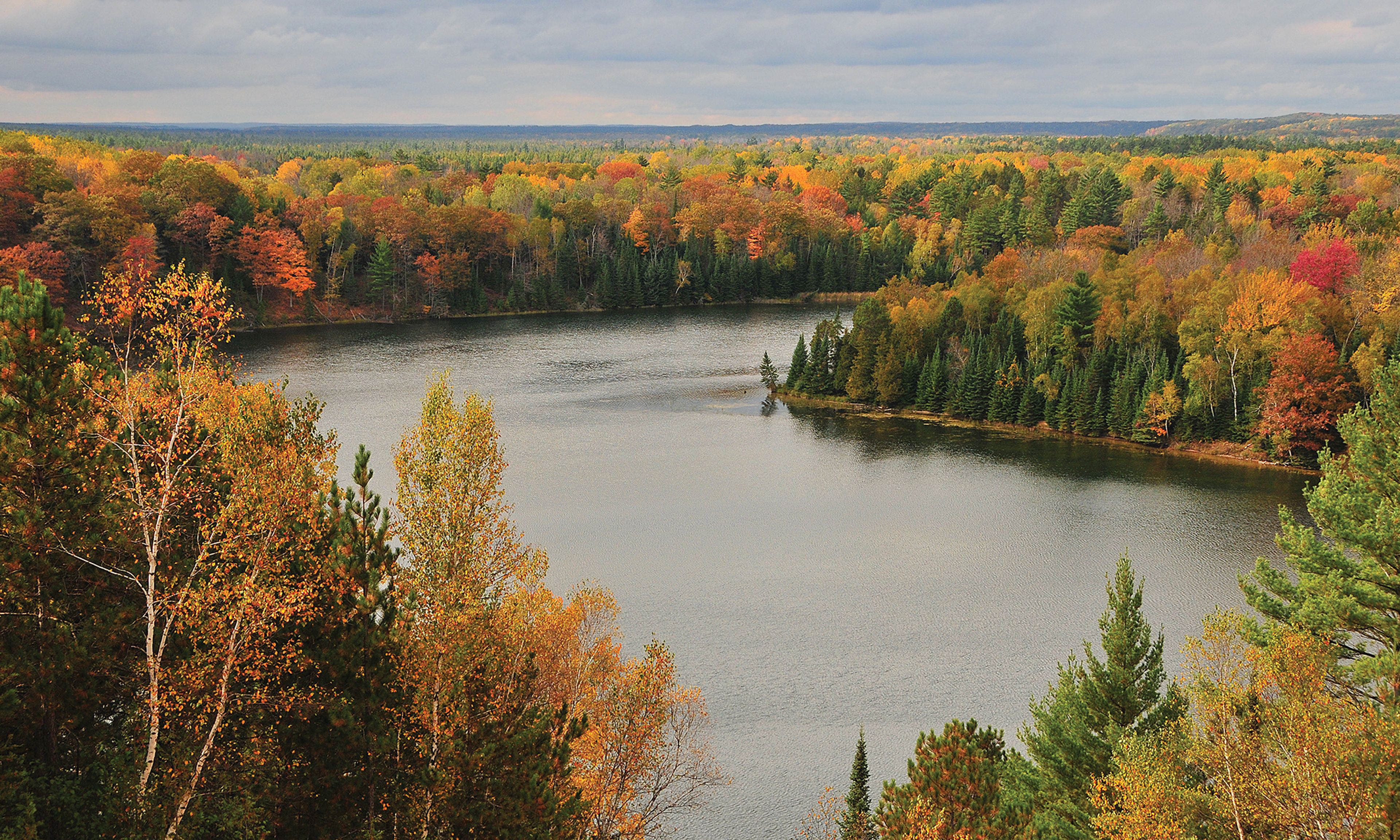
Grayling, Mich.
The first time Jorden Wakeley raced in the Au Sable River Canoe Marathon, he crashed into a support that holds up the Parmalee Bridge: “My partner wanted to go one way and I wanted to go the other,” he says. The impact tossed him and his gear from the boat and into the water. Wakeley recovered and continued to race, but he learned how much can go wrong when paddling at high speeds and in the blackness of night.
Wakeley recalled this story shortly before the start of this year’s event on July 24, when he and Matt Meersman joined 82 other two-person teams in a remarkable annual contest that begins with a fast-moving stampede but turns into an overnight test of strength and endurance. The trek lasts for 120 miles, starting on a Saturday evening in the small town of Grayling, in the middle of Michigan, and finishing on Sunday in Oscoda, an even smaller town on the shores of Lake Huron. Along the way, each paddler completes something like 50,000 strokes. Working without stop, the winning team usually needs more than 14 hours to cross the finish line. A recreational paddler would require as much as 50 hours to cover the same distance. Writing about the Au Sable marathon in Sports Illustrated in 1973, the late novelist Jim Harrison, who was born in Grayling, dubbed it “a night of unmitigated punishment.”
Many of America’s most celebrated races are tied to places, such as the Boston Marathon, the Kentucky Derby, and the Indy 500. Michigan’s canoe competition may not enjoy their fame: You can’t watch it on television, and most sports fans probably have never heard of it. Yet it’s one of the country’s great athletic challenges, demanding that paddlers combine extreme physical fitness with the mental skills of navigation on a nighttime journey. Founded in 1947 to boost tourism in northern Michigan, the yearly event also has developed a unique culture that turns devoted fans into quasi-participants — making it, as organizers like to say, “the world’s toughest spectator race.”
On the day of this year’s event, rain poured down all morning and afternoon, raising the Au Sable and making it a quicker course than it had been just 24 hours earlier. As sundown approached and the marathoners lined up with their canoes in Grayling’s downtown, Eric Dittenber, in his eleventh marathon, warned that the high water could lead to rapid exhaustion: “People go harder, thinking they can make a really good time, but then they tire themselves out and pay for it later.”
At 9 p.m. sharp, the sheriff of Crawford County fired a blank from his pistol. In a mad dash to the river, racers carried their canoes a quarter of a mile to a fly shop on the water. They ran along its curving boardwalk, splashed into the shallows, and hopped into their boats. Canoes crashed into one another and a few flipped over. The mayhem lasted for only two or three minutes, but they were hard to match for intensity and thrills. This part of the marathon, at least, would make for outstanding television — though there’s also nothing quite like seeing it in person, among thousands of hooting fans.
In canoe No. 63, Meersman and Wakeley were among the earliest duos to enter the Au Sable. They’ve done this previously a combined 17 times, with the 44-year-old Meersman once finishing in fourth place and the 31-year-old Wakeley topping out in 15th. On this night, they started near the front of the pack, but grew frustrated that they couldn’t pass their rivals in the narrow, upper sections of the river.
The marathon rewards both luck and troubleshooting because of its many hazards. Trees and branches known as “sweepers” reach over the water, sometimes clonking racers who don’t see them in the dark. Logs and rocks lying just beneath the surface and invisible to the athletes can obstruct canoes and damage their sides and bottoms. Paddles crack constantly. Everyone carries spares, and most racers attach flashlights to their bows. Even so, says five-time marathoner Paddi Thornburg, “something new always seems to come up.”
Michael Garon, a 63-year-old veteran of the race, tries to prepare for every kind of adversity. He says he once had to plug a hole in his canoe and there’s only one way to do it properly: “You have to wipe the boat with a towel, and then spray it with lighter fluid and set it on fire. That makes it dry enough for duct tape, which will get you through the race.” This year, he finished in 51st place but also extended his record of consecutive completed races to 22. Over the years, he has adopted a prerace ritual: “I always eat pizza for dinner.” Is that a healthy choice, when so many of his competitors rely on a diet of fluids? “Don’t worry, I work it off,” he says.
Thousands of fans line the riverbank for the chaos of the first few minutes. Once the race is under way, many walk to Grayling’s microbreweries or head home — but hundreds of diehards begin a chase to stay ahead of the paddlers and track their progress, in an activity that keeps them moving through the night. “Lots of people want to get to the same spot quickly,” says longtime marathon organizer Phil Weiler.
These watchers zip along rural roads, causing traffic jams in areas that normally see few cars or trucks. Popular destinations include McMasters Bridge at midnight, the Mio Dam around two o’clock in the morning, and the Alcona Dam shortly after five o’clock, as dawn begins to break. The best vistas are the river’s six hydroelectric dams, which the racers must portage around: They get out of their boats, haul them over earthen barriers, and sprint downhill to where the river restarts.
Fans greet them with ringing cowbells and whoops of encouragement. They also boast that they’re “hup all night,” in an informal slogan that appears on T-shirts and in social-media tags. It puns on the word “hup,” which canoers say to each other when they want to switch the sides of their paddling. They do this constantly because a stroke in the back has more steering power than does a stroke in the front. Switching allows them to move in a straight line. When they work in unison, in tapered canoes built for speed, the best paddlers cut through the water with grace and efficiency. Luc Robillard of Quebec, a champion in the 1970s, has described a canoe team as a “machine with two pistons.”
At bridges and dams, the athletes meet “feeders,” who are to the canoe marathoners what pit crews are to NASCAR drivers. They swap out old paddles for new ones and supply energy drinks in homemade jugs with long tubes that don’t require hands for slurping. Lots of marathoners take ibuprofen as they race, sometimes in the form of pills jammed into bananas that feeders deliver on a schedule. Some want peanut butter. Katie and Kristi Treston, sisters who started their sixth race together, asked for donuts from Goodale’s Bakery, a business in Grayling.
Most Au Sable marathoners are like their peers on foot: They’re just happy to finish, which they see as enough of an accomplishment. A handful, however, strive to win. The start in Grayling is hard to beat for up-tempo excitement, but the races in both 2016 and 2017 featured wild sprints at the end, with the first- and second-place teams separated by a single second.
This year brought a different kind of drama. Canoe No. 63 took the lead about two hours into the race and never looked back. Did Wakeley think about his earlier mishap as he approached Parmalee Bridge this year? “Oh yeah,” he said. So did Meersman, his partner, who cracked a joke as it came into sight at 12:39 a.m.: “Which way do you want to go?”
Wakeley chose to go right, and that’s the way they went. Then they kept on going. They rode the high waters of the Au Sable to a time of 13 hours, 54 minutes, and 9 seconds — a new record for a classic race.










Comments