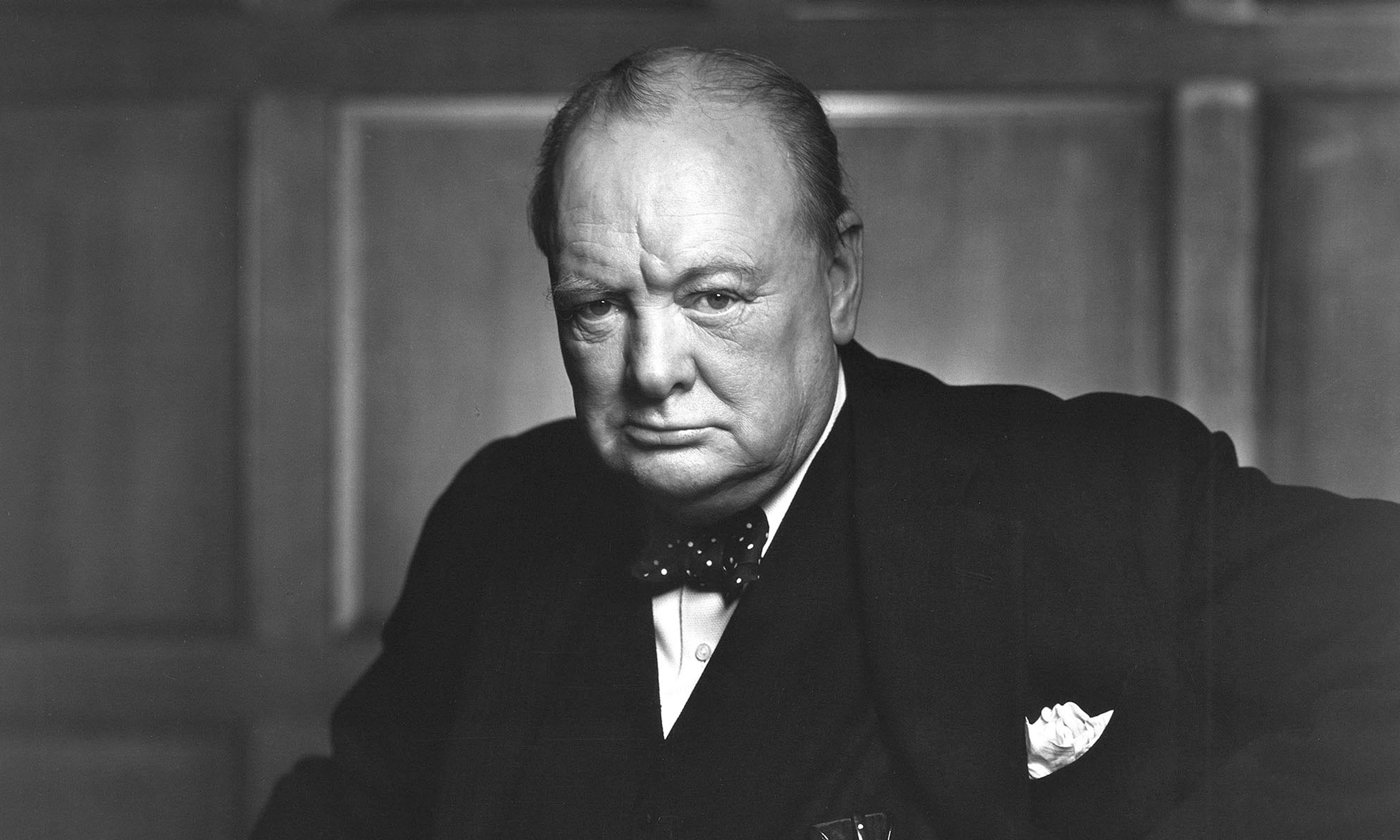
This is an interesting and important book by a very capable historian. (Max Hastings and I worked quite cordially together for a number of years in the 1990s at the Daily Telegraph in London, but have had no contact for some years.) Winston’s War does not bring, nor pretend to bring, a great deal that is new to the well-known story of Churchill’s war leadership. But it offers an insight into his foibles, his attitudes and attachments to people, and the humane, decent, and tender aspects of his intimate nature that only the most omnivorous Churchillian reader would not find very revealing.
The book also makes clear the evolution that has taken place in the received historical view of its subject. The vindicated prophet and galvanizer of the Finest Hour of 1940–41 remains, and always will. But the evocator and voice in the wilderness of the new resistance against Soviet Communism has yielded to the humanitarian eccentric and polymath, who proves more admirable and loveable than infallible and under-heeded.
This evolution is tangled in the British people’s learned and popular conceptions of their country’s modern history, and especially its complicated relations with the United States. There has been a long-running tug-of-war between Churchill and Roosevelt historians about the comparative merits of the two as policymakers. Churchill opened up a tremendous lead in this race, because he survived Roosevelt by 20 years, carried out his own promise to write the history himself (for which he was awarded the Nobel Prize for Literature), and engaged in ambitious revisionism.
It suited the whole constellation of the U.S. government’s post-war enemies to heap abuse on Roosevelt for having been swindled by Stalin into handing over Eastern Europe to be trampled by Stalin’s Red Army. Disgruntled British imperialists, grumpy about the inexorable and not always suavely gracious rise of America, rallied around the view of 0historian Arthur Bryant that Roosevelt was a sap, out of his depth with Stalin and envious of Churchill. (This was a little hard to take from Bryant, who several months after the outbreak of World War II published Unfinished Victory, admiringly referring to Hitler’s coming triumph, traceable in part to the Führer’s “Cromwellian qualities.”) The Euro SocDems who wished to appease Russia and give equivocation a chance in the Cold War — the Willy Brandts and Pierre Trudeaus, and even, for a time, Denis Healey — claimed that Roosevelt lowered and legitimized the Iron Curtain. De Gaulle and his followers took up the same cry, to show that only they, and not the Anglo-Saxons, could defend Western Europe. And, most damaging, the bedraggled Flat Earth Society of the U.S. Republican Right — at the worst, Joseph R. McCarthy (who accused Truman, Marshall, and Eisenhower of being Commies too) — defamed Roosevelt as a Stalin dupe.
Churchill avoided any direct criticism of FDR, but mischievously poured gasoline on the fire with the woeful tale of the world caught between a physically and mentally decrepit Roosevelt and a completely inexperienced Truman. For good measure, he produced, after the Tehran Conference, what Hastings calls “one of [his] great sallies, no less pleasing for its misplaced self-belief”: He said that he was the “little English donkey” between “the Russian bear and the American buffalo” but was “the only one who knew the right way home.” (This presaged Harold Macmillan’s comment, 15 years later, that Anglo-American relations were like those between the Greek and Roman empires.) The best line of the Tehran Conference was actually Churchill’s “The truth deserves a bodyguard of lies.” In this case, he certainly gave it one.
Roosevelt had cautioned Churchill at Tehran about improving social services, moving India and other parts of the Empire to self-governing Commonwealth status, dismantling part of the class system, and taking the lead in organizing Western Europe, to give the public the confidence that they had been fighting for reform and their own betterment, and not just against Nazis and for an empire. It was all good advice from an invincible democratic politician.
There was never one word of truth to the Yalta Myth: That conference guaranteed independence and democracy for Eastern Europe. It was Churchill who signed away Hungary, Romania, and Bulgaria to Stalin in Moscow in October 1944, calling “the naughty document” a “temporary arrangement,” as if he did not know whom he was dealing with. Max Hastings describes this as an act of desperation. Perhaps it was, but why did he do it?
Hastings does recount Churchill’s opposition to the cross-Channel invasion of France, his terror that it would be a failure; but he leaves out the conviction of the chief of the general staff, Alan Brooke, that Stalin supported it only because he thought it would be a failure, like Gallipoli, Narvik, Dunkirk, Greece, Crete, and Dieppe. And he omits the lengths Roosevelt went to, staying in the Soviet legation in Tehran (where he knew his suite was bugged) to pre-arrange Stalin’s support of the French landings, rather than Churchill’s proposed mad dash up the Adriatic.
Churchill loved conferences, affecting a military uniform, and clearly enjoyed them a good deal more than Roosevelt and Stalin did. (They were not parliamentarians, and were not much accustomed to conferring or debating.) And with Roosevelt he will always remain the co-author of the astounding achievement of leaving it to Russia between 1941 and 1945, to take, among the Big Three, 90 percent of the casualties of war and end up with a temporary and squalid squattership in Poland and the Balkans, while FDR and WSC brought Germany, Italy, and Japan in, and France back into, the West as democratic and soon prosperous allies. These are impregnable historic accomplishments.
If the Churchillians had clung to the Yalta Myth, his reputation would have started to unravel. Max Hastings has laid down the real bridge for Churchill to hold — his inspiring leadership in the early years of the war — and builds his further standing on his splendid personality rather than on false disparagements of others.
Of course, Churchill has long been admired as a wit, and rivaled in that among British prime ministers only by Disraeli, and as a magnanimous winner and gracious loser throughout his life. (“If the people want Clem Attlee, let them have him. That’s why we fought and won the war.” The corresponding statement from Roosevelt, after his unheard-of fourth presidential victory, about his opponent, Thomas E. Dewey, was “I still think he’s a son-of-a-bitch.”) Churchill had a readier sense of humor than Roosevelt, Stalin, and de Gaulle, and an irresistible sense of fun. This book gives much evidence of that.
When he was very tired and discouraged in 1944, when the conduct of the war was really in the hands of his allies, he told his wife, the magnificent Clementine, how exhausted and fed up he was. She replied cheerfully: “Don’t be; think of how Hitler and Mussolini are feeling.” He instantly replied: “No, Mussolini has had the pleasure of executing his son-in-law.” His mood quickly responded to this self-help.
There are a few gaps in Hastings’s book. Market Garden, Montgomery’s play for the Western Front breakthrough that ended with the bridge too far and left the Canadian army squatting on Dutch rooftops after German flooding, is not mentioned. Americans generally blame Market Garden for the German ability to launch the Ardennes offensive. The European Advisory Commission (EAC) is also not mentioned. The EAC set the German occupation zones, and the British voted with the Russians to put Berlin in the American zone, because they could thus get a larger occupation zone than their divisional strength warranted. Roosevelt didn’t want the zones demarcated because he correctly foresaw that once Eisenhower’s armies crossed the Rhine, the Germans would collapse in the West, but fight to the last cartridge against the Russians.
But this book is only incidentally intended to be about such things. It is really a close-up look at a great man and statesman. Churchill was fallible after all, but he was a humane and artistic romantic and adventurer, the stylish and amiable repository of the virtues of a civilizing empire. His greatness remains as the mighty single-combat warrior of the early war, whose personal courage, as Stalin said at his 69th birthday celebration during the Tehran Conference, had changed the world; as the original co-captain of the winning side in the war, and in the Cold War; and as the most human, compelling, and diverse of the great 20th-century national leaders.
Max Hastings is uniquely qualified for the task he has undertaken: a quick-starting, energetic former war correspondent and editor, and an accomplished military historian who writes with unembellished force, precision, and a wonderfully detached appreciation of the humorous (such as an American officer’s phobia about anyone with “a red moustache, a swagger stick, and a British accent”). He brings to the study of Churchill the man, husband, father, friend, and employer, the sensitivity of a powerful man who has also lived intensely in all those roles. This is an excellent and timely portrait of an always fascinating character, by a thorough, rigorous, and elegant writer.












Comments