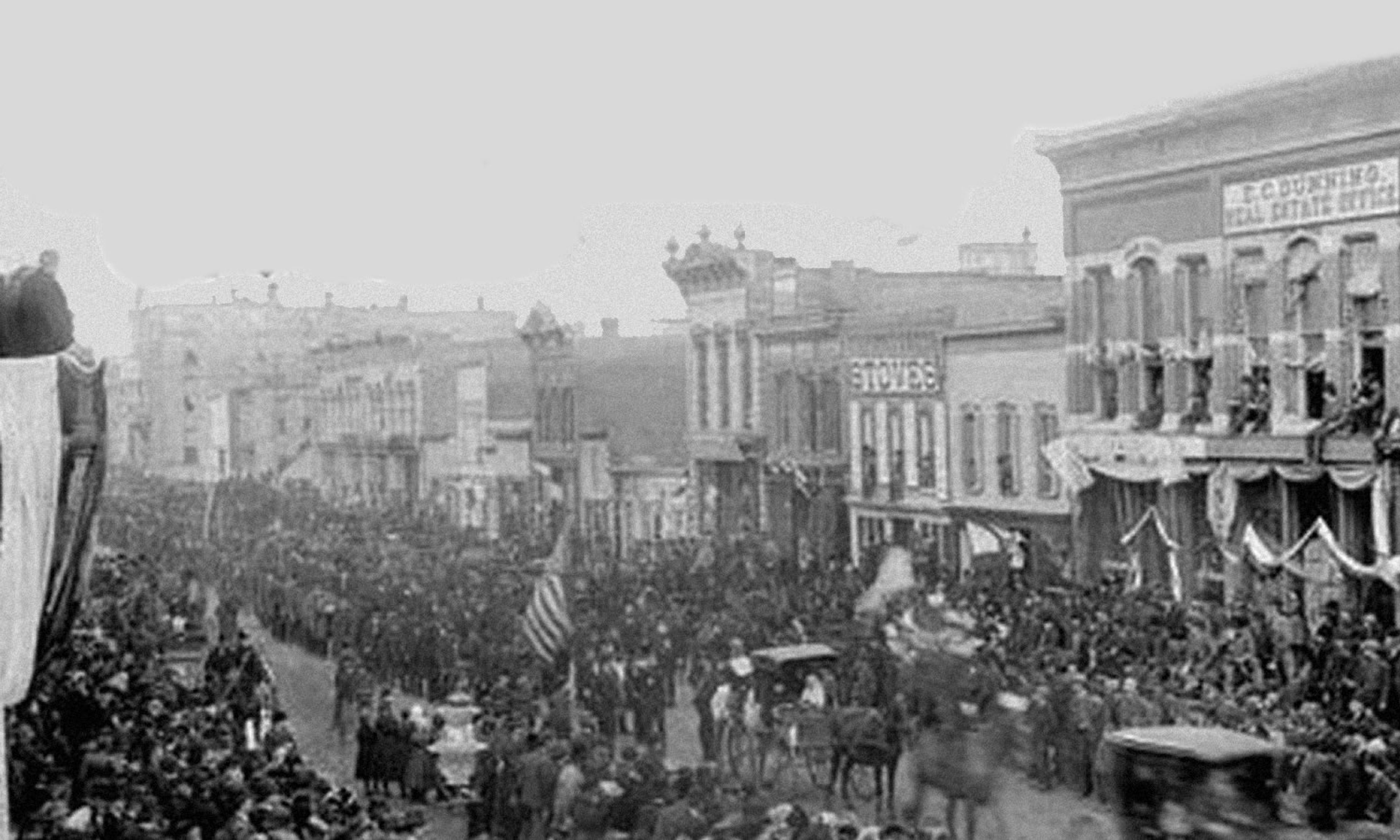
What happens when hundreds of thousands of people flush into a massive open prairie in the course of a decade, transforming a place the size of Ireland into farmland carved up into parcels about ten city blocks wide and long? One would think social discord and economic domination by a clique — and that, for a long time, has been the view of “progressive” historians on the matter.
In his enterprising new scholarly work, Jon Lauck invites us to question the stereotype of the lawless, corrupt, hang-’em-high “Wild West,” and instead paints a picture of a healthy, energetic, quintessentially Jeffersonian Prairie Republic.
Even before Congress deigned to recognize Dakota as two states — with the north the more barren, railroad-dominated locale — a vibrant civic society had developed in what became South Dakota. It was a place dominated by small landholders who distrusted Washington and hated the territorial spoils system, who were devoted to their churches and civic organizations, and who obsessed about synthesizing “the organic law” of the soon-to-be state. By the late 1880s, Dakota Territory had less illiteracy than any New England state, and more newspapers were published there, per capita, than almost anywhere else in America.
The ignorant, gun-slinging, oligarch-controlled West is not what Dakota looked like. The settlers named their towns after Virgil and Seneca. They read Tennyson, Pope, Byron. Such classical education did not, as today, destine young Dakotans for a life in academia. No, this was preparation for a life that took seriously the hard toil of the farm and the grave work of self-government.
Government is such a behemoth in the modern United States that the vast majority of citizens expect all of its institutions to work smoothly without their mundane attentions. Today, more than ever, “self-government” has come to mean merely that we are a people who vote and elect whom we care to. The definition was much broader and more demanding in Dakota Territory. There, self-government meant something closer to what Tocqueville had observed in the Ohio River Valley, which was in many respects repackaged by the historian Frederick Jackson Turner, who spoke of the yeoman farmer as cultivating not just a small landholding but a civil society on which he and his neighbors relied. To be sure, self-government included the secret ballot, but it was more than that. It meant living “the strenuous life” and cobbling together a society from scratch, according to no less than Teddy Roosevelt, a Dakota rancher for a time before he returned to New York.
Self-government began at home, proceeded to the church, and rounded itself out at the Odd Fellows or Masonic lodges. In the absence of a state government, and with only stooges of the interior secretary exercising codified political authority, self-government had very little to do with formal government institutions. Even so, Lauck writes, Dakotans governed themselves temperately. There was little of the vigilante justice of the South or Far West.
The newly minted Dakotans were serious people living in a serious time. Most of the male settlers had been soldiers for the Union, and in their journey west they never lost their devotion to the United States, indivisible, and their commitment to making the sacrifices necessary to keep it whole. They were not, unlike the “copperhead” southerners who moved farther west to mining camps after the Civil War, trying to escape the aegis of American political culture. Dakotans were embracing it, and consciously expanding it westward. Lauck notes that some territories declared what amounted to unilateral statehood, appointing officers of a state government at their constitutional conventions. The leaders of the Dakota conventions, even while resentful of a Democrat-controlled Congress, were mindful of the importance of the Union and the authority of Congress on the matter.
A century after the American Revolution, the opening of Dakota and its prospects for statehood gave settlers repeated chances at constitutional conventions. Dakotans held four in a seven-year period — each a bonanza of civic activity, each resulting in a state constitution approved by Dakota’s voters but turned down by Congress, until the last convention in 1889 finally yielded statehood. At the conventions, which despite being held in rapid succession had a turnover of 70 percent in their membership, the delegates meticulously read America’s founding documents. They adopted many of the republican elements of one in particular: the often-overlooked Northwest Ordinance, one of the four “organic laws” of the Continental Congress, which set provisions for the settlement of the Ohio Valley, including the banning of slavery and primogeniture. In Dakota, as a hundred years previously in Philadelphia, convention delegates “pledged their sacred honor” to one another in upholding the government they had just conceived.
Like the Founders, most Dakota settlers were Episcopalians or Congregationalists. Foreign-born Lutherans were a large minority. To all of them, it was a tenet of faith that obedience to Rome meant disloyalty to the legitimate secular government. Replying to the popular suspicions, Catholic bishop Martin Marty protested that “the children of the Church stand foremost as the faithful supporters, as in the hour of danger they were the enthusiastic defenders of the American Republic.” Everyone was eager to speak the language of republicanism.
Lauck’s work fits into a wider body of recent scholarship that takes seriously the role of republican political thought in world history. Indeed, one sees the influence of England’s long parliamentary tradition everywhere in countries influenced by English colonization. Others have pointed out that Indians and Africans routinely petitioned their faraway central government using English concepts of republicanism against their superiors. Similarly, Dakotans at the cusp of statehood viciously denounced their “colonial status,” which quashed their ability to carve out a self-governing republic even after territories with far smaller populations, such as Nevada, had been granted statehood.
The powerful current of political republicanism that coursed throughout the Anglo world has been taken lightly by previous historians, who in such “colonial” and “frontier” situations tend to have a Marxist bent and a myopic focus on perceived class conflict. But the political republicanism enshrined by England’s Glorious Revolution of 1688 has found salience countless times across the globe — in Philadelphia in 1776, Dakota in the 1880s, and the British colonial world after World War II, to name just a few examples. Formative historical actors of these places all wrote and spoke about how important this kernel of republican ideology was; it was a platform for them to point out the hypocrisy of the metropole, and to demand their God-given rights. Those claims deserve to be taken seriously by historians and, at least in some quarters, finally are.
Lauck is a senior adviser to South Dakota senator John Thune, and in his moving epilogue, he takes us to the modern day. He notes that many counties in South Dakota are far less populous today than they were a century ago. What little population remains is devoted to the old traditions of civic society: still gathering in church basements for community dinners, still on a first-name basis with their neighbors, still working with their hands, still with enough passion for democracy that voter turnout in some rural counties exceeds 80 percent. Lauck notes that Robert Putnam, author of Bowling Alone, found that tiny Miner County, S.D., scored highest on Putnam’s measurement of social cohesion.
Yet those days, both Lauck and this reviewer fear, are almost over. In my own state, Montana, populations in rural counties have fallen dramatically. In the past decade, farming and ranching counties with populations under 10,000 people have seen their populations shrink by double-digit percentages. In many communities, Lauck observes, funerals outnumber baptisms by a 2–1 margin. The reason is relatively simple: Farm work today requires less manpower and more capital investment, which means larger landholdings and a people less and less familiar with the closely knit social institutions of small-town America. Some once-productive land is simply being taken out of productive use altogether, put into conservation easements, wilderness areas, or dubiously conceived million-acre national monuments. This trend towards fallow cuts away at schools’ and other local governments’ tax base and further reduces the likelihood that some of America’s small towns will survive another decade. It is no overstatement to say that the West is on the verge of a new era of ghost towns.
Is that a threat to our democracy? Well, if voter turnout is an indicator of a healthy democracy, if church attendance and participation in civic organizations are measures, then yes, the depopulation of rural America is a profound threat. It undermines the premises of Jeffersonian agrarian democracy on which Tocqueville’s and Turner’s theses rested. In this theory of American government, Lauck writes, “farmers who owned their land and enjoyed an independence denied to industrial workers” were the engine of a vibrant republican government.
Prairie Republic is one of those rare scholarly works that are neither a denunciation nor a “critical” (which is to say Marxist or postmodernist) interpretation of American culture. It is a passionate story about little Dakota’s seminal decade, of which we as a nation can be proud.












Comments