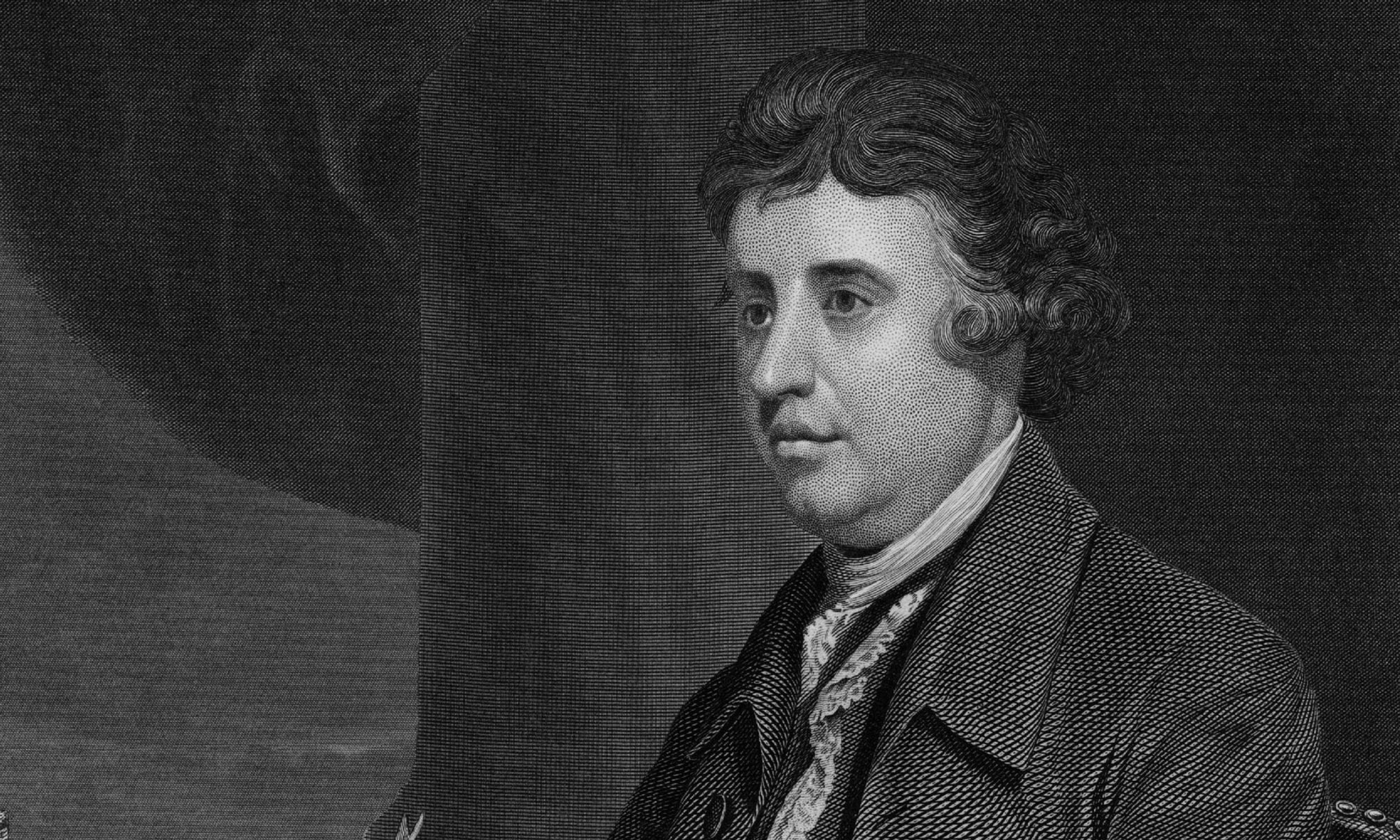
If the history of European philosophy is a collection of footnotes to Plato, the history of philosophical conservatism may be a collection of footnotes to Edmund Burke’s Reflections on the Revolution in France. “Conservatism” as a conscious political doctrine emerged after Burke. Yet the core tenets of his criticism of the French Revolution — the dangers of abstract reason, the fallible nature of man, the distilled wisdom of the ages, the perils of leveling society, the menace of social engineering, the virtue of prudence, the complexity of circumstance, the sanctity of property, the hazards of fiat money, the balance between conservation and reform, the limits of voluntary contracts, and the intergenerational responsibilities of civil society — have all settled as guiding principles of conservative thought in its various intellectual strands. While conservatism in the 20th century splintered into factions representing, for example, traditional conservatism, classical liberalism, libertarianism, national conservatism, and southern agrarianism, it is difficult to pinpoint one such contingent that would repudiate most of these precepts.
The indictment of the Reflections as a blind and reactionary apologia of the past — a complaint, dating back to England’s pamphlet wars of the 1790s, that endures to this day — of course was an inaccurate and unfair portrayal of the writing. Burke’s defense of the collected reason and inherited ornaments of European civilization was in many ways an argument for reform and improvement, not inactivity and decay. Reform and improvement in his judgment could best be achieved not by engineering sudden and radical changes to existing institutions but by anchoring them in a stable social and religious foundation, one that had been built up in great part by “the spirit of a gentleman, and the spirit of religion” throughout the generations. These two orders furnished a sturdy code of manners, as well as a blended ethos of patronage, religious instruction, and learning, that helped tame man’s baser passions and channel them toward noble ends.
Commercial prosperity in Burke’s view relied heavily on these ethical and religious preconditions. Perhaps advocates of doux commerce then mistook the cause for the effect: In the Reflections, as J. G. A. Pocock keenly observed, Burke conveyed that civility created the necessary preconditions for commercial exchange, rather than the reverse. Burke also drew attention in the writing to the crucial element of corporate affiliations in civil society. They served as warm refuges for individuals, granted them meaning and purpose, and provided necessary checks against the encroachment of political power on their constitutional liberties.
The Reflections had flaws. Did it sufficiently account for the grievances aired by French commoners? Did it diagnose why revolutions might begin in the first place? Did it offer a coherent program of reform as an alternative to the radical schemes of French innovators? What permanent lessons can we draw from an ad hoc epistle whose prose was driven by the passions?
Many, in fact, including the timeless observation that the delicate artifact of civilization endures and prospers not because of rational design or voluntary contracts but because of deeper sources of mutual human attachment that transcend consent and barter and calculation. Such ties for Burke were strengthened in a colorful yet graceful weave of social groups, spanning from our families to our local communities to our religious institutions and additional structures of social organization. Although the modern idea of civil society as a distinct sphere of intermediary institutions between the individual and the state emerged after Burke, his sharp emphasis on the importance of human association gives the Reflections a beating pulse. We live for others, not just for ourselves.
But perhaps we do not do the Reflections full justice by confining its import to conservatism. For it is quite difficult to avoid its application in liberal and progressive political circles, even if they are not aware of its lessons, and even if many liberal and progressive policy prescriptions press against them. Burke’s insights in the letter harmonize with the enduring influence of liberal communitarianism; liberal communitarians’ stress on social capital; progressive critiques of the commodification of social relationships; progressives’ reminder that an individual’s possession of wealth and privilege entails moral responsibilities to society, particularly to the poor; the rich history of black Americans’ religious traditions; city liberals’ horror over the social engineering of urban-renewal programs and the displacement of minority communities; and recent efforts by moderate Democrats to temper the radical visions and policies of democratic socialists and identitarian progressives seeking to defund the police, enact a Green New Deal, and view all social issues through the lens of race, class, and gender. One would struggle to find even the most committed progressive globalist who would declare firmer allegiance to the United Nations and nongovernmental organizations than to his little platoons of family and hometown friends.
Progressives’ flirtations with mass wealth-redistribution schemes and their antagonism toward organized religion, of course, revolt against some of Burke’s most cherished convictions in the Reflections. And the atomizing and self-liberating impulses within some corners of liberalism certainly conflict with Burke’s defense of the natural sociability of the individual and his obedience to a divinely inspired moral order. Just as it would stretch credulity to insist that the Reflections encompasses all of the general principles of liberalism, however, it would be equally ignorant to dismiss its themes that hold a presence even among secularists and progressives.
Rather than characterize the Reflections only as the founding charter of conservatism, therefore, we should consider it a statement that eclipses partisan divide. Indeed, Americans from all different political persuasions have been profoundly shaped by the very idea of cultural inheritance that Burke defends in the writing, as manifested in distinctive American customs and the deep-rooted traditions of Britain and continental Europe — including their religious and social institutions, ethical codes, jurisprudence, artistic and musical achievements, and spirit of constitutional liberty. Much as we may yearn to escape this inheritance, this inheritance refuses to escape us. For it gave rise to perhaps the most important lesson that Burke in the Reflections offers to liberals, conservatives, and everyone in between, and one that is especially pertinent in an anxious age of social fragmentation. The depth of the soul lies beyond human measurement.












Comments