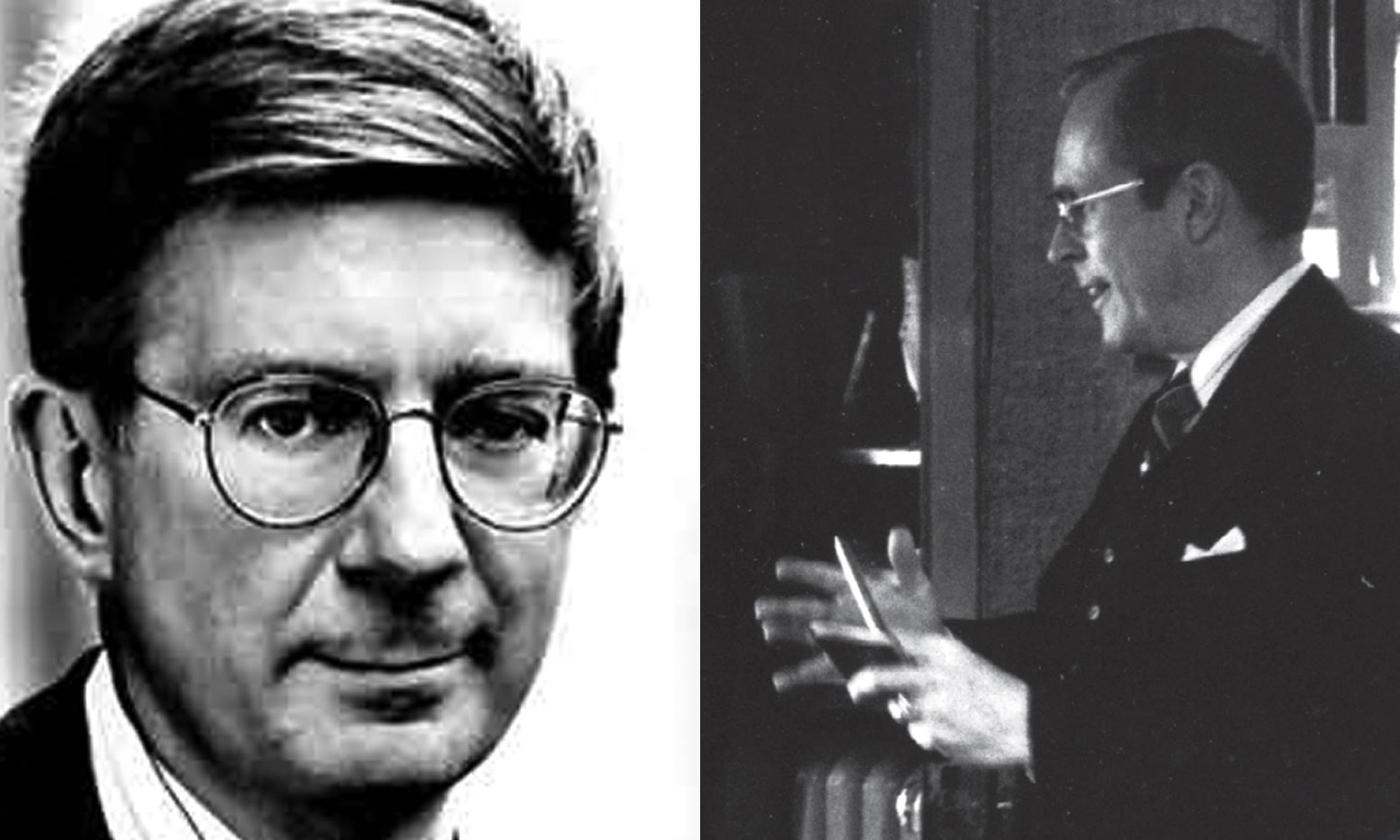
Major turning points do not always appear as such when they occur. So may be the case with a little-remembered dispute within the ranks of National Review, between its publisher William A. Rusher and the budding journalist George F. Will, more than a half century ago. In retrospect, their tiff appears to have presaged the transformation of the post–World War II conservative movement away from its commitment to small government, free trade, faith in institutional checks on power, and strong U.S. leadership in the world to a more or less disparate agenda subsumed under the motto “America First.”
The path that led conservatism to power since the founding of NR contained more zigs and zags than many realize. William F. Buckley Jr. first courted California senator William F. Knowland, who harbored presidential ambitions, as a figure to carry the conservative torch and invited him to pen the lead story for National Review’s first issue. After Knowland’s political career foundered, Buckley turned to Arizona senator Barry Goldwater, whom Rusher also supported. In 1968, when Buckley threw his rising influence behind Richard Nixon, few anticipated that Vice President Spiro T. Agnew would become the president’s liaison to conservatives and, in that role, would emerge as one of their favorite politicians.
Rusher, who despised Nixon, saw in Agnew’s rise a good omen. Buckley, though initially skeptical of Agnew (who reminded him of Alabama governor George Wallace, whom he dismissed as a demagogue), came to appreciate Agnew’s populist appeal to voters, including many former Democrats, who were more supportive of the welfare state than were traditional conservatives. The pugilistic Agnew expressed contempt for elites. His popularity among the working class can be seen as a harbinger of future populist-oriented candidates who claimed the conservative mantle, such as Pat Buchanan and Donald Trump. (Buchanan, serving as an adviser to Nixon, supplied Agnew with some of his most memorable lines.) As for Agnew’s contributions to conservatism — or to anything else — they were more stylistic than substantive. His primary role was to drum up support for Nixon’s “law and order” and Vietnam policies and stoke criticisms of network news, war protesters, and the cultural elites.
In 1972, just as he was coming to appreciate Agnew’s utility and as his colleagues’ infatuation with Agnew was growing, Buckley made one of his most consequential hires. He asked George Will, then a Senate staffer, to launch National Review’s “Letter from Washington” column under the byline “Cato.” Will shared Buckley’s initial distaste for Agnew; but unlike his mentor, he showed no interest in curbing his contempt. When Will joined NR full-time, he continued his column and served as literary editor, a post once held by the late and much-beloved Frank Meyer, an eminent libertarian intellectual and the architect of “fusionism,” which united conservatives, libertarians, and other groups on the right in hostility to communism.
Several at National Review bristled at Will’s depiction of Agnew as a boor and a vulgarian, an affront (as Buckley biographer John B. Judis notes) to the “Tory conservatism” that Buckley had hoped to foster on this side of the Atlantic. As a peacekeeping gesture, Buckley withheld one of Will’s “Cato” pieces urging Nixon to replace Agnew with former Texas governor John Connally as his running mate in 1972. Buckley instructed Will that he was free to voice views at variance with the stance of the magazine, but only under his own name.
This was not enough for Rusher, who demanded that Will mend fences with Agnew. Another colleague informed Will that Agnew was “it,” implying that the vice president had become National Review’s choice to succeed Nixon. In April 1973, M. Stanton Evans, then a columnist for the National Review Bulletin, resigned in protest against Will’s writings. “There has been opposition to George Will that frankly mystifies me, knowing his views as I do,” Buckley wrote Evans. No doubt, the magazine’s founder saw more than a little of himself in the young upstart.
Until his last days, Buckley remained of two minds about the kind of populism to which Agnew appealed. Buckley recognized that, in order to win elections, conservatives had to build the broadest possible base. But he maintained that the movement also needed its own elite to act as “tablet keepers,” to preserve ideological purity and bar the extremists, bigots, kooks, anti-Semites, racists, and conspiracy theorists.
As editor, Buckley ever played the juggler. He recognized Agnew’s political appeal and was not yet ready to anoint Reagan as the movement’s next champion. Yet he also refused internal entreaties to force Will out. The situation remained at a stalemate as the Watergate scandal unfolded. In the June 8, 1973, issue, NR ran both an editorial proclaiming that, should Nixon leave office early, an Agnew administration would bode well for the country and a piece by Will arguing the opposite.
The denouement came with the resignation of the nation’s top two officials: first Agnew, over corruption allegations dating from his days in Maryland politics, and ten months later Nixon, in the face of impeachment. Will departed NR at the end of 1974 to become a regular columnist for the Washington Post.
Rusher stayed on as publisher but gravitated toward conservatives self-identifying as the “New Right” (Kevin Phillips, Richard Viguerie, Howard Phillips, and Stan Evans, among others). This increasingly populist group gave highest priority to social and economic issues and complained that articles Buckley had been running were over the heads of the grass roots. In a fiery piece, Kevin Phillips demanded to know what contributors such as Wilhelm Roepke and Eric Voegelin had “to say to Kansas City and Scranton.”
Rusher, moving closer to the New Right, complained that his new associates were suspicious of him because of his association with Buckley. He and his new allies favored deserting the GOP in favor of a new third party. Rusher said that he had come to feel like a “prisoner” in the Republican Party, where the rightists would always have to compromise with moderates and never be powerful enough to impose their will. They repeatedly had to settle, he said, for candidates and platforms selected by the party with the intention of offending as few sensibilities as possible. In their emphasis on social issues over foreign policy, Main Street over Wall Street, and resistance to liberal elites (who told them what to think and how to live), these rightists were precursors of what today is understood as “Trumpism.”
After Reagan spurned proposals that he head a third-party ticket with George Wallace as his running mate, Rusher and others founded the Committee for a New Majority and tried to make common cause with Wallace’s American Independent Party (and the altogether different American Party, which had racist roots). “The whole situation sounds to me awfully close to the kooks, and I am troubled about it,” Buckley wrote Rusher. He warned that nothing good would come of it, and nothing good did.
In 1980, Reagan’s moment finally arrived. Buckley and NR delighted in the candidate’s prudent reformist impulses. The New Rightists, however, disliked the Californian’s reaching out to establishmentarian George H. W. Bush as his running mate and were disappointed by his emphasis on foreign policy over social issues. Aware of this grumbling, after he was elected Reagan would joke that his right hand did not know what his far-right hand was doing. The “Let Reagan Be Reagan” campaign was a not-so-subtle attempt by the rightists to reduce the influence that first lady Nancy Reagan and chief of staff James Baker purportedly had on the president. Reagan’s past service to the movement and his popular support muted much of this debate.
A couple of decades later, what had seemed settled proved to be very much up for grabs. Rusher, Agnew, and their intellectual descendants found voice in the Trump administration. Meanwhile, back in 2000, when Trump was considering a presidential run on the Reform Party ticket, Buckley had adjudged the New York developer neither a liberal nor a conservative but a “cult of personality” (and George Will has been even more excoriating). He urged conservatives to place greater importance on the retention of Madisonian checks and balances and restricted government than on any particular policy agenda.
In short, an intellectual and political debate that began 50 years ago in these pages is still ongoing. It will define the post-Trump years, and the outcome will determine whether a conservatism worthy of the name survives through the third decade of the 21st century.












Comments