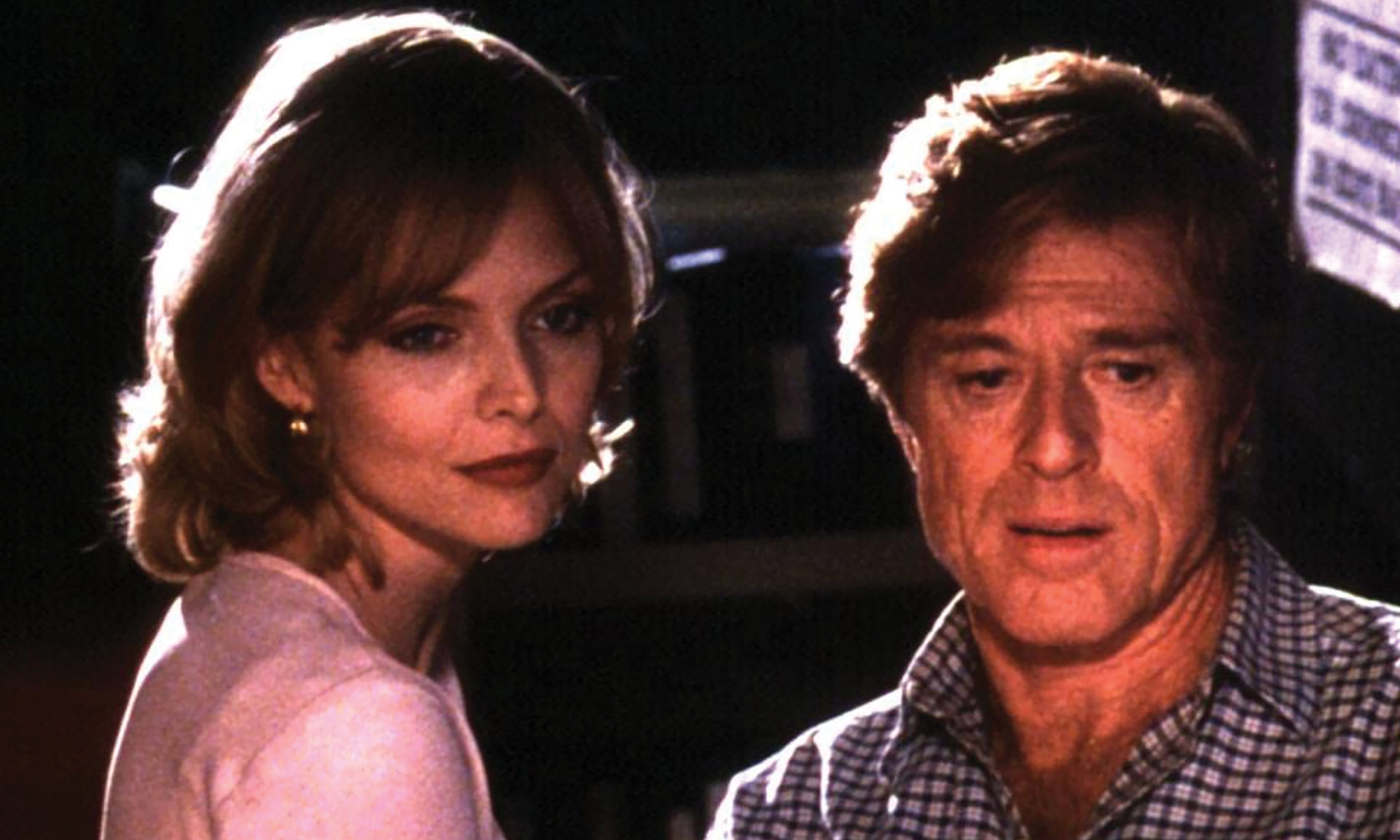
When the history of the collapse of journalism is written, only one movie on the subject will be worth a damn: Up Close and Personal, from 1996. No other film about modern journalism so openly indulged the vanity and bias of the industry — and especially of TV journalism, which today puts up a front of sensitivity and righteousness, i.e., wokeness. Up Close and Personal isn’t even a particularly good movie, but it’s more revealing than most other films about the degradation of what used to be called “the press.” It uses journalism as the pretext for a love story between media professionals: Michelle Pfeiffer, playing a naïve careerist, and Robert Redford as her cynical mentor and lover. A melodrama involving Machiavellian passions, it offers an object lesson that indicts today’s legion of activist-journalists as well as us, for our unfortunate predisposition to trust them.
Up Close and Personal’s behind-the-scenes candor about the workings of the news industry is, actually, self-congratulatory and deserves to be taken more seriously than the entertainment in which it appears. Based on the real-life Jessica Savitch and Ron Kershaw, two Seventies network big-timers, the movie represents the basic strategies by which Hollywood and New York media glamorize and protect their ranks.
A product from the era of the now-disgraced Clinton, Up Close and Personal’s rise-to-riches story features several newsworthy events merely as opportunities for media folk to display pluck, to normalize their vendibility. The film boasts about what it takes to achieve prominence in the field of mainstream egotism, what used to be known as “journalism” but is now just another clique of sacrosanct celebrityhood: they who will not be questioned. They who boast about holding others accountable but are never themselves held to account. (Note the industry-wide duplicity today behind the canard of “mostly peaceful protests.” Or consider that you see drugged-up Antifa arsonists slurring “George Floyd,” and hooligans who aren’t socially distanced, thanks only to amateur journalists on the Internet, never to mainstream reporters. The difference clarifies the class distinction that Americans are wont to acknowledge. The media elite clearly feel they know better than their audience, if only by dint of pay and fame, which make them appear smarter and superior.)
Now that the media — especially television — consider themselves the government (the Decision Desk of our electorate, controlling all public opinion, dictating all social consequences), it is essential to go back and review how we lost consciousness of this threat and ignored — or swallowed whole — the warnings hidden by Up Close and Personal’s silly newsroom romanticism. Silly, yet nothing to laugh about.
A credulous response to this tearjerker (Céline Dion’s “Because You Loved Me” was its Oscar-nominated theme song) began with All the President’s Men, from 1976, the darkly sentimental hagiography of Carl Bernstein and Bob Woodward — the key players in the Washington Post’s war on the Nixon administration. Commonly accepted as an account of journalistic moral courage, it is, in reality, a unique combination of professional narcissism and narrowly conceived partisan patriotism. It established a new occupational mythology that increased journalism-school enrollment and made the redundant term “investigative reporter” into a household phrase. Against the constabulary of mainstream reviewers, only Pauline Kael scoffed, memorably calling All the President’s Men “poisonously mediocre and, finally, a celebration of the journalistic benefits of having an informer tucked away in a garage.”
Since the ballyhooed release of All the President’s Men, we the public have all become “colleagues,” accustomed to the idea that the media speak for us. Many identify with brazen “fact-checkers” while ignoring their chattering-class privilege. At Trump-administration White House press briefings, it was astounding to see how many Woodward-Bernstein wannabes there were, attention-grubbers anxious for praise from their peers and confusing opinion, pomposity, and partisan bias for journalism, visions of Redford/Woodward and Hoffman/Bernstein — and no doubt Pfeiffer/Savitch — in their heads.
It is the malign self-righteousness of “Woodstein” (Post editor in chief Ben Bradlee’s affectionate portmanteau of his two star subordinates’ names) that inspired the casual arrogance seen in Up Close and Personal and all the other investigative-reporter movies that followed. Both Up Close and Personal and All the President’s Men idealize the ethics of today’s reporters. We’re meant to believe that journalists always do the right thing because of their instinctive valor, but lately, unignorable signs of their pettiness make that belief untenable.
Recent journo films such as Spotlight, Bombshell, and The Truth pretend to be industry exposés (and Steven Spielberg’s The Post is outright glorification), but their stories make martyrs of what are essentially well-paid bureaucrats in lip gloss, pancake makeup, and Beltway mansions. The characters presume to know a great deal about the way the world works — especially in Washington, D.C. — but the stories never confess the individual political motives of either the characters or the filmmakers. These films are lesser versions of Up Close and Personal, tangled up in tabloid shamelessness and meant to validate those communications majors and aspiring actresses, actors, and tin-god news directors who settle for herd-mentality broadcast jobs and put the customary liberal spin on events, as demanded by politically correct HR departments and envious J-school faculty around the globe.
Up Close and Personal’s screenwriters — the essayist Joan Didion and her late husband, John Gregory Dunne — may have attempted to subvert Big Journalism’s self-righteous façade by dismantling the myth of Savitch and Kershaw, revealing them as predecessors to contemporary media high-rollers. Pfeiffer’s Savitch could be any of the Fox News blond-bots, and Redford’s Kershaw is a role-model role suspiciously named “Warren Justice.” But the film’s love story, its deceptive selling point, fouled up Didion and Dunne’s critique. It cheapened their skepticism — and skepticism was formerly a sign of journalistic self-awareness. Up Close and Personal sentimentalizes the arrogance that The Boys on the Bus author Timothy Crouse cut through when he assessed journalistic practices of a half century ago — specifically the impact of television news — and with visionary clarity wrote, “It occurred to me that the networks regarded themselves as omnipotent and sacred institutions, roughly like the Presidency.”
The current collusion between Hollywood and D.C. means that we can no longer trust contemporary filmmakers to be honest about the media’s efforts to control our thoughts and habits. This isn’t just a matter of sinister corporate synergy — ABC/Disney employing the Clintons’ aide George Stephanopoulos, Fox myrmidons preening and congratulating themselves on being “fair and balanced,” to complement the MSNBC and CNN colleagues they envy. It is a crisis that stems from the loss of journalistic ethics.
Romanticized careerism — the basis of Up Close and Personal — obfuscates principles built by the grind of journalism (fact-finding, shoe-leather reporting, cold-call investigation) that depend upon the honor and honesty of hard work. The Internet age has created labor without toil, resulting in lazy opinionating and social-media mimicry, brownnosing of superiors and colleagues. There is little personal investment in TV journalism beyond merely seeming smart and joining the fashionable throng.
Meretricious as the star-is-born plot of Up Close and Personal may be, it is the closest any film has come to showing how network news directors control the political slant of the stories we’re told. Hollywood has given TV’s political journalists the fantasy and license to view their actions as unquestionable, and this has made the possibility of state media — the media as the megaphone and guarantor of the powerful and elite — no longer a threat but a likely probability. Without a sense of ethical professionalism, the media make their work an exercise in narcissism and demagoguery. The old happy-talk cliché about grinning anchor-desk camaraderie evolved into a smiler-with-a-knife team, ready to backstab the republic.
This then leaves misinformed viewers susceptible to ruling-class edicts that come down to them from politicians through the uncritical media. While observing these apparatchiks, we should rethink why we ever gave them attention or high Nielsen ratings.
In our current circumstances, in which we can no longer rely on the media to fully or honestly inform us, those reasons go deeper than politics and extend to morality and personality. These self-glorifying figures emulate Pfeiffer, Redford, and Hoffman very poorly; they are characters without conscience. It appears that they don’t really believe in our civil liberties or private well-being. They don’t have ethics. They may not even have genuine politics, only mendacity. When seen up close and personal, narcissistic journalists and activist journalists believe only in themselves.











Comments