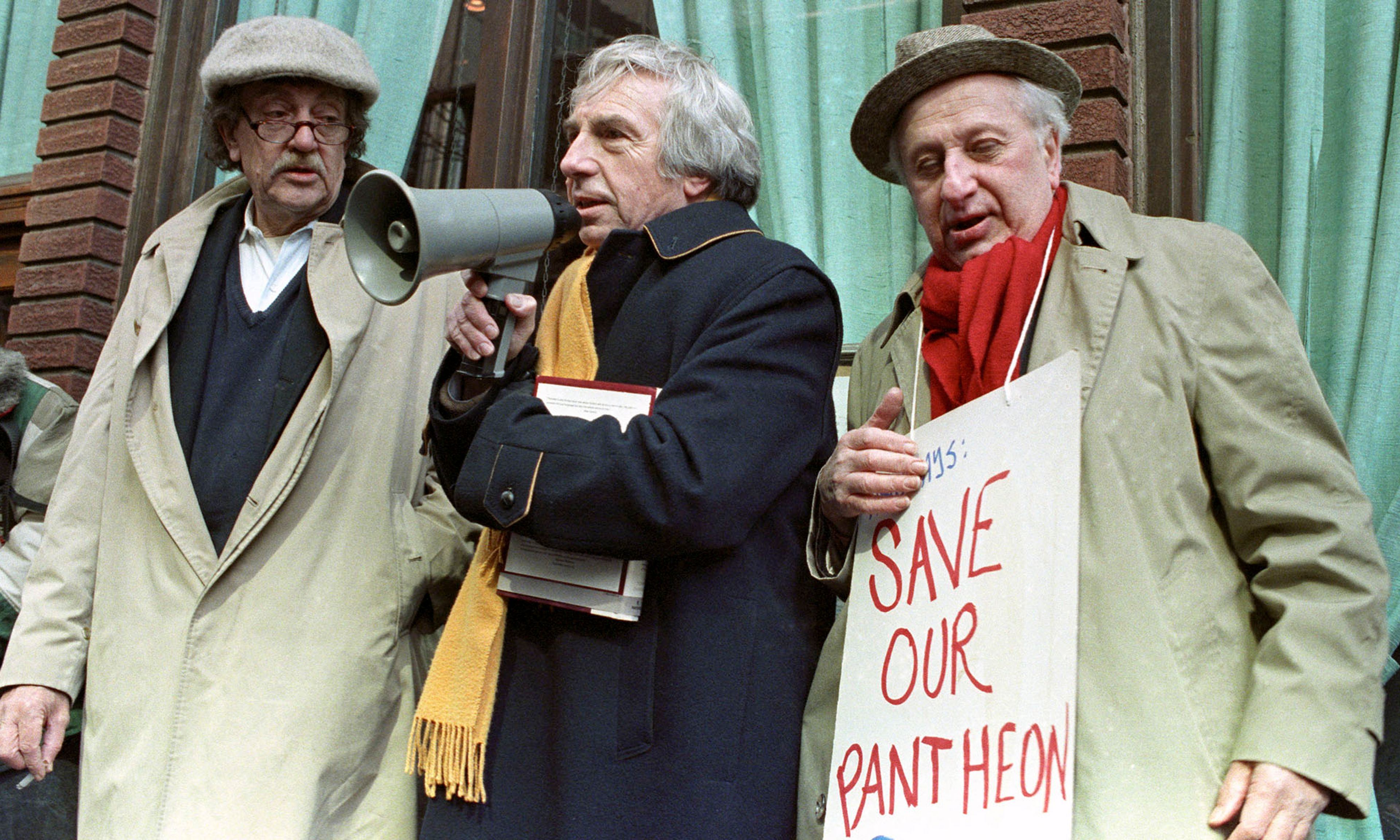
Who was the real Kurt Vonnegut? For a man who so often seemed at pains to present himself as a pessimist or even a fatalist — he wrote in his final collection of essays, A Man without a Country (2005), of his goal to file a lawsuit against the Brown & Williamson Tobacco Company for manufacturing products that promised to kill him but failed to deliver — Vonnegut could express, and often seemed to embody, the sweetest of sentiments.
Born in Indianapolis in 1922, he exuded an easygoing Midwestern courtliness. His voice was warm, resonant, and quick to cackle, and he was the owner of the friendliest bushy mustache since Samuel Clemens. In his great novels, including Slaughterhouse-Five (1969) and Breakfast of Champions (1973), he was not merely offering the stuff of fiction — characters, themes, and plotlines — but also himself: He relentlessly intruded into his narratives. In his book Reality Hunger, writer David Shields argued that Vonnegut’s opening first-person passages in Slaughterhouse-Five eclipsed the actual novel that followed: “The prologue to Slaughterhouse-Five is the best thing Vonnegut ever wrote.”
Indeed, as the years marched on and he found it increasingly taxing to churn out straight novels, Vonnegut’s autobiographical voice became his main selling point. His last novel, Timequake (1997), contains a first-person passage that exemplifies what had become his signature perspective and tone, weary but pacific. Recounting the pleasures and irritations of going into the city to purchase stationery, Vonnegut writes, “Out into the world I go! Muggers! Autograph hounds! Junkies! People with real jobs! Maybe an easy lay! United Nations functionaries and diplomats!” This might sound sarcastic, but a few pages later, when he writes of his unrequited love for a female employee at the Postal Convenience Station, Vonnegut seems to be sincere: “Every day, . . . she hangs new dingle-dangles from her ears and around her neck. Sometimes her hair is up, sometimes it’s down.” With a few choice words, Vonnegut hits on one of life’s most basic joys: simply making contact with a fellow human being.
Vonnegut did some of his best writing in the form of commencement addresses, a genre for which he was unusually well suited. To generations of soon-to-be-graduates, many of them presumably Vonnegut readers, he must have come across as a shambling, good-natured paternal figure — at once wise and hip. If he resembled, to co-opt the title of Gertrude Stein and Virgil Thomson’s operetta about Susan B. Anthony, the father of us all, perhaps that is because he actually was an unusually prolific parent: He was the father to three children by his first wife, the former Jane Marie Cox, and a fourth adopted with his second wife, the photojournalist Jill Krementz, as well as three more children adopted after the deaths of their parents, Vonnegut’s sister Alice and her husband.
It’s no wonder that, in the years since his death at the age of 84 in 2007, Vonnegut’s collected guidance to collegians has been gathered in a book currently in its third edition, If This Isn’t Nice, What Is? The title refers to a kernel of advice that came courtesy of one of Vonnegut’s uncles, Alex. “One of the things he found objectionable about human beings was that they so rarely noticed it when they were happy,” he told the class of Agnes Scott College in May of 1999. “He himself did his best to acknowledge it when times were sweet. We could be drinking lemonade in the shade of an apple tree in the summertime, and Uncle Alex would interrupt the conversation to say, ‘If this isn’t nice, what is?’”
Of course, Vonnegut knew well that there was more to life than niceness. In 1944, while he was serving in the Army during World War II, he endured a stretch of misfortune that would have flattened weaker men: In May, his mother committed suicide, and in December, his division partook in the Battle of the Bulge, leading to his capture by the Germans. The following February, the Allies firebombed Dresden, to whose prison camp Vonnegut and his fellow POWs had been taken. His grim firsthand knowledge of war’s toll was concealed by that laugh and mustache.
There’s no denying that Vonnegut fancied himself a sort of H. L. Mencken of the Great Lakes — “Whenever I swim in an ocean, I feel as though I am swimming in chicken soup,” he once wrote — or that he had a jaundiced take on the country of his birth. For example, Breakfast of Champions is shot through with indignation at everything from the proliferation of Holiday Inns to prohibitions against dipping the American flag. By the same token, Vonnegut’s political opinions, baldly stated, too often consisted of undigested left-wing outrage. Today’s Trump-weary liberals who now speak nostalgically of George W. Bush may wince when reading a 2006 Rolling Stone interview with Vonnegut in which he fully employed the apocalyptic tone the Left then preferred when it came to the 43rd president. “Honestly, I wish Nixon were president,” Vonnegut said at the time. “Bush is so ignorant. And I don’t like idiotic, impulsive people.”
Yet the astringent, bombastic side of Vonnegut was tempered by a sweet mildness that comes across in his commencement speeches, in the autobiographical nooks and crannies of many of his novels, and in a number of his gentler works, including the novel God Bless You, Mr. Rosewater (1965) and the short story “Who Am I This Time?” This quality is on full display in the latest entry to the now-voluminous catalogue of posthumous Vonnegut publications: Love, Kurt is a gathering of love letters, dating from 1941 to 1945, that Vonnegut penned to his future spouse Jane, whom he had known from kindergarten through third grade, become reacquainted with when both were 19, and whose hand he sought, often in urgent, pleading terms, all through college and service overseas.
“Kurt pursued Jane for four years with these astonishing letters,” writes their daughter Edith Vonnegut, who discovered the correspondence in her late mother’s attic and edited the present volume. “It is thrilling to read how in love with her he was. She was the single object of his desire.” This book might be said to represent the kinder, gentler Vonnegut — an appellation that surely would have annoyed him but is accurate all the same. It may be an overstatement to claim, as Edith Vonnegut does, that, as literature, these missives rank with The Sirens of Titan (1959), Cat’s Cradle (1963), and Slaughterhouse-Five, but it cannot be denied that their author’s personality comes through to a striking degree.
In a letter from 1941, shortly after Vonnegut entered Cornell University, the author’s lifelong interest in science fiction emerges in the way he frames his schoolboy-like meditation on the beauty of his intended’s full name. “I was just thinking about your fourth dimension — the dimension in which you are Jane Marie Cox, not simply Jane Cox,” he wrote to Jane, whom he called “Woofy,” and who had gone on to Swarthmore College. “How much prettier Jane Marie is than Jane. I love Jane but I’m terribly in love with Jane Marie.” Indeed, if there is a common thread that runs through this correspondence, it is Kurt’s certitude — his absolute, unshakeable conviction — that Jane was the woman with whom he must spend the rest of his days.
In 1942, Vonnegut writes to Jane, addressed as “Love of my Life,” that high among his life goals is “to have you completely convinced that none but my own nifty person could ever keep you happy for a life-time.” The following year, he imagines what might be carved on the tombstone he imagines they will one day share: “Here lie two people to whom many good and bad things came. They built a lovely and worthwhile life from splinters of pleasure. They were wonderfully happy. They were sorry they had to go.”
Naturally, when Jane — by all accounts, an unreliable correspondent — fails to promptly answer, Kurt is by turns desperate and apoplectic. In 1943, he writes, “Your wild and enthusiastic orgies of dead silence drive me a little nuts. Writing you has been as futile and frustrating as sprinkling handbills saying ‘Jesus is Coming’”; one can see that Vonnegut’s religious skepticism was fully formed even then. In a particularly doleful note, he bemoans the infrequency of his real-life encounters with Jane — over the preceding twelve months, he figures, they have been together for around nine hours — and, at the bottom of the page, sketches a drawing of a theater marquee that reads, in capital letters, “All of this is very sad and will doubtless become much worse.” Vonnegut fans will be tempted to cross-check such snappy prose against his later published works; he sounds just like his mature self.
Vonnegut can be delightfully spiky in these letters. At the end of a letter from 1941, he scribbles a note, just beneath his signature, expressing his frustration with his pen: “Goddam Postoffice Pen.” He was self-deprecating beyond his years, writing, in 1943, of the figure he cuts as a uniformed member of our armed services: “Kurt Vonnegut, Jr., in uniform, as you might guess, is not a sight to stimulate War Bond sales.”
There are heart-stopping letters here, including an earnest note Vonnegut wrote to Jane following his mother’s suicide and, most remarkably, a letter addressed to his entire family after the destruction of Dresden but before they had gotten word of him. “I’m told that you were probably never informed that I was anything other than ‘missing in action.’ Chances are that you also failed to receive any of the letters I wrote from Germany. That leaves me a lot of explaining to do,” he wrote, understatedly, from a POW repatriation center in France. What follows is an account nearly as harrowing as, and possibly more immediate than, Slaughterhouse-Five. In words that resonate, Vonnegut writes that the firebombing “destroyed all of Dresden — possibly the world’s most beautiful city, but not me.”
War had not dampened Vonnegut’s passion for Jane. “When one person from the Corn Belt misses another person from the Corn Belt he doesn’t say, for a very good reason: ‘Shall I compare thee to a summer’s day?’” he writes to Jane. “Hell, no, he doesn’t. He says ‘Holy Jesus Christ, angel; I miss you like hell. Dammit, Sweety, I’m going nuts without you.’” The dream finally came true: Kurt and Jane married on September 1, 1945. Edith Vonnegut describes Jane as a true believer in her husband’s literary endeavors and a committed keeper of the home they made together. She sounds as baffled as readers of this book will be as to what led her father to leave her mother in 1971. “My parents talked frequently and easily after their divorce,” Edith Vonnegut writes, something that, after reading the correspondence here, is easy to imagine.
This magnificent collection — which, since it contains facsimiles instead of transcriptions of the letters, shows off Vonnegut’s wonderfully bold, chunky printing style and his cartoony drawing style — does the useful work of reminding us not of the mordant, cutting Vonnegut but the humane, tender Vonnegut. In these letters’ effusive expression of honest sentiment, it is clear that Jane Marie Cox knew the real Kurt Vonnegut — a cynic, yes, but, as those of us who read him and loved him always suspected, something of a softie, too.












Comments