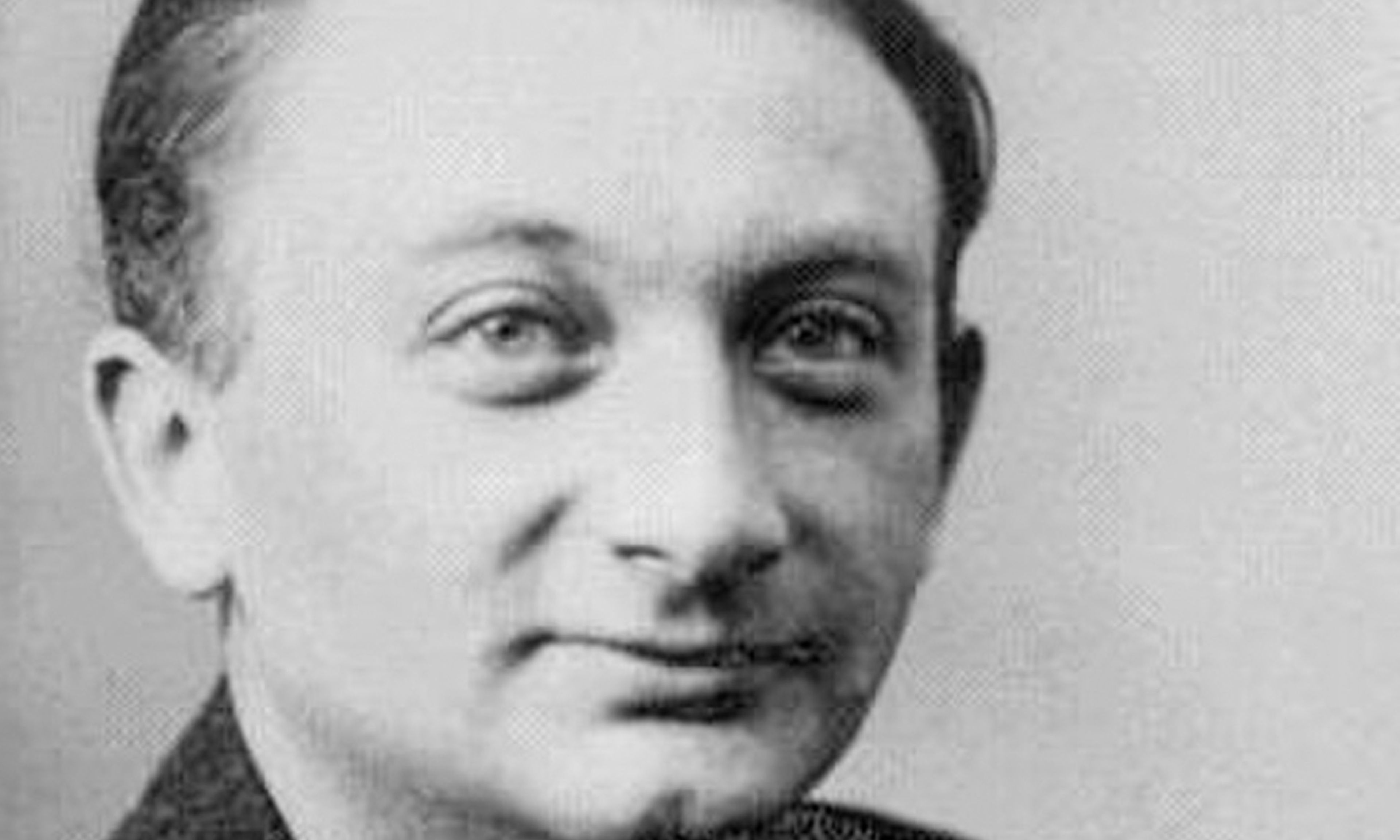
Endless Flight is the first biography in English of Joseph Roth, and that in itself is a sad reflection of native provincialism and ignorance. Roth’s claim to fame is that he is the author of The Radetzky March, one of the rare novels of the recent past as relevant as when it was first written. The title refers to the march composed by Johann Strauss the Elder in 1848 to commemorate the victory of Field Marshal Joseph Radetzky at the Battle of Custoza. Eighteen years later, Austria suffered a shattering defeat by Prussia at the battle of Königgrätz. The situation is hopeless but not serious, Austrians said with irony or frivolity at the time, but they were now committed to the German nationalism that eventually led all the way to Adolf Hitler.
Like all great literature, The Radetzky March is about destiny, what a human being is to make of the short passage of time allotted to him; or, to put it another way, great literature is a defense of universal values. No man and no nation have a moral claim to be better, more deserving, than any other. Published in 1932, when Hitler and Stalin were making such claims, the novel was an immediate international success. The narrow militancy and ethnic prejudice of the nations within the Habsburg Empire had brought about its distressing downfall. By way of a compliment to this argument, the novel was at the top of the list of books burnt by the Nazis in a public ceremony in Berlin in May 1933. The Nazis also withheld the due royalties.
Roth’s reputation has been in the hands of academics whose subject is what they like to call “Germanistiks.” Michael Hofmann had a counter-initiative. A German expatriate who became a British poet, Hofmann has translated by my count 15 of Roth’s works, including The Radetzky March and lengthy correspondence with Stefan Zweig. In short, he’s been fighting a brilliant one-man campaign.
Keiron Pim takes it from there. He’s no less brilliant than Hofmann and he’s equally thorough. He says all there is to say about those 15 books. His writing has verve and sometimes even a touch of poetry — one page has a rhapsody to the stars in the sky and another is devoted to the booze that made Roth an alcoholic. Roth’s best work, he thinks, “has beauty and substance in equal measures.” He also knows that Roth had more than his fair share of misery and misfortune, much of it self-inflicted and so leaving him the victim of his own stricken genius. A group of his friends, Pim records, were one day gossiping about Roth and his character, and their discussion apparently finished with the single word “complicated.”
Galicia was the easternmost province of the Habsburg Empire, attracting the imperial aspirations of Austria, Poland, and Russia. Brody was one of the smaller Galician towns, and as elsewhere in the province Jews were in the majority. They lived a hard traditional life with a well-founded suspicion that assimilated Jews in Berlin or Vienna looked down on them, and they were also well aware that friendly neighbors might without cause turn into murderers. Born in Brody in 1894, Roth was in the habit of incorporating features of the town, whether Jewish or Catholic, in whatever he was writing, as though he had ideal memories. Maria (née Grübel) was a devoted if demanding mother. Nachum, his father, suffered a mysterious mental illness, appeared not to know he even had a son, and lived in the care of a rabbi. The effect on Joseph was “preoccupation with how fathers fail their sons,” as Pim puts it.
It is understandable that someone who writes novels should make up fictions about himself. Did Roth really make his way in Vienna, the capital of German Jewish culture, by submitting poems to ever-willing editors, or by having trousers made to make him look like a Russian officer and sending yellow roses to the mothers of the boys he was tutoring? When it comes to the story about Roth’s admission to the army in the First World War, Pim shelters behind the deadpan word “convoluted.” In Roth’s version, he “spent six months in a Russian prisoner of war camp, fled, and fought for two months in the Red Army, then two months’ flight and return home.” None of this was true. Although a sergeant in rank, to the end of his life he liked to pose as an officer. A German friend got the point about Roth: “He does not lie, he invents.”
Because he didn’t have any money, Roth said, he started to write for the papers. “They printed my nonsense. I lived off it. I became a writer.” Editors of German and Austrian publications used to run a feuilleton (literally, a little sheet of paper), a short feature that allowed an author to pass comment on anything he liked. An editor Roth described as an overweight cigar-smoking Social Democrat gave Roth his start. In the year following April 1919, he published around 140 of Roth’s pieces. Pim finds their style “lyrical, ironic, morally engaged, suffused with melancholy,” and he goes on to list selected subjects — for instance, hotels and their staff, the Jewish theater in Moscow, Grock the clown, national borders, dancing-girl revues. Roth did interviews, one in Rome with Benito Mussolini and another in Albania with King Zog, then the self-appointed ruler of that country. In the course of 1927 he spent six months in the Soviet Union. A good many Germans became Communist Party members or fellow travelers, but not Roth. Walter Benjamin, the foremost German Marxist thinker, came to Roth’s hotel in Moscow but failed to convince him that the society Stalin was shaping had anything to offer.
Books that touch on Vienna tend to go in for romancing the city’s cafés, and Endless Flight is no exception. In Vienna, Roth favored the Café Herrenhof in the Herrengasse, ostensibly writing while talking to friends as though in a living room. He first set eyes on Friedl Reichler in this café. “She was nineteen years old, innocent and a little shy,” in Pim’s description, which is borne out by a photograph of her. “She had delicate features, wide eyes, full lips and dark hair that swept across her brow.” Roth thought his career prospects looked more promising in Germany. As soon as they were married, the Roths moved to Berlin and he began to write his first novel in a pâtisserie there. Antisemitism then drove them back to Vienna. The day Hitler became chancellor, they took a train to Paris.
Wherever they were, the couple lived in hotels. Friedl was never to have a house, never to have any domestic experience. He learnt French but she failed to do so. She was probably right to suspect that on his travels he had had an affair. Money worries and illness added to the sense of exile. To one friend he could write in all seriousness, “I am what you’d have to call insane,” abruptly switching to “My novel is coming along.” In another letter he could contradict himself: “I long for Paris. I have never given up on it, ever, I am a Frenchman from the East.” Roth felt he was to blame for what turned out to be Friedl’s schizophrenia, and he almost beggared himself paying for her treatment in psychiatric institutions in Vienna.
Pim finishes in the style the tragedy demands. Roth tries to make a complacent Stefan Zweig face up to the Nazis, who must be treated as a threat to existence. “I want the honor of being a warmonger,” he says. His last fantasy was to restore in the interests of stability the Habsburg monarchy. Alcohol can’t have helped. He died in 1939 and is buried in a pauper’s grave close to Paris. As part of Himmler’s euthanasia program, Friedl was led naked with up to 60 other psychiatric patients into a gas chamber. If they’d listened to Roth, millions of lives might have been saved, and Europe would not be in the dismal state it is today.











Comments