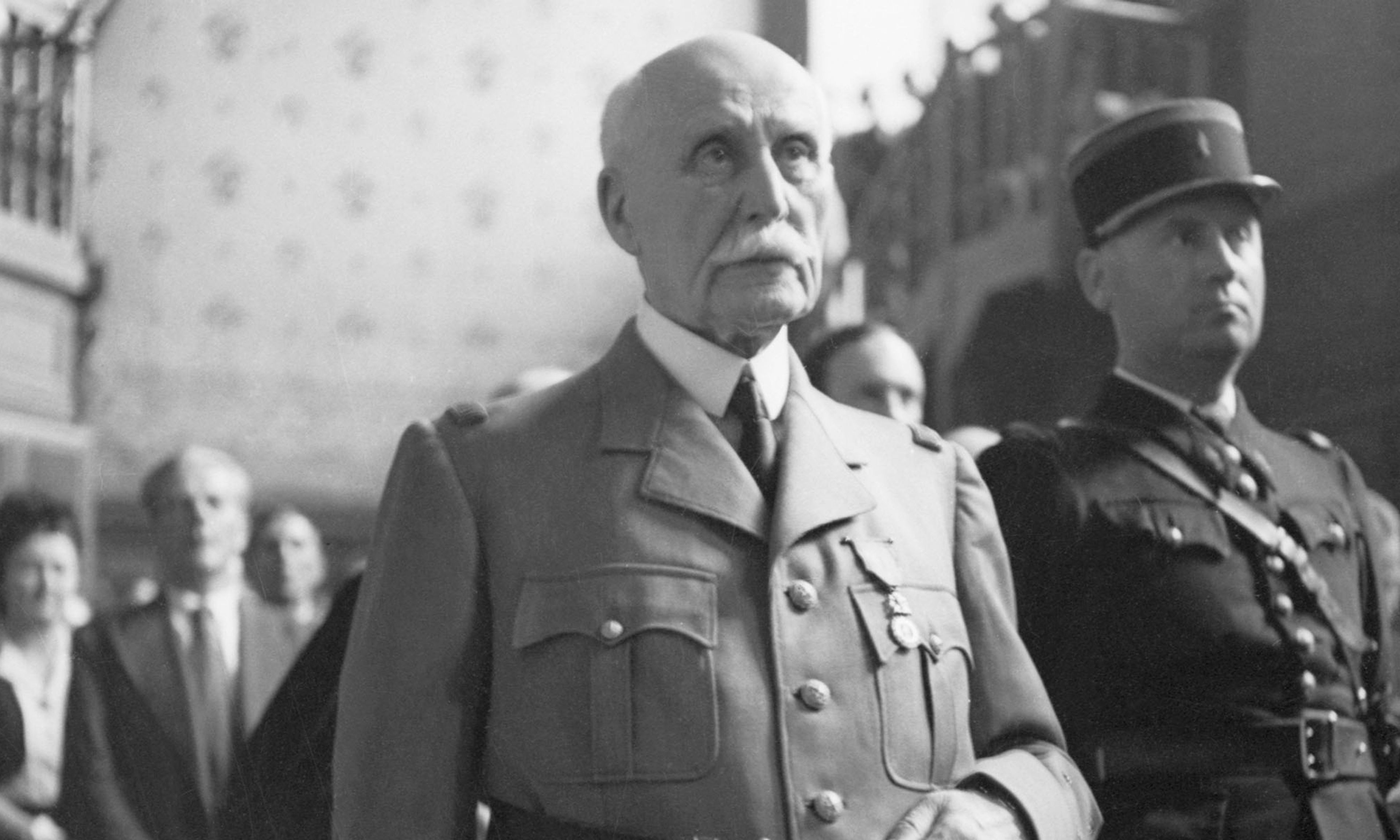
In 1916, Marshal Philippe Pétain, the hero of Verdun, had become the personification of a France that would never submit to German aggression. In 1940, he symbolized the France that did. Appointed prime minister at the age of 84 as his country’s armies buckled, he asked for an armistice. Among other humiliations France was divided into occupied and “free” zones.
An overwhelming majority in the French legislature, which had decamped to Vichy, the de facto “capital” of the free zone, then put Pétain in charge of writing a new constitution. He awarded himself wide-ranging “interim” powers, abrogating any inconvenient parts of the old constitution. France’s Third Republic was replaced by the authoritarian and reactionary “French State” (l’État français) with Pétain at its head.
In November 1942, after the Allied landings in French North Africa (which had remained under Vichy control), the Germans occupied the free zone. But Pétain’s regime, which had, to varying degrees, also administered much of the initial occupied zone, endured, even as the marshal’s power continued to be whittled away by the occupiers and their confederates within his own government. In 1944, with the Allies approaching, the Germans removed Pétain (who didn’t want to go) from France. He ended up with an unsavory collection of Vichy grandees and hangers-on in Baden-Württemberg’s 800-room Sigmaringen Castle.
Julian Jackson’s description of life there is an early highlight of his gripping, meticulously researched, and unusually thought-provoking France on Trial. Jackson, a British historian well known for his writing on 20th-century France (France on Trial was, fittingly enough, preceded by a masterly biography of General de Gaulle), is, as he repeatedly demonstrates in this book, a gifted storyteller, and he makes the most of the opportunity presented by Vichy’s bizarre coda, housed in a temporary French exclave (theoretically) presided over by a “government” that Pétain wouldn’t acknowledge.
With the Third Reich disintegrating, the marshal headed for Switzerland, but without any intention of staying there. A new high court had been set up to try Vichy’s leaders, and Pétain’s “consuming obsession,” relates Jackson, was “to defend his reputation before it.” That was not what de Gaulle was hoping for. He knew that the armistice — in his eyes the marshal’s original sin — had been greeted with relief by millions of his compatriots. In an intriguing counterfactual, Jackson suggests that France had better military options than is generally imagined, but I doubt that the French people would have wanted to explore them. De Gaulle was, as he wrote in his memoirs, also aware that, despite all that had transpired since 1940, many “still felt respect or pity” for the “aged” soldier.
De Gaulle, by then heading a provisional government, appreciated that a “solemn verdict” was required but would have preferred that the trial that supplied it be held in Pétain’s absence. The spectacle of Pétain in court risked reviving wartime divisions. This could endanger the general’s ambition to rebuild and reinvigorate a country he envisaged being brought together, in part, by an embellished narrative of shared suffering and resistance. Such a reshaped collective memory would have little space for Vichy’s troubling ambiguity. Speaking after the liberation, de Gaulle asserted that there had been only a “handful” of traitors. Informally, he let the Swiss know that while Paris would be obliged to request Pétain’s extradition, it would not be pursued. The marshal, however, voluntarily returned to France, more confident, Jackson speculates, than he should have been in the magic of his legend. Living within a bubble has its disadvantages.
Jackson’s book is called “France on Trial.” “The Case of Marshal Pétain” is merely a subtitle, a framing that de Gaulle would have detested. He had always insisted that the Third Republic had lived on after 1940, albeit in exile from the French mainland. For reasons of both personal conviction and the politics of post-war reconstruction, he wanted Vichy to be regarded as an alien imposition, nothing more. To him, it was in no sense “France.” France therefore had nothing for which it needed to apologize — or be judged.
This position was officially abandoned only in the 1990s, in an era when a broader intellectual and cultural reckoning with Vichy was well under way. Up until then, the French authorities had been extremely reluctant to dwell on what Vichy — a puppet state, but one, incidentally, recognized by the U.S., the Soviets, and others — really was. In their interpretation of the past, Vichy was, if it was anything, another country. Nor were they interested in looking too closely at the roles played by many of those who had either worked for or colluded with it, a practice that began early. The judge presiding over Pétain’s trial had, like all serving French magistrates at the time, sworn an oath of loyalty to the accused only four years before. The lead prosecutor had, through a mixture of luck and opportunism, gravitated towards the resistance as the war dragged on. Earlier, he had sat on the commission set up by Vichy to review all grants of French citizenship after 1927. For Jews, denaturalization frequently proved to be a significant step along the way to the gas chamber.
In 1945, the French legal system was ill equipped to tackle the issues thrown up by Vichy. But a message had to be delivered that the rule of law had returned. Pétain’s trial had to be handled in a way that clearly distinguished it both from Vichy’s authoritarian methods and from the summary justice dealt out by resistance groups after the liberation. The trial, writes Jackson, would obviously be “political” but would have to be “legally robust” even if “it was inconceivable that Pétain would not be found guilty.”
The (remote) chance of an acquittal was eliminated by the composition of a jury made up of twelve members of the resistance and twelve pre-war parliamentarians picked out of the 80 who had either voted against the handover to Pétain in 1940 or had been absent (649 had voted in favor). Testifying at the trial about the assisted suicide of the old republic, former premier Léon Blum recalled how he saw “men transformed and corrupted in front of [his] eyes, as if they had been dipped into some kind of toxic bath.” But, however ugly the circumstances of that vote, it constituted, if only arguably, a defensible legal foundation for Vichy.
The discussion over what laws Pétain had broken runs, explicitly or implicitly, throughout France on Trial. “Today,” maintains Jackson, “he would be tried for ‘crimes against humanity,’ a category of crime that was developed at Nuremberg just after [his] trial had finished.” Pétain would, in particular, have to answer for Vichy’s complicity in the Holocaust. That topic is far better understood now than in 1945, but it is still shocking to read how little of the court’s time was taken up by the fate of France’s Jews. If the trial was planned, as Jackson argues, to be an exercise in “national pedagogy, enabling the new political authorities to deliver their version of history,” French participation in genocide ranked low down in the curriculum.
Treason, said Talleyrand, that supplest of French statesmen, is a “question of dates,” and so it is, albeit in a different sense, when weighing Pétain’s culpability. If asking for an armistice was not treasonable, and if the establishment of the French State was not treasonable (Pétain went further than many of his parliamentary supporters had intended, but was that illegal?), then a finding of treason ought, at least when considered from a 21st-century perspective, to rest on whether there was a point when Pétain crossed the hazy line from “pragmatic” collaboration with the enemy (which Germany remained: an armistice is not a peace treaty) to more active collusion with Berlin. Pétain’s claim that he had consciously acted as France’s “shield,” leaving de Gaulle to act as its sword, was an unconvincing ex post facto justification.
That said, Vichy’s collaboration preserved France’s hold over most of its empire and may have spared it from some of the worst of which the Third Reich was capable. But, based on the experience of German occupation elsewhere in Western Europe, Jackson is skeptical that the alternative to the armistice would have been “Polandization,” an argument frequently repeated at the trial. Seventy-five percent of France’s Jewish population survived the war, a far higher proportion than in Belgium and the Netherlands. Jackson rightly challenges how much of that was due to the “protection” of Vichy’s somewhat less exterminatory antisemitism. And then there is that 25 percent: Nearly 75,000 Jews were murdered, often after being rounded up by French police for “deportation to the east.”
There are a number of dates that could mark the point that Pétain crossed over into treason. His meeting with Hitler in October 1940 was nauseating enough, but the terms in which the marshal described it in a subsequent radio broadcast made it worse. Collaboration, he revealed, could include participation in the “construction of a new European order.” Staying in office after Germany occupied the “free zone” looks a lot like treason, and there were other such decisions, including moments when he might have changed his course away from Berlin, but did not.
Pétain’s conduct can be partly explained by vanity and his ideological leanings, although, contrary to accusations made by the prosecution, his ascent was not the result of a far-right conspiracy set in motion before the war. Nevertheless, assessing Pétain’s actions raises complex questions about France’s “true” national interest, the nature of political legitimacy, and the conflict between law and morality, issues seemingly confronted more directly in Jackson’s perceptive account of the trial than in the proceedings themselves.
The trial lasted barely three weeks. After making a statement focused above all on hard choices undertaken to “preserve” France, Pétain said next to nothing, a position made easier by a conveniently fluctuating deafness. The jury duly found Pétain guilty of treason, but the court recommended that, on account of the marshal’s age, he be spared the death penalty that normally followed such a verdict. De Gaulle, as he’d always intended and most jurors had wanted (and expected), commuted the sentence to life imprisonment, a decision, Jackson notes, that was broadly accepted. Pétain was imprisoned in an island fortress until his death in 1951.
On being told by an aide that “Pétain” had died, de Gaulle, in a gesture of respect for the man Pétain had once been, replied with a correction: “Yes, the marshal is dead.”












Comments