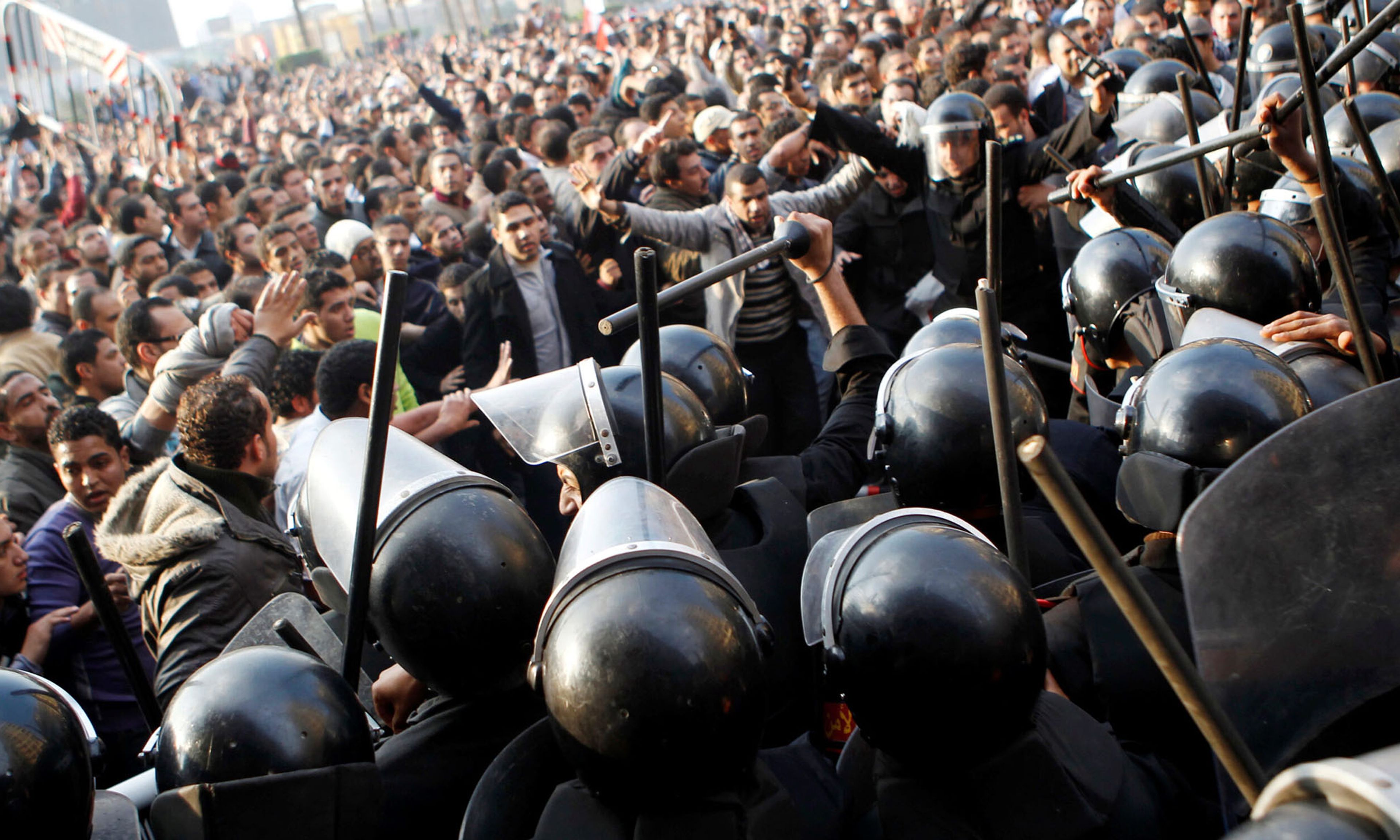
‘Tragedy” generally connotes fateful disaster: predestined failure, star-crossed lovers, young lives cut short, unexpected natural catastrophes. Greek tragedy, in particular, involves themes of destiny and fortune, where no matter how hard the hero strives to overcome his nature, he’s doomed to fall victim to his fate.
But in Noah Feldman’s tragedy The Arab Winter, a concise, convincing recapitulation of the causes and consequences of the Arab Spring, “the protagonists make choices based on their individual characters and by their actions participate in the construction of their fates.” The series of uprisings across the Arab world in the early 2010s resulted in death, dislocation, ethnic cleansing, and few significant changes to the political and economic status quo in the greater Middle East, but, in Feldman’s telling, they nevertheless demonstrated a new agency among would-be Arab reformers, an unprecedented effort to take matters into their own hands, that may yet pay dividends.
Feldman — a polymathic law professor at Harvard with extensive experience studying the Islamic world, including in post-war Iraq and revolutionary Tunisia — seeks to uncover the salutary remnants of the regional revolt. He aims “to save the Arab spring from the verdict of implicit nonexistence and to propose an alternative account that highlights the exercise of collective, free political action.” After centuries of imperial rule by the Ottomans, the British, and the French, followed by decades of indigenous authoritarian control, the Arab world for the first time exhibited a deep and authentic desire for just governance, even if that desire lacked a certain forethought, maturity, and responsibility.
The Arab Spring sprang in Tunisia in December 2010, when an act of self-immolation by a vegetable merchant in Tunis prompted crowds to gather, chanting, “The people want the overthrow of the regime.” This chant spread like wildfire across North Africa, into Syria, and down the Arabian Peninsula, where disparate but culturally linked movements sought to overturn autocratic rule. Feldman likens the chant to the Lockean notion, long enshrined in the West, that “the people may legitimately seize power from unjust and undemocratic rulers.” Defining “the people” entails certain difficulties, but Feldman concludes from the available polling, social-media posts, and his observations of the protests that these demonstrators authentically represented the voice of a strong, and perhaps overwhelming, majority.
Overthrowing regimes, however, entailed different strategies in each country, as did forging replacements. The protesters, Feldman reckons, sought “change in the structure of government that would provide economic and social justice,” albeit “without much specificity about what a new government would look like or how it would achieve those goals.” Confronting hardline thugs would turn out to be the easy part.
In Egypt, the chanters of Tahrir Square implored the army to oust the longtime authoritarian president Hosni Mubarak. Feldman deems “noble” and “legitimate” their “participation in the ultimate political act of shaping their own governmental regime in accordance with what the majority of Egyptians would eventually choose it to be.” The army obliged, placing Mubarak under arrest and promising — and implementing — democratic elections, which Mohamed Morsi’s Muslim Brotherhood narrowly won in 2012. The Egyptian people then adopted, by even tighter margins, a constitution congenial to the Brotherhood’s Islamist goals.
But if Mubarak’s overthrow was legitimate in Feldman’s eyes, equally legitimate was the protesters’ return to Tahrir Square a few years later to urge the military to evict Morsi from power. Fed up with the excesses of the Brotherhood, and seeking a less Islamist alternative, the “Tahrir II” participants should be considered genuine agents of the vox populi, because they “expressed a popular repudiation of the results of a series of formally democratic elections.” Feldman regards their actions as a grave error, as they unwound the constitutional democracy inaugurated only a few years earlier and ushered in an illiberal military autocracy not very dissimilar to the Mubarak regime. Nevertheless, he concludes that deposing even a democratic regime can itself be a form of democracy under certain conditions.
Meanwhile, in Syria, a vicious civil war has claimed half a million lives and displaced nearly half the country’s population. Initially peaceful demonstrations in early 2011 in the southern cities of Homs and Daraa swiftly deteriorated into violent conflict after Bashar al-Assad’s ferocious crackdown on the protesters. Feldman fingers as the chief culprit Assad’s cruel Alawi regime, “a minority-based dictatorship that fundamentally disempowered much of the country’s Sunni majority.” A sect representing only 10 percent of the Syrian population and regarded by Sunnis as heretical, the Alawis have governed from Damascus with an iron fist, firmly in control of the armed forces but terrified at the prospect of sectarian reprisals.
Feldman is unsparing in his criticism of President Obama, whose studied inaction during a nascent genocide in Syria derived from his implacable resolve to avoid blame for the aftermath of an American intervention. Yet, ultimately, the brutal sectarian violence was the result of Assad’s ruthlessly stoking denominational tensions and attacking his own countrymen. In Syria, even more evidently than in Egypt, efforts by Arab protesters to claim agency and seek justice were an important step forward that was swiftly overshadowed by two large steps backward.
Another aspect of the tragedy unfolded across the border. The hotbed of violence in Iraq incubated, and the Syrian civil war nurtured, the Islamic State (IS), which at its height controlled territory the size of Great Britain. Feldman calls IS “a purpose-built Islamic polity intended to solve the problem of politics once and for all” by resolving all legal, cultural, and economic ambiguities in Western thought and political practice by means of a strict reading of the Koran.
IS, in his account, constituted a utopian project that sought to implant a purely Islamist society through revolutionary violence and the acquisition of territory. Its willing participants, mostly men but also some women, flocked to Raqqa from all over the world in order to shape an Islamic future, however dystopian that project appeared to outsiders and however short-lived it proved to be. In this way, even the Islamic State evinced the agency of its adherents, who sought their own version of a just society, and it can therefore fairly be regarded as an offshoot of the Arab Spring.
In contrast, Tunisia, which sparked the regional movement, produced successful and enduring change through what Feldman calls “political responsibility.” Tunisian “protesters, activists, civil society leaders, politicians, [and] voters . . . did more than attempt to shape the course of their governance through their collective action. They realized that they must take into account the probable consequences of each step of their decision making.” The birthplace of the Arab Spring yielded its most robust offspring as demonstrators replaced an authoritarian regime with a durable alternative.
After ousting strongman Zine El Abidine Ben Ali in January 2011, Tunisia’s Ennahda (“Renaissance”) movement, running under an Islamist banner, won a plurality of votes in elections a few months later. But in a remarkable act of political pragmatism, Ennahda’s leadership renounced its commitment to sharia after gaining power, opting instead for a liberal and pluralistic approach to governance that Ennahda’s leaders have sustained into a second decade. To be sure, economic woes have curbed the gains of Tunisia’s “Jasmine Revolution,” and the old, corrupt ways of buying off constituencies have stubbornly persisted, to the dismay of everyday Tunisians.
Still, the revolt and reform of Tunis plainly advanced the demands made by protesters and are a model for mature, successful reform in the Arab world. Indeed, since then, popular movements in Algeria and Sudan have peacefully deposed their autocratic leaders. While the Algerian story remains unsettled, the Sudanese are in a transition process that appears more likely to produce a liberal and democratic regime. The transitional government won Sudan’s removal from the American list of state sponsors of terrorism and even provisionally normalized relations with Israel, with which it had technically been at war since 1948.
Ultimately, Feldman concludes that “it is time to recognize that the future of the Arabic-speaking world is and ought to be made by the people who live there, not from the outside.” The Middle East’s imperial era has ended, with apologies to Russian and Chinese designs on the region. Some authoritarian regimes have been cast off, and some of those regimes have been replaced by more-just governing structures. And Arabs have taken steps, however haltingly, toward self-determination. There’s a long way to go, but the Arab winter may be slowly thawing.










Comments