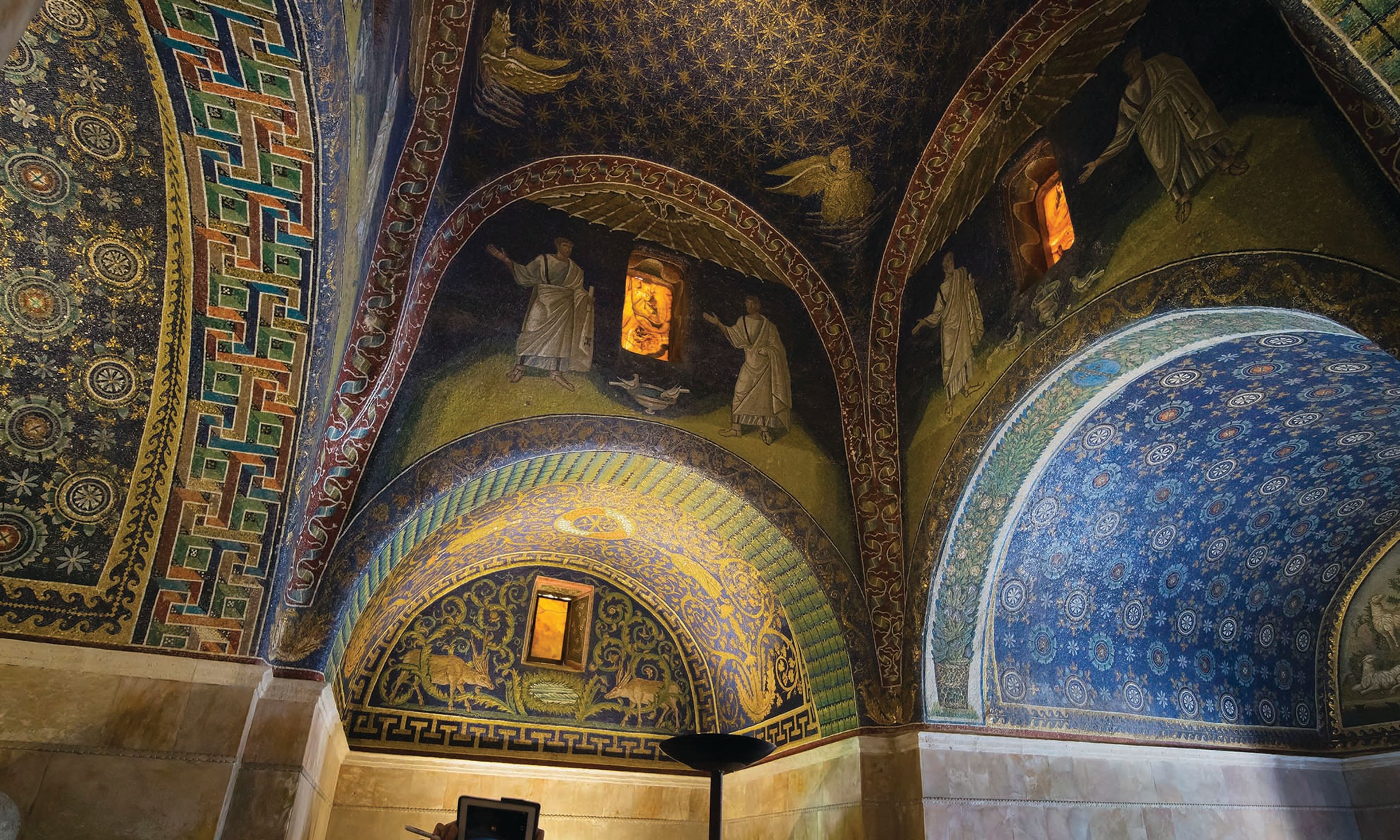
I liked Judith Herrin’s Ravenna for three big reasons. I am an art historian by trade and worship Ravenna’s churches, tombs, and baptistries decorated with mosaics for which the city is famous. Dating from around 420 to around 550, the mosaics certainly glitter. Made of lustrous little squares of glass in endless shades of pure color, they’ve hypnotized visitors from Dante to today.
The tomb of Galla Placidia, or, simply, Placidia (around 390–450), was built around 425. It’s one of the most moving little monuments in Europe. She was the mother of Valentinian III, one of the last Roman emperors, and his regent for many years. It’s a small building on one side of which is a mosaic scene of Jesus as the Good Shepherd, young and soothingly handsome, flanked by sheep so convincing they seem to bleat and baa. On another are mosaics of the Evangelists. Between the two is a vaulted ceiling decorated with mosaics of twinkling stars against a cobalt sky. Cole Porter is said to have been inspired to write “Night and Day” after seeing the tomb on a trip to Ravenna.
Herrin is not an art historian but a classics professor emerita specializing in Byzantium studies. Still, the brilliant mosaics are well treated in her history of the city and contextualized. I love it when they get some ink. That’s the first reason.
Herrin teaches us much more. Ravenna, I knew, aside from its mosaics, is a pleasant, prosperous city near the Adriatic and due east of Florence. I also knew it was the capital of the western half of the Roman Empire sometime in the fifth century (402 to 476, to be precise), its last stand before the empire collapsed and Rome itself became a backwater.
The fall of the Roman Empire is a big topic, as are the long hegemony of Constantinople, the early years of Islam, the collapse of paganism, how Roman Catholic doctrine contentiously coalesced, the rise of popes as potentates, and the conquest of the old world of Greece, Rome, Jerusalem, and, yes, Constantinople itself by a new world of Goths, Huns, Vandals, Arabs, Bulgars, Lombards, Franks, and many others. Herrin takes each of these thematic behemoths and explains them through the filter of Ravenna. By the end of her history, I had a new and deeper sense of the trajectory from Constantine to Charlemagne. This is the second reason I liked the book.
In the heyday of imperial Rome, Ravenna was more or less the small, prosperous city it is today. Its place as the crucible of Europe, or, as Herrin calls it, “the first European city,” started with Emperor Constantine, who gave flesh and bone to the split of the empire into eastern and western spheres, with the senate, the aristocracy, and polytheistic cults in Rome and the imperial court in Constantinople, a new city that became, in 330, the empire’s political capital. Soon it was its biggest and most vibrant city.
Power and prestige continued to drift from Rome, not only to Constantinople but to cities throughout Italy. Rome simply wasn’t safe. The Gauls sacked it in 390, then the Goths in 410. The city that had once conquered the world was itself laid low. By 400, the imperial class in Rome looked to Ravenna as a brighter prospect for the business of survival. It was then a cultured, sophisticated place and surrounded by swamps, making invasion difficult. An ancient road to Rome slithered through the Apennines, making communication between Rome and Ravenna possible. Most important, Ravenna was connected to the Adriatic by a river. (Its harbors were later clogged with silt.) It was a day’s sail to Croatia. Constantinople wasn’t far, either. For 400 years, Ravenna was Europe’s intermediary with the East.
Placidia was among Ravenna’s first celebrity refugees from Rome, though her path to Ravenna could not have been more circuitous or rocky. Her regency, lasting from 425 to 437, when Valentinian turned 18, was stabilizing for Roman bigwigs upset at having been transplanted. She was a practiced manipulator whose impact spanned the crumbling Roman world. She also helped to establish Ravenna’s roll-with-the-punches spirit.
Placidia is the female lead in Herrin’s story, and this is the third reason I liked the book so much. The cast of characters in Ravenna’s complex history has lots of outsized personalities, but none is a doughtier survivor than Placidia. She is a profile of courage amid chaos.
For Herrin, Placidia’s story is a case study for Ravenna’s centrality in the history of both West and East. It’s a story worth reviewing not only because it gives a flavor of the rest of Herrin’s narrative, but because it points to the only challenge I felt as a reader.
Theodosius I, Placidia’s father, was the last emperor to rule the entire Roman Empire. At his death, it was formally divided in two, administratively but not politically, with his son Honorius taking the western half and his son Arcadius taking the eastern half, ruled from Constantinople.
With her father always away for warring, Placidia lived at the court of Stilicho, Theodosius’s defense and spy czar. Stilicho was only half Roman. His father was a Vandal cavalry officer. For years, Rome, so vast and disparate that it was impossible to manage, hired mercenaries, among them Vandals and others from northern tribes, who sometimes were insiders and sometimes went rogue. Living in Stilicho’s home, Placidia learned the ways of assimilated barbarians as well as plotters.
When Arcadius died in Constantinople in 408, Stilicho tried to become the regent for the late emperor’s young son, Theodosius II, Placidia’s nephew. Stilicho hoped to reunify the eastern and western parts of the empire under his own rule, first by deposing Theodosius and placing his own son, Eucherius, on the eastern throne, then by axing the childless Honorius, who, by the way, was his son-in-law. Stilicho had already arranged the marriage of Eucherius and Placidia to strengthen his bloodline’s claim. It all turned to mincemeat as Stilicho was executed in Ravenna, on Honorius’s orders, and Eucherius was murdered by Honorius’s court eunuchs.
Placidia, still living in Rome, was unharmed in the bloody retributions that followed, though she saw lots of heads on spikes. Stilicho’s surviving supporters joined forces with Alaric, the king of the Visigoths, who sacked Rome in 410. Placidia was captured by the Goths and taken to Gaul, where she soon married Athaulf, who’d succeeded Alaric as king when Alaric died. She was now a Gothic queen. She probably felt like Tarzan’s Jane.
Athaulf was soon stabbed in his bathtub by a disgruntled courtier. Placidia was kidnapped by Wallia, Athaulf’s successor, and eventually traded in a hostage deal made by Honorius. Honorius then forced her to marry Constantius III, a general and his co-emperor. (So unstable was the western empire that it often had co-emperors. Honorius had some blood claim to rule, while Constantius was a military man who kept the troops in line.)
Honorius was already based in Ravenna when he ransomed Placidia. There, Placidia married Constantius, howling as she made her way up the aisle. After Constantius died in 421, Honorius is said to have wooed her — allegations of incest were raised. Mortified, she fled to Constantinople with her and Constantius’s son, Valentinian, and sought the protection of her nephew, Theodosius II, who’d survived Stilicho’s earlier machinations and grown to manhood.
When Honorius died in 423, Theodosius was, by blood, now emperor of both halves of the empire. Theodosius decided to name his baby cousin, Valentinian, the western emperor, sending him to Ravenna with Placidia as regent. She was a hands-on ruler during her twelve-year regency, doing much to hold the Vandals at bay as they moved through Spain and parts of Africa and began to eye Italy. It was only after her death that they sacked Rome.
It’s all dizzying but juicy.
I had a classical education, so I’m used to Herrin’s style. It’s never impenetrable, but it’s thorough, linear, and matter-of-fact. It’s not light and airy, and there are few up-close-and-personal, warm-and-fuzzy moments. This is fine. Herrin is a superb historian who tells us that she’s tethered to the tangible evidence of primary sources. Praise the Lord, I thought. Someone’s still doing history the right way. In Herrin’s Ravenna, those inclined to wear their hearts on their sleeves didn’t write about it.
This never makes her story dull but, for the first 50 pages or so, the steady, sometimes quick march of unfamiliar facts and strange names can befuddle the reader. I write this as a warning to take Herrin’s book slowly. It’s not a skimmer. There’s a lot to absorb. A careful, patient read best reveals the book’s richness.












Comments