• If Harry Reid is so worried about being embarrassed by new senators, shouldn’t he keep Al Franken out?
• With the Fed having done all it safely can to stimulate the economy — perhaps more than it safely can — President-elect Obama is proposing that Congress pass a $1 trillion stimulus. He wants that figure to include $300 billion in tax relief — mostly in the form of the credits he campaigned on. If Congress is willing to take that revenue hit, though, it is able to finance better tax cuts, such as reductions in the corporate-income tax and the payroll tax and increases in the child tax credit. Republicans should seize the opening that Obama has given them.
• The recorded conversations of Illinois governor Rod Blagojevich, soliciting bids for Barack Obama’s Senate seat, threatened to embarrass the president-elect. How could Venus have arisen from such a polluted local sea? Blagojevich then made his million-dollar move, awarding the seat, gratis, to Roland Burris, a comfortable old hack. Did you know Burris was black? If anyone forgets, there is Rep. Bobby Rush (D., Ill.) to remind him; Rush has warned reporters not to “hang or lynch” Burris, and accused the Senate of “plantation politics.” Democrats in Illinois and nationally find themselves in this pickle because they did not want to call for a special election — Republicans might have won — yet they could not arrange Blagojevich’s impeachment quickly enough. Majority leader Harry Reid threatened not to seat Burris. The Constitution may give the Senate that power, but what’s the justification for using it? Nobody alleges that Burris bought the seat: pristine conduct by Illinois standards. All hail Senator Burris; vox Blago vox Dei.
• “In the most popular governments,” wrote John Adams, “elections will generally go in favor of the most ancient families.” The Kennedys have confirmed his judgment, providing representatives, senators, and a president over 60 years. But now Caroline Kennedy wants to skip the annoying election process, and seeks to be appointed by New York governor David Paterson to Hillary Clinton’s soon-to-be vacant Senate seat. She would then have to run for real in 2010. No matter that she has never run for, nor ever particularly done, anything. Her political résumé consists of being a little girl in her father’s Oval Office and campaigning for Barack Obama last year. The local media have not been kind to her public appearances (“vague . . . undefined” — New York Times; “cringe-inducing” — New York Daily News). The governor would do himself, Ms. Kennedy, and New Yorkers a favor by appointing some minimally seasoned figure and letting the heiress-not-so-apparent prove herself next year.
• Al Franken pulled 225 votes ahead of Sen. Norman Coleman in the recount of Minnesota’s poll, according to the state canvassing board. The Coleman campaign believes that 150 ballots in Democratic Minneapolis were double-counted, and that some 650 absentee ballots in Republican-inclined counties were wrongfully rejected. They will take their case to the Minnesota supreme court. Conservatives have to resign themselves to the possibility that Coleman may have lost narrowly, but fair and square. Bad years happen, and 2008 was a whopper. If the people of the North Star State wish to be represented by a left-wing comedian, then they — and we — will have him for the next six years.
• Until 2005, the standard biography of New Mexico governor Bill Richardson included an item about how the Kansas City Athletics drafted him as a pitcher. It turns out that this wasn’t true, but nobody knew until the Albuquerque Journal decided to vet the story. The Obama transition team appears not to have done much vetting of the governor, either. Before Obama announced Richardson as his choice for commerce secretary, his aides apparently shrugged off a federal probe into Richardson’s campaign finances. Investigators would like to know if CDR Financial Products, a California company, captured nearly $1.5 million in New Mexico state contracts because of its political contributions. On January 4, Richardson said that he no longer wanted the cabinet post. The next day, he hired a lawyer. It remains to be seen what will happen to him. For Obama, the episode is an unexpected balk.
• Get used to it. Jihadist demonstrators in Jakarta, enraged (this minute) by Israel’s invasion of Gaza, waved a poster of Obama, with symbolic bullet holes in his forehead. When George W. Bush gave a press conference in Baghdad last month, an Iraqi zealot threw his shoes at him. This was the culmination of years of the demonization of Bush by Islamists and Muslim totalitarians (the shoe is a degrading item in the Middle Eastern wardrobe). Bush’s many critics here tend to assume that he brought such hatred on himself by a variety of mistakes. They are wrong. Our enemies in the Muslim world hate us, liberals and conservatives, Democrats and Republicans, because we are Americans: because our women are free, our Jews aren’t killed, and our public speech doesn’t have to square with some mullah’s reading of the Koran. They will hate President Obama as much as they hated his predecessor. We shall greet their new hatred with the contempt that all of us should have shown for their current brand.
• President-elect Obama shrewdly sequenced his cabinet appointments. Early picks such as Tim Geithner for Treasury and Bob Gates for Defense established the media narrative of Obama’s “centrist and pragmatic” advisers. The script has stuck even as Obama has appointed a labor secretary, Hilda Solis, who opposes free trade and the secret ballot in unionization elections; a science adviser, John Holdren, who has long associated with the discredited environmental hysteric Paul Ehrlich; and an HHS secretary/“health czar,” Tom Daschle, who seeks a government takeover more thoroughgoing than what Obama proposed during the campaign. If Obama wants to lurch left, he will have the personnel to help him.
• Obama’s invitation to Rick Warren, evangelical megapastor, to deliver the invocation at his inauguration accomplishes several things and seeks to accomplish several others: Thank you. Warren invited Obama to an AIDS conference in 2006, and was firm but polite to him in the candidates’ debate he moderated last August. One good turn deserves another. I set my own agenda. Obama’s gay supporters howled — Warren supported Proposition 8 — but the president-elect is letting everyone know that he intends to call his own tune. Enemies, and friends, take note. The seamless garment. Don’t Christians care about an array of issues when they go to the voting booth, besides abortion? This has been a maneuver of Catholic liberals for years. Could there be a similar trend among the new generation of evangelicals? Warren probably won’t fall for it, but Obama wants to float the idea. Come unto me. Obama wants to establish himself as a national arbiter of moral concerns, heeding us all, left and right. He wants to build a governing coalition, and a governing image, for the next four and eight years. Nice work if you can get it.
• President Bush spoke about life after January 20: “One thing I don’t want to do is stay on the stage. The spotlight needs to shift to President-elect Obama . . . because he’s the president. Therefore, I won’t try to get it to shift to me. And I’ll be very respectful of him during his presidency.” Well, that’s no different from Clinton and Carter, right?
Super-Sized Stimulus
Responding to fears shared by most economists that the current recession might turn into a depression, President-elect Obama pulled out all the stops in early January and proposed the mother of all stimulus packages. He would devote as much as $775 billion over the next two years to stimulus.
The proposed package consists of both spending and tax measures. The proposed increase in spending is a massive $475 billion, roughly 3 percent of GDP. In addition, a tax cut of up to $300 billion would amount to about 2 percent of GDP.
Traditionally, stimulus packages have focused on tax measures. Spending has not generally increased enormously during recessions. The massive spending increase is, then, unprecedented.
The history of stimulus has been studied by Obama’s designee for chairman of the Council of Economic Advisers, Christina Romer, and her husband, David. Although taxes change over time for many reasons, the Romers’ study identifies the changes that are designed to be short-term stimulus. The nearby chart compares previous tax measures with the Obama proposal as percentages of GDP.
The first bar on the chart is the Tax Reform Act of 1969, which gradually phased out a 10 percent income-tax surcharge, expanded the personal exemption, increased the standard deduction, repealed a 7 percent investment tax credit, and included a handful of other reform and relief provisions. It was a bit larger than 1 percent of GDP.
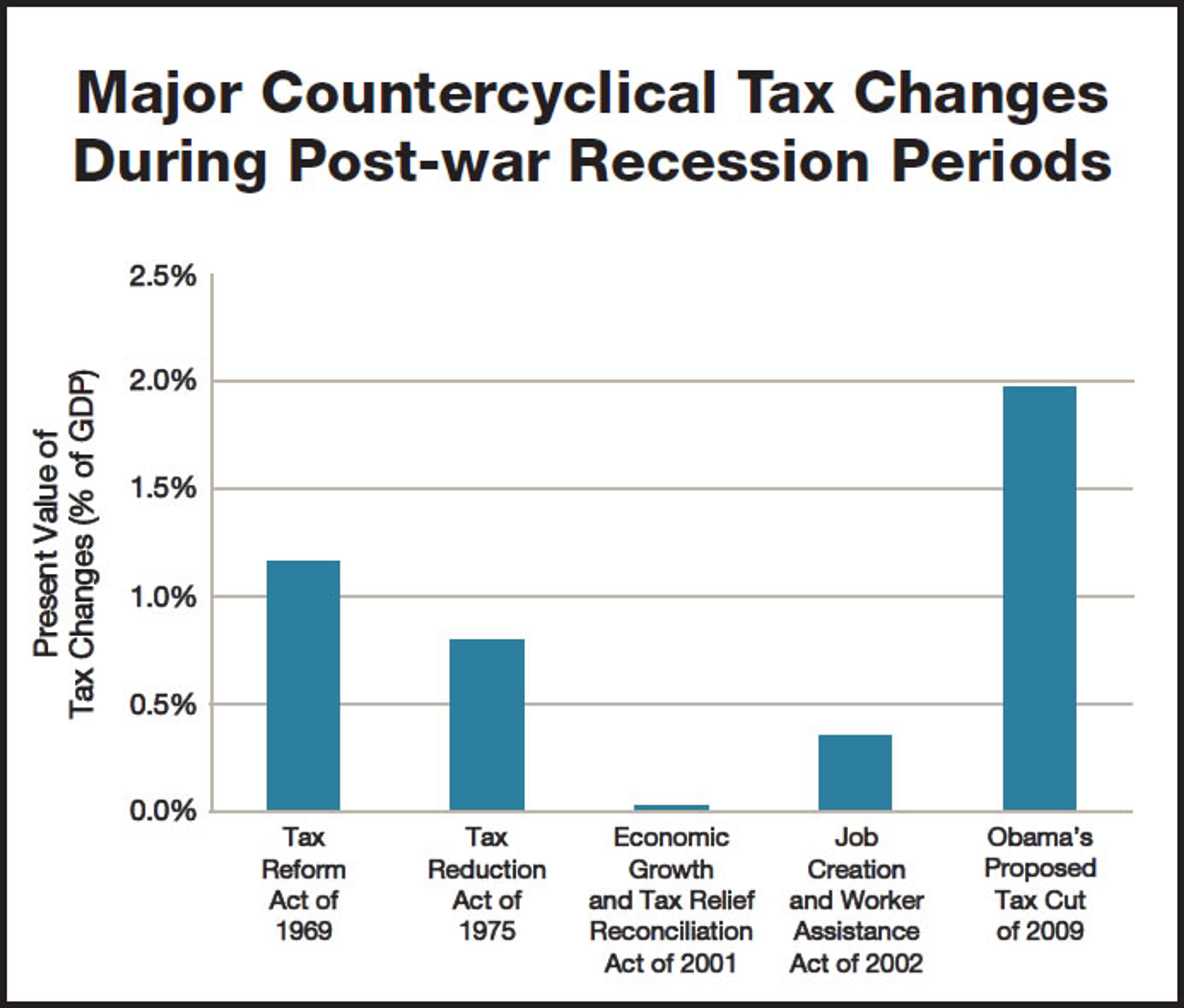
The next three measures were significantly smaller. The Tax Reduction Act of 1975 contained several temporary tax-relief provisions, including rebates, an increase in the standard deduction, new tax credits, and a temporary increase in the investment tax credit.
The Economic Growth and Tax Relief Reconciliation Act of 2001 fulfilled President Bush’s campaign promise of a significant tax cut and addressed an impending economic slowdown. The bill reduced marginal tax rates and created a new 10 percent tax bracket. It also expanded the child credit, increased contribution limits for retirement plans, and reduced or eliminated the estate and gift taxes.
Just after 9/11, President Bush and Congress enacted additional tax relief designed to spur business investment. The legislation allowed firms to carry back losses up to five years and claim a bonus depreciation on new investments.
The Obama proposal is almost twice as large as the most significant stimulus bill, the 1969 act. Obama also proposes a spending increase that dwarfs anything in past cycles. One would have to go all the way back to World War II to find such drastic government action.
— KEVIN A. HASSETT
• Remember all those reports suggesting that Hillary Clinton might have a conflict of interest as secretary of state in dealing with the foreign donors who contributed zillions of dollars to her husband’s foundation? Well, the reports were right. Under pressure from all sides, the William J. Clinton Foundation made public its donor list in late December. It turns out the government of Saudi Arabia gave between $10 million and $25 million. (The disclosure did not reveal the exact number.) Government agencies in Australia and the Dominican Republic kicked in similar amounts. The government of Norway gave between $5 million and $10 million. And the governments of Kuwait, Qatar, Brunei, and Oman each threw in between $1 million and $5 million. “Also among the largest donors,” reported the New York Times, “were a businessman who was close to the onetime military ruler of Nigeria, a Ukrainian tycoon who was son-in-law of that former Soviet republic’s authoritarian president, and a Canadian mining executive who took Mr. Clinton to Kazakhstan while trying to win lucrative uranium contracts.” And on top of it all, the Dutch national lottery gave between $5 million and $10 million. The disclosure solves part of Mrs. Clinton’s problem; now we know where her husband’s foundation money came from. But what about the conflict? A secretary of state can’t exactly recuse herself from issues involving Saudi Arabia, Kuwait, Qatar, etc. It seems to us that this is a chronic problem, a mess built into Barack Obama’s choice of Hillary Clinton to head the State Department. It will pop up from time to time, because it can’t be resolved.
• Charlie Rangel has ventured out from his complex of rent-controlled Manhattan apartments just long enough to get himself into another ethical soup, this time by soliciting donations from American International Group, the troubled insurance giant, and from its former CEO Hank Greenberg, who is among its largest shareholders, while considering legislation that would have given the firm millions of dollars in tax benefits. Rangel, in his usual style, was brass-faced when asked about any possible impropriety, protesting: “I can’t think of one piece of legislation that impacts them, and there has never been a time that they’ve raised any legislation to me.” That statement is false on both counts. AIG spokesman Joseph M. Norton confirms that the firm contacted Rangel directly about legislation pending before the House Ways and Means Committee, which Rangel chairs. The AIG executive who signed the letter attended Rangel’s fund-raising meeting, and Greenberg’s charitable foundation committed $5 million to a project that Rangel, with characteristic modesty, has named the “Charles B. Rangel Center for Public Service.” Unsurprisingly, Rangel also solicited donations from Donald Trump, who shares the congressman’s passion for naming things after himself.
• Vicki Iseman, the lobbyist whose friendship with Sen. John McCain was the subject of an insinuendo-filled New York Times article last February, has filed suit against the Times for libel. While we sympathize with Miss Iseman, she faces a difficult road ahead. In the first place, the story’s very lameness, its hedging and arm’s-length accusations, will work to the paper’s benefit. Times lawyers will surely attempt to portray the lobbyist as a public figure, which would make a libel suit virtually impossible to win, and during discovery they will dig up the names of every co-worker she’s ever smiled at and every classmate she flirted with in high school. After all, just as the Times will eagerly reveal vital national-security secrets but not the ending of a movie, the paper is scrupulously respectful of people’s privacy, except when violating it can embarrass the right parties. Moreover, should the case ever go to trial, no one can match the New York Times at slanting narratives to make Republican politicians look bad. With all this, it seems likely that the Times will prevail, and thus uphold its inalienable right to retail third-hand water-cooler gossip. John Peter Zenger would be proud.
• In March 2007, the Los Angeles Times published an op-ed piece called “Obama the ‘Magic Negro.’” Paul Shanklin, a parodist, saw the opportunity: He penned a song called “Barack the Magic Negro,” to the tune of “Puff the Magic Dragon.” Shanklin is associated with Rush Limbaugh, and is a friend of Chip Saltsman. Saltsman is a politico running for chairman of the Republican National Committee. For Christmas, Saltsman sent to committee members a Shanklin CD, bearing 41 tracks — including the “Barack” song. A controversy ensued. The current RNC chairman, Mike Duncan, flipped out: “I am shocked and appalled that anyone would think this is appropriate as it clearly does not move us in the right direction.” One of Saltsman’s rivals for the position, Kenneth Blackwell, who is black, took no offense, speaking instead of “hypersensitivity.” He was right; the controversy is baloney.
• John Taylor, former undersecretary of the treasury, is worried about the future of the Fed, and it is fit that he fret. Taylor’s first concern is that the Fed has ceased conducting monetary policy — which is to say it has moved well beyond its fundamental duty to fight inflation — and has instead begun conducting what amounts to freelance industrial policy, intervening in the markets, picking winners and losers in a broad array of industries, and creating money to finance these ambitions. Taylor calls this by the appropriately ugly neologism mondustrial policy. “It’s not a monetary framework,” Taylor told the American Economic Association, “it’s an intervention framework financed by money creation.” His second concern is a consequence of the first: Between mission creep and a rapidly growing balance sheet (the Fed’s holdings have trebled in recent months), the central bank is all but inviting more meddlesome management of its activities by Congress. The Fed’s independence from electoral politics and its sharp focus on monetary stability are its two most desirable features. Losing the former by losing the latter would be a tragedy in two acts.
• The Bernard Madoff scandal raises the question: What exactly is the point of the Securities and Exchange Commission? In spite of eight separate inquiries into Madoff’s operations, neither the SEC nor any other regulator penetrated the financial fog that obscured the scam. It was not for want of evidence: Madoff’s hedge-fund rivals eagerly fed information to regulators, and investigators determined that some branches of Madoff’s business were generating returns in spite of the fact that they apparently had no clients. Financial analysts were sending the SEC letters accusing Madoff of operating a Ponzi scheme as far back as the 1990s. This evidence was available to the SEC and to the Financial Industry Regulatory Authority (FINRA), which tsk-tsked Madoff for relatively minor technical violations. As a reward for this crack detective work, Obama is naming FINRA boss Mary Schapiro to head the SEC. As much as the lumpen Left would like to characterize the Madoff scandal as a case of deregulatory excess, we note that the relevant regulation here is still very much in force: “Thou shalt not steal.” The needful thing isn’t better laws, but a better sheriff. It is far from obvious that the SEC is institutionally capable of performing its mission: In 2000 the agency was faced with a vacancy on its Advisory Committee on Market Information, and it filled the spot with one Bernard Madoff, last spotted free on bond and mailing a million dollars’ worth of jewelry to far-flung relatives.
• The Bush administration authorized a $17 billion rescue package for GM and Chrysler. Ford, the only one of the Detroit automakers that was not facing bankruptcy, turned down the cash. GMAC, GM’s financing arm, immediately used the money to offer zero-interest financing on three models of sport-utility vehicle that were clogging up its dealers’ lots, something GM’s vice president admitted it would not have been able to do without the bailout. One would think that giving Ford’s competitors the means to offer better deals on their cars would be unfair to Ford, but Ford prefers this state of affairs to the alternatives. The way Ford sees it, a messy bankruptcy for GM and Chrysler might have been too disruptive to the industry, while a government-backed bankruptcy that forced the creditors of GM and Chrysler to accept write-downs and their unions to accept pay cuts would have made GM and Chrysler too competitive. It is a sign of just how screwed up the U.S. auto industry has become that Ford’s CEO actually asked the U.S. government to help its competitors limp along beside it, and it is a shame that the Bush administration acquiesced to this warped demand.
• Democrats are intent on cultivating a mythology of torture to discredit George W. Bush’s administration, and the latest epistle of their faith is Sen. Carl Levin’s misleading and relentlessly partisan report, “Inquiry into the Treatment of Detainees in U.S. Custody.” Contrary to the report, the Bush administration did not “redefine” detainee-treatment law; it undertook to determine precisely what the law says and whom it covers. Neither did the Bush administration negate the Geneva Conventions’ Common Article 3, which requires that the prisoners it covers be “treated humanely.” By definition, al-Qaeda is not qualified for Geneva protections because it is a terrorist organization. Nonetheless, the Bush administration made humane treatment of Qaeda prisoners a matter of policy. Three Qaeda captives have been waterboarded during interrogations, a practice that Congress has declined to criminalize. The abuse of prisoners is not to be tolerated — and under the Bush administration it has not been: Dozens of U.S. military personnel have been disciplined and a number tried in courts-martial. There is a world of difference between freelance wrongdoing at the hands of a minuscule proportion of soldiers at Abu Ghraib and a government policy of torture. The Democrats’ attempt to conflate the two is a shameful elevation of politics over the sometimes unpleasant necessities of national defense.
• Jerry Brown, California’s attorney general, thinks that the voters have approved an unconstitutional constitutional amendment. Last year the state supreme court foisted same-sex marriage on the state. The voters undid it. Brown’s legal argument is that amendments cannot take away rights granted by the state constitution — never mind that the state constitution includes no such limit on amendments, any more than it includes a requirement that same-sex marriages be recognized. The real principle underlying his brief: When it counts, the people are not allowed to amend the constitution; only judges can do that.
• As the economy tightens up, many folks will find themselves going out less and seeking entertainment at home instead. Anyone planning to watch much TV in California, though, had better act fast: The state’s lawmakers are working on a law requiring retailers to sell only the most energy-efficient television models. It would go into effect in 2011 and become stricter in 2013. Supposedly, this is a measure to save energy, but it’s unlikely to be all that effective: Modern TVs use more electricity than older ones did, but they still account for only 4 percent of total usage (10 percent of the average California household’s electricity bill). And with California outlawing many TVs, consumers will be more likely to order their sets from out of state. If the state truly needs to lessen the strain on its power grid, a better idea would be to raise the price of electricity. The people and businesses who could most afford to cut back would — some of them by buying appliances, including TVs, that use less energy. This would slash usage across the board, instead of for a single appliance, and wouldn’t require dictating to residents what products they can own.
• Israel’s attacks on Hamas are being widely condemned as “disproportionate” since Israel has inflicted more damage than Hamas has. The criticism is a bizarre distortion of traditional just-war theory, which requires (among other things) that military actions be proportionate to the evils they seek to prevent, e.g., the slow-motion extinction of Israel. If the new tit-for-tat standard were applied to its conduct during World War II, the U.S. would be guilty of war crimes for going beyond the sinking of Japanese ships after Pearl Harbor. So far, however, the standard has been applied only against Israel — because it is not a standard at all, just a rhetorical weapon.
• The U.S. handed over control of the Green Zone to the Iraqis, in a historic step toward the reestablishment of Iraq as a sovereign independent state. Almost as notably, the Washington Post ran a front-page article declaring the war “over, at least the conflict as it was understood during its first five years.” The progress in Iraq has indeed been nearly miraculous, with attacks dropping 95 percent from a year ago. But we still confront fighters supported by countries neighboring Iraq, and the Iraqi political situation — on which so much depends — remains perilous, with crucial provincial and parliamentary elections in the offing. A war doesn’t end until the enemy is no longer able to operate or acknowledges defeat. Neither has happened in Iraq, even though we celebrate milestones that would have been unimaginable two years ago.
• Further signs of Russia’s retreat into authoritarianism came with a December 4 raid on the offices of Memorial in St. Petersburg. Memorial is a private organization that for 20 years has been collecting data on the victims of Stalin’s dictatorship. The raid was carried out by nine policemen, two of them wearing black facemasks. They spent six hours combing through Memorial’s office, finally taking away with them twelve computer disks containing several terabytes of data. The data include thousands of hours of audio histories, digital versions of faded photographs, and video evidence of mass graves. Using Memorial’s database, one can easily retrieve images of written denunciations by a son against his father, or hear torture-weakened voices reciting forced “confessions” that implicate family members or colleagues. Most of the data are backed up, we are told, but some may have disappeared irretrievably into the apparatus that generated them in the first place — the ravenous, apparently unkillable beast that is Russian state power.
• In the 1950s, Cuba was one of the better-off Latin American countries. It had a dictatorship, like so many other countries in the region (and world). That dictatorship was neither the best nor the worst. It was overthrown by revolutionaries led by Fidel Castro, and they promised freedom and democracy. They delivered one of the most brutal Communist police states we have known. Castro’s democratic-minded former comrades either fled or were imprisoned. Soon, Castro hosted Soviet missiles. The United States tried to get rid of him, in various ways: We failed. Castro acquired a huge following in the West, people in free countries hailing a tyrant who ruled an unfree one. Stars and starlets sat at his feet. Armando Valladares published a Solzhenitsyn-style memoir: Against All Hope. Fewer people sat at his feet. The Cuban Communists are now 50 years in power. We have marked these anniversaries before: have done so for decades. When that dictatorship finally dies, we, and the Cubans, will celebrate with laughter and tears.
• The British are good at tradition, and one of them is that Queen Elizabeth broadcasts to the nation on Christmas Day. It brings everyone together, don’t you know? Britain’s Channel Four likes to run an alternative broadcast; this year, Mahmoud Ahmadinejad was the star. He’s the fellow who as president of Iran made a point of taking hostage 15 British sailors and humiliating them in public, and he’s Gestapo-minded about Jews. That’s what gets you a prime spot on British television. Speaking to the camera, Friend Mahmoud lambasted “bullying, ill-tempered, and expansionist powers.” Now whomever could he have had in mind? The Left’s sense of humor is at work, is it not? But the Queen and her subjects were not amused, and a cry arose to cut the subsidies without which there’d be none of this.
• Uneasy lies the head that wears a beauty queen’s tinsel tiara. Consider, for example, 23-year-old Laura Zuniga of Mexico, who was crowned Miss Hispanic America in a Bolivian pageant last October. Just a few weeks later Miss Zuniga was being paraded in handcuffs with head bowed on Mexican TV news programs, along with half a dozen males whose general appearance brought to mind the crew of a pirate ship. Miss Zuniga, it seems, is a gangster’s moll, girlfriend of Angel Urquiza, a senior staffer in the Carrillo Fuentes drug-smuggling organization based in Ciudad Juárez. She was arrested while riding in Urquiza’s truck in company with, according to police, two AR-15 rifles, three pistols, 633 cartridges, 16 mobile phones, and $53,000 in cold cash. The Mexican media are enjoying a field day, having dubbed the lady “¡Señorita Narco!” (if the crown fits, wear it, Laura), while Mexico’s entire corps of criminal lawyers are falling over each other with offers to defend her. In Mexico’s current state of corrupt degeneracy, the wonder is that enough honest cops were found to carry out the arrest.
• “In the Bleak Midwinter” is one of the most beloved of English carols. It hails the coming of the Christ. But, on National Public Radio, it goes a little differently: It hails the coming of Barack Obama. At least it does on Garrison Keillor’s show, A Prairie Home Companion. Just before Christmas, the soprano Renée Fleming did the honors. She sang, “In the bleak midwinter, at the Christmas feast, a family leaves Chicago and travels to the East, for a public mansion in Washington, D.C., in a time of trouble and festivity. All across the nation, sea to shining sea, people watch the passage of that family” — and so on. We don’t begrudge liberals their enthusiasm, but could they try to be a little less creepy about it?
• Once upon a time, the wire services were pretty good about reporting the facts (and just the facts, ma’am). Today, their reports read a lot like opinion columns — ones that come from the left. Here’s a habitual offender, the Associated Press: “When the auto bailout talks collapsed, Sen. Bob Corker won by losing. The freshman Republican from Tennessee represented conservative Republicans who opposed the $14 billion rescue package passed by the House and saw Senate negotiations as one last chance to bludgeon organized labor before the GOP minority shrinks and Democrats expand their control of government.” And AP saw one more chance to bludgeon Republicans.
• Our congratulations to Jim Bob and Michelle Duggar of Arkansas on the birth of their 18th child the week before Christmas. The Duggars are now the proud parents of ten sons and eight daughters, their eldest almost 21. Conservative Baptists, the Duggars take the straightforward view that children are gifts from God, to be welcomed in any numbers. Their kids are all home-schooled, and the Duggars live debt-free on rental income from commercial property they own outright. With food bills at $3,000 a month, it probably helps that they now have their own reality TV show. Not the least reason to speak up for the Duggars is to counter the gross vilification they have come in for from leftist anti-natalist commentators on the Internet, some of whom seem to be personally offended by this family’s private arrangements. “Litter” is among the milder of the terms bandied around by the Duggar-haters. Well, the hell with them, and good luck to Jim Bob and Michelle; and welcome, little Jordyn-Grace Duggar, to a world in which truth ever vies with falsehood, beauty with ugliness, and good with evil. May your life be filled with truth, beauty, and goodness.
• Actress Nicole Kidman has just made a movie about Australia. On a German TV talk show to promote the movie, Ms. Kidman was handed a didgeridoo — a crude wind instrument favored by Aborigines down under. She obligingly played a few notes. Alas, this well-intentioned venture into multiculturalism soon boomeranged on Ms. Kidman, as such gestures so often do. The didgeridoo, you see, is a male instrument. A female who plays it not only outrages Aborigine sensibilities, but renders herself infertile. Aborigine cultural leaders convened a kangaroo court to condemn Ms. Kidman — who, had she paid more attention to the news, would be better attuned to the multicultural minutiae of her homeland. A few months before Ms. Kidman’s German misadventure, the book publisher HarperCollins had to apologize to Aborigines for including a section on how to play the didgeridoo in The Daring Book for Girls. It has removed that section from subsequent editions of the book. So many ways to give offense in a multicultural society! So many people ever poised to take offense!
• Paul Michael Weyrich is dead at the age of 66. He was one of the conservative movement’s great institution builders. A native of Wisconsin, he was inspired by the presidential campaign of Barry Goldwater and soon moved to Washington, where he made his career. In 1973 alone, he became the first president of the Heritage Foundation as well as a founder of two other enduring organizations: the American Legislative Exchange Council, which coordinates right-of-center state legislators, and the Republican Study Committee, a conservative redoubt on Capitol Hill. He went on to give birth to the Free Congress Foundation and, in the 1990s, to National Empowerment Television. Weyrich had a strong pessimistic streak — coupled, thankfully, with an optimism of the will. R.I.P.
• Avery Cardinal Dulles, S.J., was in some ways an emblematic figure of the American Century. A scion of the WASP elite — he was the son of Eisenhower’s secretary of state, the great-grandson of Benjamin Harrison’s, and the grand-nephew of Woodrow Wilson’s; not to mention the nephew of JFK’s CIA director — he lost his Protestant faith and became, in turn, an agnostic and a Catholic. He was a brilliant theologian, whose 1974 book Models of the Church was used by Catholic colleges to teach liberal Catholicism to their students — and whose many other writings have served to reinvigorate conservative Catholicism in the years since. His contribution to the restoration of orthodox Catholic theology was greatly appreciated by Popes John Paul II and Benedict XVI. In 2001, John Paul named him a cardinal; last year, Benedict took time during his U.S. trip to pay the ailing scholar a personal visit. Perhaps the best introduction to his work is the 2008 collection Church & Society: The Laurence J. McGinley Lectures, 1988–2007. Avery Cardinal Dulles, dead at 90. R.I.P.
• The career of Conor Cruise O’Brien, the Irish writer/politician, broke into two halves. In the Fifties and Sixties, as a diplomat and man about the global village, he pushed a neutralist line at the U.N. and worked to no good effect with African despots (Patrice Lumumba, Kwame Nkrumah). Coming home again took him in a new direction, as a scourge of sentimental and murderous Irish nationalism. In his seventies he wrote The Great Melody, a biography of Edmund Burke. The lessons he drew from 20th- and 18th-century politics were the same: People, whether Irish Protestants or anti-revolutionary Frenchmen, must not be coerced into grand visions they do not share. When the forces of nationalism or enlightenment forget liberty, they shed blood. His interests turned to early American history; he was working on a study of the Washington administration when he died. National Review was pleased to publish some of the fruits of his later years. Dead at 91. R.I.P.
• Samuel P. Huntington was not afraid of controversy. Serving on the Harvard faculty for almost six decades, the distinguished political scientist was a member in good standing of the mainstream academic elite. But in the early 1990s, when post–Cold War euphoria about “the end of history” gripped the leadership of politics and academia, Huntington wrote of the continuing “clash of civilizations.” And in the 2000s, when bipartisan political, academic, and business elites united in support of the ideal of amnesty for illegal immigrants, he raised the alarm about the negative long-term consequences of changing the character of the American people through flood levels of immigration. Both of these Huntington ideas will continue to be debated well into the 21st century — a fact for which we have this honest scholar to thank. Samuel Huntington, dead at 81. R.I.P.
• Helen Suzman was probably the leading anti-apartheid politician among South African whites. She had brains, style, and guts. After apartheid fell, she was staunch against South African corruption, and against the horrors next door, in Mugabe’s Zimbabwe. She once said, “I am proud to acknowledge that I am a liberal,” one who adhered to “old-fashioned liberal values such as the rule of law, universal franchise, free elections, a free press, free association, guaranteed civil rights, and an independent judiciary.” Yes, “liberalism” can be like that, in certain times and places. Suzman died on New Year’s Day, age 91. R.I.P.
• The playwright Harold Pinter was widely referred to as “the Shakespeare of our time” and his obituaries certainly treated him as such. In contrast, many people come out of his plays wondering if there is anything to them beyond the atmospherics of a world somehow going wrong for no very good reason. Pinter himself thought that the United States was the cause of everything going wrong, and he never passed up the opportunity to say so in very short sentences consisting mostly of four-letter words. Being rude was his medium, and swearing at American presidents a favorite recreation. If not Shakespeare, he surely had the smallest and grossest vocabulary of anyone who ever won the Nobel Prize for Literature. R.I.P.
Conflagration
Israel has been extremely reluctant to respond to the aggression of Hamas, but nobody doubted that the day of reckoning would come. Since taking power in Gaza in January of 2006, Hamas has been preparing for war, training a fighting force maybe 20,000 strong, and stockpiling weaponry. A six-month truce did not stop the regular firing of missiles and mortar shells from Gaza into Israel. New and improved missiles have brought more of Israel’s territory within range. The Israeli government was obliged to protect the population and national sovereignty as well.
Israeli reluctance to act was nevertheless well-founded. A peace process is supposed to be under way. But with whom? Hamas has split the Palestinians into two irreconcilable camps, with itself as victorious Islamists and the Palestinian Authority — otherwise Fatah — under Mahmoud Abbas as underdogs and secular nationalists (albeit with elements as eager as Hamas to wage jihad). One of the side effects in Gaza is that Hamas gunmen are now busy murdering members of Fatah on the pretext that they are “collaborators” providing Israel with intelligence. Abbas is in the invidious position of publicly criticizing Israel while privately hoping for its complete victory and therefore the reinstating of a peace process that can only favor him and his lot of Palestinians.
Hamas is never going to change its belief that it has a God-given mission to destroy Israel. It is tragic that fellow Islamists are demonstrating on the streets in support of the Hamas decision to attack Israel as though it really were a divinely inspired strategy. Nowhere is this more extreme than in Tehran. The regime of the Iranian ayatollahs sees itself mobilizing the entire Muslim world in a bid for supremacy. To that end, it finances and arms Hamas with the aim of destroying Israel as an essential step toward supremacy. In that same spirit, Tehran financed and armed Hezbollah in Lebanon. The war provoked by Hamas now is an exact reprise of the war against Israel provoked by Hezbollah in 2006.
At this point the ethnic and religious divide between Shiite Iran and Sunni Arabs becomes uppermost and decisive. In the same bind as Abbas, the Egyptian president and the kings of Jordan and Saudi Arabia — all of them Sunnis — stay tongue-tied in public while hoping privately that Israel will curb Hamas and the Islamists. It is therefore not accidental that Arab governments have been unable to formulate a position about the Gaza fighting. Israel in their view is actually doing invaluable work checking Iranian imperialism.
Will there be time enough for the Israeli army to bring the campaign to a satisfactory conclusion, namely, destroying all missile stocks and so eliminating at least for the time being the means of realizing the death-dealing Islamist fantasy? Following the sad example of the earlier Israeli–Hezbollah clash, the United Nations and the Europeans are once more clamoring that Israeli measures are “disproportionate.” Their idea of diplomacy is to call for a ceasefire that would only allow Hamas and the Islamists to regroup and fight another day.
Israeli reservists have been called up to defend the Lebanese border, but the good news — at least so far — is that Hezbollah has not tried to come to the rescue of Hamas. Perhaps they are bad at coordination. Perhaps they are realistic enough in Tehran to distinguish between strategy and Islamist fantasy. And perhaps, as their nuclear program moves toward completion, they are testing out the balance of forces with Israel, the Arabs, and the West.










Comments