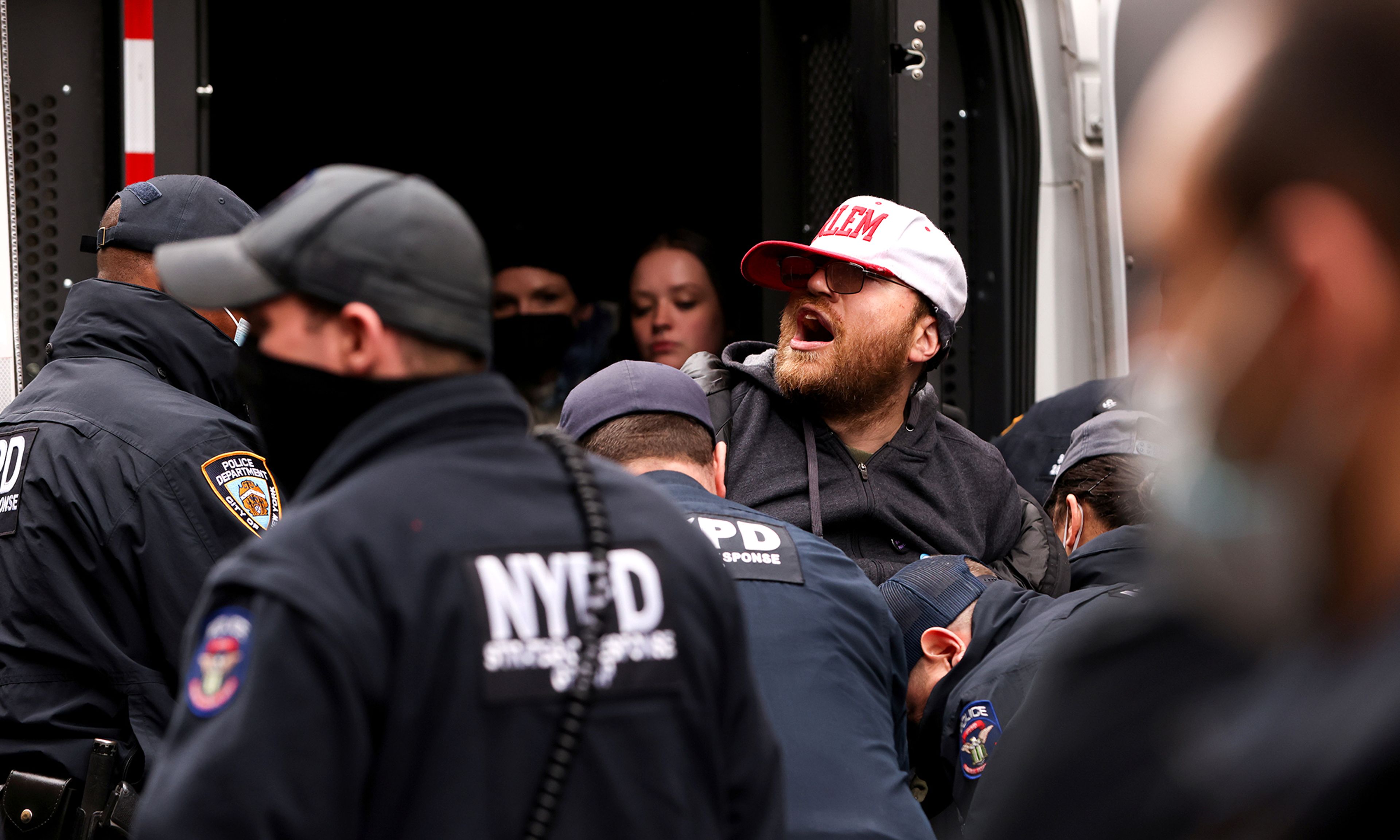
Since taking office on January 1, New York City mayor Eric Adams has focused intently on mental-illness-related crime and violence. For most New Yorkers, aghast at spectacles such as the mass shooting in Brooklyn on April 12, the need for such a focus is obvious. But many leading mental-health advocacy organizations, such as the New York Association of Psychiatric Rehabilitation Services, view things differently. As they see it, even asking whether mental illness causes violence risks exacerbating the larger mental-health crisis. They fear not only that stigmatizing the mentally ill will create discrimination but, what’s worse, that it will make people who need help too ashamed to seek it.
Mental-health advocates urge us to view mental illness as a social problem. The point is fair enough. Serious mental illness is generally assumed to be at least partly biological at root, even if the precise causal mechanisms remain obscure. (“Serious mental illness” is a government term that connotes a psychiatric disorder that impairs someone’s ability to function in ordinary society: hold down a job, maintain relationships with family and neighbors, etc. Most people considered seriously mentally ill have been diagnosed with either schizophrenia, bipolar disorder, or major depressive disorder.) But there’s no doubt that, from a clinical perspective, we neglect the social dimension of mental illness at our peril. An effective treatment program for schizophrenia includes many nonmedical components, such as housing, personal relationships, and meaningful daytime activities. Medication may suffice for many illnesses, but not for this one.
Accepting that mental illness is a social-policy question, however, can lead in more than one direction. The seriously mentally ill won’t thrive in a society that’s unfriendly to their needs and proclivities. Mental-health advocates see stigma as the main reason why mentally ill people so often do fail to thrive in ordinary American society. But there is another contender: high rates of crime. If we can’t control crime, we can’t more broadly provide the mentally ill with communities suitable for recovery.
One standard way to evaluate the connection between mental illness and violence is to look at epidemiological studies. In this approach, researchers take two large population samples, one composed of people with serious mental illness, the other of people without it. When the two are compared, researchers typically find the seriously mentally ill cohort to be more violent. According to one summary of the research, by the Treatment Advocacy Center, based in Arlington, Va., 10 percent of all homicides are committed by people with schizophrenia or bipolar disorder, conditions that afflict 3–4 percent of the population.
For many, the epidemiological evidence will suffice to settle the question as to the connection between mental illness and violence. Those who oppose the stigmatization of mental illness disagree: The real problem, they say, is that the mentally ill are more likely to be victims of violence than perpetrators. This claim is based soundly enough in the research but too often sophistically deployed. Focusing on rates of victimization creates the impression that those rates have no connection whatsoever to rates of perpetrating violence. But in various criminological contexts, groups associated with elevated rates of committing crime are also associated with higher rates of suffering crime. Examples include gang members, homeless people, and the average citizen of an unsafe neighborhood. The seriously mentally ill also spend more time than those without mental illness in circumstances in which crime and violence are almost normalized.
A great deal of the violence perpetrated against mentally ill people is done by other mentally ill people. Two recent examples would seem to be the series of shootings of homeless people in New York and Washington, D.C., this year and the series of fatal subway stabbings on New York’s A train in early 2021. Homeless shelters can be dangerous places, as attested by surveys of people living on the street who’d previously made use of them, by police statistics, and by academic studies. It is not clear who, other than homeless-shelter clients themselves, could be making them so. It is hard to know what, if not mental illness, would motivate someone to push a stranger in front of an approaching subway train — particularly when, after such an incident, the alleged perpetrator proclaims, “I’m God.” Other violent crimes that credible research has found to be disproportionately committed by the mentally ill include mass shootings and intra-family violence.
Regarding spectacularly brutal crimes with a straightforward link to mental illness, a fair question to ask is: How representative are they? There are 350,000 to 400,000 seriously mentally ill people in American jails and prisons. They’re not all there because they threw their four-year-old brother off the roof of a seven-story building, as one man did a few years ago, “to see if God could protect the kid.” Mentally ill offenders’ crimes are often more mundane, and the causal role of mental illness less direct. In other words, a crime committed by a mentally ill person is not the same thing as a crime caused by mental illness. Mentally ill offenders’ profiles typically feature numerous criminological “risk factors.” They tend to live in bad neighborhoods, to be unemployed and poor, and to abuse drugs and alcohol. Since mentally ill offenders share all these qualities with offenders without mental illness, the causal effect of mental illness itself has a way of washing out, at least to a degree.
But while spectacular crimes caused directly by mental illness may be rare, policy-makers and the public find them difficult to ignore. That goes just as much for subway pushings as it does for mass shootings. A core premise of Mayor Adams’s “Subway Safety Plan,” rolled out in February, is that mental-health reform, defined as reducing the rate of untreated serious mental illness in the community, can reduce crime and disorder. Many scholars, and all advocates, prefer the argument that mental-health reform is worth doing for its own sake. But where will the urgency come from? Violence has a way of concentrating attention. Congressional leaders believed that the series of mass shootings during the Obama presidency justified a push on mental-health reform. The result was a package of valuable reforms passed as part of the 21st Century Cures Act in 2016. That Congress succeeded refutes the idea that sustained public focus on the link between crime and mental illness makes the mental-health crisis worse.
Civic trust underlies the stigma debate. Even when conceding that violence and untreated serious mental illness are not wholly unrelated phenomena, most scholars will insist on numerous qualifications. The implication often seems to be that, unless the public understands that only a subset of mentally ill Americans are violence-prone, we’re at risk of a mass reinstitutionalization of the mentally ill.
The public may well be misinformed about the connection between violence and mental illness. But it’s possible that most citizens, if they ponder the connection between mental illness and violence, are in fact thinking of exactly the same subset of the mentally ill that experts have in mind. The average subway rider who supports Mayor Adams’s efforts to restore public order does not, when visualizing the problem, have in mind Simone Biles, adolescent TikTokers with Tourette’s, or blissfully medicated suburbanites in a drug ad. He is likely thinking of a symptomatic street person who’s shouting obscenities at random pedestrians. It is sensible to think that someone like that is more prone to violence than normal Americans.
Stigma’s importance is exaggerated. An October 2021 Wall Street Journal article lamented that many white-collar professionals don’t maximize their health plan’s mental-health benefits out of fear that “there could be repercussions if their employer finds out they have depression, anxiety or another mental illness.” Whatever may be the case there, when it comes to the seriously mentally ill, who should be policy-makers’ prime focus, stigma likely explains little about why they are not in treatment. Other powerful barriers to treatment include individuals’ dislike for medication’s side effects, disbelief that they have mental illness (what clinicians refer to as “lack of insight”), difficulty navigating the mental-health-care system’s notorious fragmentation (a problem even for those with mild mental disorders), and lack of resources. The writer Freddie deBoer recently attested in UnHerd: “Stigma, that cartoon monster, has never been in the top 100 of my problems in 20 years of managing a psychotic disorder.”
Stigma is a consequence of system failure. A mental-health system that worked better than the one we have would push down the proportion of serious mental illness that is not treated from its current level of at least one-third. One result would be a greater number of positive encounters between members of the public and schizophrenic and bipolar individuals. That would lead to a more positive, or at least more benign, public opinion of schizophrenia and bipolar disorder. Research supports the idea that lowering the rate of untreated serious mental illness would also reduce victimization. As the psychiatrist E. Fuller Torrey has explained, “the sicker people are, the more likely they are to be victimized.”
Across the nation, the “defund the police” movement is in retreat. But one core principle of the “defund” philosophy remains broadly influential: the belief that crime and violence are symptoms of deeper social problems such as poverty and behavioral health. Progressives have argued for decades that the more far-sighted approach to crime would focus on social-services investments that target criminal behavior at its roots. A traditional understanding of liberalism holds that government’s first responsibility is the protection of life and property. Proponents of “root causes” crime-fighting argue that securing life and property must wait until we’ve addressed social dysfunction.
The case of mentally ill offenders shows the flaw in this philosophy. Providers of mental-health services are strong candidates to receive funds meant for social improvement. But those providers will find it difficult to treat serious mental illness so long as they must contend with the many malign influences to which seriously mentally ill individuals are subject in the bad neighborhoods where often they live. Crime control would give the mental-health system more of a fighting chance, by stabilizing neighborhoods. Thus, crime control strikes at the root causes of our mental-health crisis.











Comments