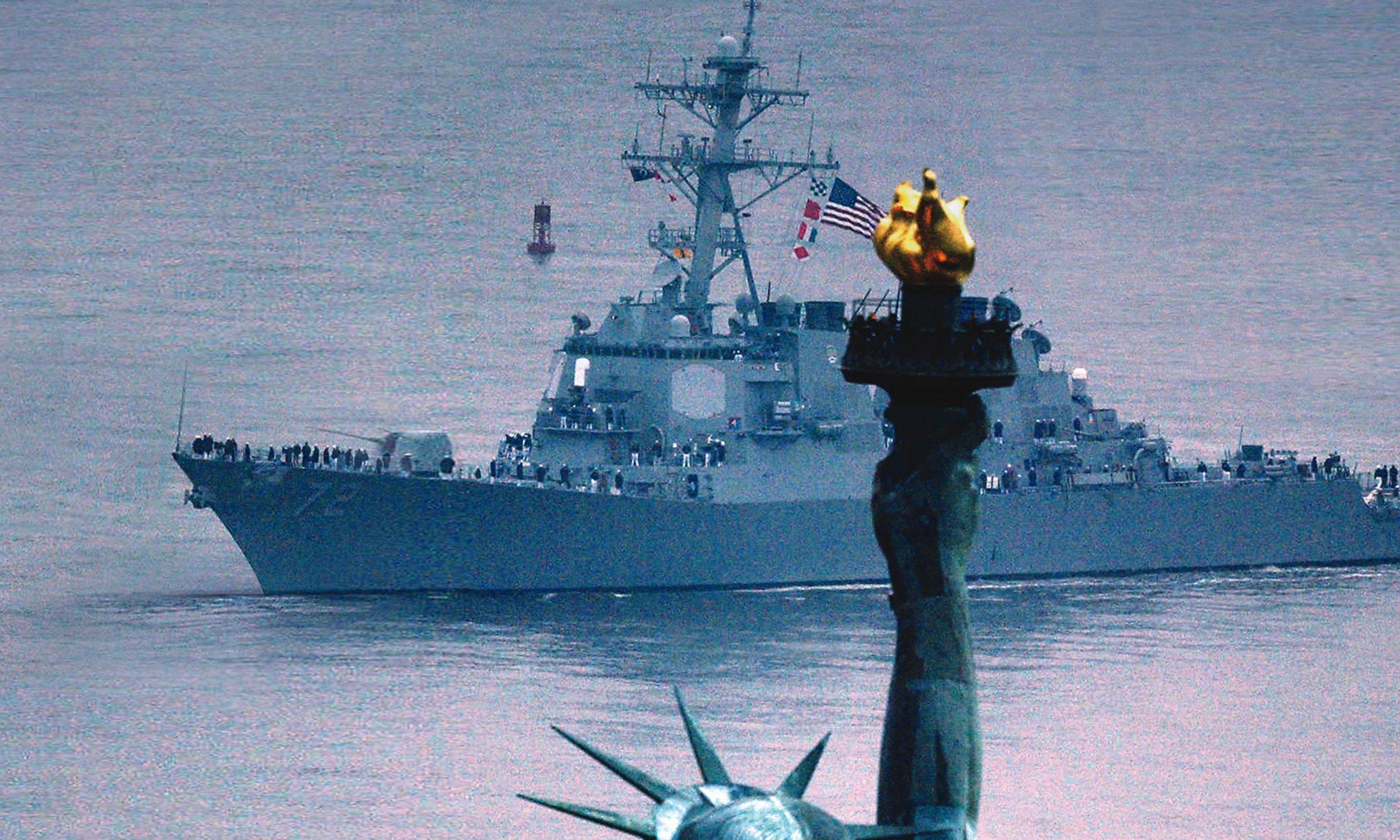
Seize the Seas
At the heart of Jerry Hendrix’s striking essay (“To Rule the Waves,” June 1) is a simple fact: America has the luxury of strategic choice. As he observes, sea powers are built on geographic opportunity, political participation, and cultural choice.
More than a century ago, the great American strategist Alfred T. Mahan stressed the need for a powerful navy to secure the American hemisphere from external threat and to support the promotion of American trade and values. He saw cooperation with like-minded nations as the key, foreshadowing the grand alliances that secured victory in the three global conflicts of the 20th century. In all three conflicts, command of the sea and cooperation with like-minded allies proved critical.
Today, the grand alliance of liberal-progressive trading nations across the world looks to the United States for strategic leadership against hostile authoritarian empires that challenge the fundamentals of those values. The current flash points stretch from Ukraine to Myanmar and the Western Pacific, and they challenge our shared values and interests.
The historical record is clear: Continental empires such as China and Russia close markets, control economies, and suppress liberty. When the British tried to impose a similar model on their empire in the 1760s, some of the colonies revolted. Overextension on land proved costly and put the security of the nation at risk. The British recognized they could not be powerful in all domains.
Hendrix suggests that the time has come for America to face the same reality. After 1782, Britain focused on the strategic, economic, and cultural advantages of being a sea power. It survived, prospered, and above all upheld its cultural and economic interests against a succession of continental tyrants and warlords, working with like-minded allies and partners.
Strategy, like identity, is a cultural construct. Continental military power distorts the body politic and the economy, something the Founding Fathers understood.
Andrew Lambert Laughton Professor of Naval History King’s College, London
Jerry Hendrix responds: Andrew Lambert is, as always, wise in his distillation of both his arguments from his 2018 book Seapower States and my own recent essay. It is indeed a moment for strategic choices. I again emphasize that the United States no longer has the option to be both a continental power and a sea power simultaneously and must choose. Professor Lambert’s words highlight the fact that sea-power strategies leverage the advantages of open, democratic, and free-market nations while continental powers progressively find themselves at odds with these ideals. Our strategic decisions today will not only impact our approach to competing with China and Russia; they will also set our own culture and society on a new course, for good or ill. Our future should not be accidental; we must consciously choose our path, and we must choose wisely.
Correction
“The Magnificent Mrs. Reagan” (June 1) stated that Landon Parvin worked with Reagan on the president’s remarks at Bergen-Belsen commemorating the victims of the Holocaust, on the heels of a controversy surrounding his visit to a military cemetery near Bitburg, Germany. In fact, Parvin did not draft those remarks. It also spoke of Loyal Davis’s son as becoming Nancy Reagan’s older brother; in fact, he was younger than she.











Comments