There have been three phases in the career of M. Night Shyamalan. A period of mainstream glory, from The Sixth Sense through (arguably) The Village, when he made hit movies that seemed to establish him as an heir to Steven Spielberg, a maker of supernatural thrillers for the masses, exercises in controlled suspense with a dose of moral-spiritual uplift. A period of hubris and debacle, beginning with the comically messianic Lady in the Water and descending to various unmentionable depths thereafter. And a period of professional recovery as a maker of modest horror movies as taut and simple as their titles — Split, say, or Old — with his earlier ambitions confined to the edges of the story.
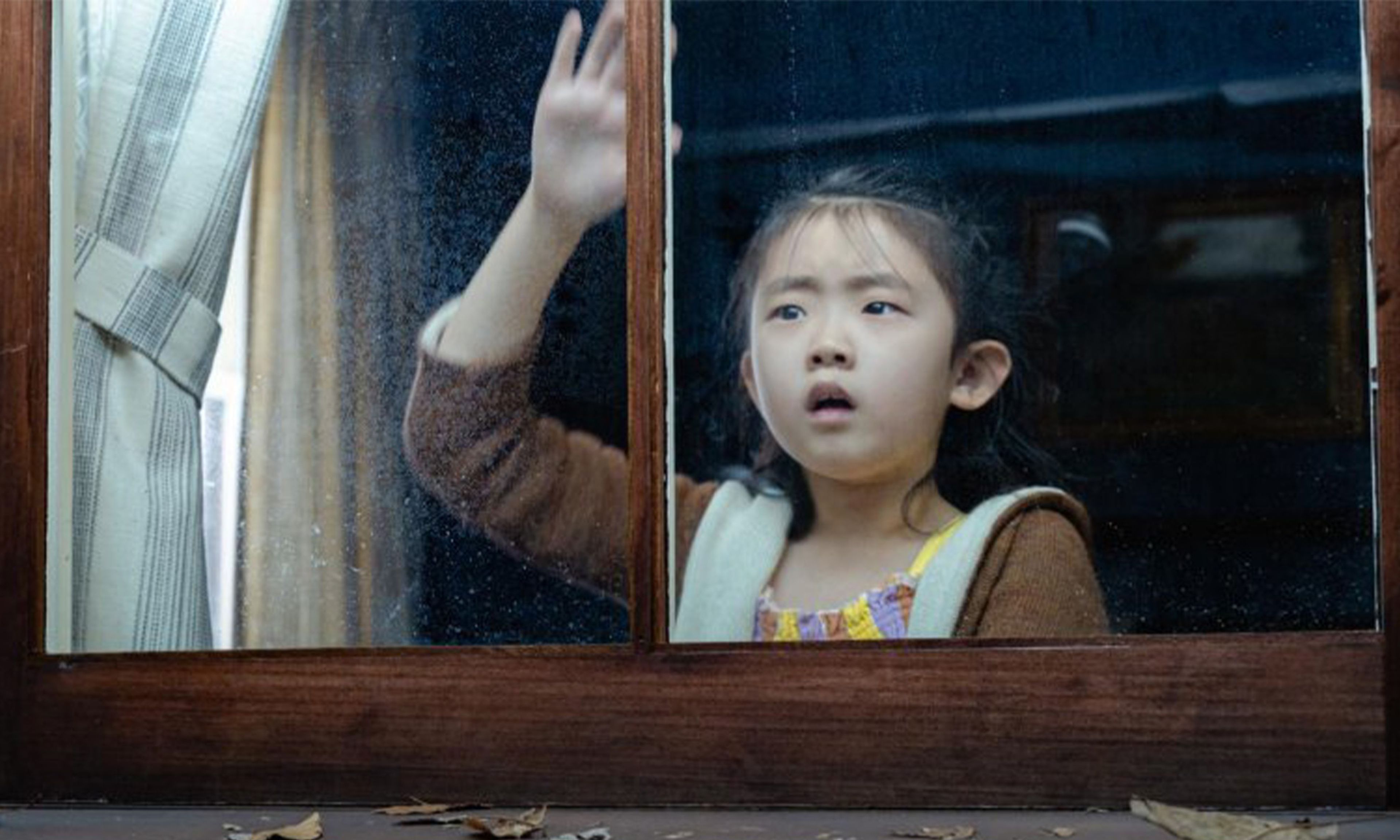
In the latest of these, Knock at the Cabin, the story is still self-contained and quickly told, but you can feel the old Shyamalan, the ambitious storyteller with the messiah complex, pushing a little harder on the material. The setup places a gay couple, Eric and Andrew (Jonathan Groff and Ben Aldridge), in a far-from-civilization vacation cabin with their adopted daughter, Wen (Kristen Cui). Their idyll is interrupted by the arrival of Leonard (Dave Bautista, in a terrific performance), a gentle hulk of a man who makes apologetic introductions to Wen while she’s out collecting grasshoppers. While she runs back to her two dads, he’s joined by Sabrina (Nikki Amuka-Bird), Redmond (Rupert Grint), and Adriane (Abby Quinn), and their quartet proceeds, first gently and then not so gently, to invade the cabin and hold Eric and Andrew and Wen prisoner while they issue their demand.
It’s a simple one: The two men and the little girl must choose one member of their family to sacrifice — kill them, that is, right there in the cabin. If they don’t, if they refuse the awful choice, the entire human race will perish in fire or darkness.
The invading four know this because, despite being strangers to one another, they’ve all had the same prophetic visions, which have brought them together in this horrible purpose that they’re sure is the only way to save the world. They won’t hurt Wen and Eric and Andrew; they’re just holding them prisoner, begging them to choose. But the invaders will hurt one another: At intervals, they ask if their prisoners are ready to choose a sacrifice, and every time Eric and Andrew answer in the negative, one of the quartet is ritually killed instead. And then the remaining invaders turn on the television, which reliably shows some sudden disaster — a Pacific tsunami, a possible pandemic — breaking on the outside world.
There are reasons to doubt these proofs, which Andrew, the more skeptical of the couple, latches onto. For instance, the initial shock of the Pacific earthquake hit before the foursome arrived at the cabin, so maybe they knew the tsunami was going to happen through non-supernatural means. And Redmond looks a lot like a guy who attacked Andrew years ago in a gay-bashing incident, which confirmed Andrew in an us-against-the-world attitude — a sense that now leads him to shout that, even if the rest of the human race could be saved by their sacrifice, it wouldn’t be worth it, he wouldn’t do it.
Long before the movie reveals whether the quartet is legit and the sacrifice necessary, it’s clear that the movie is not on Andrew’s side on principle — that he’s being asked to love the world enough, bigotries and all, to want it to survive even at some harrowing cost. This in turn has yielded a predictable online debate about whether the movie is “good for the gays” — whether the idea that a gay couple’s sacrifice could save humanity ennobles same-sex love (which appears to be Shyamalan’s intent), or whether the quartet represents some kind of QAnon-style religious fanaticism and the movie is allegorically “softening America up to accept and comply with even the outrageous and devastating demands of the religious right,” as the New Yorker’s Richard Brody recently declared.
Brody is a reliable source of hysterical readings, but this time I have a little sympathy for his outrage. Shyamalan has always had a fideistic streak, a fascination with blind faith (literally in The Village, where Bryce Dallas Howard gropes sightlessly through a hostile forest). But here his story’s setup is asking for the suspension of not just reason but morality, in obedience to a hypothetical Power that demands not just self-sacrifice but outright murder.
This scenario is not entirely alien to the biblical tradition (see Abraham and Isaac), but in general it’s ruled out: The God who loves the world does not ask His children to shed innocent blood for creation’s sake or any other purpose. Indeed, the formulation that hung in my mind while I watched Knock at the Cabin belongs to John Henry Newman, who wrote that Christianity “holds that it were better for sun and moon to drop from heaven, for the earth to fail, and for all the many millions who are upon it to die of starvation in extremest agony, as far as temporal affliction goes, than that one soul, I will not say, should be lost, but should commit one single venial sin, should tell one wilful untruth, or should steal one poor farthing without excuse.”
I don’t have quite that kind of anti-consequentialist fortitude: If you told me that an act of shoplifting would prevent the apocalypse, I’d probably do it and hope to be forgiven. But if some dubious god demanded that I kill my spouse or daughter as the price of withholding divine vengeance from the world, I hope I’d have the guts to watch the heavens fall.












Comments