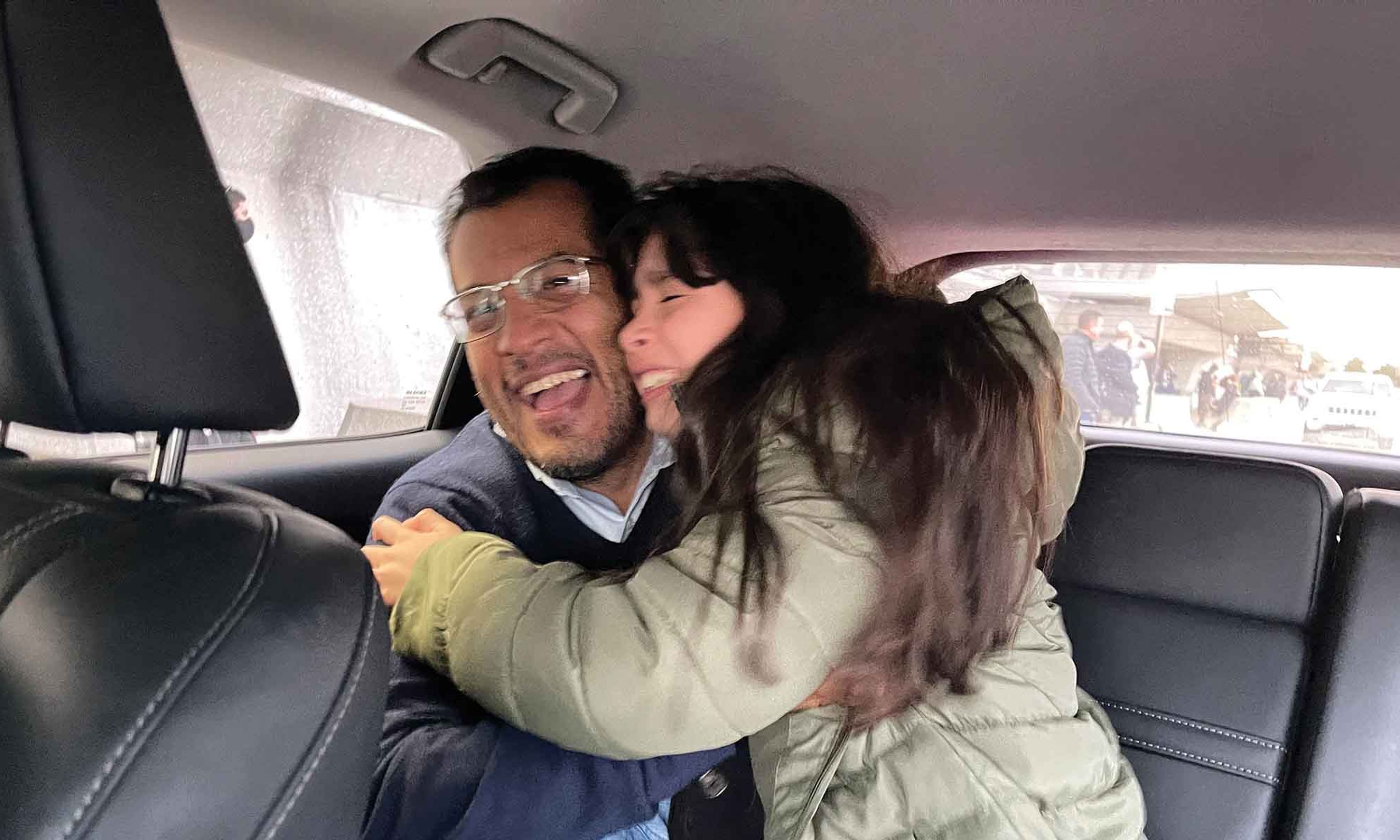
‘Is this a dream?” Alejandra kept saying. “Am I dreaming?” Alejandra is nine years old, and she was hugging her father, whom she hadn’t seen in almost three years. He kept assuring her: “You are not dreaming. It’s me. Your dad is here.”
He is Félix Maradiaga, the democracy leader from Nicaragua. He tried to run for president in 2021, opposing his country’s dictator, Daniel Ortega. On June 8 that year, he was arrested, along with other opponents of the regime. The dictator was cracking down.
Members of Maradiaga’s family have been in exile, in the United States, since 2018: his wife, Berta Valle; their daughter; and Maradiaga’s mother, Carmen Blandón. He had last seen them in March 2020.
Maradiaga spent 611 days — about a year and eight months — in prison. On February 9, he was released, along with 221 other political prisoners. On a charter plane, they were exiled to the United States. The Biden administration had placed great pressure on the Ortega regime, through sanctions and other measures. So had other democratic governments. Evidently, Ortega concluded that the prisoners were more trouble than they were worth.
I have known Félix Maradiaga for several years and admire him a great deal. I admire Berta, too, and interviewed her last fall. She has campaigned for Félix, and other Nicaraguan prisoners, tirelessly. She has had a partner in Victoria Cárdenas, the wife of another democracy leader, Juan Sebastián Chamorro. Like Félix, he had tried to run for president and had been taken prisoner. And like Félix, he was among the 222 released.
Both men were represented by Jared Genser, an American human-rights lawyer, who, pro bono, helps dissidents and political prisoners all over the world.
On February 10, the day after the Nicaraguans arrived in the United States, Berta sent me an audio message: a greeting from Félix. He sounded like himself — even in his second language, English. From what I could hear, he had not lost a beat.
Two nights later, he called me, saying, “I’m sorry for interrupting your Super Bowl.” (He knew that Americans, ritualistically, watch this game.) I could only reply, “You are my Super Bowl!”
Talking with him now, in a subsequent and extensive conversation, I ask him about his ordeal, starting with the day of his arrest. He was not arrested by regular policemen, he tells me. He was arrested by special agents of the regime — men known for their extremism and fanaticism. When arresting Maradiaga, they beat him severely.
They took him to El Chipote, the infamous prison in Managua. The name “El Chipote” has struck terror in the hearts of Nicaraguans for generations. “A lot of people have disappeared in El Chipote,” says Maradiaga. It’s like Evin, in Tehran: a place synonymous with evil.
Maradiaga is an academic, among other things, and he has studied dictatorship, and how to oppose it, for many years. “But nothing,” he says, “prepares you for El Chipote prison.”
The first 77 days, he was kept in solitary confinement. He was denied contact with his lawyer and with his family. He was permitted no contact whatsoever. Of food, there was very little.
In El Chipote, there was no drinking water at all, for prisoners. If they wanted water, it had to be brought by a family member, at 5 in the morning. A family member was allowed to bring two bottles of water, per day. But he or she had to show up at 5 in the morning.
Maradiaga’s sister, Ana, did this faithfully. Other prisoners were not so lucky. Maradiaga shared his water with them. Their families might have lived hours away from Managua, and transportation is a problem.
Toward the end of Maradiaga’s time in prison, family members were allowed to bring milk and juice, in addition to water.
Guards would tell Maradiaga, “You can have this juice, but you have to drink it in front of us, right now.” Sometimes he would reply, “No, thank you. I am not thirsty. Why don’t you have it?”
It was important to him to assert control over his own mind and body — not to be a plaything of the guards. “I knew they were trying to break us, physically and mentally,” he says. Early in his confinement, he fasted quite a bit, so that his body would get used to very small amounts of food and liquid. He wanted to reduce the leverage the guards held over him.
In general, prisoners were not permitted to speak. Occasionally, they could speak to cellmates (when they had them) in whispers, and the guards would let it go.
Maradiaga did plenty of speaking in interrogations. He underwent more than 400 of them, in his 20 months at El Chipote. He was interrogated about everything he had ever done: every action he had ever taken, every article he had ever written, every interview he had ever given. (“They asked about the one I did with you, Jay.”) The interrogators were trying to establish him as a foreign agent, paid to tarnish Daniel Ortega’s reputation.
Characteristically, Maradiaga viewed the interrogations as teaching opportunities. I say “characteristically” because he is a natural and perpetual teacher and explainer. “I tried to speak with compassion,” he says. “I tried to open their eyes.” (The eyes of the interrogators.) “I don’t know if I got anywhere. It’s probably my imagination, but I think I was able to change a couple of hearts in those interrogations.”
During the 611 days, he was permitted no reading material, at all. In the final months, when the prisoners were allowed to receive milk or juice from family members, the guards removed the labels. The prisoners could not see even the labels on bottles.
“Did you ever feel in danger of losing your sanity?” I ask Maradiaga. The answer is no. He has a strong religious faith. And, day after day, he went through mental exercises. “I resorted to every crazy idea you can imagine,” he says. He tried to remember movies he had watched. And conversations he had had.
“I even thought up TED talks” — brief speeches to be given at TED conferences, held around the world. To one of his speeches, Maradiaga gave the title “Talk to Angels.” He tells me what was behind it — the speech and the title.
“Sitting there as a prisoner, I told myself, ‘When you are in hell, you can either talk to your own demons or talk to your own angels.’ My personal angels were Berta, Alejandra, and my mother, Carmen. I held imaginary conversations with them — and that would give me mental, physical, and spiritual strength.”
What of the guards and their attitudes? Was there any humanity evidenced by these men? Maradiaga thought he could sense something in their body language: a certain discomfort in dealing with political prisoners (as opposed to drug lords, say, or terrorists).
Toward the end of Maradiaga’s confinement, one of the guards said to him, “I am in a worse situation than you, because one day you may be free, but I am stuck here in this prison forever.”
“That was shocking to me,” says Maradiaga. “It let me know that even Sandinista supporters — even people who wear the uniform of the notorious Chipote prison — know that the Ortega regime is getting worse and worse.”
February 9 started just like any other day — but soon there was noise in the hallway, and the prisoners were made to change into civilian clothes. They were put on a bus, whose windows were closed and covered in black cloth. The prisoners were handcuffed and ordered to keep their head down.
Eventually, they arrived at the Managua airport. They saw before them a team of American diplomats — and then they knew.
When the plane took off, the prisoners — now ex-prisoners — sang the national anthem. And prayed. The moment was “bittersweet,” says Maradiaga. Sweet, because they were out of prison. Bitter, because it would be some time before they were allowed to return to their homeland. (If ever?)
Note something about the national anthem: It is illegal to sing it in Nicaragua. It is also illegal to raise the national flag. Why? Because the dictatorship sees both the anthem and the flag as symbols of the opposition.
The plane landed at Dulles Airport, outside Washington. To see and hug his family was “surreal,” says Maradiaga, and “a miracle.” Other exiles were unluckier — for they had had to leave their families behind.
There was another blow, to all of them: On landing, they learned that the regime had stripped them of their citizenship. The regime regards them as traitors and mercenaries. The ex-prisoners regard themselves, of course, as Nicaraguan patriots, unlike the brutes who rule the country.
Félix Maradiaga spent a few days in Washington, meeting with American officials, including the secretary of state, Antony Blinken. He is very, very grateful to Americans — officials and ordinary citizens alike — “for opening their hearts and their arms to us.” He hastens to say, however, that the United States can’t take in every freedom fighter, and every democrat, in the world. There is a limit to American power and influence. “It is our job to fix our own countries.”
What’s next for Maradiaga? He is thinking that through. “One thing I know is, I will never stop working for the freedom of my people. That’s my life commitment.” In the near term, he is getting reacquainted with his family. When he last saw Alejandra, she was six and unable to speak English. Now she chatters away in English, and Maradiaga has trouble steering her toward Spanish.
He is also reading — reading at last. What? The letters that his wife, daughter, and mother wrote to him, while he was in prison. Those letters could not be delivered to him. He is also reading the Bible.
When I talked with his wife, Berta, last fall, she said that one of her biggest challenges was “to keep hatred out of my heart.” Félix has the same challenge. “I want to make sure that my heart has no hard feelings,” he says. “We cannot work politically out of hatred. Hate is not a good incentive for political change.”
People who overthrow their oppressor, Maradiaga says, often wind up as oppressive as their enemies. “They become exactly what they hated.” He believes that this happened in Nicaragua when the Sandinistas replaced the Somozistas. And “I don’t want that to happen again.”
He says, “I dream of a better Nicaragua, even for those who put me in prison. I hold no resentment toward them. I hope that we can have a free and democratic Nicaragua, for the children of those who work in El Chipote and for everyone else. A Nicaragua in which we all fit, and where we can all live in tolerance, and under the same flag.”











Comments