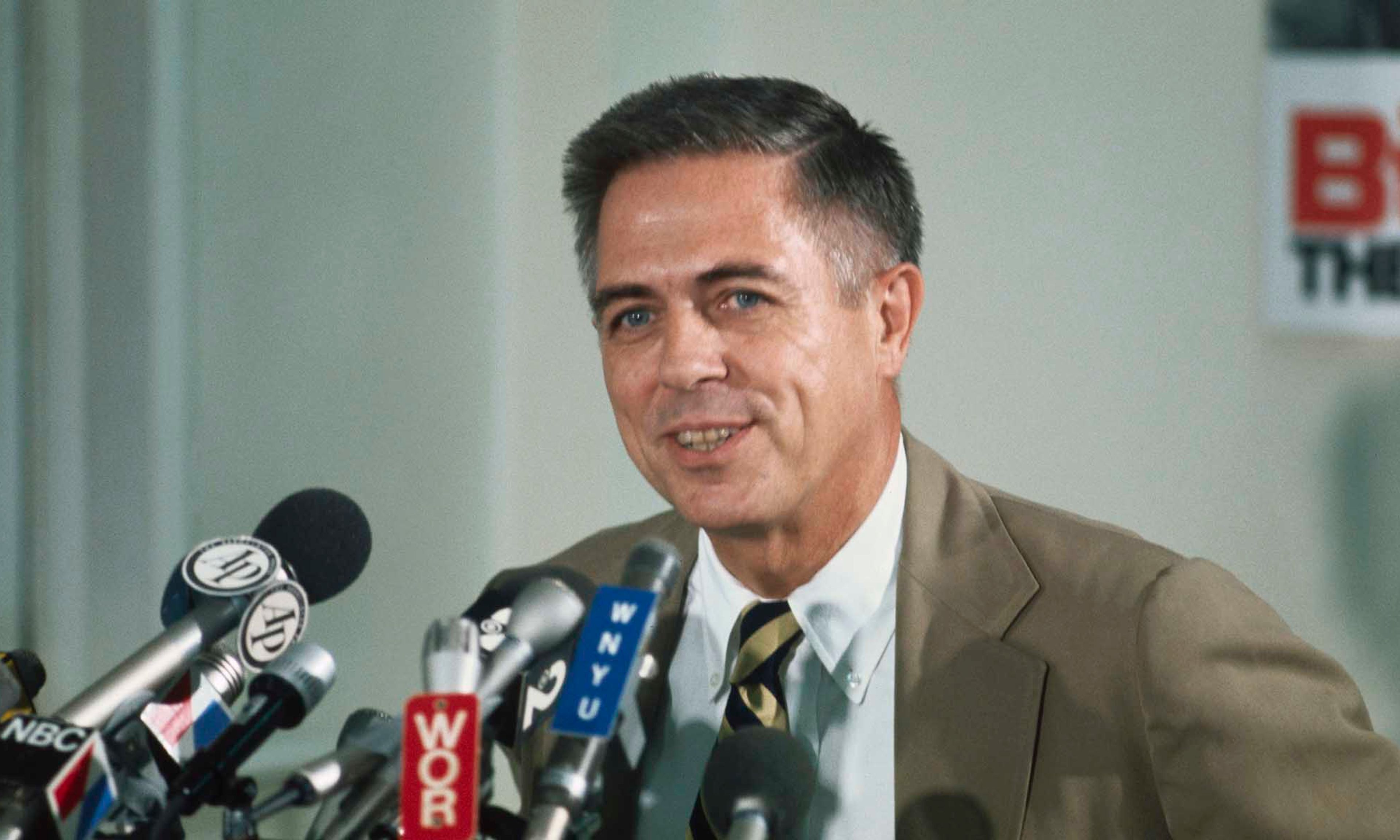
Editor’s Note: Jim Buckley, Bill’s older brother, is one of this country’s most distinguished conservatives, having served as a U.S. senator from New York, in Reagan’s State Department, and as a longtime federal judge. Jim’s last public address was given in 2019 at the National Review Institute Ideas Summit. In 2020, he was awarded the William F. Buckley Prize for Leadership in Political Thought. Now, in honor of his 100th birthday in March, National Review Institute is inaugurating the James L. Buckley Lecture on Principled Leadership to be given at the 2023 NRI Ideas Summit.
On March 9, one of the few people to have served in high positions in all three branches of the federal government will celebrate his 100th birthday. Over the course of a remarkable life, James L. Buckley has been a corporate lawyer, a U.S. senator, an undersecretary of state, and a judge for the D.C. Circuit Court of Appeals. He is the author of four books, an eloquent orator whose extemporaneous speech is as seamless and graceful as his prose, a committed naturalist, and a devoted paterfamilias. For conservatives in particular, Buckley’s centennial is an opportunity to retell his story, appreciate his legacy, and learn from him, too.
James is the fourth of ten children born to Aloïse Steiner Buckley and William F. Buckley Sr. His younger brother Bill, the founder of National Review, was No. 6, born in 1925. Though their parents were from the South, and though their family traveled abroad, the Buckley children spent much of their youth in Sharon, Conn. They imbibed their parents’ devout Catholicism and staunch opposition to President Franklin Delano Roosevelt. “When my parents were growing up,” James says in the interview that forms the basis of his memoir Gleanings from an Unplanned Life, “the Republican Party was the party that favored a strong central government. The Democratic Party was for states’ rights. The national parties changed their stripes; my parents didn’t.”
James went to Yale. He wrote for the Yale Daily News and kept a pet boa constrictor. The Japanese attack on Pearl Harbor on December 7, 1941, interrupted his sophomore year. He joined the Naval Reserve, finished his bachelor’s degree at the end of 1943, and entered active duty as an officer on an LST (landing ship, tank). He spent the next two years on the same vessel, supplying U.S. forces in Leyte Gulf, Lingayen Gulf, and Okinawa. “I witnessed a fair amount of action,” he says, “but never felt threatened.” In August 1945, when news arrived that the Japanese had agreed to surrender, James watched as the U.S. ships that were gathered in Leyte Gulf launched dazzling pyrotechnics.
After his honorable discharge, Lieutenant Junior Grade Buckley enrolled in law school at Columbia before transferring to Yale. (His brother Bill was then an undergraduate.) James wanted to be a country lawyer. He received his law degree in 1949, settled in Connecticut, and through family connections met and courted Ann Cooley, who wed him on May 22, 1953. The couple had six children and were married for 58 years before Ann’s death in 2011. “The only flaw I have been able to detect in over 50 years of marriage,” James wrote in 2006, “is her refusal, as a matter of misguided principle, to cross either the Arctic or Antarctic Circle.”
Also in 1953, James joined his father’s energy business. The job at the Catawba Corporation involved a fair amount of international travel, including return trips to the Philippines. Over the next twelve years, James’s family grew and prospered, mainly out of the public eye. Circumstances changed, however, when Bill launched a campaign to become mayor of New York City.
In the spring of 1965, James was traveling in California with his wife and children. Bill reached him on the phone. Bill said he was going to run for mayor as the Conservative Party nominee. Would Jim be Bill’s campaign manager? “I said, ‘Bill, I don’t know anything about campaign managing,’” James recalled. “Bill answered that that was not important.” No one believed that Bill Buckley would win — especially Bill Buckley. What Bill needed was someone he could trust, someone who could shield him from amateurs, gadflies, and cranks. James signed on.
Bill Buckley did lose, as expected, but not before articulating a detailed platform, having a great deal of fun, and revealing that a sizeable number of working-class Democrats were open to the ideas of National Review. The mayoral campaign in retrospect had three significant consequences: It provided the material for one of Bill Buckley’s best books, The Unmaking of a Mayor; it inspired his long-running public-television show, Firing Line; and it introduced James Buckley to electoral politics.
The connection would last. When New York’s liberal Republican U.S. senator Jacob Javits was up for reelection in 1968, the Conservative Party asked James to be its nominee. He agreed and used the campaign to flesh out his distinctive brand of constitutional conservatism. In addition to advocating federalism, limited government, and the separation of powers, James Buckley articulated a vision of freedom that encompasses environmental conservation as well as policies intended to encourage economic self-improvement among black Americans.
James lost in 1968. He thought he was done with elections. “Then,” he writes in his memoir, “in the next couple of years, in 1969 and 1970, some very strange things started happening in the United States.” The anti-war movement and campus counterculture turned violent. Bombings, shootings, and assassinations were on the rise.
A Palestinian terrorist murdered New York senator Robert F. Kennedy in the summer of 1968. Governor Nelson Rockefeller appointed GOP congressman Charles Goodell — father of the current NFL commissioner — to serve out Kennedy’s term. In James’s view, Goodell was moving in the direction of the radicals, his policies were wrong, and he was pushing the Republican Party to the left. To stop this trend, James joined the 1970 Senate race as the Conservative Party candidate.
Conservatives rallied behind him. F. Clifton White, architect of Senator Barry Goldwater’s presidential nomination six years earlier, was James’s campaign manager. John Wayne recorded a television ad. Spokesmen for blue-collar “hard hat” voters backed James’s candidacy. “It was enough that I stood by our men in Vietnam,” he writes, “and had called for enforcing the law against student vandals and arsonists.” James was the silent majority’s surrogate for national pride, middle-class values, and support for the troops.
Critics pointed out that James Buckley’s main home was in Connecticut. He replied that his job was in New York, along with his apartment, and that he had been paying taxes to the Empire State since 1953. In so doing, he defused the “carpetbagger” charge.
Early in the morning of November 4, the race was called for James. He won 39 percent of the vote, enough for first place in a three-way contest. He was the first third-party candidate to win a Senate race since Progressive hero Robert La Follette Jr. in 1940. “The American people want a new course, they want a new politics,” James told the crowd at his victory celebration. “And I am the voice for that new politics.”
Buckley’s Senate office became a proving ground for conservative talent. It was filled with men and women who would become prominent in D.C. policy-making circles: speechwriter William Gavin, defense expert William Schneider Jr., polling guru Karlyn Bowman, and attorney Kate O’Beirne. James would give young people The Federalist Papers — though in the 1970s he had trouble finding copies in print.
His term as senator was a case study in principled statecraft. He chided his colleagues for overstepping their mandate by violating the strictures of federalism. “When considering the merits of a particular bill,” he writes, “I would consciously apply the ancient ‘rule of subsidiarity,’ which holds that political authority should be assigned to the lowest level that is capable of exercising it.” By this standard, environmental protection was a congressional prerogative. Why? Because pollution does not obey state boundaries.
Many of James’s Senate initiatives are relevant today. He lobbied for tax rates to be indexed to the inflation rate, an idea that became part of the Reagan tax bill in 1981. In the spring of 1973, a few months after the Roe v. Wade decision, he introduced the first version of the Human Life Amendment to the U.S. Constitution, applying Fifth and 14th Amendment protections “to all human beings, including their unborn offspring at every stage of their biological development, irrespective of age, health, function, or condition of dependency.”
The Family Educational Rights and Policy Act of 1974, otherwise known as the Buckley Amendment, stipulated that parents have rights in their children’s education. In January 1975, James filed a lawsuit against Francis Valeo, secretary of the Senate, over spending and political-contribution restrictions established in a law passed the previous year. “The core value protected by the First Amendment is the freedom of political speech,” James writes. Campaign-finance regulations violate that guarantee.
In an unusual — and perhaps the only — collaboration between a Buckley and the American Civil Liberties Union, Buckley v. Valeo went to the Supreme Court. Its decision was complicated and confusing. The Court struck down limits on campaign spending but maintained the limit on contributions, favoring millionaires and billionaires who self-fund campaigns. The experience soured James on the political process. Congressmen would have to spend even more time scrounging for money. And the Court had played lawmaker rather than impartial arbiter.
James’s political courage lessened his chances of reelection. In March of 1974, he became the first conservative member of the Senate GOP conference to call for Richard Nixon’s resignation over the Watergate scandal. Buckley’s statement, written in collaboration with National Review senior editor James Burnham, said that Nixon’s stepping down would be “an extraordinary act of statesmanship and courage” and would spare the country impeachment proceedings and social disruption.
James’s fellow conservative senator Barry Goldwater disagreed. And Goldwater was not alone. Angry mail and phone calls flooded Buckley’s office for his betrayal of a Republican commander in chief. In the end, of course, Nixon did resign. After the damage was done.
The next year, in an interview with his brother Bill, James said that “the Watergate episode, and others leading up to it, illustrate the fundamental conservative principle, and that is if you concentrate enough power, especially discretionary or arbitrary power, in any one place, at some point or another it’s going to be abused.”
This belief in the dispersal of power, among the branches of government as well as the levels of government, informed James’s decision to oppose a federal bailout for New York City in 1975. In an exercise of civic virtue, he put the public interest ahead of the parochial interest of his city and state. New Yorkers never forgave him. When James ran for reelection in 1976, activists handed out leaflets displaying the famous New York Daily News cover — “Ford to City: Drop Dead” — along with a line reading, “Buckley was the pallbearer.”
Buckley faced a single opponent that year. The Democratic nominee, former U.N. ambassador Daniel Patrick Moynihan, positioned himself as an alternative to the increasingly radical politics of the progressive Left. “In making the case for federal help,” wrote Norman Podhoretz in Breaking Ranks, “Moynihan was thus simultaneously able to mount a general defense of the liberal welfare state against its enemies on the Right.” Moynihan accused James of having his feet planted in 18th-century concrete. James pleaded guilty so long as the concrete was understood to be the principles of the Constitution and the Declaration of Independence.
Moynihan defeated Buckley 54 percent to 45 percent.
James was not finished, however. Four years later, he ran for Senate in Connecticut as a Republican. His opponent was Democrat Christopher Dodd, son of longtime Connecticut senator Thomas Dodd. James lost once more — in a GOP year — by 13 points. Meanwhile, Ronald Reagan won Connecticut by ten points. James’s Senate days were over.
The Reagan Revolution, however, was just getting started. James signed on. Reagan appointed him first as an undersecretary of state, then as head of Radio Free Europe/Radio Liberty, and finally as a federal judge. He spent 15 years on the federal bench, practicing judicial restraint and opposing the concept of a living Constitution that evolves according to the whim of liberal jurists.
Whatever the office he occupied, James exhibited the same dignity, consideration, reserve, and conviction. He has defended the American system of checks and balances and federalism. His books advocate limiting government through block-granting federal grants-in-aid to the states, establishing term limits, and abiding by the original understanding of the Constitution. Nor has he wavered from the credo he set forth in the preface to his 1975 book, If Men Were Angels, where he wrote, “I believe that in the last analysis the most important thing in social and political life is freedom, and I believe that it is because of the safeguards written into the Constitution, and the character of the American people, that we have enjoyed it in so great a measure.”
James went on to say that his “first goal in political life” is “to defend, preserve, and expand the realm of freedom.” Rarely has the conservative mission been so well stated. But then, a man as humble, thoughtful, wise, and brave as James L. Buckley is rare indeed.












Comments