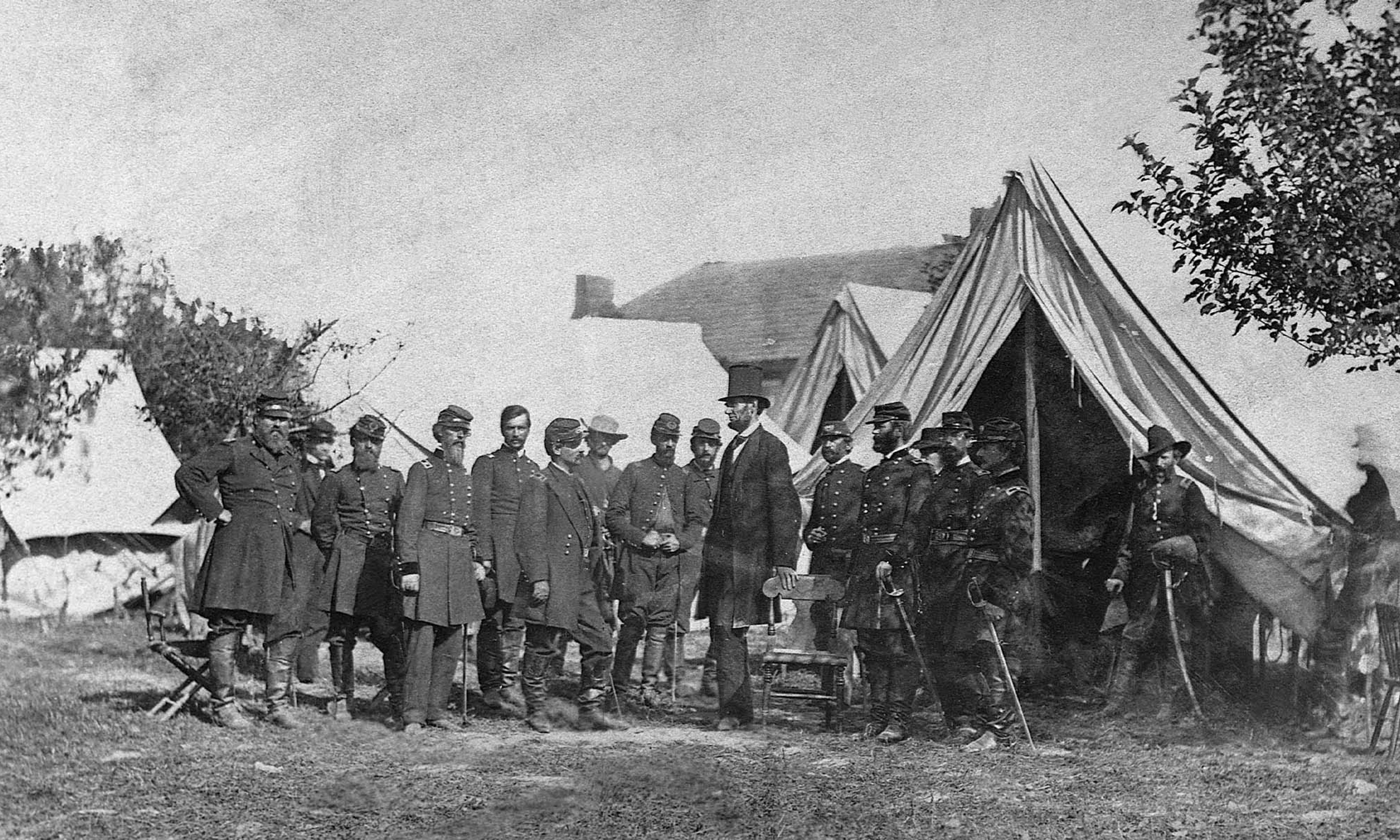
Stephen Budiansky’s new book on the Civil War’s most catastrophically bloody day, at Maryland’s Antietam Creek on September 17, 1862, is an unexpected departure for him. Since 1992, Budiansky has written 18 books on topics as varied as animal husbandry, the War of 1812, and spycraft, but this is his first venture into one of the most written-about eras in American history. What makes this new work even more surprising is the unpredictable but rewarding twist he puts on that peculiar genre of Civil War history, the “battle book.”
The Civil War was, of course, a war, so it’s no surprise that battles would be centerpieces of historical writing about it. At its best — in the hands of Bruce Catton, for instance — a Civil War battle narrative can have all the evocative sorrow of a Charles Ives symphony; at its worst, and most frequent, it can sound blandly similar to a description of a football game.
In 1974, in The Face of Battle, the late British military historian Sir John Keegan asked us to step away from that latter kind of battle-book writing. Keegan turned instead to the aural, visual, and emotional impact of battle — what it smelled like, what could be seen, how soldiers relied on one another, why some units disintegrated and why others fought like machines. It was an approach taken up by Richard Holmes in a succession of books about the British soldier over the years, and in Holmes’s Acts of War in 1986, and by Paddy Griffith in Battle Tactics of the Western Front: The British Army’s Art of Attack in 1994.
But apart from Griffith’s Battle Tactics of the Civil War, plus the numerous studies by Earl Hess of Civil War logistics and weapons technology, and Edward Hagerman’s The American Civil War and the Origins of Modern Warfare (1988), what became known as “the new British military history” has not had a comprehensive application to the American Civil War — not even, ironically, by Keegan himself in his final book, The American Civil War: A Military History (2009).
John Keegan, Richard Holmes, and Paddy Griffith appear nowhere in Budiansky’s bibliography, although Hess and Hagerman do, and perhaps that division of focus explains why Budiansky’s book on Antietam takes us in a very different and very welcome direction in Civil War battle history, and yet not nearly far enough.
Antietam is one of the lost battles of the Civil War, overwhelmed by the vast outpouring of books on Gettysburg, Vicksburg, and Shiloh. Antietam’s most comprehensive researcher, the Antietam veteran Ezra Carman, did not live to publish the detailed history of the battle that he assembled from a voluminous correspondence with its survivors (although Tom Clemens patiently guided Carman’s manuscript into print as a three-volume set with the first volume published in 2010). Antietam had to wait until 1965 and James V. Murfin’s The Gleam of Bayonets to get a compelling modern accounting. This was followed by Stephen Sears’s Landscape Turned Red in 1983, by the late Joseph L. Harsh’s three careful explorations of the Antietam campaign in the late 1990s, and most recently by D. Scott Hartwig’s two enormous volumes, To Antietam Creek (2012) and I Dread the Thought of the Place (2023).
This may seem like an impressive shelf of books for just one day in the fall of 1862. But compared with Gettysburg, on which almost a full-length book exists for every ten minutes of the battle, this comes close to outright neglect. Part of that neglect stems from Antietam’s lack of a clear-cut victor. Robert E. Lee’s Confederate Army of Northern Virginia came close to destruction at the hands of George McClellan’s Army of the Potomac. But only close. Lee bluffed McClellan for a day after the battle, then withdrew across the Potomac River, rebuilt his army, and fought for two and a half more destructive years. McClellan himself is a second reason why Antietam comes up shy. He is the Union general we love to hate: a man with the perfect résumé and no imagination, a soldier who made no secret of his contempt for Abraham Lincoln, a narcissist whose letters read like a mirror in which he preened. Above all, Lincoln did not give an Antietam Address to hallow that particular ground. He visited Antietam only weeks after the battle, but he delivered no speech.
Or did he? Five days after the battle, Lincoln released the preliminary version of his Emancipation Proclamation, a release that he explicitly said the battle had made possible. That, Budiansky insists, made Antietam “a moral victory for the Union.” And, Budiansky adds, Antietam was also remarkable for the relentless and unprecedented fury of the battle. Its aftermath of littered corpses was captured, for the first time in the American experience, by the battlefield photography of Alexander Gardner. Both the nation and its professional soldiers were utterly unprepared for the scope and violence of the war’s battles; Antietam taught them otherwise. In a republic of small towns and a Maryland of small farms, nothing on the scale of this battle had ever been dreamt of, and its impact was devastating.
Still — and this is the most remarkable argument of the book — the wordless shock of what happened that day in David Miller’s cornfield, in William Roulette’s sunken farm lane, and across the Rohrbach Bridge did not turn these soldiers into whimpering, hopeless skeptics. It has been fashionable over the last 20 years to speak of a “dark turn” in Civil War history-writing, emphasizing the war’s “atrocities, disease, suicide, alcoholism, and mental illness.” But Budiansky interrupts this litany of woe by showing how the soldiers stared that frightfulness in the face, and without flinching. They understood that they were fighting for “a cause greater than themselves,” a cause “openly exalted and valued” that “became a source of solace to those who endured its ordeal.”
If Budiansky comes to new conclusions about Antietam, he also organizes his story of battle in a new way. Conventionally, Antietam is defined by three phases: the early-morning fighting for control of the Hagerstown Pike, the attack on the Sunken Lane, and the last-minute repulse of the Union advance that had swept over the Rohrbach Bridge and almost into the undefended rear of the Confederate army.
Budiansky ignores this. Instead, he writes nine biographical chapters, each of which focuses on a significant individual: Lee, the classic product of pre-war West Point; McClellan, the wonder boy who was afraid to fail; Jacob Cox, McClellan’s relentless critic; Jonathan Letterman, the chief surgeon of McClellan’s army; Oliver Wendell Holmes, the sadder but wiser veteran; James Longstreet, the unappreciated master of operations; Gardner, the photographer; Clara Barton, the wonderworker nurse; and finally Lincoln.
This means that Budiansky actually spends comparatively little of A Day in September narrating, in the way so beloved of Civil War battle narrators, the play-by-play of the action on the battlefield. We are well over halfway through the book before Joe Hooker makes his first move into Miller’s cornfield, while the fighting in the Sunken Lane and over the Rohrbach Bridge occupies no more than 15 pages. Nor is there the deep dive into archival sources that we find in Harsh or Hartwig, and one can rightly fault Budiansky for fashioning his descriptions of the fighting from an unreasonably small number of well-known memoirs and letters.
What he accomplishes in compensation, however, is well worth exploring. He understands, even if instinctively, that the war was a pain-studded classroom in operations — in logistics, intelligence, staff coordination — that no one had ever thought to teach at West Point in the pre-war days. Even those officers who had direct experience in the Mexican War of 1846–48 had no real understanding of combat beyond “the level of companies and regiments.” No one, for instance, seemed to know what was to be done with cavalry at Antietam; no one seemed to care that half of the Union soldiers who made up Joseph Mansfield’s Twelfth Corps were fresh recruits who barely knew how to get through the manual of arms, much less go into battle.
Occasionally, Budiansky’s lack of depth in his subject betrays him. Longstreet was not a prophet of future operational warfare, Clara Barton was not the monster that Elizabeth Brown Pryor made her out to be (as Pryor did with almost everyone she wrote about), Fitz John Porter was not a selfish oaf. And, for all that one can fault George McClellan as a field commander, his reorganization of the Army of the Potomac in the two weeks prior to the battle really was little short of an organizational miracle.
But these shortcomings are paid for by the extraordinary coin of Budiansky’s attention to the Keegan-like details: the civilian after-battle deaths from unexploded ordnance, the officers who came unhinged by the blood and noise, the smell of the Confederate army on the march. After this 19th book, I am sure that Budiansky has more than a few more in his quiver; I am inclined to hope that he will not turn away from another exploration, in thicker detail, of the Civil War.












Comments