
Dolly Parton — singer, songwriter, philanthropist, and all-round American treasure — was born in 1946, the fourth of twelve children, and then raised on much love and little else in the Great Smoky Mountains of East Tennessee. As a teenager, Parton recalls, she saw a woman who people said looked like trash, but who she decided was “the most beautiful woman in the county.” Parton would see her, all dolled up with “her big dyed hair, her bright red nails, her feet squeezed tight into her high heel shoes, and all paint and perfume,” and, behind her family’s back, she began to imitate her style. Before long she was busted by her mother, a good southern woman. “Do you think you will ever get to heaven looking like that?” she said. “Of course I wanna go to heaven, Mama,” Parton replied. “But I don’t think I have to look like hell to get there.”
To this day, the tension between how Parton appears (tacky and over the top) and her deeply rooted Christian faith is the emblematic paradox of her brand, inasmuch as it is a brand. Parton is an inside-out celebrity. For underneath the blonde wigs, thick makeup, and flamboyant outfits tucked in tight at the waist to accentuate her ample bosom, beneath the layers of Botox and plastic surgery, beats an impossibly genuine heart. A heart for the Lord!
Because authentic goodness is so rare, and because having the canniness to dress it up with artificiality is so disarmingly clever, many people admire Parton. (They also admire her, of course, because she is fabulously talented, rich, and famous, and those sorts of things impress people.) And yet there is a tendency to translate Parton’s attractive, essential goodness (i.e., her Christian faith) into whatever it is her admirer most admires about him- or herself. That means that when Parton expresses something that cannot be so easily adapted for an egotistical or political purpose — something explicitly about God, for instance — it is typically ignored or distorted or else the cause of irritation. This tendency is the main flaw of Sarah Smarsh’s She Come By It Natural, a progressive-feminist tribute to a brilliant artist who is neither a progressive nor a feminist. The antidote to such a misreading is to return to the original source, which can be done with the truly beautiful coffee-table book Dolly Parton, Songteller: My Life in Lyrics and Parton’s accompanying albums.
Dolly Parton has lived a remarkable life. She went from rags to riches in true American style. She married only once, and she and her husband, Carl Dean, are still going strong 54 years later. She’s sold over 100 million albums and stands eternal in the Songwriters Hall of Fame. Since 1964, she’s had more than 3,000 published songs to her name, spanning a broad array of genres. She has starred in popular and enduring movies, written musicals, authored memoirs and other books, provided millions of children with free books through her Imagination Library, funded countless other worthy causes, and even been awarded an honorary doctorate. And yet, she says, “I’ve often been misunderstood, and it has taken 40 years for people to realize how serious I am about the music.” Today, she is a phenomenal and undeniable success. But in her early days, her future was by no means guaranteed.
Parton was hardly the only woman in the 1960s who had to fight for fair treatment. Some people thought women had no business writing music. Others were suspicious of the way she dressed; they didn’t like the size of her breasts, or the fact that she was always on the road and in the company of men other than her husband. Yet rather than wasting time justifying herself, complaining, or giving way to self-pity, Parton shrugged it all off, leaning into the caricatures and false accusations with a healthy dose of ironic detachment and self-deprecating humor. She knew she could laugh, because the joke was really on her detractors. She knew exactly who she was and what she was about. And still does.
Though Parton has always resisted the label of “feminist,” Smarsh suggests that, at the very least, she behaves as one. Smarsh argues that while Gloria Steinem was writing
about reproductive rights, the patriarchal institution of marriage, and the socioeconomic inequality that often accompanies motherhood, Parton gave Maclean’s the same message in 2014: “One of the reasons I think I’ve done so well is because I’ve had the freedom to work. . . . I never had children and I never had a husband who’s wanted to bitch about everything I did.”
But to see this as an affirmation of feminist dogma is to mischaracterize what Parton has called a “dark time” in her life.
After enduring “female trouble” in her 30s, she was unable (not unwilling) to have children. Moreover, she has described the missed opportunity of motherhood as a source of heartache, not feminist liberation. Yet, rather than wallow, she decided to make the best of it, acknowledging that having children must not have been part of God’s plan for her, and giving thanks for the countless other blessings.
Still, Parton’s songs about children (of which there are many) are tinged with tenderness and tragedy. She wrote “Jeannie’s Afraid of the Dark,” about a little girl who dies and whose family put an eternal flame on her grave. The song was inspired by the memory of her baby brother Larry, who died when Parton was nine years old. Parton chokes up whenever telling the story of how she had been assigned to be Larry’s “little mama.” (The older siblings were each given a young one to look after, and Larry was to be hers.) When Larry died suddenly, soon after birth, “it just absolutely crushed” her. She remembers seeing his little dead body in his coffin and it feeling “like I’d lost a baby of my own.”
As for “reproductive rights,” it is true that girls in trouble do feature in Parton’s songs. Perhaps the most famous example is “The Bridge,” in which a girl plunges into a river, taking her “unborn child” with her. Yet rather than serving as an endorsement of abortion, these stories mainly speak of the cruel abandonment of desperate women and girls by those who were obliged to help them — namely, their boyfriends, families, and society, in that order. And as for “the patriarchy,” Parton’s songs feature plenty of good men, such as those in “The Man” and “Daddy’s Working Boots,” none of whom fit the profile of male feminists. Indeed, Parton’s songs do not tear down masculine norms but rather honor self-sacrifice and male strength.
Parton’s hit single “Just Because I’m a Woman” (1968) is another brave and challenging song frequently claimed by feminists. It is arguably the most personal song Parton has written. Shortly after they were married, her husband asked whether she’d ever been with anyone else. When she said that she had, he was crushed, and she felt rejected. But then, after some thought, she wondered, given that he also had a past, what made him think that he deserved an angel? The lyrics go:
Yes, I’ve made my mistakes,
But listen and understand,
My mistakes are no worse than yours
Just because I’m a woman.
In the recent Netflix documentary Dolly Parton: Here I Am, musicologist and author Lydia Hamessley says that Parton was saying in this song that “if it’s okay for the men [to have premarital sex], it’s okay for the women.” But if that’s true, why does she use the word “mistakes”? Given that Parton frequently describes herself as a Christian, and never as a feminist, and given that it is a fairly mainstream Christian belief that it is damaging for both parties to fool around with other people before marriage, isn’t it more likely that she’s saying that if it’s not okay for the women, then it’s not okay for the men? Or, even more simply, it can be taken as a song about forgiveness, mutual understanding, and not dwelling on the past.
“A woman can leave the poor countryside and a domineering male boss, but she can’t leave a culture of sexism and misogyny,” writes Smarsh. “Mindfully reject it every day with some success? Perhaps. Exist outside it? No.” But Parton, whose songs feature eagles, sparrows, and butterflies — creatures capable of soaring out of any and all impossible circumstances — does not see a working-class woman’s life as such a cage. “I like being a woman,” she says. And many of her songs are unapologetically warm and feminine, such as the cheerful tune “I’ll Make Your Bed” or her various songs about the dignity of working women. Parton implies that even when a woman’s work and family life are demanding, and even when they do involve some traditional gender roles, so long as there’s love, then she isn’t condemned to being walked all over.
Moreover, Parton is very explicit about what motivates her. “Every day, I ask God to help me lift people up and to glorify Him. That’s my mission, to lift mankind up if I can and to make people happy. If there’s any light shining on me, I’d rather direct it at Him.” Why, then, do so many of her admirers seem unwilling to take this motivation at face value, or leave it at that? Why should you need to be in exact political alignment to enjoy a person’s gifts, anyway?
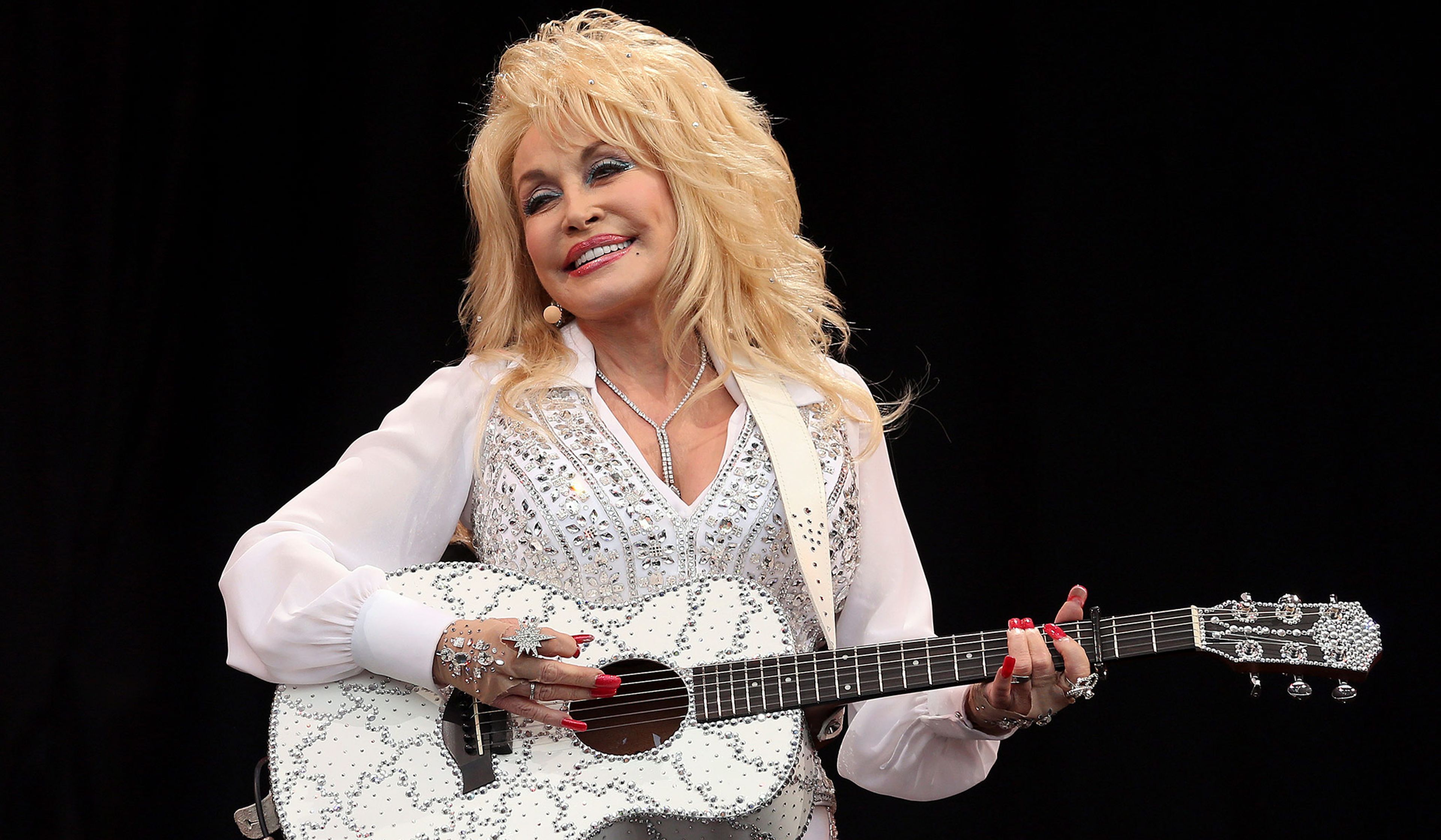
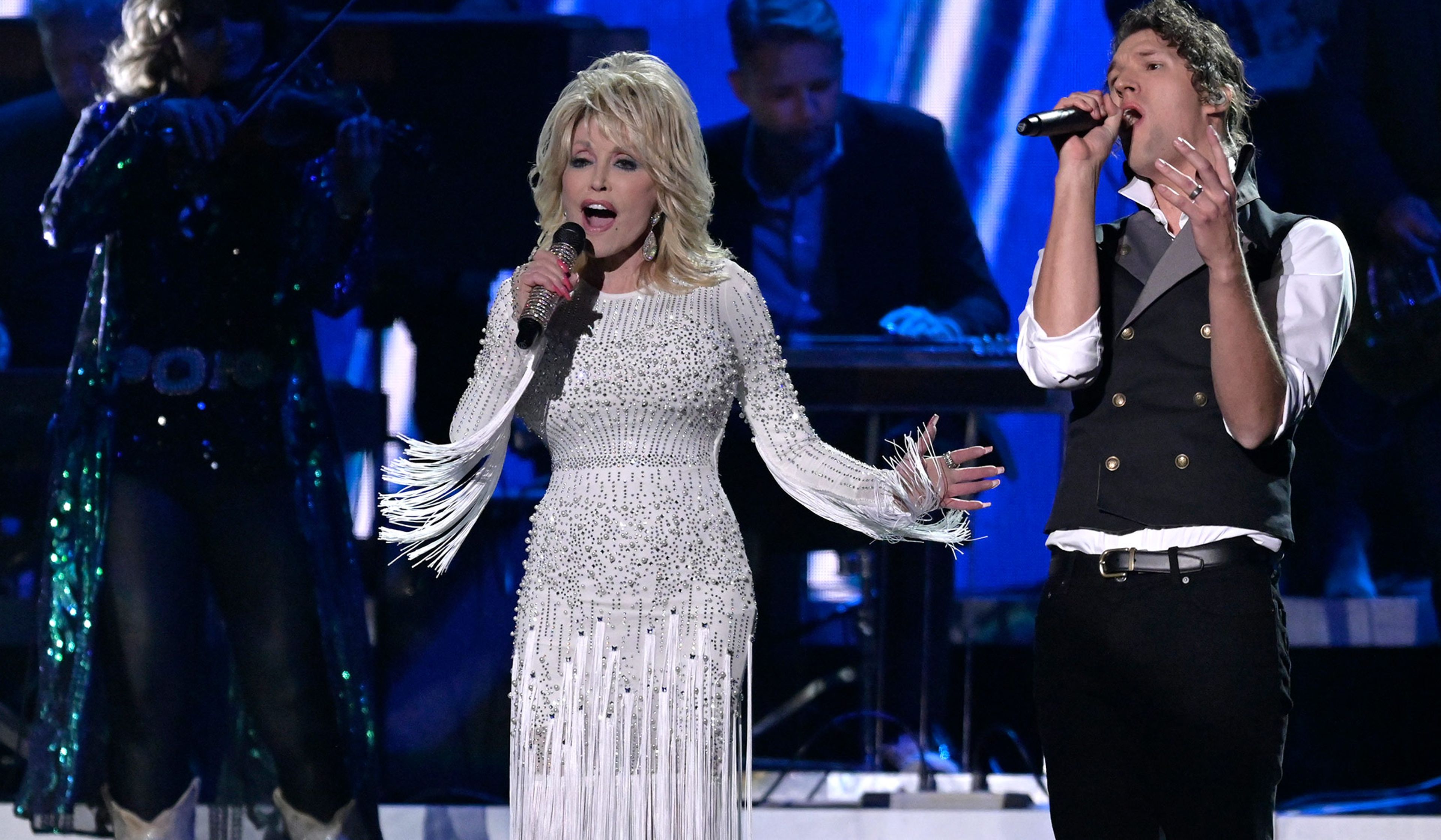




Dolly Parton performs on the Pyramid Stage at Worthy Farm during the Glastonbury Festival in Somerset, England, June 29, 2014.
Cathal McNaughton/Reuters
Parton, who is a natural peacemaker as well as a crowd-pleaser, has always resisted being dragged into political fights. When she is asked about politics, she either deflects with a joke at her own expense or else makes a general statement affirming the dignity of all God’s children and the Christian duty not to judge. At the 2017 Emmy Awards, she was on stage, reunited with her 9 to 5 co-stars Jane Fonda and Lily Tomlin, when she found herself in the middle of their diatribe against President Trump. Visibly uncomfortable, she joked about her boobs and then threw in another nervous joke about vibrators. “I just did not want everybody to think that whatever they think is what I think,” she told the Guardian two years later. Yet Smarsh argues, unconvincingly, that this too was proof of her feminist and progressive credentials. “What’s more anti-Trump than a rich seventy-one-year-old woman fantasizing about a sex toy on national television after his name was invoked?” Maybe expressing anti-Trump sentiments, as Fonda and Tomlin did?
Occasionally Smarsh does stumble backwards into what Parton is really all about. Parton’s success is “about an unfashionable quality in our angry society — grace — and its ability to inspire the best in others.” Though, of course, she doesn’t acknowledge that Parton understands grace to be a divine gift, not elegance or pizzazz. Likewise, she writes, “If her presence and the appreciation it instills in people could be whittled to a phrase, it’s ‘be what you are.’” Which, again, is true, except that to Parton this means being who and what God designed you to be. Not whatever you happen to feel like being. And then finally she writes, “One sees and feels the power of a woman who truly lives the teachings of Jesus — love all, judge not — in contrast to the hollow Christianity so much of Nashville’s country music machine falsely espouses.” Only, to Smarsh, following the teachings of Jesus seems to mean supporting whatever the prevailing progressive orthodoxy is, whereas for Parton it means loving God above everything and her neighbor as herself.
Parton’s mother’s remark about her appearance and the road to heaven was not the most telling part of that story. Back then, as a teenager, she told her mother that she didn’t care if she did look like trash. She recalls her mother’s wise rebuke: “Don’t ever let me hear you say you don’t care. I didn’t put you here on earth to just suck up the air and not care.” Thanks to Mama, Parton now realizes that “the few people in this world who care more change the world and the people around them.” There is no doubt that Dolly Parton cares. Nor that what she cares about is a lot bigger than politics.












Comments