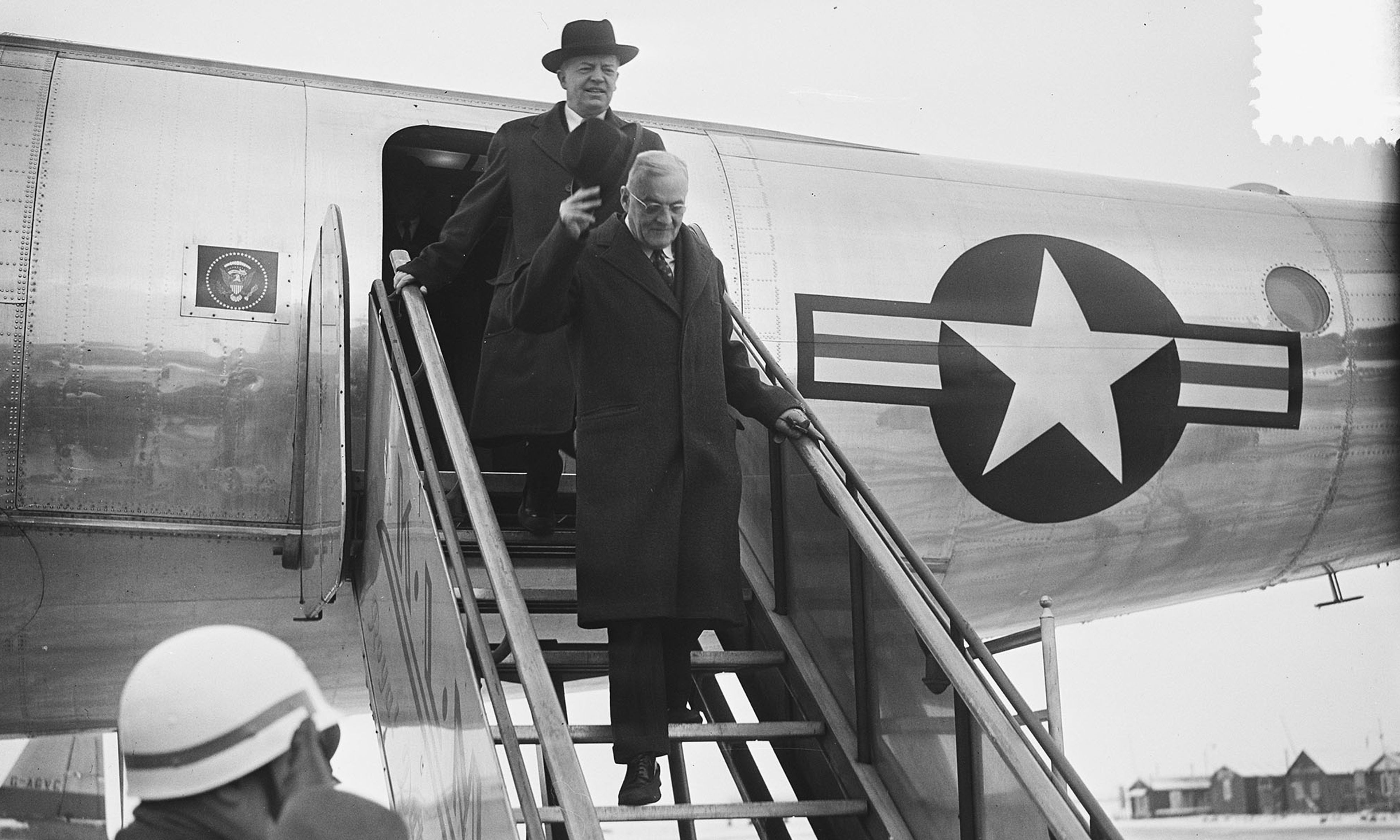
More people use the name of John Foster Dulles today than ever used it during his six-year tenure as U.S. secretary of state in the Eisenhower administration — which would be quite an impressive historical marker if it were not for the fact that the “Dulles” so often invoked is the name of an airport that services the D.C. metro area.
John Foster Dulles himself has not been so generously treated. Although Dulles earned the coveted Time designation “Man of the Year” in 1954, he never managed to achieve the world-shaker status of some other secretaries of state — Thomas Jefferson, James Madison, Henry Clay, William Henry Seward, Henry Kissinger — much less to display any dramatic flair for multi-nation summitry, international oratory, or even ordinary humor. He was, Winston Churchill once acidly remarked, “the only bull I know who carries his own china shop around with him,” and Churchill’s acolyte Anthony Eden once described JFD as “dull, duller, Dulles.”
John Wilsey’s new biography hides none of JFD’s blemishes, even as it enters deeply into his channels of thought. A reserved, shy Presbyterian lawyer, JFD spent his happiest hours away from the public eye on a remote family island at the eastern end of Lake Ontario. Few of his classmates at Princeton could, in later years, even recall details about him. Yet, as Wilsey makes us understand, no one seemed more obviously born to the role, which he assumed at Dwight Eisenhower’s invitation in 1953, than John Foster Dulles.
To begin with, his maternal grandfather, John Watson Foster, had been American envoy to Mexico, Russia, and Spain, served briefly as secretary of state from 1892 to 1893 in the presidency of Benjamin Harrison, and was an adviser to the Chinese government in its negotiation with Japan to end the first Sino–Japanese War in 1895. (Foster also helped to engineer the less savory annexation of the Hawaiian Islands, and the overthrow of Queen Liliuokalani, by drafting the original annexation treaty.) In 1907, Foster represented the U.S. at the Second Hague Conference on World Peace — and initiated his grandson, JFD, into the world of high diplomacy by taking him along to The Hague as his secretary. And that was just on JFD’s mother’s side. His uncle by marriage was Robert Lansing, Woodrow Wilson’s secretary of state, and JFD himself was tagged to join Wilson’s delegation to the Versailles Peace Treaty, which ended World War I, as a member of the reparations commission.
At the same time, Dulles was also the product of an upstate New York parsonage, although he was certainly no country mouse. His father, Allen Macy Dulles, was the pastor of the Watertown Presbyterian Church and a graduate of both Princeton University and Princeton Theological Seminary, and later a professor at Auburn Theological Seminary. Watertown was a comfortable and prosperous outpost of Gilded Age America, only five miles up the Black River from Lake Ontario and once the home of Frank Woolworth (of five-and-dime-store fame), and Allen Macy Dulles’s Presbyterianism was of a piece with the Gilded Age: doctrinally relaxed, open-ended, intellectually modest. His one book, The True Church (1907), cast Christianity in gentle, ethical terms and decried all “catholic” systems that “limited Christian liberty and corrupted Christian service.”
As a distinguished Church historian (and an associate professor at the Southern Baptist Theological Seminary), Wilsey weighs Allen Macy Dulles’s religion as a placid and serenely complacent faith in which duties and smiling tolerance sufficed to reconcile the world with God — and does not hesitate to find it wanting. So did JFD, although not in quite the same way. JFD followed in his father’s footsteps to Princeton, where he was class valedictorian in 1908, but he did not follow Allen Macy Dulles into the Presbyterian ministry. JFD took his father’s watered-down version of Christianity only seriously enough to stop practicing it. He instead majored in philosophy and spent a year abroad studying Henri Bergson’s version of pragmatism at the Sorbonne before returning to enter law school and join the firm of Sullivan and Cromwell in 1911.
JFD became an unabashed admirer of Woodrow Wilson and Progressivism, and his one serious involvement with religion was his skillful defense of Harry Emerson Fosdick before the Presbyterian Church’s Permanent Judicial Commission after Fosdick had brought down the wrath of conservative Presbyterians on his head with his 1922 sermon “Shall the Fundamentalists Win?” They certainly wouldn’t if Dulles had anything to say about it, and he defended not only Fosdick but the ecclesiastical cases of modernists Henry Van Dusen in 1925 and Carlos Fuller in 1926. (Ironically, when it came to pleasure-sailing on Lake Ontario, no one was more of a fundamentalist than Dulles, who equipped his 40-foot yawl Menemsha with only “simple gear, without many winches or gadgets.”)
Throughout the 1920s and ’30s, JFD’s experience at Versailles led him to write frequently on international affairs. It was not, however, until 1937, when he was invited to attend the Oxford Conference on Church, Community, and State, that Dulles rediscovered Christianity as the moral cement needed for creating a stable international order. In 1939, he published War, Peace, and Change, criticizing the temptation of populations to worship their nations as deities and charging the churches with the task of inculcating devotion to God first. This was, admittedly, an odd insistence: His own religion had been so diluted with modernism that it hardly seemed to offer substance for his own life, much less the lives of others. (He was shocked, almost to the point of disownment, when his son Avery announced in 1940 that he was converting to Catholicism because, unlike his father, it took Christianity literally.)
But religion became a growing theme in Dulles’s writing as he assumed leadership of a variety of commissions during World War II that looked toward the construction of a post-war world order. His role in negotiating the Treaty of San Francisco (which officially ended the war with Japan) incorporated themes of Christian reconciliation, and this work, and his success in cajoling 49 nations to sign a treaty that eschewed retribution, earned him the ticket to draft the foreign-policy plank of the Republican Party’s platform in 1952. It was only a short jump thereafter for Eisenhower to turn to JFD as his secretary of state.
Dulles’s statecraft was guided by his now resolute conviction that diplomacy had to be guided by moral law and that a “special responsibility” had “devolved upon the United States to bring international relations into conformity with that moral law.” Soviet totalitarianism, being instinctively amoral, had to be opposed — not merely contained, as the Truman Doctrine had laid down, but rolled back, since “it is only by keeping alive the hope of liberation . . . that we will end this terrible peril that dominates the world.”
Even before assuming the role of chief diplomat, Dulles called for “a policy of boldness” (the title of an article he published in Life in 1952) that would use the threat of “massive retaliation” against communist aggression as a means by which “the present captive world can peacefully regain national independence.” The article generated accusations that Dulles was a brazen warmonger, “bringing us” (in the words of Democratic presidential candidate Adlai Stevenson) “to the edge of the nuclear abyss.” Yet it was largely Dulles’s brinkmanship that prevented the Korean War from exploding into a thermonuclear conflict and kept another war from erupting in 1956 over the Chinese coastal islands of Quemoy and Matsu.
Early in 1959, routine hernia surgery revealed the presence of cancer in Dulles’s colon; he died just three months later and was succeeded by his protégé, Christian Herter. No subsequent secretary of state until Mike Pompeo ever made a moral agenda the centerpiece of American diplomacy the way Dulles had. At the same time, JFD’s comments on Indochina in the 1950s lend no confidence that he would have managed a route around the Vietnam debacle different from that of Dean Rusk in the 1960s. And for all of his moralism on the international scene, JFD was peculiarly obtuse to the moral challenge posed at home by the civil-rights movement.
Wilsey has not attempted to write a comprehensive biography, concentrating instead on the crooked path Christianity took through Dulles’s life. But he has read Dulles’s writings closely and with care, and even taken the trouble to follow the tracks of Dulles’s sailing adventures across Lake Ontario. He is unrelenting in his assessment of JFD’s blandly progressive Christianity in the 1950s as a failure, largely for having “rejected the Augustinian dichotomy between the city of man and the city of God” and resting too confidently in the assumption that diplomacy could build the kingdom of God. It is a careful, lucid study, by a sympathetic but sympathetically critical hand. It speaks not only of an individual, and that individual’s time, but to anyone who seeks, from their place in political life, to catch a glimpse of a higher order in human life than mere material arrangements. And yet it serves to remind them that even that glimpse may not be seen clearly enough to be thoroughly understood or easily applied.











Comments