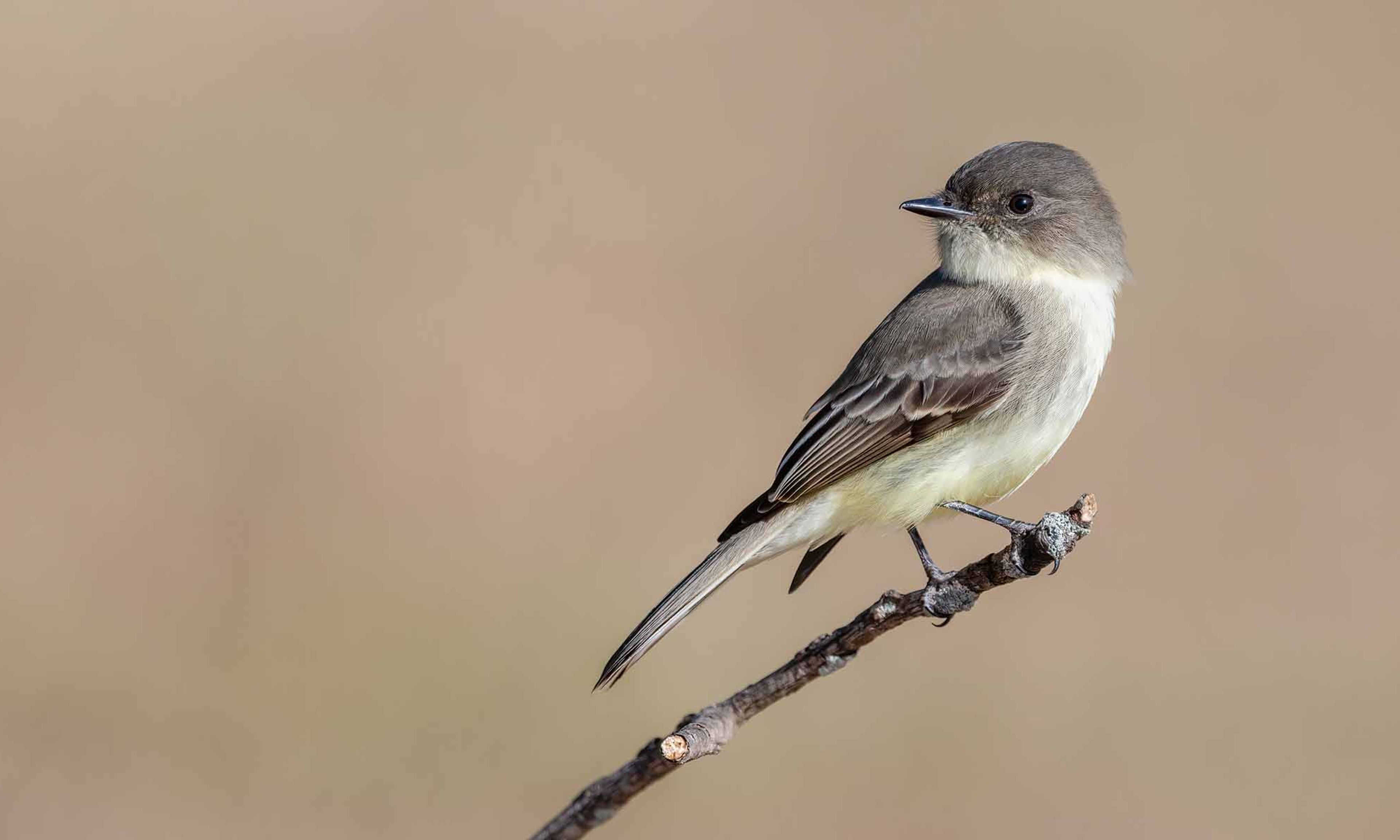
There is a window — it will shut even as these words appear — between the melting of the snow and the unfurling of leaves. The trees stand crowded together like empty coat racks; daylight, moonlight, and eyesight travel through them for yards and yards. In May the green curtain falls and nature will display itself, but also hide itself. Now you can track the birds.
In the winter we put out seed and suet, and attract a flock of small dependents. Experience has taught us to bring the feeders down at the end of March, though: After a bear just out of hibernation came onto our deck for some nighttime clean-up, we made the open house seasonal. The early-spring window shows birds doing what they do naturally, unaided by us.
Every year a pair of phoebes builds a nest, sometimes on the light fixture in the carport where they leave their droppings on the roof of my ’77 Camaro, most often on the lintel of the front door. All winter long the old nests decay, tugged by the wind, plundered by other birds for material. Then a few weeks ago I noticed that the front-door nest looked smooth and solid, as if it had just come off a potter’s wheel. No one was home, so I held my wife’s makeup mirror over it to look inside. White eggs looked back. After that, whenever I step outside, an alarmed adult phoebe speeds away. Our routine is comic, like eccentric neighbors in some old sitcom. The bird books tell me that phoebes like to build on or near human houses, and have even nested in the pockets of pants hanging on clotheslines. Why would a wild creature court such vexing proximity? They clearly appreciate the shelter of overhanging roofs and gutters. Are they smart enough to sense that humans, though large and noisy, are not specifically hostile, and might actually deter less bold predators? Soon the mirror will reveal silent nestlings; soon after that, another vacancy.
Phoebes belong to the large cohort of small birds. Bigger birds seem to be less common. The largest woodpecker in North America — depending on the fate, still uncertain, of the ivory-billed woodpecker — is the pileated woodpecker. We have at least one in my neighborhood. He has a loud, rather maniacal call — the model, I imagine, for Woody — and depending on the timbre of the tree that he is excavating, he can make the woods ring. He is an elusive bird, though, seemingly aware of prying eyes and likely to pick the far side of tree trunks if he is being observed. So I was surprised to see a black shape coasting over my lawn. It had a rocking flight, and there was a flash of white. But not until the bird landed did I see the drill beak and the blazing red head. For all his caution, a good meal will induce him to expose himself. There must have been ants in the trees at the edge of the yard, for he posted himself in full view and whacked away. The force in his neck and shoulders is amazing; he leaves large rectangular holes, and little piles of chips on the ground below. Naturalists who tried to tame pileated woodpeckers in the early 19th century reported that it was impossible: The birds demolished their cages, and then went to work on everything in the room. Like John Randolph of Roanoke, they love liberty, and they are more than equal to the task of destruction.
Crows project intelligence. I suppose birds have no true intellectuals, but crows are James Burnham’s managers. They appear to have plans; they certainly seem to act together in pursuit of enlightened self-interest. They communicate; more, they network. Their harsh calls fetch others. Twelve crows flying home after sunset is the image of a posse. Nothing fazes them. There is a slight hump to their black backs that gives them a permanent shrug. It is the mark of their worldliness, and their persistence: Never mind, we got something else going on the next ridge. They have seen it all, and they will be back tomorrow.
The owl of Minerva flies only at nightfall, said Hegel. I don’t know about that, but that’s when the owl of death flies. At this time of year, the ground is thick with last year’s leaves; quite small animals make a great stir. Squirrels and chipmunks run about, but the ground cover crackles with unseen things too: moles, voles, mice, I am not naturalist enough to know. Owls know. I was on my deck, grilling dinner, at the hour when there was still just enough light to almost see by. I heard a sound slightly louder than usual. A largish bird had lighted on a tree branch about 15 feet away. Then it flew off. I walked to the lawn to get another view, and its friend — or the same bird again — left another branch. Both takeoffs, and the flights that followed, were absolutely silent. I have heard owls asking, “Who cooks for you?” and hooting, huffing, and cackling. This was business. They say Turks used mutes to strangle victims. Later on (dinner done) I took out a flashlight. As I swept it along the ground, I picked out a shape and two sharp red eyes. Red — blood, fire, devils! But, more to the point, it is the refraction of light from an owl’s corneas. He had finished dinner too perhaps, or was between courses.
Last bird. I was driving on Sunday to the bus that would take me home to the city, down the main artery of the valley, the U.S. highway that was the canal route and before that the Indian trail. Flying along, between the Catholic church and the PX, was a bald eagle. It was low, unmistakable: white head, white tail, huge. I couldn’t believe it, but my friend Doug said, No, they’re around. News to me.











Comments