Salzburg, Austria
The summer festival that takes place here in this fair city is a very big deal: probably the most prominent music festival in the world. It stretches for five weeks, in July and August, and includes over 100 performances. The Salzburg Easter Festival is a less big deal: but a wonderful deal.
Herbert von Karajan, the late conductor of the Berlin Philharmonic (and other orchestras), founded this festival in 1967. He wanted a showcase for his Berlin band. The resident orchestra during the summer, you see, is a rival orchestra: the rival orchestra: the Vienna Philharmonic. Also, Karajan wanted to create something special for Easter. This holiday is a big occasion in this part of the world: much bigger than in, say, Sandusky, Ohio.
The format of the Easter Festival is neat and compact: four distinct evenings. After a couple days’ break, the evenings are reprised. Typically, you get a purely orchestral concert. And then an orchestral concert with instrumental soloist. And then a choral concert — usually of sacred music (which dominates the choral repertoire). And, finally, an opera: fully staged.
The Easter Festival is a very good idea — one of the best ideas Karajan had, in his long career. (Joining the Nazi party — twice — was a less good idea.) (Though it did him no harm, did it?)
Conductors and soloists come and go, but, at the Easter Festival, the orchestra always remains the same: the Berlin Philharmonic. And a superb orchestra it is. The Berliners are heavily hyped, but you can excuse the hype: Their sound is extraordinary; their technical skills are equally so; and their musical wisdom is considerable.
Not often can you judge an orchestra alone: apart from a conductor. So much depends on the guy standing in front of the orchestra. Leopold Stokowski could get “his” sound with the Saskatoon Sinfonietta. But we can say that the Berlin Philharmonic is an entity unto itself: a type of musician, with about 200 legs.
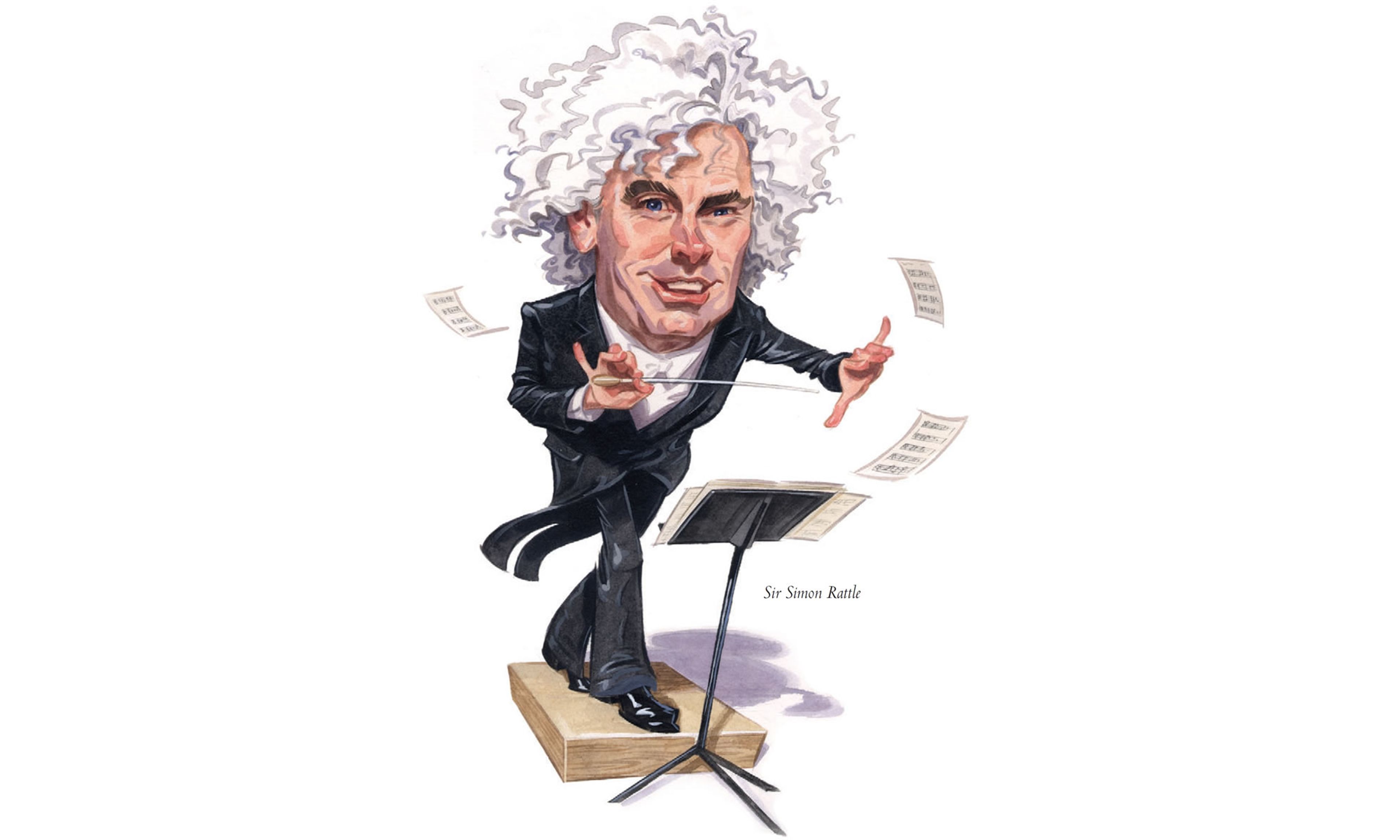
Since 2002, the Philharmonic has been led by Sir Simon Rattle, and it is he who has been leading these Easter Festivals. An Englishman (as that “Sir” suggests), he had a long tenure at the CBSO, which is to say, the City of Birmingham Symphony Orchestra. Then he stepped up onto what is arguably the most prestigious podium in the world.
His tenure has had its share of controversy: Some orchestra members, critics, and others like him; some don’t. Of whom is that not true, really? I myself have had “issues” with Sir Simon: He can be a little loose and uninspired. He can be just okay: “good enough for government work.” But he can reach a great height, too. At any rate, he seems secure in Berlin, as they have signed him up through the 2019–20 season, if you can believe it.
Over the years, he has had a large, rather wondrous “afro”: a big crown of curly hair. At first it was dark, then it was gray, and now it is white. One sees a hint of a bald spot. But this is still a first-class head of hair — and everyone knows how important hair is where conductors are concerned. A woman in Philadelphia was overheard telling another woman, “Say what you want about Muti, but, God, what great hair.”
The first concert I attended, at Easter Festival ’09, featured Yefim Bronfman in the Brahms Piano Concerto No. 2. This is the concerto famously dubbed “a symphony with piano obbligato.” Bronfman was born in Russia, went to Israel, and is now an American citizen. That is a common trajectory. And he is something very rare in the world: a great pianist. Furthermore, he is a pianist without specialty, at home in music of every sort. He is a thundering virtuoso; and also a highly sensitive and satisfying Mozartean (for example).
He also knows his way around Brahms — as he has proven in the chamber music, not least. And he proved it again in the Second Piano Concerto. He played it in neither a Russian style nor a Germanic style, but in a thoroughly Brahmsian one. He demonstrated what can best be summed up as “judgment” — musical intelligence, musical knowing. And the Berlin Philharmonic sounded glorious, as expected.
After intermission, they offered The Rite of Spring, Stravinsky’s shocker from 1913. Would they be raw and primitive enough in it? Are they too elegant and refined a group to express what the work should express? No, they brought it off splendidly, making Salzburg’s Great Festival Hall groan and rock.
The next night, we got, to begin with, Angelika Kirchschlager, in Kurt Weill’s Seven Deadly Sins. Kirchschlager is an Austrian mezzo-soprano, and, in fact, a Salzburg native. In a public interview with me a few years ago, she said that she had been in the children’s chorus in Carmen. Today, she is brainy, sexy, versatile, and just about every other good thing one can be.
What was she like in the Weill? Well, do you remember a lyric from The Music Man? “I smile, I grin, when the gal with a touch of sin walks in.” Kirchschlager imparted more than a touch — yet she also knows the value of understatement. And she sang in a particularly delicious German.
After her, we had Stefan Dohr, world’s greatest French hornist, almost certainly. He is a member of the orchestra, though he was soloing on this night. I first heard him years ago, in a chamber concert: and I could not believe my ears. He did things you are not supposed to be able to do with a French horn — most rude and obstinate of instruments. In Dohr’s hands, it was a lamb: pliant, nimble, sweet. People around the world have shaken their heads in wonder.
Here in Salzburg, he played the Concerto No. 2 of Richard Strauss, who was partial to the horn — his father was a pro. And Dohr’s performance? Put it this way: I heard it, but I’m still not sure I believe it.
Then the Berliners and Sir Simon gave us Beethoven’s Fifth Symphony. I like to quote Robert Graves, who said, “The thing about Shakespeare is that he really is good.” Well, so is this symphony. And these forces did it up royally, stirringly, thrillingly. Seldom have I heard this conductor so convincing.
On the next evening — Easter Sunday — came the choral concert. The main work was the Mozart Requiem. You might say that a requiem was not the best choice for this day. Anyone for Mahler’s Symphony No. 2, the “Resurrection”? But a good performance of the Mozart Requiem is always welcome.
And that is what we got. On the podium was, not Simon Rattle, but Franz Welser-Möst, the Austrian — a Linz boy — who is music director in Cleveland. He led a Requiem that was brisk but not rushed, disciplined but not unfeeling. The entire work breathed well. And Welser-Möst conducted with total commitment: musical commitment, sure, but also a moral one (if you will allow).
Of the soloists, I would like to cite the two women: Genia Kühmeier, soprano, and Bernarda Fink, mezzo-soprano. Like Kirchschlager, Kühmeier is a Salzburg girl, and her singing is reliably fresh, pure, and appealing. Fink is from Argentina. (Her Slovenian parents explain her last name.) And she is a grossly underfamous singer, in my view. I have never heard a better Bach singer: not in the flesh, and not on recordings. And she of course did her part — minor — in Mozart’s Requiem admirably.
Speaking of singing, the final night brought the opera: Siegfried, third installment of Wagner’s Ring (a tetralogy, or a four-parter). The Easter Festival has been doing one installment a year. Next year, we will end in flames, with Twilight of the Gods. The production — of the entire Ring — is in the hands of Stéphane Braunschweig, a French director. The most I can say for his Siegfried is that it is better than his Rhine Gold or Valkyrie. Wagner’s score and story are vibrant, enchanting, and multicolored. This production is austere, ungenerous, blah (despite commendable touches). Oh, well.
Our Siegfried was supposed to be Ben Heppner, today’s heldentenor of choice. But he was indisposed, and instead we had a youngish unknown, Lance Ryan. Both Heppner and Ryan are from British Columbia, amazingly enough. Must be something in the water there. And Braunschweig dresses his Siegfried in a lumberjack shirt: very Western Canadian. Ryan sang easily and beautifully, with no Wagnerian bark. But he had trouble making himself heard through Wagnerian orchestration.
Brünnhilde was Katarina Dalayman, the fine Swedish soprano — who on this night brought no top. No high notes whatsoever. Too bad, because Brünnhilde has plenty.
Siegfried, like other Ring operas, and other Wagner operas, is unabashedly symphonic, and the Berlin Philharmonic was the star of the show. Sir Simon, having seized the reins back, did not have his best night. There were jarring problems of coordination, and Wagner’s ending — one of the most joyous things in all of music — had almost no joy at all. A real cheat. But the sound of this Berlin bunch, overall, is hard to beat.
And they consistently meet a very high standard. You could get used to it. And, after a couple of nights, you pretty much do.












Comments