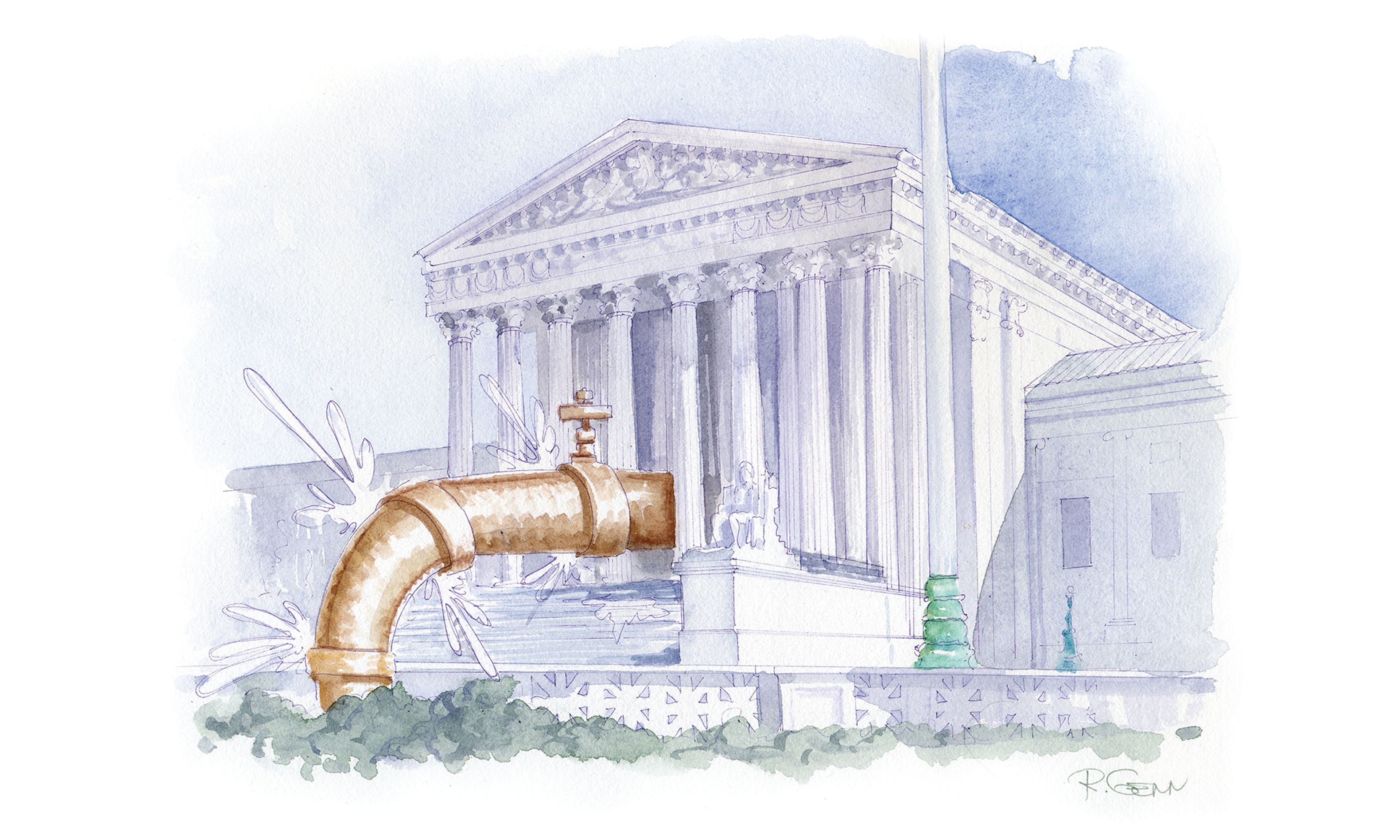
• House staff members have been granted the right to unionize. Gosh, wouldn’t it be terrible if they went on strike?
• In a development that is almost beyond parody, the Biden administration has created a new ministry of truth at the Department of Homeland Security, bearing the Orwellian name of “Disinformation Governance Board.” Just as the Ministry of Truth in 1984 was dedicated to the cultivation and propagation of lies, the Biden administration’s Disinformation Governance Board already is engaged in putting out what it is supposed to be combating. The new minister of truth, Nina Jankowicz, is a political operative who is known for claiming — falsely — that the Hunter Biden laptop and its embarrassing contents were part of a Russian disinformation campaign. Nobody believes that, including, based on belated reporting, the New York Times and Washington Post. So the disinformation board is to be overseen by a disinformation operative who traffics in disinformation about disinformation — if that were any more meta, Mark Zuckerberg would be running it. Not to be outdone, Homeland Security Secretary Alejandro Mayorkas dismissed criticism of Jankowicz as misinformation. We are not sure that an impeccably managed Disinformation Governance Board staffed exclusively by Platonic philosopher-kings would be a good or necessary thing for a free people — and we are quite sure the Biden administration is short on philosopher-kings. If Republicans take control of Congress in January, they should drop Jankowicz and her ministry of truth down the memory hole by means of appropriate legislation.
• President Biden has now decided he’s for fiscal responsibility. With the pandemic spending packages winding down through no effort of his own, Biden is taking credit for a falling federal budget deficit. You may recall that he and his party spent the entire past year debating a piece of legislation, the Build Back Better Act, whose primary goal was to spend lots of money, with the wish list of progressive policy goals to be worked out later. You may recall that he and his party used every budget gimmick imaginable to game the Congressional Budget Office into saying that that legislation was fully paid for, while the actual budgetary impact would have been trillions of dollars higher if, as Democrats intended, the programs had been made permanent. You may recall that Biden and his party actually did pass a $1.9 trillion spending bill — the American Rescue Plan, supposedly to stimulate the economy (which did not lack stimulation) — that didn’t even pretend to be paid for. Biden hasn’t embraced fiscal responsibility; he wants us to embrace fiscal gullibility.
• Mark Esper is the latest Trump-administration official to write a book casting doubt on the former president’s fitness to hold office. Esper was one of Trump’s defense secretaries. (Trump had two defense secretaries and five acting defense secretaries.) Esper says that Trump wanted the military to shoot protesters. To bomb Mexican drug labs. And so on. In response, Trump has said, “Mark Esper was a stiff who was desperate not to lose his job. He would do anything I wanted, that’s why I call him ‘Yesper.’” Also, “He was recommended to me by some very weak RINOs and that is what he turned out to be.” Also, “Mark Esper was weak and totally ineffective and, because of it, I had to run the military.” And so on. In interviews surrounding the book, Esper has said that Trump is a danger to American democracy, particularly in light of his behavior from Election Day 2020 to Inauguration Day 2021. Trump, he said, tried to overturn a legitimate presidential election. Many who witnessed Trump up close — Jim Mattis, John Kelly, H. R. McMaster, John Bolton, Esper, et al. — have cast doubt on Trump’s fitness. His standard response is to cast doubt on his own hiring acumen.
• Few governors have faced storms on all sides like Georgia’s Brian Kemp. After his 2018 election victory over Stacey Abrams, the national media tarred Kemp as a vote-suppressor and Abrams won press plaudits for insisting, baselessly, that Kemp had stolen the election. In April 2020, when Kemp became the first governor to reopen his state, the Atlantic ran an article headlined “Georgia’s Experiment in Human Sacrifice.” In November 2020, after Donald Trump narrowly lost Georgia, the president embarked on an intense pressure campaign to get Kemp to convene a special legislative session to extricate Trump from his own defeat. Trump also blamed Kemp for decisions by his successor as Georgia secretary of state, Brad Raffensperger. By depressing Republican turnout with charges of rigged elections, Trump then cost Republicans the Senate seats of David Perdue and Kemp-appointed Kelly Loeffler. Then, in 2021, Kemp signed a reasonable election-security bill and drew the fire of the White House again, with Joe Biden pronouncing it “Jim Crow 2.0” and strong-arming Major League Baseball into pulling the All-Star Game out of Atlanta. Perdue, rather than blame Trump or himself for his defeat, launched a shameful Trump-backed primary challenge to Kemp built entirely around spite over the 2020 election — this despite Kemp’s strong support for both men in that election. Trump even claimed that Abrams “might be better” than Kemp. Through it all, Kemp has kept his cool and compiled a solid conservative record. He has earned another term. Republican primary voters should choose him over Perdue without hesitation.
• Freshman congresswoman Marjorie Taylor Greene has been a disgrace to her office and a disservice to her constituents in Georgia’s 14th district. Greene made headlines during her 2020 campaign over her prior musings on QAnon, Jewish space lasers, the “so-called plane that crashed into the Pentagon” on 9/11, and the Parkland shooting as a false flag. She has not mended her ways in office, claiming that January 6 was an “inside job” and a “Fed-surrection.” She told Lou Dobbs that joining the U.S. military was “like throwing your life away.” She spoke at the America First Political Action Conference, a white-nationalist gathering organized by a Holocaust denier. Of course she promoted theories that the 2020 election was stolen. For a busy, effective member of Congress, these remarks would be ugly baggage; for Greene, who serves on no committees, does no apparent legislative work, and rarely appears in a district she moved into in order to run for office, they are accomplishments. A fixture in the national headlines, she has drawn fire locally for her lack of constituent service. Greene’s district is too red for her to face a real Democratic challenger. Fortunately, Greene has a conservative primary opponent: Jennifer Strahan, a health-care entrepreneur who pledges to focus on serving the district rather than courting controversy. The district’s voters should choose Strahan.
• There is a popular democratic tradition in American elections of office-seekers making a show of going to the polls to vote. That’s grade-A Americana, except in the case of Mehmet Oz, who votes in Turkey. The reality-television quack from New Jersey who wants to be the next senator from Pennsylvania enjoys the support of fellow reality-television star Donald Trump, but Trump’s secretary of state, Mike Pompeo, is backing his opponent and points out that as recently as 2018, Dr. Oz was voting in Turkish elections. That is not entirely surprising: Oz has many professional and social connections to the regime of Turkish caudillo Recep Tayyip Erdogan, who was running for reelection in the election that drew Dr. Oz to the Turkish polls. Dr. Oz had said that he had not been active in Turkish politics, a claim that now seems to be untrue. Taking a page from the progressive handbook, Oz denounced the criticism as “xenophobic.” Oz is a Turkish citizen who has agreed — with obvious reluctance — to renounce his Turkish citizenship if he wins the election. He has always been a crackpot and is a carpetbagger to boot, with no real connection to Pennsylvania other than having gone to school there and having in-laws in the Philadelphia suburbs. (The Pennsylvania address Oz originally claimed for political purposes is his in-laws’ home.) The Senate seat in question is being vacated by Pat Toomey, one of the best men in that august body. Putting Dr. Oz in that seat would be a step in the wrong direction: in this case, in the direction of Turkey by way of New Jersey.
• The Federal Reserve raised its federal-funds-rate target by 50 basis points. This was often referred to in media reports as the largest such increase since 2000. While correct, this fact says more about how few rate hikes the last two decades have seen than it does about the latest move. More to the point, we still have plenty of reason to believe the Fed is behind the curve on inflation. Simply raising rates does not automatically mean tightening; it could be that money is merely loosening at a slower rate. After the Fed’s March rate increase, money continued to loosen: Total dollar spending continued to accelerate. Fed chairman Jerome Powell talks about a “soft landing” in which inflation comes down largely on its own with the aid of interest-rate hikes. It’s hard to shake the feeling that “soft landing” has become the new “transitory” — a term that’s loosely defined and weakly theorized and, ultimately, won’t describe reality.
• Secretary of the Air Force Frank Kendall announced that his service would no longer pursue its Trump-era goal of growing to 386 squadrons. “I’m not focused on counting end strength or squadrons or airplanes,” Kendall said during a Brookings Institution webcast. Instead, Kendall said, the Air Force would concentrate on building high-end capability that would deter aggression. If American air power, Kendall says, can’t “deter or defeat the initial act of aggression, then you’re in a situation like we’re seeing in Ukraine: a protracted conflict.” Yes, Mr. Secretary, but we can’t always count on deterring aggression. Our adversaries sometimes decide that they’re going to do what they’re going to do whether we like it or not. A serious defense policy would be based on building up enough capacity to fight such a “protracted conflict” if it ever came to that. The Air Force’s failure to reach 386 squadrons — much like the Navy’s fumbling efforts to build a 300-ship Navy — is a provocative display of weakness that Congress must correct.













The active duty 388th and Reserve 419th Fighter Wings conduct an F-35A Combat Power Exercise at Hill Air Force Base, Utah, January 6, 2020.
R. Nial Bradshaw/USAF
• The most troubling shortage currently facing Americans is of one of our most vital food staples: baby formula. At the end of April, around 40 percent of formula from major brands was sold out. For mothers who are unable to breastfeed or depend on formula as a supplement, these shortages are top of mind. The proximate cause of this shortage is a recall of baby formula made by Abbott Labs, one of the largest manufacturers, and baby-formula makers are dealing with the same shipping problems and hiring challenges as the rest of the economy. But the magnitude of the shortage indicates that something else is going on too. A market prone to widespread shortages and long-term sticker-price increases (as any family with an infant can attest, formula is normally expensive) is usually a sign of government involvement, and baby formula is no exception. The Supplemental Nutrition Program for Women, Infants, and Children began in 1972 as a temporary program to help truly impoverished mothers afford food for their babies, but has expanded so much that now over half of all baby-formula consumption in the U.S. goes through it. That means the price system, which normally corrects shortages before they start by allowing price increases to incentivize greater production, doesn’t work as it should. As if harming the domestic market weren’t bad enough, the government also has protectionist trade policies that make it more difficult to import baby formula, even from safe, highly regulated peers such as the European Union. The current emergency should lead to a rapid lifting of those barriers, followed by reform that keeps future shortages from developing.
• NASA administrator Bill Nelson recently discussed a dramatic shift in how the agency plans to issue contracts for its space-exploration projects. Speaking before a Senate appropriations subcommittee, Nelson endorsed the use of “fixed-price contracts” while calling its traditional cost-plus contracts “a plague” on the agency. The difference between the two turns on who picks up the bill for delays or cost overruns. Under fixed-price contracts, a maximum payout for a good or service is set out, and the contracted company absorbs any unanticipated expenses beyond that number. Under cost-plus contracts, however, the government pays for the cost of work plus additional fees. NASA has awarded numerous multibillion-dollar cost-plus contracts over the years, without much to show for them. According to Nelson, recent fixed-price contracts have had better results. He cited, for example, the Commercial Crew program, which the agency used to award SpaceX about $3.1 billion and Boeing about $4.8 billion over the past decade to develop spacecraft to deliver astronauts to the International Space Station. Competition: It’s not just good here on Earth.
• Just outside of Boston’s city hall are three flagpoles. The city flies the American flag on the first and the flag of the Commonwealth of Massachusetts on the second. The third, however, has typically been reserved for private groups. During events held on the plaza, they’re allowed to hoist a flag of their choosing, subject to the city’s approval. This policy, according to the city’s website, is meant to “foster diversity” and “strengthen connections among Boston’s many communities.” Between 2005 and 2017, it approved the raising of 50 different flags, for 284 ceremonies. They included flags of foreign countries but also that of Boston Pride, the Chinese Progressive Association, and others. The city had never denied a request, until Camp Constitution — a Christian group — asked to fly a flag with a Latin cross, to commemorate the signing of the Constitution and the city’s religious history. Boston’s commissioner of property management contended that the city must fly only secular flags to comply with the First Amendment’s establishment clause. Camp Constitution sued, arguing that the city’s decision had violated, among other things, its free-speech rights. Now Justice Stephen Breyer has written for a unanimous Court that the city had “discriminated on the basis of religious viewpoint.” Camp Constitution has won a victory for its namesake.
• The Court is hearing the case of Joe Kennedy, who in 2015 lost his job for daring to pray in public. The Supreme Court may finally be ready to give him his job back. Kennedy was an assistant football coach at Bremerton High School in Washington State. He began taking a knee to offer a brief postgame prayer, and some students asked whether they could join him. “This is a free country,” Kennedy told them. “You can do what you want.” The school saw things differently as the prayers attracted attention; Kennedy’s knee was less fashionable than Colin Kaepernick’s. The school punished Kennedy out of fear that letting people see him pray would amount to an unconstitutional establishment of religion. Justice Elena Kagan frets that voluntary prayer by a coach might be seen as “coercive.” What’s truly coercive is forbidding teachers and coaches to engage in voluntary speech and prayer that no one would confuse with an official curriculum.
• Russia’s war on Ukraine continues in multiple theaters, physical, geopolitical, and moral. Ukrainian forces in the north launched a counteroffensive against Kharkiv even as Russia tightened the vise on the Azovstal steel plant in Mariupol, last redoubt of the resistance in that southern city. If Putin can’t take an entire country the size of Texas, perhaps he plans to decimate and seize only a portion of it. On the stage of grand strategy, the Biden administration does all it can to help Ukraine without crossing the line to open conflict with Russia. That is why President Biden told his intelligence agencies to stop leaks about sharing information with Kyiv (we reportedly helped Ukraine pinpoint the Moskva, flagship of Russia’s Black Sea fleet, now docked with Davy Jones). Of course we share intel with Ukraine, and of course the Russians know it, but to say so, even off the record, is to say too much. Worst of all, always, is the human cost. The Associated Press reports that the Russian bombing of the Mariupol Drama Theater, a civilian refuge, killed 600. Whom they do not destroy they deport. British sources report 66 camps, as distant as the Arctic Circle and the Far East, for captured Ukrainian civilians. One fatality, lost to a Russian missile strike on Kyiv, was Vera Gyrych, journalist for Radio Free Europe/Radio Liberty. Truth about Putin’s doings is perhaps his greatest enemy. May it prevail, however many messengers he kills.
• When asked how Russia can claim to be denazifying Ukraine when its president, Volodomyr Zelensky, is Jewish, foreign minister Sergey Lavrov reached for antisemitic tropes (they seemed to be near at hand). Hitler, he said, had Jewish ancestors, so formal Jewish ties mean nothing; why, he went on, some of the worst antisemites are Jews themselves. This got the attention of Israeli prime minister Naftali Bennett, whose government condemned the remarks. On Israel’s independence day, Vladimir Putin called Bennett to apologize; Bennett accepted. Israel’s position on Ukraine is attentive to its own interests (don’t antagonize Russian forces in nearby Syria) and the interests of Jews in both Ukraine and Russia. During a war between two European countries, one of them with nukes, it is not bad to have a neutral-ish nation on the sidelines, capable of communicating with both.
• Pope Francis leads the world to wonder which side he’s on in Russia’s war against Ukraine. Shortly after the invasion in February, he called Zelensky but not Putin. “It was meant to be a clear gesture for the whole world to see,” Francis said in an interview in the Italian newspaper Corriere della Sera in early May. He added, however, that he didn’t know whether it was right to supply weapons to the Ukrainian army. He described NATO, a defensive military alliance, as “barking at Russia’s gate.” He had “no way of telling” whether Putin’s “rage” had been “provoked,” he said, but he suspected that “it was maybe facilitated by the West’s attitude.” Francis described a Zoom meeting at which he pushed back when Patriarch Kirill of Moscow justified the invasion: It was wrong for the patriarch to become “Putin’s altar boy,” he said. He canceled a scheduled meeting between himself and Kirill but said that he wants to travel to Moscow to meet with Putin before going to Kyiv to meet with Zelensky. Catholics cherish the mysteries of their faith. Vatican diplomacy doesn’t need to be one of them.
• The Biden administration is moving toward putting Chinese surveillance giant Hikvision on the Global Magnitsky sanctions list, the Financial Times reported. Hikvision, which has furnished many of the cameras that the Chinese Communist Party installed across Xinjiang to create a high-tech police state, is already the target of numerous U.S. sanctions. Being listed would block Hikvision’s assets in the U.S. and prevent Americans from completing transactions with the company. Hikvision has cameras all over the world, and the U.S. is one of its top customers. Time to make that “has been” one of its top customers.
• President Biden’s political headaches from the Iran negotiations are getting worse. Sixteen Senate Democrats voted with their GOP colleagues for a nonbinding resolution that said that an agreement should address Iranian-backed terrorism and not rescind the terrorist designation of the Islamic Revolutionary Guard Corps. The administration has said that it will not address Iran’s support of terrorist groups in the negotiations, vowing to do so in a second, follow-on agreement. But after lifting the current sanctions on Tehran, the U.S. would likely find it to be almost impossible to get the Iranians back to the negotiating table. If the administration can’t see that, it has no business at that table to begin with.
• The U.K.’s governing Conservative Party was expecting defeats in the May local elections. Polling had predicted losses of up to a third. Such a blow might have mobilized Boris Johnson’s enemies in a bid to replace him as party leader. The real loss was not quite as bad as feared. The Tories lost three of their London strongholds, but beyond London, the Labour Party failed to make significant gains. That’s in part because the Liberal Democrats underwent something of a revival, especially in the southwest and rural areas. In Northern Ireland, Sinn Fein held its vote as the Democratic Unionist Party dwindled — marking the first time a nationalist party has ever come first. The Scottish National Party, which has been the Scots’ dominant party for 15 years, also made gains, prompting its leader to hint at a future breakup of the U.K. If the performance of Labour leader Keir Starmer was mediocre, it still comfortably surpassed the historically low bar set by Jeremy Corbyn in 2019. Johnson is still hanging on — for now.
• In April, a nine-member committee of the American Bar Association recommended dropping the Law School Admission Test as a requirement for accredited law schools. The ABA had already watered down the uniformity of the LSAT in November by allowing schools to use the Graduate Record Examinations as an alternative. The academic bureaucracy despises objective tests because they impede the quest to achieve a desired “racial balance.” But while no testing regime is perfect, the LSAT has proven a good predictor of success in law school. Moreover, the LSAT is egalitarian. Because it tests logical-reasoning ability rather than learned topics such as vocabulary, it is difficult for expensive prep courses to meaningfully alter an applicant’s scores. The proposal will be voted upon May 20 at a meeting of the ABA council handling law-school accreditation for nearly 200 American schools. From there, it would go to the ABA House of Delegates. In 2018, a similar effort was abandoned on the eve of the House of Delegates vote. Presumably, the proponents think they have more favorable chances now. This is part of a broader war against academic standards in general and standardized testing in particular, and it ought to be rejected. It also calls into question why the ABA has power to accredit law schools at all if its aim is to destroy standards rather than enforce them.
• The Harvard Crimson published a long editorial endorsing the “boycott, divestment, and sanctions” movement, which seeks to pressure Israel into ceding territory to Palestinians. In doing so, it threw itself behind a movement that the U.S. Congress voted overwhelmingly to condemn. The lone dissenter at Harvard was Natalie Kahn, Harvard’s Hillel president and a Crimson editor, who wrote an op-ed that demolished the editorial. Standing alone, she has kept the conscience of that publication.
• Rich Strike, winner of the 148th Kentucky Derby, came from nowhere. The chestnut horse was not even slated to run until the day before, when a dropout allowed him to snag the miserable 20th position, far on the outside. His thread-the-needle run through the pack, around the clubhouse turn and down the homestretch, was a masterpiece (especially when seen from above) of speed on his part and smart maneuvering on the part of Venezuelan jockey Sonny Leon — who, by the way, was competing in his very first Derby. These athletic achievements pass in a moment. Philosophers will sneer that they are as nothing to contemplating the Forms. Au contraire: The forms they offer us are hard work, good luck, and a happy ending — and we all need that, if only now and then.
• Johnnie A. Jones Sr. lived an American life, and a brave one. He was born in 1919, in northern Louisiana, and grew up on a plantation. When World War II came, he was drafted into the Army. He became the Army’s first black warrant officer. He fought on the Normandy beaches and in the Battle of the Bulge. He escaped death on more than one occasion. When he got home, he was beaten up by a white police officer. He decided to go to law school and become a civil-rights lawyer. He dodged bombs at home, even as he had dodged bombs in Europe. He was the first black member of the Baton Rouge Bar Association. Johnnie A. Jones Sr. has died in the Louisiana War Veterans Home at the age of 102. R.I.P., and thank you.
• Kathy Boudin has died at 78. She almost died at 26, in the “townhouse” — the Greenwich Village residence where she and her fellow Weather Underground radicals were making bombs. They were planning to attack an NCO dance at Fort Dix, and the administration building at Columbia University. But, on the day of the dance, something went wrong, and a bomb went off in the basement of the townhouse. It killed three of the Weathermen and spared two — one of whom was Boudin. She was on the lam for ten years. In October 1981, she took part in the “Brink’s robbery,” as it became universally known. The body count in that caper was one Brink’s guard and two cops. Boudin spent 22 years in prison, before being released on parole. Everyone said she was a “model prisoner.” She was honored with prestigious jobs, at Columbia, where she was an adjunct professor, and New York University, where she was a scholar in residence (just a few blocks from where the townhouse stood, before being blown up). She talked a lot about justice. But political extremists tend to be better at delivering death. R.I.P.
• Pop culture plus three decades equals art. The word “paparazzo,” taken from a character in La Dolce Vita (1960), was derived from an Italian term for an annoying flying insect and originally had a connotation to match. In the 1970s paparazzi began to gain respect for their ingenuity in tracking down subjects, and some even became celebrities themselves. Foremost among these was Ron Galella, who meticulously planned his shots, hiding in bushes and bribing retainers to obtain the brief moment of access. To be sure, celebrities were often scared by his ambushes. The whole profession seemed decidedly less fun after the 1997 car crash that killed Princess Di as she fled a French paparazzo. Still, when it came to capturing celebrities looking angry, surprised, or both, Galella was unmatched, and in his final years he spent most of his time curating his photos for use in books and museum exhibits, with reams of learned analysis by art historians. Dead at 91, R.I.P.
• Midge Decter, née Rosenthal, came to New York City in the flowering of the Family, that post-war circle of all-knowing, always-arguing liberal anti-communist intellectuals, and the blossoming of the New Journalism, reporters with attitude. She worked for Robert Warshow at Commentary and Willie Morris at Harper’s; in the last gig, she helped wrangle Norman Mailer’s many many-thousand-word dispatches on the 1968 political conventions. She came into her own when a significant part of her world began to move right. Liberalism was no longer as anti-communist or as pro-Israeli as it had once been. Decter described her migration (her cohort took the name “neoconservative”) as joining the side you were actually on. She wrote about communism, feminism, and the free world, for many publications, mainly Commentary but also including NR, and she sustained her firebrand husband Norman Podhoretz. In controversy she took no prisoners; in person she was equal parts warm and wry, in a mixture that was archetypically Jewish. Dead at 94. We extend our condolences to her family. R.I.P.
Hope and Strife
The reign of Roe v. Wade is ending as it began, in a festival of lawlessness. In 1973, the Supreme Court — in an act of “raw judicial power,” as Democratic appointee Byron White put it in dissent — swept away the laws of all 50 states to impose an abortion policy so radical that it could not prevail democratically anywhere. Roe and its companion case Doe v. Bolton made it impossible for legislators to provide effective protection to unborn children at any stage of pregnancy. The Court imposed this inhumane policy even though nothing in the text, original understanding, history, or structure of the Constitution gave it that power.
This usurpation of power has diminished the usurper. Roe, along with the Court’s obstinate refusal to reconsider it, has sunk the institution deeper and deeper into the partisan mire. It is perhaps fitting, then, that the news that a majority of justices are finally prepared to conclude the experiment in abortion policy-making from the bench came via a leak about Dobbs v. Jackson Women’s Health that appears to be designed to generate a political backlash. Roe’s friends have defended it as such. Demonstrators have gathered at justices’ homes to protest, which is an illegal effort to affect the outcome of a pending case. Roe’s friends have defended this tactic, too, on an analogy with patriot mobs before the Revolution: a self-aggrandizing comparison that suggests a dangerous detachment from our Constitution and laws.
When opponents of abortion have resorted to violence in the last five decades, the vast majority of pro-lifers have vocally condemned them. President Biden is, however, silent about the demonstrators’ dangerous methods, even as he thunders against a judicial opinion in line with the preferences he expressed early in his career, when he voted to amend the Constitution to restore legislative authority over abortion. Other Democrats are talking, again, about “expanding,” that is packing, the Court, to rethrone Roe.
Desperately, some of them are claiming that the justices in the majority perjured themselves during their confirmations by leading senators to believe they would vote to reaffirm Roe. None of these justices, of course, said they would reaffirm it. Several of them made a point of refusing on principle to commit to voting for particular outcomes regardless of the topic of senatorial questioning. All the nominees said was that Roe was “settled law” in the sense of having binding force on lower courts, and deserving some weight as precedent. They did not say it was settled in the sense of commanding their assent in future cases. If any senators were actually misled, they were not paying attention.
The justices must hold firm, and should even expedite their release of a final opinion. Justice Samuel Alito’s draft opinion from February, released in full in the unprecedented leak, needs very little amending. He lays out his argument dispassionately and masterfully, covering the falsity of the historical account on which the Supreme Court relied in Roe, the contrived doctrine of precedent three justices conjured in Casey, and the damage these decisions have wrought to the functioning of our democracy.
Alito tries to preempt the expected scaremongering about the consequences of overturning Roe, saying that nothing in his opinion undermines precedents that protect contraception or mandate recognition of same-sex marriage. Certainly his opinion does not logically compel the overturning of those precedents. If a case that squarely tested any such precedent ever came to the high court — which is a very big if, especially with respect to contraception — the justices would have to conduct a new analysis of its specific strengths and weaknesses. In none of those other cases would the Court be dealing with an interest, on the side of overturning the precedent, as weighty as the protection of human life (an interest, by the way, that the Court always recognized to some degree as a legitimate one even in the bleakest years of the Roe regime).
What the consequences will be for abortion policy depends on democratic decisions yet to be made. In Washington, D.C., Democrats are engaged in a familiar bait and switch: The rhetoric is about abortions following rape; the legislation requires abortion on demand at any stage of pregnancy — and goes beyond even Roe in striking down parental consent. That tactic, like the resort to slippery-slope arguments about contraception, and like the decades-long campaign to insulate abortion from democracy, betrays a lack of confidence in the pro-abortion maximalists’ ability to rally the public.
Pro-lifers and Republicans — two groups that have come to overlap more and more in the Roe era — will have to act with determination, courage, savvy, and compassion. Crisis-pregnancy centers will need new support. The safety net may need rethinking and refurbishing. Legislators will need to keep in mind both that unborn children deserve legal protection and that their protection requires the development and strengthening of a social consensus against abortion. In many places, pro-lifers may need to settle, temporarily, for incomplete protection, while continuing to press the argument for a fuller measure of justice.
If the Court issues something like Alito’s draft opinion in Dobbs, it will not end abortion. It will allow a democratic debate over abortion policy, and allow that debate to result in more protection of unborn life than we have today. Our highest law will no longer be perverted into an obstacle to human rights. If it is not the nationwide recognition of those rights we rightly seek, it is something for which we should be grateful.
That gratitude extends to the scores of millions of pro-lifers who have voted, organized, argued, and prayed for this day; to the politicians, from Reagan to Hyde to both Bushes to McConnell to Trump, who stood with them when it counted; and to the justices themselves. It includes, perhaps above all, those many mothers who, in difficult straits, refused the invitation to abort their children.
Our country may be about to take a great step toward fulfilling the national promise. Here everyone has a right to life, liberty, and the pursuit of happiness. And life comes first.
America’s Crisis of Self-Doubt — A Statement
We live in an age of increasing national self-doubt.
The American project, as such, is under assault. Our history is the subject of a revisionist critique that is all-encompassing, unsparing, and very often flatly inaccurate. Our traditional heroes are under threat of being run out of the national pantheon. Our institutions, from elections to the job market to law enforcement, stand accused of perpetuating a systemic racism that is impossible to eradicate. Our educational system, from kindergarten through graduate school, is increasingly a forum for crude propagandizing. Our system of government is attacked as archaic, unfair, and racially biased. Our traditional values of fair play, free speech, and religious liberty are trampled by inflamed ideologues determined to impose their will by force and fear.
The national mood resembles those of the 1930s and 1970s, when radical critiques of America got considerable traction and our national self-confidence often seemed to hang by a thread.
It is in this context that we reclaim what once was a consensus view of America that has now become bitterly contested.
No matter the fashion of the moment, we believe that America is a fundamentally fair society with bountiful opportunity; that its Founding was a world-historical event of the utmost importance and established governing institutions of enduring value; that its original sins have been honorably, if belatedly, repudiated; that it came to be wealthy and powerful primarily through its own internal strengths, not via expropriation and conquest; that its model of ordered liberty is a boon to human flourishing; that its people are a marvel and its greatest resource; that its best days needn’t be behind it, and that it remains a beacon to mankind.
To the extent that these notions are falling out of favor, it is the responsibility of those who love America to revivify them.
Even some on the right have become disenchanted with the American project and are prepared to quit on it on grounds that it is already lost or hopelessly corrupted.
There is no doubt that the country faces severe challenges, many the result of shortsightedness and wishful thinking, but we still have an enormous capacity for renewal. It is because our ancestor patriots rejected despair and kept faith with America that we are here to fight another day.
The ultimate answer to the illiberalism ascendant on college campuses and elsewhere and to the rampaging anti-Americanism of our elite culture will have to be found in the common sense and decency of the American people. The rule of law, federalism, and the protections of the U.S. Constitution continue to be bulwarks against the most ambitious designs of ideological fanatics. Families, churches and synagogues, neighborhoods, and voluntary associations — all under pressure — remain the foundations of society, more relevant to the lives of individuals and communities than social media or edicts from Washington.
In protecting and revitalizing America, there is no substitute for the hard work of public persuasion.
We represent various points on the conservative spectrum and may travel under different labels. We certainly have disagreements about policy questions and priorities. But we are united as devotees of America. We continue to be thankful for her, and we are determined to defend her and lift her up.
Elliott Abrams Senior Fellow for Middle Eastern Studies, Council on Foreign Relations
Ayaan Hirsi Ali Author
William B. Allen Emeritus Dean and Professor, Michigan State University
Ryan T. Anderson President, Ethics and Public Policy Center
Andre Archie Associate Professor, Colorado State University
Hadley Arkes Professor of Jurisprudence Emeritus, Amherst College
William P. Barr Former Attorney General of the United States
Martha Bayles Boston College
James W. Ceaser Professor, University of Virginia
Victoria Coates Distinguished Fellow in Strategic Studies, American Foreign Policy Council
Elizabeth Corey Associate Professor of Political Science in the Honors College, Baylor University
Dan Crenshaw Member of Congress
Marjorie Dannenfelser President, Susan B. Anthony List
Christopher DeMuth Distinguished Fellow, Hudson Institute
Betsy DeVos
Dick DeVos
Robert Doar President, American Enterprise Institute
Doug Ducey Governor of Arizona
Mary Eberstadt Panula Chair in Christian Culture, Catholic Information Center
Senior Research Fellow, Faith and Reason Institute
Erick Erickson Host, the Erick Erickson Show
Niall Ferguson Milbank Family Senior Fellow, Hoover Institution
Ed Feulner Washington, D.C.
Matthew J. Franck Senior Fellow, Witherspoon Institute
Mary Ann Glendon Learned Hand Professor of Law, Emerita Harvard University
Allen C. Guelzo Princeton University
Mary Katharine Ham Author and Commentator, CNN
Mark Helprin Author
Hugh Hewitt Host, the Hugh Hewitt Show
Kay Hymowitz William E. Simon Fellow, Manhattan Institute
Philip Klein Editor, National Review Online
Yuval Levin Senior Fellow, American Enterprise Institute
Glenn C. Loury Merton P. Stoltz Professor of the Social Sciences, Brown University
Tiana Lowe Commentator, the Washington Examiner and the First TV
Rich Lowry Editor in Chief, National Review
Mario Loyola Florida International University
Senior Fellow, Competitive Enterprise Institute
Rachel Lu Associate Editor, Law & Liberty
Myron Magnet Author, The Founders at Home
Daniel J. Mahoney Professor Emeritus, Assumption University
Senior Fellow, RealClearFoundation
Harvey C. Mansfield William R. Kenan, Jr., Professor of Government, Harvard University
Michael B. Mukasey Former Attorney General of the United States
Andrew C. McCarthy Senior Fellow, National Review Institute
Michael McCaul Member of Congress
Charles Murray F. A. Hayek Chair Emeritus in Cultural Studies, American Enterprise Institute
Darcy Olsen Founder, Gen Justice
John O’Sullivan President, Danube Institute
John Podhoretz Editor, Commentary
Ramesh Ponnuru Editor, National Review
Wilfred Reilly Associate Professor, Kentucky State University
Naomi Schaefer Riley Resident Fellow, American Enterprise Institute
Karl Rove
Avik Roy
President, the Foundation for Research on Equal Opportunity
Diana Schaub
Professor of Political Science, Loyola University Maryland
Nonresident Senior Fellow, American Enterprise Institute
Carrie Severino President, Judicial Crisis Network
Serena Sigillito Editor at Large, Public Discourse
Christina Hoff Sommers Senior Fellow Emeritus, American Enterprise Institute
Jim Talent Former Senator from Missouri
Pat Toomey Senator from Pennsylvania
George Weigel Distinguished Senior Fellow, Ethics and Public Policy Center
Bob Woodson Founder and President, the Woodson Center
Signer affiliations are for identification and do not necessarily reflect institutional endorsement.












Comments