The letter came on stationery unlike any I had ever seen.
At the top was a dark blue drawing, running nearly the width of the page, that showed the cross-section of a multilevel residence. The first level contained objects that might have been purloined from ancient Egypt: vases and what looked to be a mummy case. Was it a home? A museum? A mausoleum? Spiral staircases led to the upper levels, which included a room lined with ornately framed paintings and a library with a grand bookcase, on top of which sat a toy horse that could have escaped from a carousel somewhere in the American Midwest.
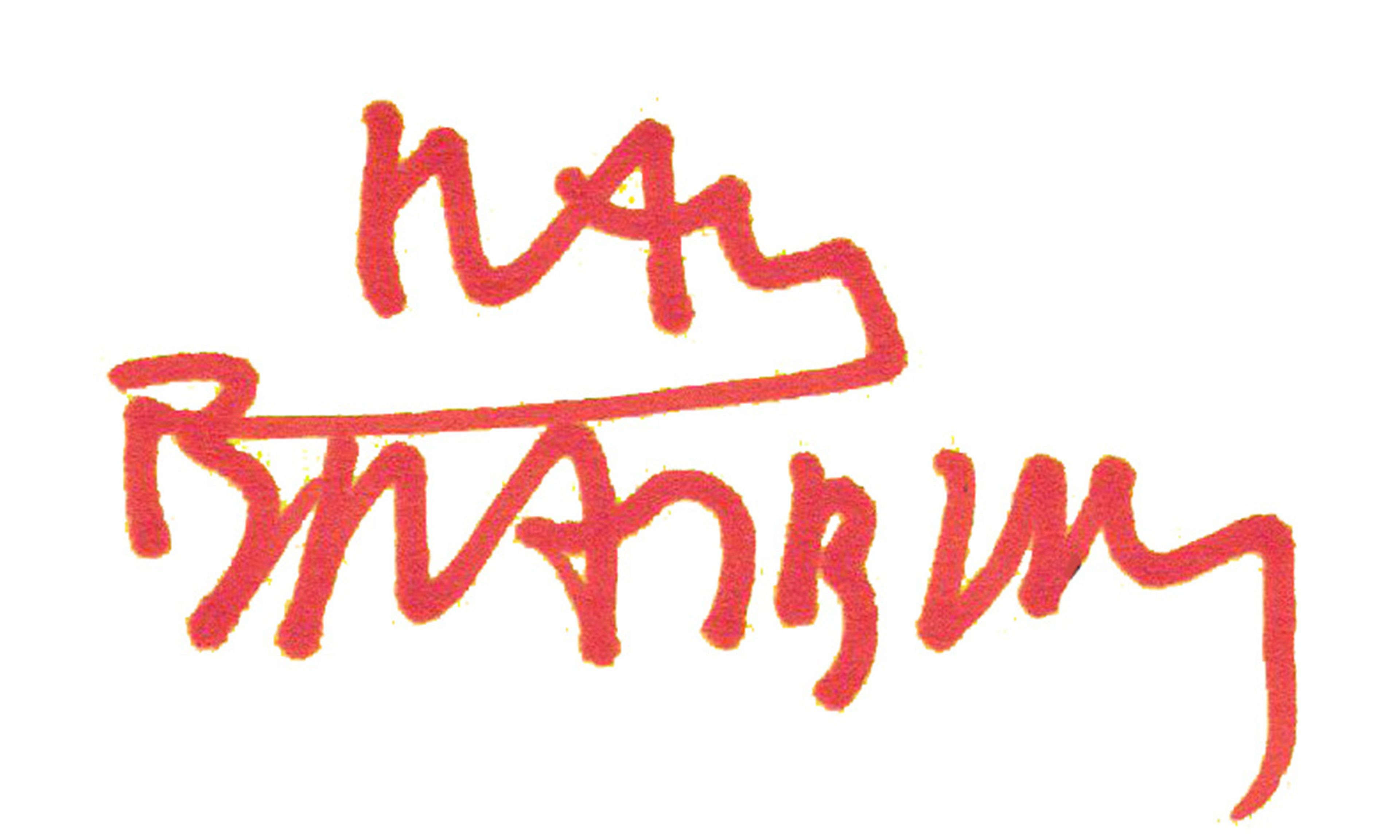
Printed on the line below this rendering was the name of the letter-writer — Ray Bradbury — along with his address on Cheviot Drive in Los Angeles. Below that, a short note was capped off by a hasty signature in pale black ink.
How did I come to receive this missive from the author of The Martian Chronicles (1950) and Fahrenheit 451 (1953)? One spring in the mid 2000s, when I was in my early twenties, I found myself with the sudden urge to write a batch of fan mail, something I had not done since I was a preteen. My motives were probably not dissimilar to those of other fan-letter-writers — some combination of the thrill of sending a letter, so much like a message in a bottle, and the anticipation of receiving a reply.
A few weeks later, I heard from the great man. Perhaps Bradbury — a son of Waukegan, Ill. — was feeling kindly toward a correspondent from Columbus, Ohio, or perhaps he had a flashback to his own days as a teenager soliciting autographs from movie stars. I no longer remember what I wrote to him, but since the bulk of his reply concerned his enthusiasm for Orson Welles — he wrote that he still felt there was no film finer than Citizen Kane — I am sure I told him that I was then working on a book on Welles.
Most of all, though, my letter was an excuse to express my gratitude to the man whose flights of fancy had taken off in my mind. From my earliest years as a serious reader, I was captivated by the mechanics of time travel outlined in his story “A Sound of Thunder,” and I was at once fascinated and repulsed by the ambiguously described contents enclosed in a backwoods yokel’s jar in the story “The Jar.” (Is it organic matter, or merely manmade junk?) And, like millions of others, I was rattled by the vision of printed matter transformed into crisp, smoky ashes in Fahrenheit 451. Bradbury, who died in 2012 at the age of 91, would have turned 100 in August. His novels, stories, and musings have become more relevant than ever.
Like Kurt Vonnegut, born just two years later (1922) and one state over (Indiana), Bradbury made it his business to speculate about the future but retained a healthy appreciation for the past. Both men were Luddites; Vonnegut railed against the Internet, while Bradbury, a nondriver, declined to participate in the automobile revolution. While the moon landing had no greater fan than Bradbury, his enthusiasm for science fiction often seemed less rooted in an interest in technological advances than in nostalgia for the enthusiasms of his youth. Interviewed for a documentary on the BBC, he referred to his basement home office as his “nest” — a womblike space filled with magic sets, filmstrips, and other bric-a-brac of a 1920s-era childhood in America. “I’m surrounded by science-fiction books,” Bradbury said. “Comic strips: Buck Rogers, Flash Gordon. All of these things which are my security blankets.”
Despite being a resident of Los Angeles since adolescence, Bradbury again and again permitted his imagination to wander to the Midwest, which he reproduced in his fiction in the form of Green Town, whose residents apparently have it all over Los Angelenos. “Well, he felt sorry for boys who lived in California where they wore tennis shoes all year,” Bradbury wrote in one of his Green Town books, Dandelion Wine (1957), “and never knew what it was to get winter off your feet, peel off the iron leather shoes all full of snow and rain and run barefoot for a day and then lace on the first new tennis shoes of the season, which was better than barefoot.”
Even Bradbury’s works of fantasy and horror, despite their moments of genuine terror and strangeness, depict small-town life as vividly as the work of Booth Tarkington; Sherwood Anderson’s Winesburg, Ohio, Bradbury said, was a key source of inspiration for The Martian Chronicles. “Wind rattled the empty trees,” he wrote in another Green Town novel, the masterly Something Wicked This Way Comes (1962). “Sunlight, breaking through a small rift in the clouds, minted a last few oak leaves all gold.” In The Halloween Tree (1972), Bradbury effortlessly evoked the sheer bliss of All Hallows’ Eve — blissful not for the acquisition of candy but for the sights and sounds and smells. “Everything seemed cut from soft black velvet or gold or orange velvet. Smoke panted up out of a thousand chimneys like the plumes of funeral parades. From kitchen windows drifted two pumpkin smells: gourds being cut, pies being baked.”
Some may wonder whether the man responsible for such high-flown, misty-eyed prose has anything to say to readers muddling through the confused, contentious reality of 2020. In fact I remember wondering, when the coronavirus pandemic prompted, or compelled, Americans to withdraw to their homes, whether we might collectively return to Green Town–style virtues for a season — to disconnect from our devices and permit ourselves to luxuriate, as Bradbury did, in the howl of the wind, the rays of the sun, and the aroma emanating from the kitchens of our mothers.
In an essay included in the marvelous collection of nonfiction pieces, Bradbury Speaks (2005), the author argued for just such a mass unplugging. “Plant me in a room with two hundred chaps at two hundred computers, give me a number two Ticonderoga pencil and a ten-cent Mohawk Red Indian pad, and I will outthink and outcreate the whole damn bunch,” wrote Bradbury, who also inveighed against email, computer games, and laptops, saying batteries for the last should be doused with salt: “Watch them sizzle like snails. Get a life.” A high-school graduate who bypassed college, Bradbury credited the institution of the library — memorably described in Something Wicked This Way Comes as “a land bricked with paper and leather” — as the real source of his education, but he scorned Internet research.
Yet Bradbury would have recognized the risk of sending home the inhabitants of a nation that, a day earlier, had been utterly dependent on every conceivable electronic device; what if, instead of letting us run through cool grasses in our bare feet, our return home simply hastened our attachment to human contact by way of Wi-Fi? Bradbury saw it coming. In one of his best and timeliest stories, “The Pedestrian,” Bradbury imagined a future world in which an ordinary action — taking a solitary walk on a brisk November evening — has been made strange and worthy of interrogation by law enforcement, while unnatural addictions have become the norm. The year is 2131, but Bradbury’s description of homes dimly illuminated by television screens — “where the people sat like the dead, the gray or multicolored lights touching their expressionless faces but never really touching them” — rings true in our current land of business executives participating in meetings via Zoom and schoolchildren trying to learn world history through Skype.
So, instead of using the pandemic to re-create the idyllic summers and cozy autumns of Bradbury’s fantasies, we doubled down on a technology-dependent lifestyle that was the stuff of his nightmares. In another piece collected in Bradbury Speaks, the author anticipated our concurrent pandemic of smartphone-camera picture-taking — not the gadgets themselves but the mindset that leads otherwise normal people to become self-documenting, iPhone-wielding narcissists: “In Orwell’s urban prison, Big Brother glared from every ceiling. Today we are everywhere loving to be watched.”
Most prophetically of all, Fahrenheit 451, generally seen as a broadside against McCarthyism, clearly foretold what we now know as cancel culture; after all, there is no surer way to cancel something than to incinerate it. The weird, almost irresistible irony of future firefighting squads whose mandate is to burn books rather than stamp out fires helps account for that novel’s perennial popularity, but Bradbury makes clear that this turn in society was not accidental. In fact, the burning of books was decided upon in the hopes of advancing fruitlessly utopian aims.
As the chief firefighter explains to the protagonist, Montag, a book is to be feared because it inspires readers to compare their lives against those of others and thereby invites the impression of inequality: “Each man the image of every other; then all are happy, for there are no mountains to make them cower, to judge themselves against. So! A book is a loaded gun in the house next door. Burn it.” Books are burned because those with unpleasant topics or troubling facts are thought to induce unacceptable levels of unhappiness. “Someone’s written a book on tobacco and cancer of the lungs? The cigarette people are weeping? Burn the book,” the chief says. “Serenity, Montag. Peace, Montag.” In this 67-year-old novel, Bradbury foresaw society’s first safe spaces.
Of course, during the peak years of Bradbury’s creativity, few could have anticipated that Green Town would become so distant, while metaphorical book-burning, in the form of attempting to erase works of art from the public sphere, would appear so near. With its twin visions of a pastoral past and a sterile, anti-culture future, Bradbury’s work remains timely a century after his birth. Long ago in Waukegan, a carnival worker famously instructed Bradbury to “live forever!” — and so, for better and for worse, he has.












Comments