I was once trying to catch a ferry from Turkmenbashi, the Caspian Sea port formerly called “Krasnovodsk,” to Baku, Azerbaijan. I was told that’s the easiest way to get from one side of the Caspian Sea to the other, and maybe it is. My advice, if you find yourself there, is to exhaust all of the other options first.
In order to get on the ferry — actually, in order to do anything at all in that part of the world — you must first present yourself to a sour-looking lady bureaucrat of indeterminate age and try to make yourself understood. “Is that the ferry to Baku?” you ask, pointing to the large ferry at the dock. “And may I buy a ticket?”
What follows is a torrent of downcast Turkmen-inflected Russian, with a lot of head-shaking and shrugging and generally negative guttural sounds.
So you figure that the boat outside is not the ferry to Baku and you cannot buy a ticket and you start to walk away, until the bureaucrat calls you back to clarify. That is, in fact, the ferry to Baku and you can, in fact, get a ticket. You just didn’t understand what she was saying. You heard her tone and read her body language and thought, Nyet, when the answer was actually, Da, da!
The problem is, everything in Russian sounds like bad news.
I remembered that moment a week ago when I finally went to the dentist after an eight-month COVID-required hiatus. My dental hygienist is a taciturn Russian woman of a certain age, and as I walked into the little room and reclined in the chair, she looked me up and down.
“You lost weight,” she said. It’s true — I’ve spent my corona time eating better and taking long walks, and have dropped nearly 20 pounds — but she made it sound like an insult.
She waved an instrument in the direction of my head. “And your hair is better like this, longer. Is more attractive.”
I tried to thank her, but by this time she was already exploring my mouth with her steel prongs. She poked around and then leaned back.
“And you have been flossing,” she said like an accusation. I nodded.
“You are having,” she slowly said, in her thick Russian accent laced with suspicious contempt, “a very good pandemic.”
Which I have to admit is true. I have taken the past eight months to lose some weight, start some promising writing projects, sell a TV show. Of course, whenever the subject comes up — which it does, regularly, for all of us — I don’t lead with that. When someone asks how I’ve been, I don’t smile widely and cheerfully bray, Doin’ great! Losing weight, making bank, I am loving this corona situation! Do not want it to end!
Instead, I follow the lead of my Russian friends. I make it sound like bad news. I stipulate, at the outset, that it’s been a tragedy for many people. I acknowledge, with somber words, that nearly a quarter of a million Americans have died. I convey, in tone and body language, that this is all a terrible disaster, and yes, thank you, I have lost some weight and am developing a new television series, but let’s not forget that the second wave is here and the recent vaccine trials suggest . . .
You get it, right? It’s unseemly, in the middle of the disaster, to start counting up the benefits. But there is always some good news somewhere, buried deep in the back pages of the only-depressing-news newspaper. And here’s one of the least bold predictions possible: In a few years, we will look back on this pandemic and be able to enumerate, with tempered gratitude, the positive changes that COVID-19 ushered in.
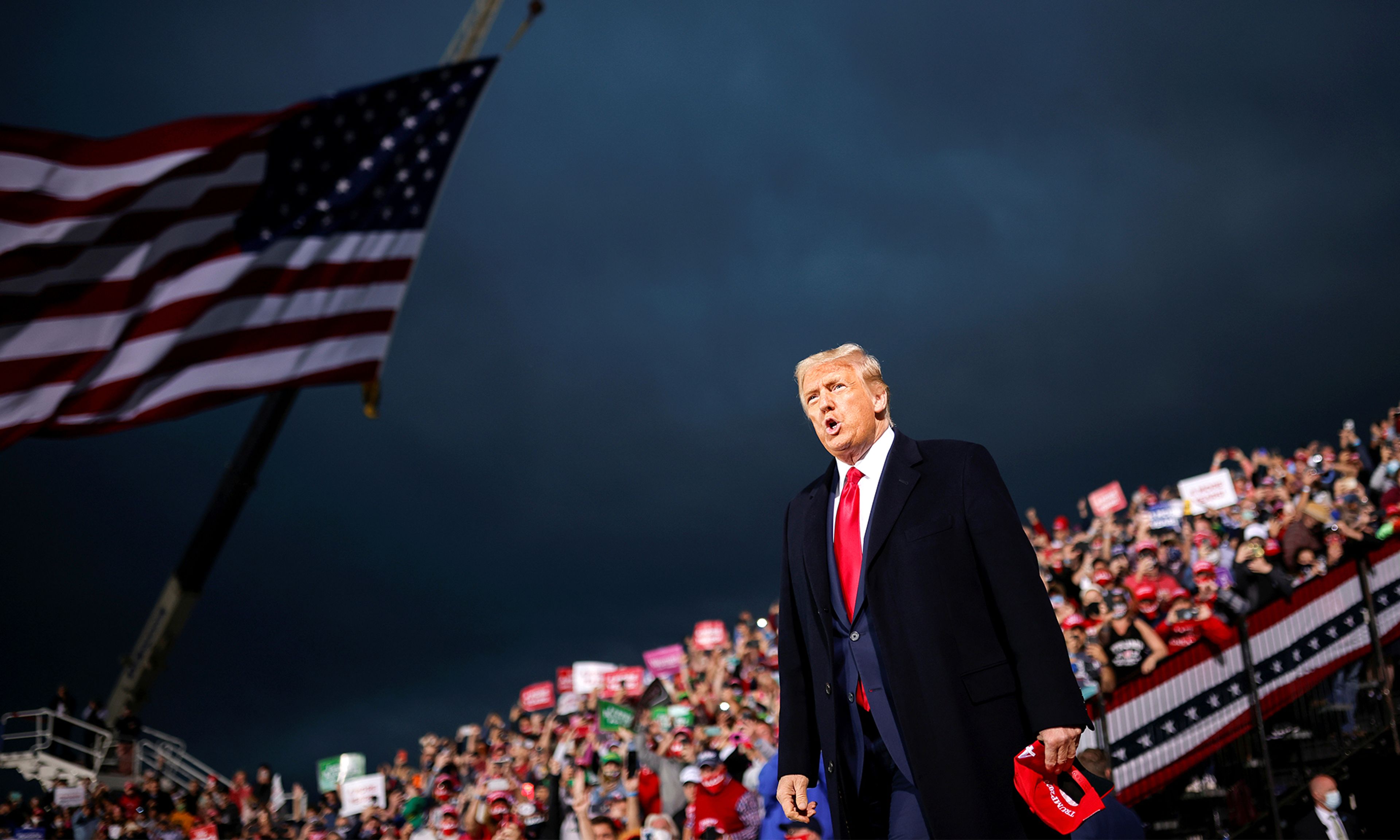
And here’s a slightly bolder prediction: In a few years, we will look back on the Trump administration in a similar way.
I stipulate, at the outset, that the president is an undisciplined and emotionally unstable creature, and I acknowledge, with somber words, that the amateur-hour incompetence of his administration is entirely his fault. He has many smart and accomplished people working for him, but he insists on undermining his own team. The reputation of the office of the presidency — and American prestige and influence abroad — has never been lower, and our allies never more baffled. And I say all this like my dental hygienist, as a dark and sour litany of complaints.
But, maybe.
Maybe when he’s gone — which is looking, according to recent national and battleground-state polls, like it’ll be January 20, 2021, at 12:01 p.m. Eastern Standard Time — we’ll notice certain positive changes that the Trumporona virus ushered in.
After decades of flirting with citizen-candidates — Perot, Nader . . . hell, Lyndon LaRouche — we now know just how complicated and awkward it is when an untested citizen becomes the chief executive of the administrative branch of the largest, slowest, most sclerotic organization in human history. Should this happen again — unlikely, after the past four years — we will be more prepared. (The same could be said about the next big respiratory contagion as well.)
It’s been nearly a century since the American Century began, and the zany and unpredictable Trump administration has hastened it to an end. We may well look back on this development with genuine regret, but it’s also possible that we’ll see the end of American global nannyship as a welcome relief. Our allies will never trust us again, a deeply concerned foreign-policy expert (is there any other kind?) intoned to me last week. That may not be the worst possible outcome. Sometimes a little disruption leads to positive outcomes.
That has certainly been the case when it comes to Israel. For nearly its entire existence, the ironclad rule was, America cannot move its embassy to Jerusalem. We just can’t, was what everyone said. And then Trump did, and it ignited the most interesting — and arguably the most auspicious — developments in Arab–Israeli relations since Camp David.
But of course there are the tweets. And the vulgarity, and the general low-rent behavior — we’re used to middle-class respectability from our presidents. Even when they sin, it’s of the small-town-mayor variety. Nixon with his enemies lists and bumbling office-breakers; Clinton with his intern — Trump has brought the office of the presidency to a new low in tacky embarrassments, huffing and puffing on the Truman balcony, sending out cascades of barely coherent tweets riddled with typos and Freudian projections. It’s hard to see how the office will ever regain the seriousness and majesty it once had.
And that’s the best news of all. We’ve seen a steady increase in the pomp and pomposity of the presidency — the engorged traveling entourages, the endless line of limousines and Suburbans, the royal trappings that have slowly accrued to what is supposed to be a plain-Jane citizen’s job. In the middle of a workday in the middle of a cold war, Harry Truman could walk across the park and grab a drink at the bar at the Hay-Adams Hotel, something that would now require legions of advance workers and self-important staffers and hundreds of people with White House placards dangling from lanyards. The presidential portraits that line the White House walls will now include Donald J. Trump, and that should be enough to remind whoever sits behind the Resolute Desk that, let’s face it, the people have already shown that they’re capable of electing the class clown. Don’t get so high and mighty.
There is always, in other words, some good news to share. In the midst of a pandemic, you can lose weight and discover a better hairstyle. At the probable end to an improbable and unhappy presidency, we can celebrate the bursting of some very deserving bubbles.
When I sauntered onto the Turkmenbashi–Baku ferry, I felt very smug and happy with myself. How funny, I thought, that the lady on the pier had such a pessimistic and saturnine worldview. How sad, I thought, that these people cannot see the bright side of life.
And then it started to rain. There was no interior cabin to shelter in — it was still under construction after a shipboard fire. The ferry itself was traveling at half speed because of a faulty engine, so it was a wet ten hours. Maybe that’s what the Russian lady was trying to tell me, with her head shakes and her nyets.
So what sounded like bad news that turned into good news was actually, once I was thoroughly wet and miserable, bad news again. The good news was sandwiched between two bad-news slices of bread, which it often is.












Comments