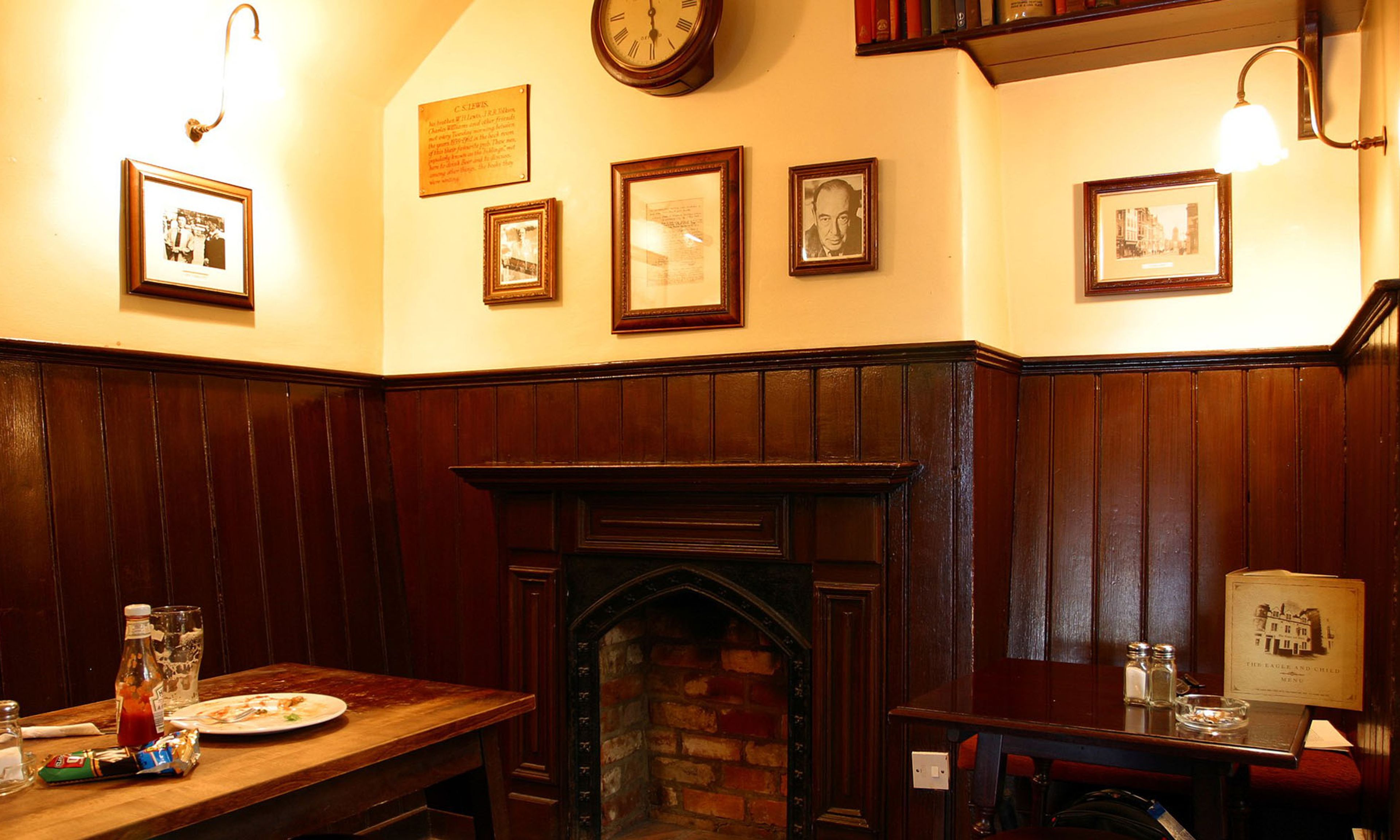
Much has been written about the Inklings, perhaps the world’s most famous group of friends, who formed a discussion group at the University of Oxford in the 1930s and ’40s to share their love of literature and help one another in their fiction writing. Nearly 100 years later, scholarly interest in the group remains significant, owing in large part to its two most famous members, C. S. Lewis and J. R. R. Tolkien.
The latter is renowned for his Lord of the Rings trilogy, its prequel The Hobbit, and various other stories centered around Middle Earth, the symbolism-imbued fantasy world Tolkien created. Tolkien was unashamed to admit that he did not think much of his friend Lewis’s efforts at fiction, most notably his fantasy series The Chronicles of Narnia, but Lewis remains at least as popular an author as Tolkien — and his extensive writing in Christian apologetics has cemented him as a household name more than half a century after his death.
Lewis, Tolkien, and the Inklings have been the subject of careful study and popular interest for decades, but thus far scholars have paid relatively little attention to the friendship between Lewis and another well-known contemporary of his, Dorothy L. Sayers. The mind behind the Lord Peter Wimsey detective series, Sayers was a fiction writer who, like Lewis, devoted herself also to the study of Christian theology and produced several works of apologetics.
In a new book, Dorothy and Jack, Gina Dalfonzo delves into the correspondence between these two writers, which spanned more than a decade, beginning with a letter from Sayers to Lewis and ending with Sayers’s death. With this compact tome, Dalfonzo draws out the ways in which the writers might have helped spur each other to greater creativity in their work and to deeper understanding in their personal lives. The book features long quotations from many of their exchanges, following the thread of one topic or another through the course of several letters back and forth, but their text is set inside what is primarily a case Dalfonzo outlines: that the correspondence between them, illuminated by knowledge of their personal lives, illustrates how the friendship altered both for the better.
While in some ways it might seem more satisfying to pick up a collection containing the full correspondence between Sayers and Lewis, there is something uniquely valuable about this selection. For a reader drawn to the volume by a preexisting love for either Lewis or Sayers, Dalfonzo’s work serves as an introduction to another important author of the 20th century, and it might be an impetus to look into that writer’s oeuvre.
Meanwhile, to a reader already familiar with both Sayers and Lewis, this book offers a real service by situating their correspondence within the biographical background of each writer and the broader frame of their careers, while suggesting some ways in which each helped to change the other’s thinking for the better. Rare is the reader knowledgeable enough about both writers to draw from all of their correspondence the meaning and significance that Dalfonzo uncovers.
The friendship that formed between the two writers seems to have begun early in 1942, when Sayers first wrote to Lewis. Sadly, that first missive has been lost, so we do not know with certainty what topic she addressed with him. Her letter came as Lewis’s work was beginning to become more famous and as her own literary career was winding down. It appears likely, to judge from later correspondence, that this first letter might have concerned a project called “Bridgeheads,” a series Sayers developed to showcase the work of Christian writers.
After that initial contact, they continued corresponding until her death 15 years later, and they may have met in person for the first time in the summer of 1942, though Dalfonzo notes ruefully that neither author left a record definitive enough that we can know for sure. In large part because Lewis himself did not keep detailed records or copies of all the letters he received, the first extant letter from Sayers was sent the following year, when she tried her hand at writing in the distinctive style that Lewis displayed in what remains one of his most popular works, The Screwtape Letters.
Dalfonzo’s ability to pull the right excerpts from these letters and capture the playful spirit in which they corresponded will make readers feel almost as if they are being immersed in this very real friendship, watching slowly as Sayers and Lewis warm up to each other, their mutual fondness growing over the course of years. It is immediately obvious, thanks to the brief biographies Dalfonzo provides, that Sayers and Lewis had much in common in how they approached their work and in the values that undergirded their efforts. Most notably, both were profoundly shaped by their days at Oxford, and both had undergone significant personal experiences earlier in life — he a conversion, and she a series of troubled relationships — that helped explain their passion for using the written word to influence readers.
But those similarities did not mean they always saw eye to eye, even on those vital matters where their interests aligned. Dalfonzo points out that “integrity, artistry, evangelism, and the way in which these various qualities and callings might end up interfering with each other” were recurring themes of the letters between Sayers and Lewis. While both believed they had a responsibility to communicate the truth in their fiction, they disagreed on what burden that imposed on the writer.
Both struggled with the relationship between their work and their faith, which for each of them were intimately connected, in their fiction as well as their apologetics. Lewis and Sayers both grappled with a fundamental question, as Dalfonzo puts it: “Should artists create art to communicate a message — such as the gospel message — or should they create art simply because they were called to create art and let it speak for itself?”
The two writers reached decidedly different answers. For her part, Sayers concluded that, in the words of her biographer Barbara Reynolds, “her conscience prevented her from writing for the purpose of edifying readers.” In a somewhat heated disagreement with Lewis on this point, Sayers wrote, “You must not tell people what they want to hear, or even what they need to hear, unless it is the thing you passionately want to tell them.” Lewis, meanwhile, although he professed not to disagree with his friend as much as she thought he did, objected to what he saw as her decision to “take as the criterion of honest work the sensible desire to write, the ‘itch,’” which, as he put it, was too much like “making ‘being in love’ the only reason for going on with a marriage.” Though it is evident from their many exchanges on this subject that they had a fundamental difference of opinion on how best to pursue their literary vocations, their disagreement seems to have strengthened their friendship, showing Sayers in particular that she could “freely speak her mind without fear of reproach,” Dalfonzo explains.
In some of the book’s strongest sections, Dalfonzo explores ways in which this friendship between a highly intelligent man and woman may have shaped — and reshaped — Lewis’s views on friendship between the sexes and on women in general. Lewis didn’t marry until a little more than a year before Sayers passed away in late 1957. By that time, it seems clear from his writing, her presence as a strong female friend in his life had altered his attitude toward women and the possibility of platonic friendship.
Bringing to Dalfonzo’s book some outside knowledge of Lewis’s work is helpful on this point. In his 1960 nonfiction book The Four Loves, he offers insight into relationships and the nature of love, between friends as well as spouses. In his chapter on eros, he observes that because the Christian idea of marriage involves separate and seemingly unequal roles for man and wife, “we might take the Christian mystery not seriously enough.” But, he suggests, we ought to understand it differently:
Christian writers (notably Milton) have sometimes spoken of the husband’s relationship with a complacency that makes the blood run cold. We must go back to our Bibles. The husband is the head of the wife just in so far as he is to her what Christ is to the Church. He is to love her as Christ loved the Church — read on––and give his life for her.
The fact of the man’s headship, in other words, is not meant to be opposed to the wife or her flourishing. “The sternest feminist need not grudge my sex the crown offered it either in the Pagan or in the Christian mystery,” Lewis observes. Exercised properly, not as the crown of a ruler but as a crown “of thorns,” the man’s willingness to lead should better enable a wife to thrive. It is only when husbands “allow or compel their wives to usurp” that role that both men and women are degraded and the relationship between them is, ultimately, destroyed.
Though some modern ears will balk at the traditional, conservative nature of Lewis’s views on women, feminism, and marriage, Dalfonzo’s examination of his friendship with Sayers demonstrates that his thoughts on women were free of what today’s readers might think of as “patriarchal” notions. His eventual departure from Milton’s more rigid conception of male and female roles — and from the idea that male headship required male willfulness or dominance — was thanks in part to his friendship with Sayers.
Sayers did not live to read The Four Loves, but Dalfonzo supposes that she would have “noticed with glee” that Lewis was careful not to portray marriage, as Milton did and as Lewis himself once had done, as a relationship in which the “husband casts the deciding vote.” It is no insignificant thing that Sayers influenced the thought of one of the most influential writers of the 20th century.
Dalfonzo recounts that when Sayers passed away after a sudden heart attack, Lewis cried — the first time his stepson Douglas Gresham ever saw the older man shed a tear. That event recalls a passage earlier in the book, when Lewis told Sayers he had “shed real tears (hot ones)” after reading her play-cycle The Man Born to Be King. Perhaps his tears on both occasions were evidence of Lewis’s belief that our most meaningful friendships are those in which we see and share the same truth.
Aside from drawing us into deeper study of these two significant writers and enticing us to encounter or revisit their work, Dalfonzo offers the modern reader a powerful reminder of the timeless value of letter-writing, a practice long out of fashion. May her careful recounting of the camaraderie between Lewis and Sayers, which existed primarily through the written word, inspire in us gratitude for the epistolary art — if only because we have something left by which we can better remember their fascinating friendship.












Comments