
When I first voted in the city, it was at the old high school. The pre-war building — pre–World War I — was a monument of old pedagogical ideals. The lobby displayed murals of the state’s colonial past; the auditorium hosted chamber-music concerts, attended by mostly gray-headed audiences. In my time, they added metal detectors at the doors, to suit modern pedagogical necessities.
You waited in a line that branched out, funneling citizens into their particular neighborhoods. When you arrived at the proper table, you gave your name to an Election Day volunteer, who looked it up in a plus-folio-size volume with heavy covers. There you signed in, matching your signature to the one you had inscribed on your first trip to the polls; as the years passed, you saw how your handwriting changed (degenerated). I also saw my changing taste in self-identification. In my youth I had supplied my entire middle name, though it soon came to strike me as an antique affectation, as if I had called myself Esq.
You cast your vote in a voting machine, a contraption with a wrap-around curtain. The only things like it were photo booths at carnivals, or the changing rooms in dry-cleaning establishments that employ tailors. Wrapped in privacy, you faced a ballot listing the candidates for each office. My state allows candidates to receive the endorsements of more than one party, which encourages third parties, as either single-issue advocates (legalize pot) or ideological pressure groups (socialism now). The candidates for down-ballot offices (judgeships at obscure levels of the court system) clung like pilot fish to party loyalty or the reflected renown of up-ballot candidates of whom one had actually heard. You chose by flicking small tear-shaped metallic switches, which made satisfying clicks when moved into position. If you were feeling hesitant, you could unflick them at the last minute — a friend told me that the first time Little Billionaire ran for mayor he had decided to vote for then against him, changing his mind three times, until he remembered that L.B. had been accused of sexual harassment; I will not say which way that caused him at last to vote. When your decision was final, you cast your metallic choices by hauling a metal lever at the base of the ballot display through one-third of a circumference; I forget now whether it went from 10 to 2, or 2 to 10. The curtain opened, and you returned to normal existence.
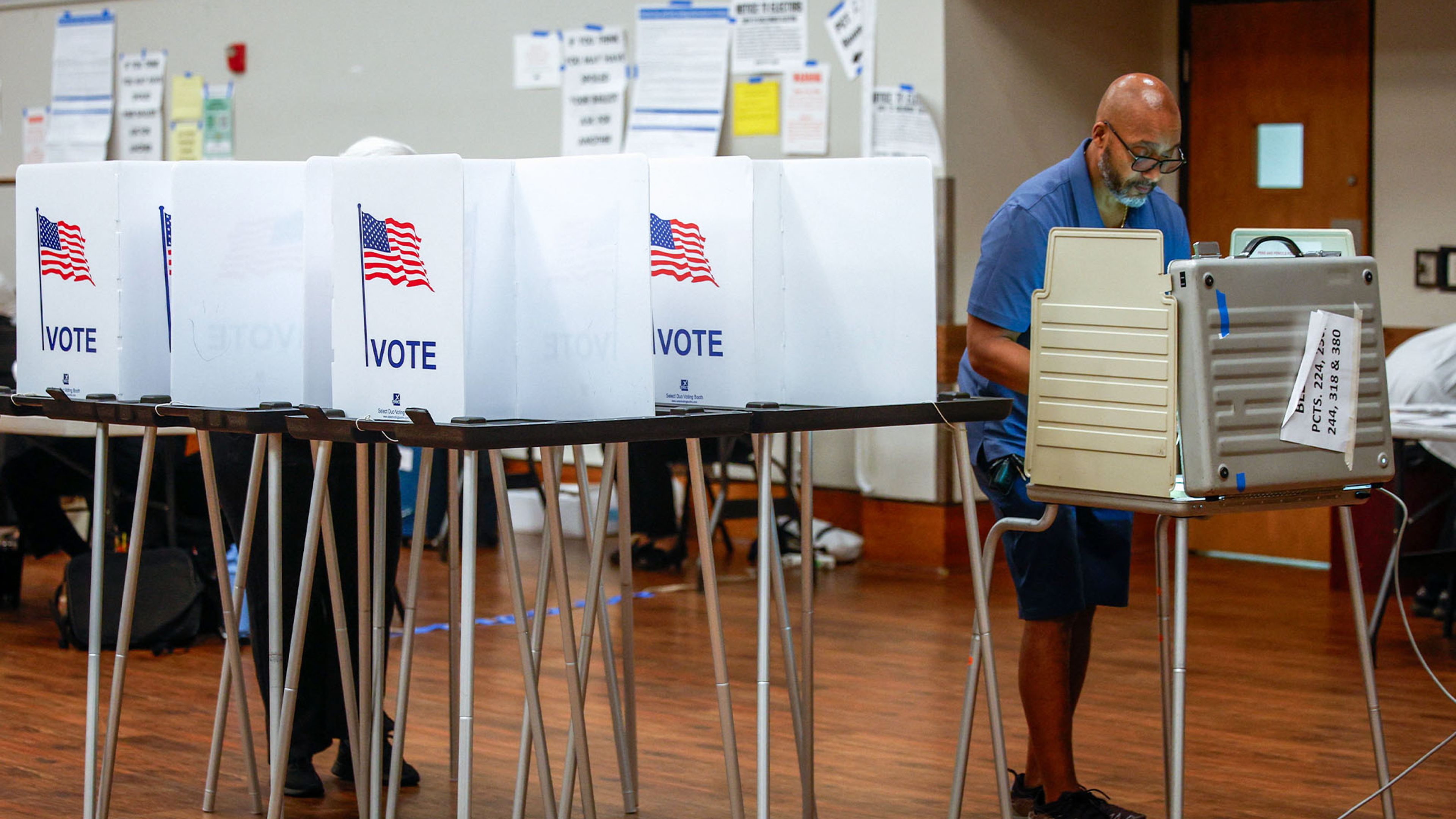
Over time, the routine changed. The polling place moved to another high school, then to a building of the university that ate downtown. The latter building, being modernist/functional, had no visible pedagogical aspirations. You couldn’t tell whether the rooms you passed on your way to your rendezvous with democracy were classrooms, offices, or what. Did they still use the old voting machines the first few times I voted there? Maybe, but soon they were gone too, replaced by touchscreen monitors. This brought the process forward by decades; the old machines would not have looked out of place in a beat-the-Axis newsreel; now we had joined our own era, of PCs and handhelds and generated omniscient voices. That change did not make this voter feel more secure, because as a conscript, willy-nilly, to the new era I had seen its malfunctions: the glitches that, because their causes are invisible, are incomprehensible; the files that vanish like a baseless fabric; the blue screen of death. The old machines were analog, they left some mark on some piece of paper, durable as Sappho fragments in Egyptian mummies. In the touchscreen age my vote could vanish in data nirvana.
Came the virus. How would we vote now? My wife and I thought of the hordes of our deep-blue urban neighbors, yearning to vote the incumbent out of office; of the impossibility that, with the best wills in the world, they could maintain themselves in the inevitable conga line six feet apart; of their arrival at the room with the table, the sign-in book, and the actual act in which, whether we all voted by touchscreen, tear-shaped switch, or voice vote, we would be even closer together. My wife and I requested absentee ballots.
We did it weeks in advance. There were still leaves on the trees, we were still picking tomatoes in our garden, the farm stands were still selling corn. We came into the city from rural Elba regularly to run errands, among them checking our mailbox. Nothing.
There was an online tracker by which you could monitor the progress of your absentee ballot. It found our ballots, and told me that they had been mailed — to our building, but to the apartment we had not occupied for 40 years. Forty years ago, there was still a Soviet Union, neither of us had written a book, and I had hair. Bruxism, brimstone.
I used the reply option to supply the correct apartment number and kept checking the online tracker and, during our flying visits, our mailbox. Nothing. Finally I called the board that oversees elections in the city.
Amazingly, I got a person. She seemed harassed, but she helped. She knew me, she knew of the mistake, and she assured me that our ballots had been resent, to the correct apartment.
We drove into the city the day before the election, checked the mailbox. Catalogues, bills, the magazine everyone reads for the cartoons. But no absentee ballots. Time for a redefinition: absentee ballot = ballot that is absent.
Of course, what would our votes have mattered in a city with 5 million voters, a state with 13 million? They matter to us. Freedom riders, framers, farmers who stood on the rude bridge that arched the flood, wanted governors picked by us, not by a panel of wise experts, nor (more likely) by cronies and relatives of those already in power. If we end up governed by cronies and relatives, it is because we put them there.
Maybe we should have stood in line.











Comments