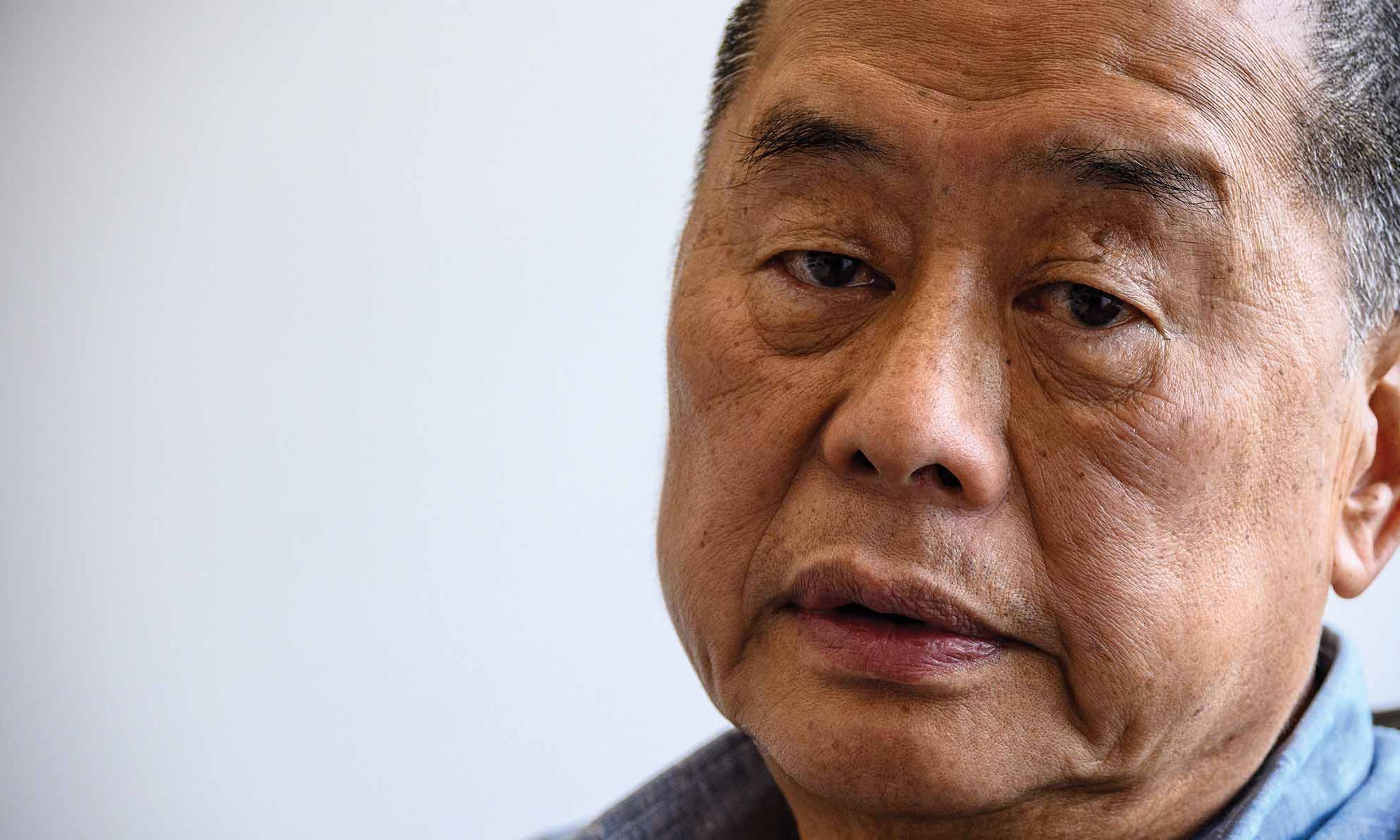
‘It would be so boring just being a businessman,” said Jimmy Lai, as the Chinese government was tightening the noose around Hong Kong. “I want to make my life more meaningful and interesting.” That is why he had gotten himself into trouble, he said. He was loath to stand on the sidelines while others — especially young people — were being arrested and imprisoned.
Jimmy Lai is probably the most famous person in Hong Kong. He is a legendary businessman. He is a champion of liberal democracy. And he is, by his own choice, a political prisoner.
“By his own choice”? That is too loosely worded. Lai did not choose for the Chinese government to take away Hong Kong’s freedoms, making it essentially another city in a vast police state. But he did not flee the city when he could have. He chose to stay and face the consequences of his activism — and to suffer for his ideals.
That’s a word he has used: “suffer.” For many years, Hong Kong held a candlelight vigil in commemoration of the Tiananmen Square massacre (which the Chinese government carried out on June 4, 1989). Suddenly, the vigil was a crime. Many people continued the tradition anyway. And in December 2021, eight people were sentenced for it.
One of them was Jimmy Lai — who said that if remembering the massacre was a crime, then “let me suffer the punishment of this crime, so I may share the burden and glory of those young men and women who shed their blood on June 4 to proclaim truth, justice, and goodness.”
Lai’s son Sebastien cites the cliché that “money isn’t everything.” This certainly applies to his father. “I don’t know of anybody else,” says Sebastien, “who has basically given up everything he has ever built, to sit in a prison cell.”
Jimmy Lai symbolizes the struggle of freedom and democracy against tyranny. He also has an amazing life story. It is a Horatio Alger story, with Chinese characteristics, you could say.
He was born on the mainland in 1948. Or was it ’47? No one can be sure, says Sebastien Lai. Records are spotty from that chaotic, convulsive time. In any event, the Communist revolution soon triumphed. Jimmy’s mother would sometimes joke, “He brought the Communists with him.”
Jimmy’s father had been very rich — a shipping tycoon, by some accounts. The family lost everything in the revolution. The father left the country. The mother was put into a reeducation camp. When he was only six or seven, Jimmy was left to take care of his two sisters.
These are “crazy things to think about,” says Sebastien, with understatement.
Jimmy worked on the streets. This was in Shunde, outside Canton, or Guangzhou. When he was eight or nine, he got a job at a railway station, carrying people’s bags. That gave him a taste of the outside world: People from far away were coming in. One day, a man tipped him, then handed him a chocolate bar. Hungry, as he perpetually was, Jimmy bit into it, immediately. He could not believe how good it was.
“Hey,” he called to the man, “where are you from?” “Hong Kong,” said the man. That made Jimmy think that this Hong Kong must be a kind of heaven.
At twelve, he escaped to Hong Kong. He was smuggled in the hold of a fishing boat. People vomited all the way. The voyage was rough and dangerous. But when Jimmy arrived in Hong Kong, he had really . . . arrived.
That very night, he went to work in a garment factory. He had to pay off the smuggler. He worked twelve-hour days. “He still has some physical reminders of those days,” says Sebastien. Jimmy can’t hear out of one ear; one of his fingers got caught in a machine.
But, oh, Jimmy loved it. For one thing, there was so much food. The workers ate and slept in the factory. On his first morning there, when he saw the breakfast — the abundance of it — Jimmy cried. More broadly, he sensed that he had a future.
How did he acquire that English name “Jimmy”? (His Chinese name is “Chee-ying.”) Sebastien doesn’t know. Maybe we can ask him someday. Sebastien knows how he learned English, however. An accountant at the factory took a liking to him and taught him the language after hours.
Sebastien recalls an interview that his father once gave to the BBC. The interviewer asked him why he wanted to learn English. Jimmy thought about it for a second, then answered, “I noticed that everyone who was pointing at me, telling me what to do, also spoke English.” It was the language of the managers and bosses.
In due course, Jimmy Lai got a job in sales. This had him traveling between Hong Kong and New York, which opened up yet other worlds for him. One evening, he was invited to dinner at the home of “a retired Jewish lawyer,” as he once put it. (Lai is a thoroughgoing philosemite.) At some point, his host went to a bookshelf and plucked a book, giving it to Jimmy and recommending he read it.
It was The Road to Serfdom, by Friedrich Hayek — that canonical volume of classical-liberal thought. “The book changed my life,” Lai has said. It provided new understandings and planted new dreams.
Allow me to intrude with a personal memory. In 2012, I was in Taipei, and I had arranged to meet some people at Apple Daily, the newspaper (based in Hong Kong) owned by Jimmy Lai. Walking into the lobby, I came face-to-face with a bust of Hayek. I had not seen one before; I have not seen one since.
Later, Lai became an admirer of Milton Friedman’s, and he became a friend of Friedman’s, too. They visited China — the mainland — together.
In the 1970s, Lai threw himself into free enterprise. He was not averse to risk-taking. After all, he had already taken the biggest risk he could imagine: getting onto that boat, at twelve, to seek out a new life. In 1975, he bought a bankrupt factory. He started to manufacture sweaters. The company did well. He got bored with manufacturing, however, and got into retail — founding Giordano, which eventually sold clothes all over Asia and beyond.
Why the name? Lai had been to a pizza parlor in New York. The next day, he pulled a napkin out of his pocket — a napkin from the parlor: Giordano’s. There was the name of his new company.
When the Tiananmen Square protests started in April 1989, Lai was moved. He was deeply affected by the idealism and bravery of the students. He had Giordano make T-shirts with pictures of student leaders on them. He sent money, and clothes, and food to the students. And when the government committed the massacre, Lai wanted to embark on a new kind of life. He wanted to take a firm stand for freedom, democracy, and human rights.
He got into media, founding Next Magazine. (The name “Next” signified the owner’s new calling and purpose.) He not only oversaw the business, he wrote a column. In one column, he blasted Li Peng, the premier of China, known as “the Butcher of Beijing” for his role in the Tiananmen massacre.
Beijing did not hesitate in blasting back. The government hampered Giordano stores in China, and Lai soon sold the company. That was “the fork in the road,” says Mark L. Clifford, a longtime friend and associate of Lai’s who is completing a biography of him. “The government figured that, like 99.9 percent of businessmen, he’d back down. He would know which side his bread was buttered on. He would want to preserve his beloved retail chain.” But Jimmy is an unusual cat.
He is not only an ardent democrat, he is also an ardent Catholic. He wanted to devote himself to what he held to be the higher and most important things in life.
In 1995, he founded his paper, Apple Daily, a strong pro-democracy voice. Why “Apple”? This name did not come from a napkin. It came from the story of the Garden of Eden, and the tree of the knowledge of good and evil. “If Eve hadn’t eaten the apple,” Lai has been known to say, “there would not be any news!”
Flash forward to 2014: when the “umbrella movement” started in Hong Kong. This was a mass pro-democracy movement, which got its name from the use of umbrellas as shields against tear gas and water cannons.
The streets were filled with the young. And Jimmy Lai was among them. He talked with the protesters day after day, and, more important, listened to them. And got arrested with them.
He did just the same during the mass and ultimate protests of 2019 and 2020 — when Hong Kongers put forth a great last gasp to prevent their city from succumbing to tyranny. The authorities harassed Lai and his family, trying to intimidate them. They rammed his car; they firebombed his home; etc.
Lai counseled the protesters — his fellow protesters — not to return the violence of the police with violence of their own. It would “forfeit the moral authority we have,” he said.
On November 23, 2020, Lai sent out a tweet. “Let us not be afraid and fight on!” The greater the danger, said Lai, the easier to arouse the world’s attention. And “the world’s attention is our saving grace.”
Jimmy Lai has been in prison since the last day of 2020. The authorities raided his newspaper, twice — first with 200 agents, then with 500 — shutting it down and arresting various executives, in addition to Lai.
Like other dictatorships, this one invents charges against its critics — fig leaves. The authorities in this instance have accused and convicted Lai of fraud. And of unauthorized assembly. But mainly, they want him out of the way and silenced. They are also sending a message: “If we can do this to the great and famous Jimmy Lai, we can do it to anyone.”
Lai now awaits a further trial for violation of the National Security Law — which is a law that essentially forbids criticism of the government. The government has boasted that its conviction rate under this law is 100 percent.
According to reports, Lai is kept in solitary confinement for 23 hours a day. He is in his mid 70s. What the government is doing to him, as Sebastien Lai says, “is cruel. Just cruel.”
Sebastien is a key part of the worldwide campaign to highlight Jimmy’s case and win his release. The Chinese government has put bounties on the heads of Hong Kongers in exile — exiles who continue to speak out against tyranny in their home city. Asked whether he is taking precautions, Sebastian pauses. He then says, “Look, my father does not deserve to be in jail, and I’ll keep fighting until he’s out.”
He admires his father a great deal. He understands his father’s decision to stay — to be imprisoned, rather than seek exile. “You don’t get to choose where you were born,” says Sebastien. “But often you get to choose where you call home. And Dad chose to call Hong Kong home, and when someone comes for your home and your people, you stand firm.”
Sebastien misses his father terribly, but, reflecting on all his father has done — from boyhood onward — he says, “It’s an incredible, inspirational story.” It is.












Comments