At his State of the Union address in February, President Biden got a bipartisan round of applause when he urged Republicans and Democrats to promise not to reform Social Security or Medicare. In the debt-ceiling negotiations over the summer, they didn’t reform either program. With vanishingly few exceptions, nearly every politician in Washington refuses to countenance major spending reform.
While politicians used to talk more about spending reform, their inaction on the issue is not a new phenomenon. According to inflation-adjusted Treasury data, the last year the national debt decreased was 2001. That capped off three years in a row of decreases. The debt in 1998 was $10.03 trillion, and in 2001 it was $9.67 trillion. It has gone up every year since then and currently sits at over $31 trillion.
A September 3 headline in the Washington Post read, “U.S. deficit explodes even as economy grows.” It referred to estimates from the Committee for a Responsible Federal Budget, which showed that the deficit for fiscal year 2023 will likely double to $2 trillion. The CRFB has been on this issue forever, and it knows the facts inside and out. Nobody should have been surprised by 2023, and 2022 should have been the warning siren on spending.
In 2022, the pandemic itself was over. The pandemic recession was past. The unemployment rate was near or below 4 percent for the entire fiscal year. Four percent was, historically, considered to be full employment, or slightly better than full employment. (Unemployment will always be in the low single digits, even in the best of times, because people still change jobs voluntarily or hold off on taking a new one.)
The U.S. was not at war. No major new domestic programs were created, thanks to the Supreme Court striking down the unconstitutional and illegal student-loan program. Inflation helped revenues because tax brackets adjust the year following new inflation. Collections of individual income tax were at an all-time high. Corporate-tax collections were up as corporations reported strong profits. Total revenue was $4.9 trillion, the most ever. The federal government took in 20 percent of GDP in taxes, compared with an average of 17 percent over the past 50 years.
Yet in 2022 the U.S. ran a $1 trillion deficit. And it would have been $1.4 trillion if the Biden administration had gotten its way on student loans.
Because that deficit was much smaller than the ones in the previous two years, which included trillions in Covid spending, the 2022 deficit was celebrated by the Biden administration and probably treated too kindly by most in Washington. Yet that deficit should have been the alarm. If the highest federal revenues in American history, in a time of low unemployment, no wars, and no major new programs, was still not enough to come even close to balancing the budget, that’s a problem.
If that weren’t alarming enough, it has long been public knowledge that the deficit is expanding in 2023. The Congressional Budget Office issues a publication called the “Monthly Budget Review.” Federal spending can vary considerably from month to month. Sometimes, owing to the timing of payments or receipts, the federal government can run a surplus in a given month even if it is massively in the hole for the year.
So far in fiscal year 2023, which began in October 2022, in every month except the first one the government has been in a deeper hole than it was in that same month the prior fiscal year. And the only reason that first month looked good was that October 1, 2022, fell on a weekend, so the federal government made $63 billion in payments a few days earlier, which put that spending in the previous fiscal year.
The cumulative deficit was $44 billion higher in November of fiscal year 2023 than in fiscal year 2022. By December it was $105 billion higher. By January it was $264 billion higher. The gap grew every month through July (the most recent one for which data are available from the CBO), when the cumulative deficit was $954 billion greater in fiscal year 2023 than in fiscal year 2022.
“Revenues were 10 percent lower and outlays were 10 percent higher from October through July than they were during the same period in fiscal year 2022,” the CBO says. It projects the 2023 deficit to be $1.7 trillion, but that includes phantom savings from the Supreme Court’s ruling overturning the student-loan program. That’s why the CRFB projects the actual deficit to be around $2 trillion.
The discrepancy due to the student-loan program is not the CBO’s fault. Using its neutral budget-scoring rules, it includes in its estimates programs the government enacts whether they are legal or not. Only when programs are removed, either by a change in the law or by court decisions, does the CBO remove them from its estimates. The Biden administration’s lawlessness, not the CBO’s scoring rules, is the culprit for the discrepancy.
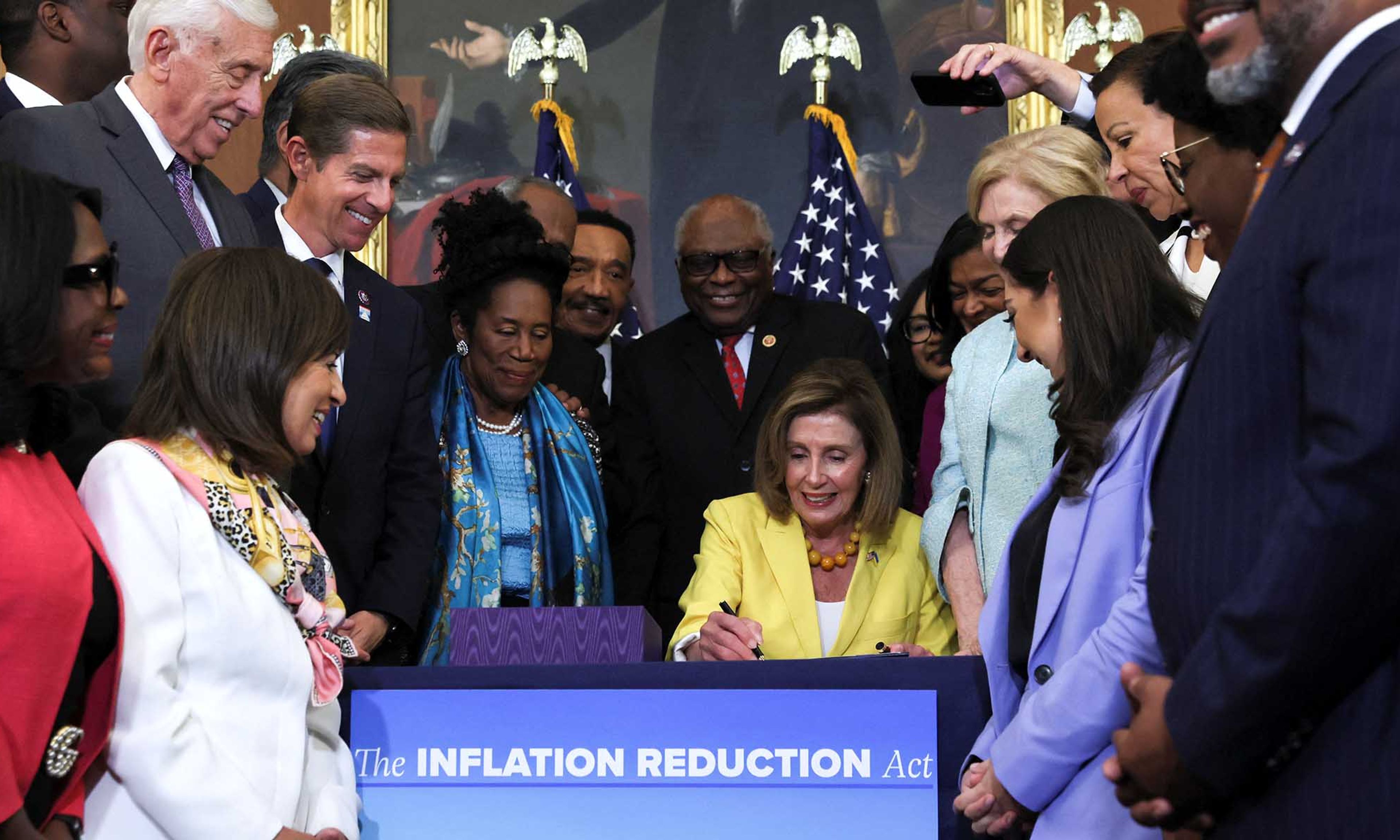
The so-called Inflation Reduction Act has not lowered deficits as its supporters claimed it would. The IRA included tax increases mostly on corporations, to pay for subsidies mostly for green energy. Biden signed the IRA into law on August 16 of last year, so on August 16 of this year the Tax Foundation released a report on how the law’s implementation has gone so far.
On the revenue side, the IRA is confusing corporations and the Treasury alike, the report explained. The IRA included a 15 percent minimum tax on corporations’ profits according to their financial accounting rather than their tax accounting. The purpose of financial accounting is to provide information to shareholders about the company. The purpose of tax accounting is to measure taxable income according to the tax code. Because the tax code is so complicated, corporations have countless ways to lower their taxable income even if their financial reports show high profits.
That’s perfectly legal, but Democrats thought they could outsmart corporations with the 15 percent minimum tax on profits according to financial accounting rather than tax accounting. That provision was, as the Tax Foundation report put it, “a new tax on a new tax base,” and it has created bureaucratic nightmares in figuring out how such a tax would even work. Several guidance documents from the Treasury have failed to clarify important aspects of the tax, and collection of revenue from it has been put on hold until the kinks are worked out.
On the spending side, the IRA’s 22 tax credits are being taken up much faster than expected. When Congress’s Joint Committee on Taxation (JCT) released cost estimates for the tax credits in August 2022, it expected a total cost of $271 billion from 2023 to 2031. When in May the JCT recalculated the scoring according to how the law was actually being implemented, the total cost over the same period had nearly doubled, to $536 billion.
When Congress passes a tax law, such as the IRA, that’s only the first step in determining what the law will do. The Treasury, including the IRS, has wide latitude to interpret the statute Congress passed. As with the discrepancy in the CBO’s deficit estimates, it’s not the JCT’s fault that its first estimate was so far off. It couldn’t have known ahead of time how Biden-administration bureaucrats would implement the law.
Various guidance documents from the IRS expanded the tax credits beyond what the JCT had anticipated. For example, the IRS said that income limits, car-price limits, and domestic-content requirements in the tax credit for electric vehicles (EVs) don’t apply to leased cars. Leasing now accounts for about one-third of EV sales in the U.S., and the projected cost of the EV tax credit increased by 524 percent, according to the updated JCT scores.
The JCT score is also limited to the text of the statute and doesn’t take into account how some other government programs will interact with it. The Tax Foundation notes in its report that the EPA’s separate efforts, including the imposition of stricter emissions standards announced earlier this year, to spur EV adoption could encourage more taxpayers to use the credits. The EPA itself estimated that its own mandate would lead to a loss of $210 billion in tax revenue between 2027 and 2032.
The IRA is bad, Democrats lied by saying it would reduce deficits, and Republicans were right to oppose it. But both parties have agreed to not reform the ultimate driver of the debt: Medicare and Social Security. That they have kept that promise has created a new budgetary goblin: interest payments.
As Brian Riedl wrote for Capital Matters on NRO in April, Medicare and Social Security this year will spend $649 billion more than they took in. In 2033, they’ll spend $1.7 trillion more than they take in. Cumulatively over the next 30 years, according to the CBO, Medicare and Social Security will spend $69 trillion more than they take in.
Benefits must be paid, by law, and the CBO assumes that the government will borrow money to make up the difference. (It could also print more money to help make payments. If nothing changes, it will likely end up doing a mix of both, spurring tax increases and inflation.) The CBO projects that the borrowing will add $47 trillion on top of the $69 trillion in debt, bringing the grand total of the cost of Social Security and Medicare to $116 trillion in new debt over the next 30 years. The entire remainder of the federal budget — which includes the military, education, infrastructure, nutrition programs, national parks, agricultural subsidies, law enforcement, foreign aid, a.k.a. all the stuff that politicians usually argue about — will not increase the national debt by any significant amount over that same time span.
Net interest payments took up 10 percent of federal outlays in 2023. They’ll take up 23 percent in 2053. Almost a quarter of federal spending will be just to finance other federal spending. About two-thirds of the projected increase in borrowing costs is due simply to interest-rate increases, and one of the reasons that the CBO cites for an increase in interest rates is the ballooning federal debt. Higher debt causes higher interest rates, which causes even more debt and crowds out private investment, reducing the productive capacity of the economy.
It’s one of the nastiest vicious cycles in politics, and both parties have essentially promised to bring it to you. This year’s growing budget deficit should not have been a surprise, and don’t be surprised when more deficits come in the future. For once, politicians are keeping their word, and it would be better if they didn’t.









Comments