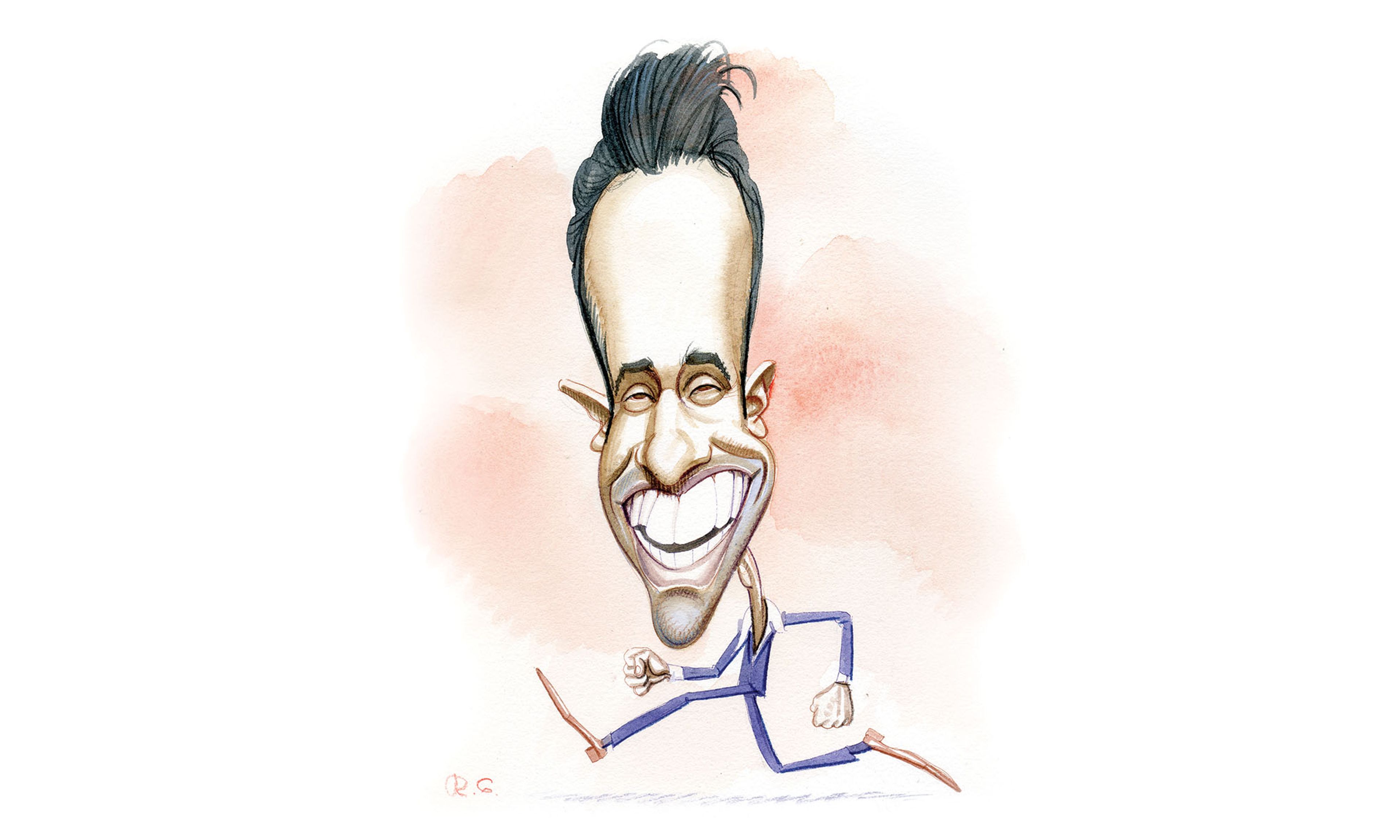
Nevada, Iowa — Vivek Ramaswamy is sitting in the back of an SUV barreling due west down the highway into a blinding Iowa sunset when we come very, very close to a high-speed collision. “Jesus Christ,” he says, as our driver hits the brakes and swerves to avoid being sideswiped by a vehicle pulling a camper. “I’m sorry, sir,” Ramaswamy’s driver replies. But it appears the other driver, who because of the sun probably didn’t see us while changing lanes, was at fault, and we’re all grateful for the campaign driver’s successful maneuvering.
It’s what happens several minutes later that is more disconcerting and somewhat revealing. A Ramaswamy staffer says the organizers of the GOP dinner in Boone County, Iowa, would like Ramaswamy to arrive by 7:35 p.m., but we’re running a couple minutes late, and the staffer asks whether the driver could shave some time off the trip. Ramaswamy agrees. “Okay, let’s do that, then — just walk in, go on stage,” he says. “And let’s cruise after this.” With nothing but highway between us and Boone, the driver is left with no choice but to speed into the hazardously blinding sunset. After arriving at our destination, the campaign driver tells me that we came “really f***ing close” to crashing. A second campaign driver who was following our vehicle tells us that to keep up he was “going like 98 miles an hour.”
The reward for racing is that Ramaswamy indeed arrives at the Boone County GOP dinner by 7:35 p.m. — just in time to stand in the back of a ballroom for several minutes and listen to a recorded video message from Donald Trump.
* * *
Vivek Ramaswamy has always been a young man in a hurry. A prep-school valedictorian and Harvard grad, he worked at a hedge fund while attending Yale Law School and became a biotech centimillionaire by his early thirties. Dressed in tech-bro chic on the campaign trail in Iowa — black skinny pants, black crew-neck T-shirt, and a black blazer — he recounts the advice that his father, an immigrant from India, gave him when he was growing up in Cincinnati: “If you’re going to stand out, then you might as well be outstanding.” Even in middle age, Ramaswamy has found a way to remain a young man in a hurry: by running for president with no prior political experience at the age of 38. But what end is he really seeking?
He traces his political awakening to a backlash against wokeness that swept over corporate America in 2020 following the murder of George Floyd, but a Yale classmate tells me that Ramaswamy talked openly about having presidential ambitions while he was a student more than a decade ago. “It was always an ambition coupled with responsibility,” says the former classmate, who views Ramaswamy’s candidacy favorably. Paraphrasing, the classmate recalled Ramaswamy once saying something to the effect of: “Is running for president — is being the president — is that enough to return the favor and to take full advantage of our one shot here on this earth? . . . Is that even enough for me?”
“I’ve never met a more ambitious person, that’s for sure,” the classmate said. “He had a certain unrelenting, unforgiving — for himself — quality.”
But is there any true ideological core to Ramaswamy, or just a deep and insatiable need to succeed for the sake of success? The classmate could not recall any particular political issues that animated Ramaswamy but said he was interested in big ideas and freewheeling debate and had a notable respect for tradition.
* * *
For the past several months, Ramaswamy has been making a name for himself as the Trumpiest of all the GOP candidates in the race other than Trump. Trump himself declared Ramaswamy the winner of the Trump-less GOP-primary debate in August. The debate did little to change the polling in the race — Trump continued to hold a commanding lead, with most GOP primary voters nationwide behind him, and Florida governor Ron DeSantis remained a very distant second in the mid teens. In the RealClearPolitics average of national GOP-primary polls, Ramaswamy garnered 7.6 percent of the vote on August 25 and ticked down to 6.8 percent by September 10. But in the unlikely event that the 77-year-old Trump had to leave the race for health reasons, Ramaswamy would be a real contender, according to a postdebate Emerson College poll in which Trump is excluded from the list of GOP candidates.
Ramaswamy has dismissed questions about whether he would serve as running mate in the likely event that Trump is the 2024 GOP nominee, and during the ride from Nevada to Boone I ask him whether he would categorically rule out accepting the VP slot. He doesn’t. “Well, I think that National Review already has a view on my role as press secretary,” Ramaswamy replies. When I inform the candidate that he’s referring to an article published not by me (but by Charles C. W. Cooke, who wrote in April that as “a candidate, Ramaswamy is not running to be Donald Trump’s press secretary; he is running as Donald Trump’s press secretary”), a mildly miffed Ramaswamy says, “There’s the other guy, too.”
The “other guy” really could have been any number of guys at National Review. Perhaps it was Jeffrey Blehar, who wrote on August 28 that Ramaswamy had given a “remarkably weaselly” answer to a question I posed to the candidate after the August debate; or perhaps it was Rich Lowry, who published an article that same day titled “Vivek Ramaswamy’s January 6 Charade”; or perhaps it was a reference to “Vivek Ramaswamy’s Cynical Crusade,” an NR editorial on August 23.
As I ride with Ramaswamy on August 31, I don’t try to suss out which of my colleagues irritates him most, because our time is short. Ramaswamy is known for his omnipresence in the media and willingness to talk to anyone. He rolled out the red carpet for all-access profiles by the Atlantic and the New Yorker, but weeks after requesting an hour-long interview, I’ve been told by a campaign staffer to expect a five- to ten-minute interview, which I manage to stretch to a little more than 15 in the car.
Are there two or three key reasons, I ask, why GOP primary voters should prefer Ramaswamy to the front-runner, besides Ramaswamy’s belief that he could win in a landslide while Trump would win just narrowly? “Well, look, I’ve got fresh legs. I’m 38 years old,” he says. “I’m grateful for every day. Maybe that car would have ended our life 15 minutes ago, and that’s the way things go. But . . . I believe and hope and pray that my best days in life are still ahead of me. And I think it takes someone whose best days are still yet ahead of himself to see a nation whose best days are still yet ahead of itself.”
In other words, Ramaswamy is young, while Trump is old. Is that it? Would Ramaswamy govern differently from Trump in any way? “Vision translates itself into having a better chance of reuniting the country,” he replies. “I think I’m the single best-positioned candidate to reunite the country, to revive national pride amongst young Americans. These are things I think I can do, uniquely, of anyone in this field.”
Asked why he didn’t vote in 2016, Ramaswamy says it was “part of my period of being cynical, jaded, skeptical. . . . I have to admit I rolled my eyes a little bit at Trump–Clinton, but I judge based on results.” He says that Trump “was a guy who kept us out of wars. I have always been very war-skeptical. . . . He grew the economy. He was somebody who revived and served as a voice for the many people in this country who didn’t have one. That is something that speaks to me. And so I said, I’ll reward him with that vote.”
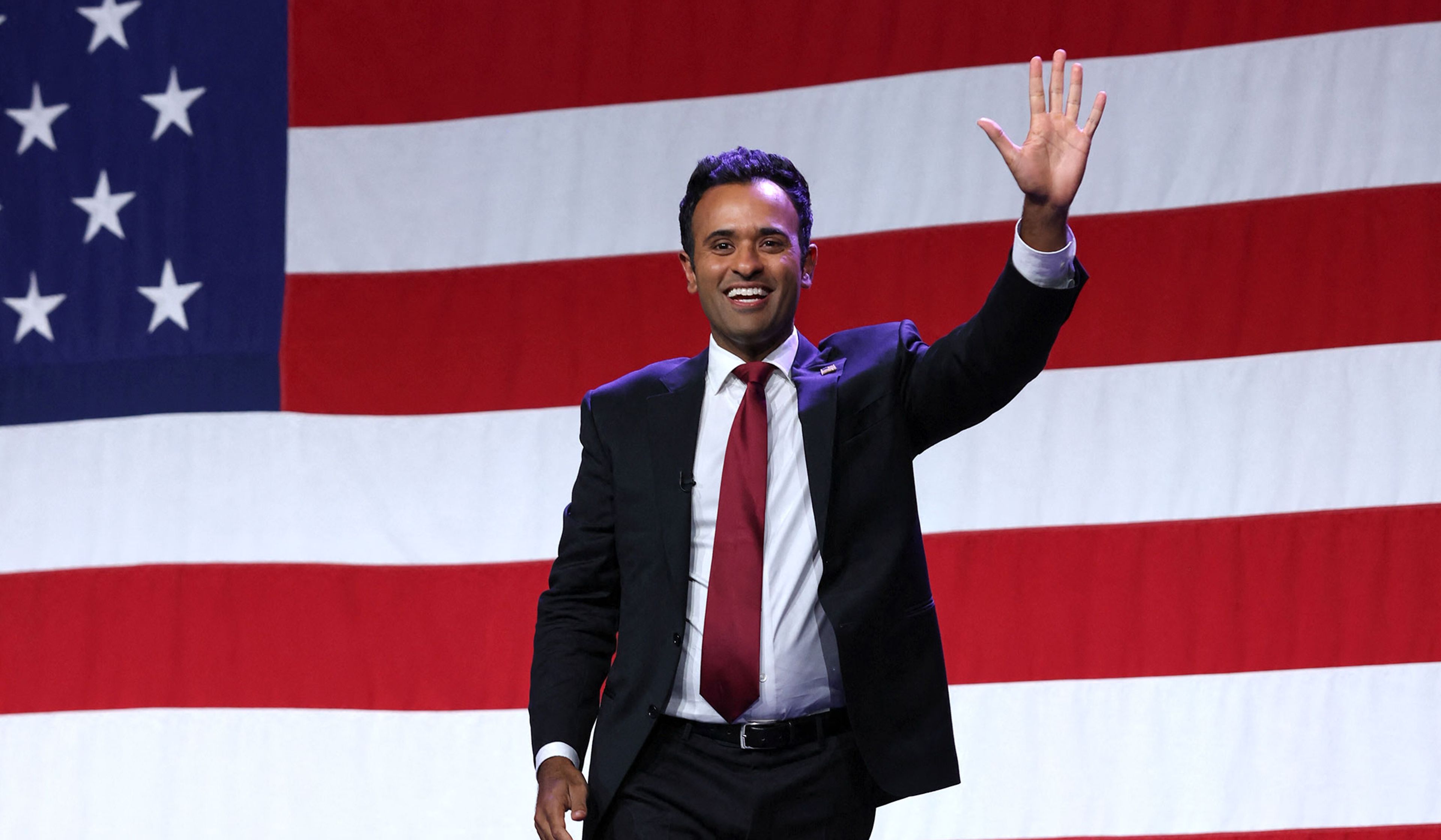
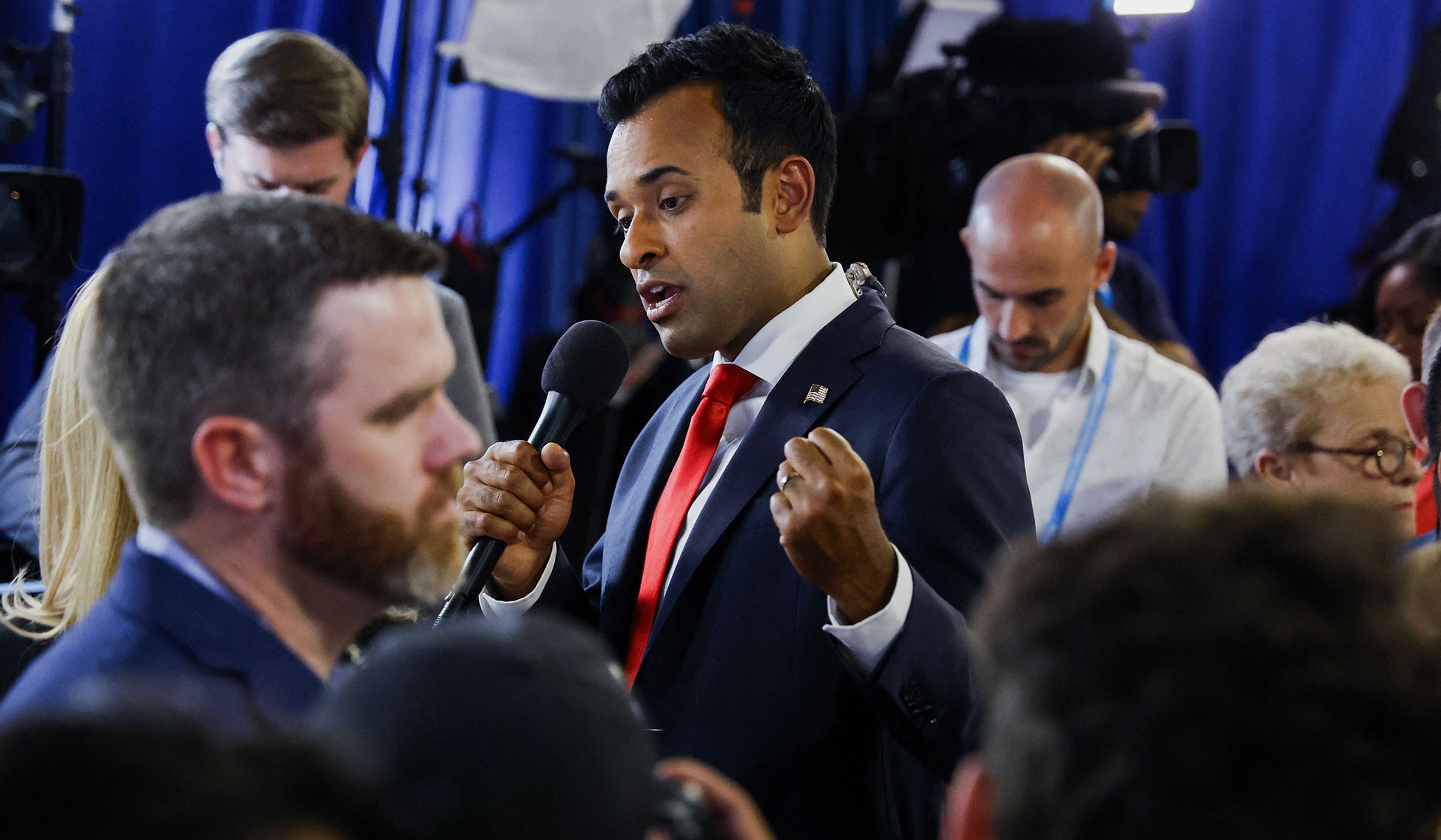
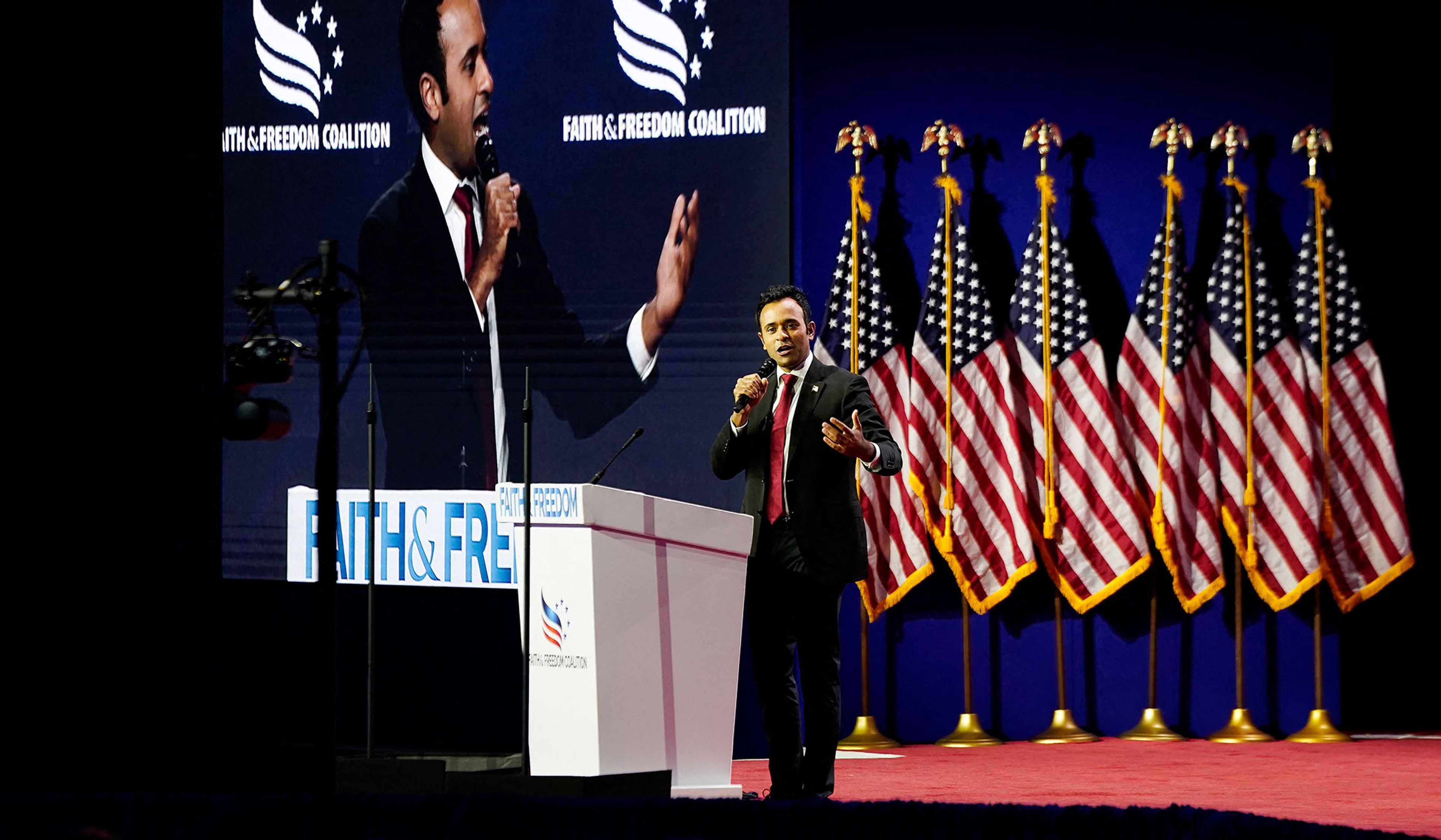
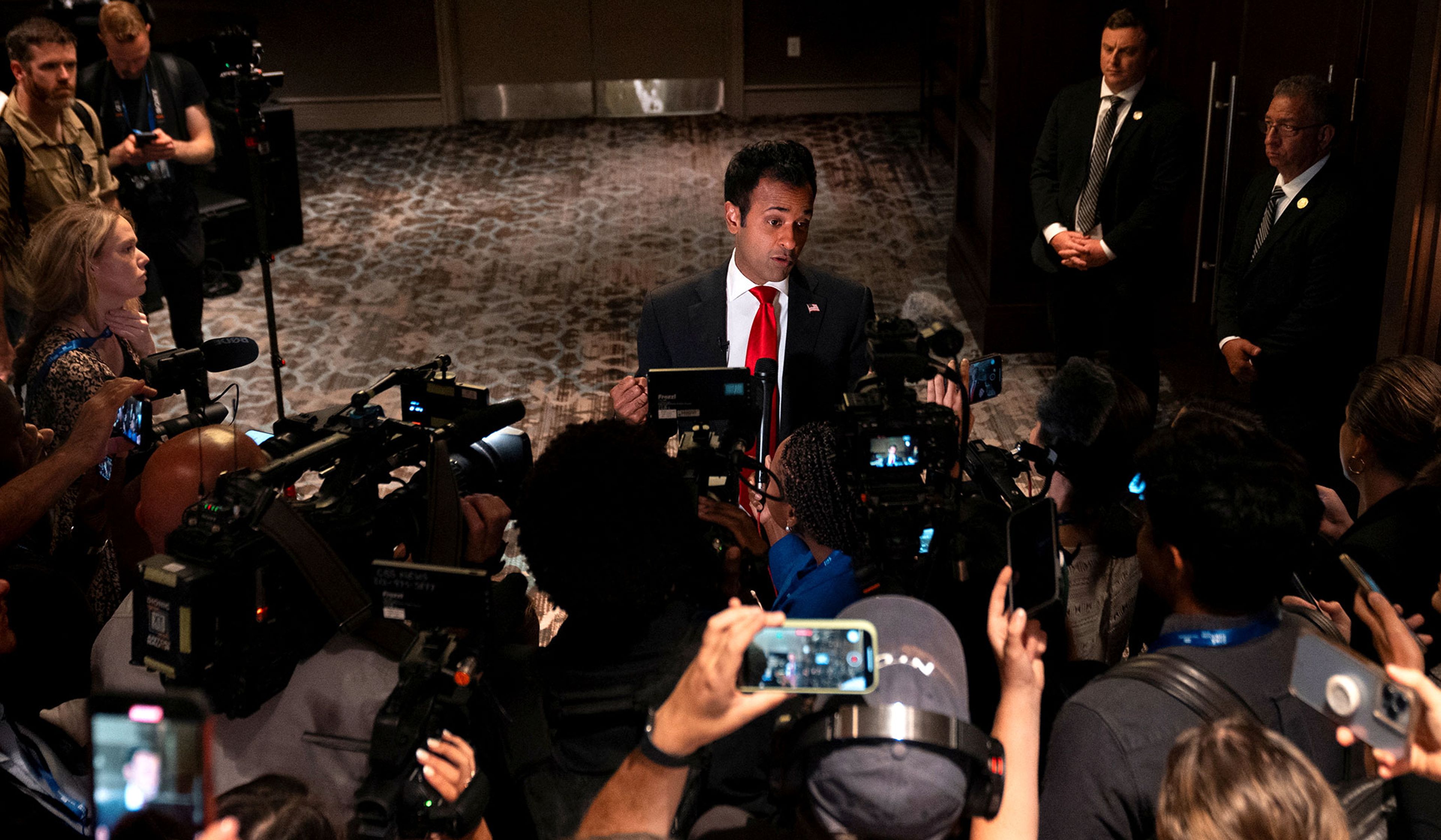
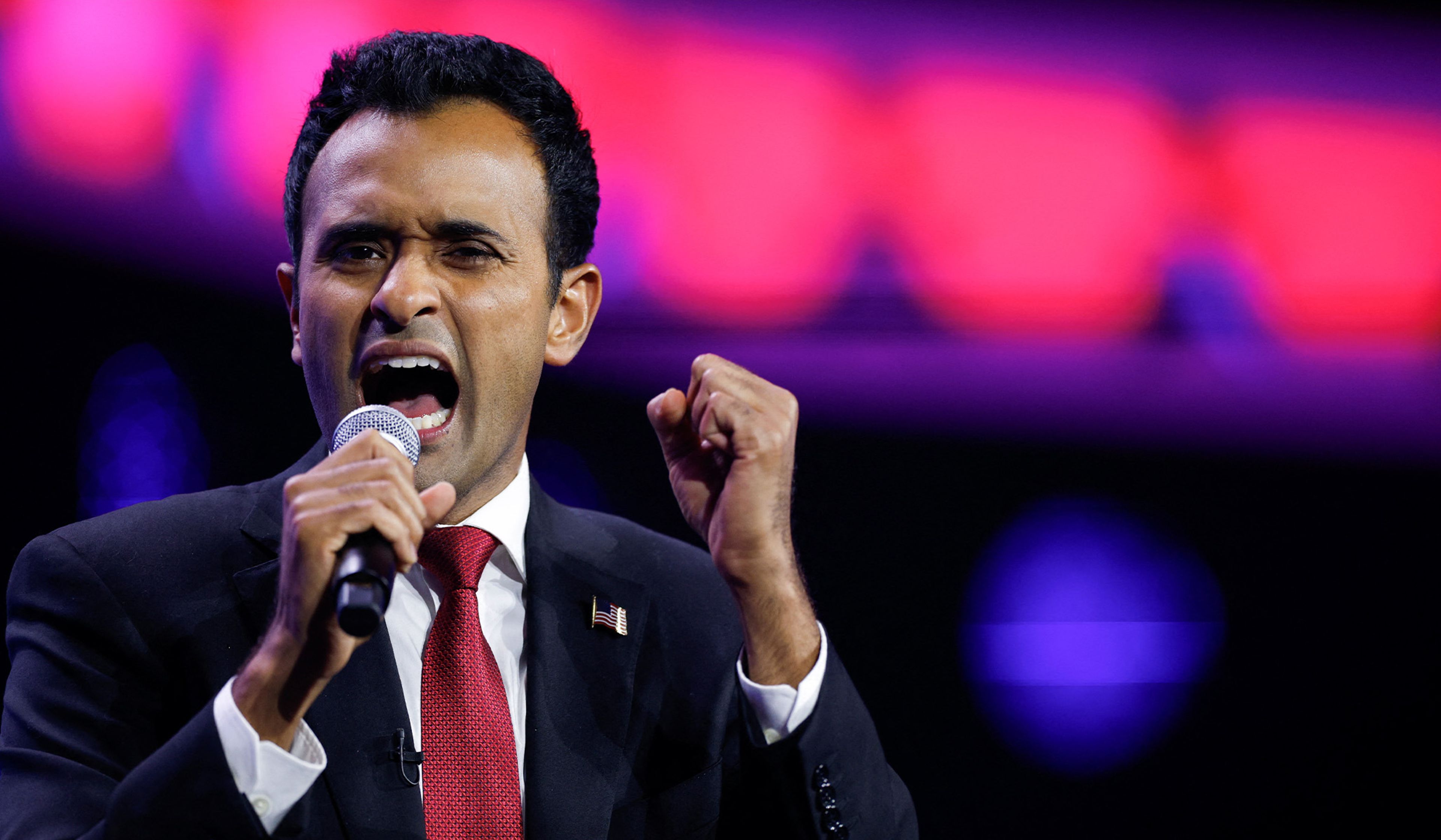
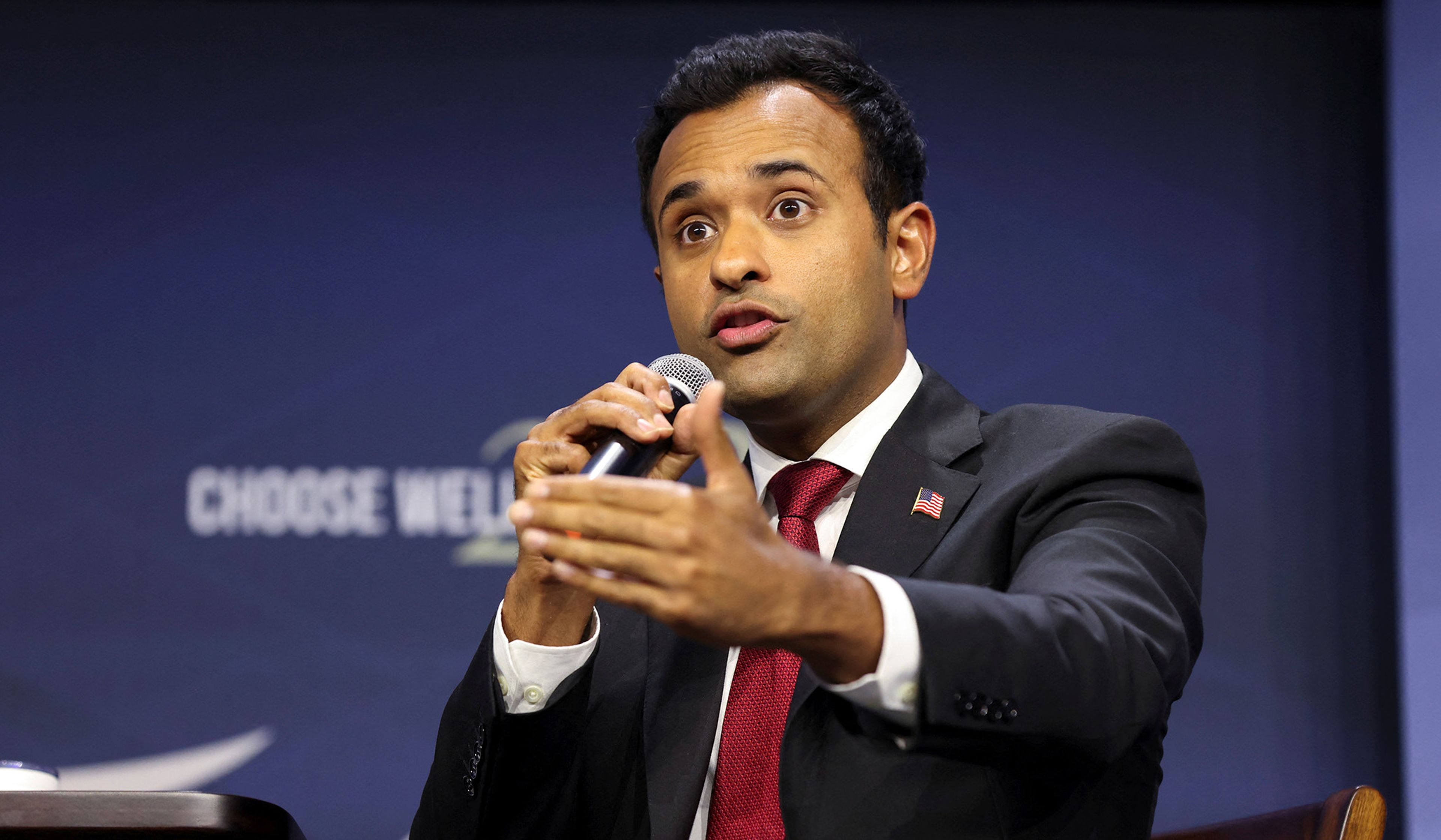
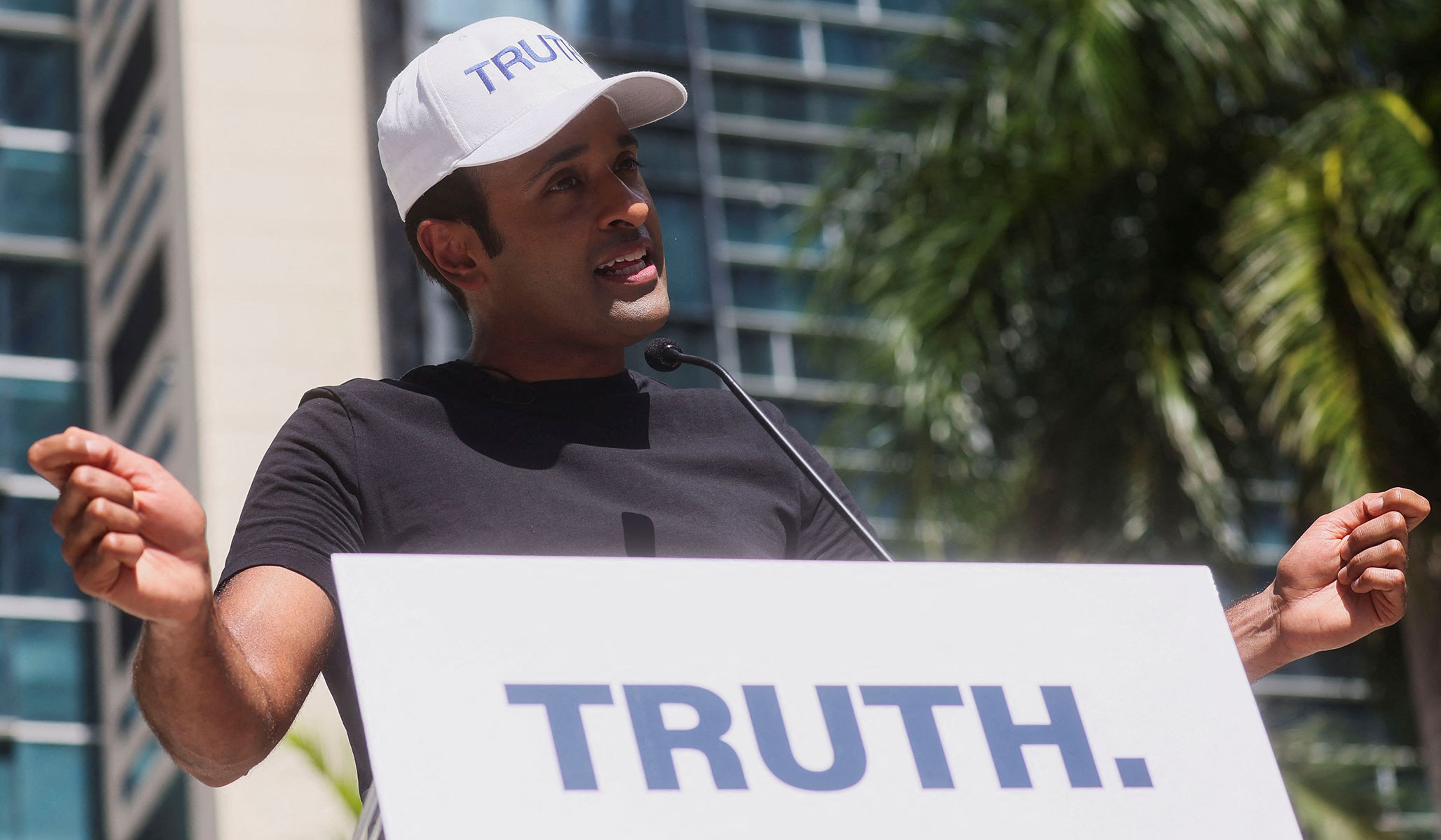
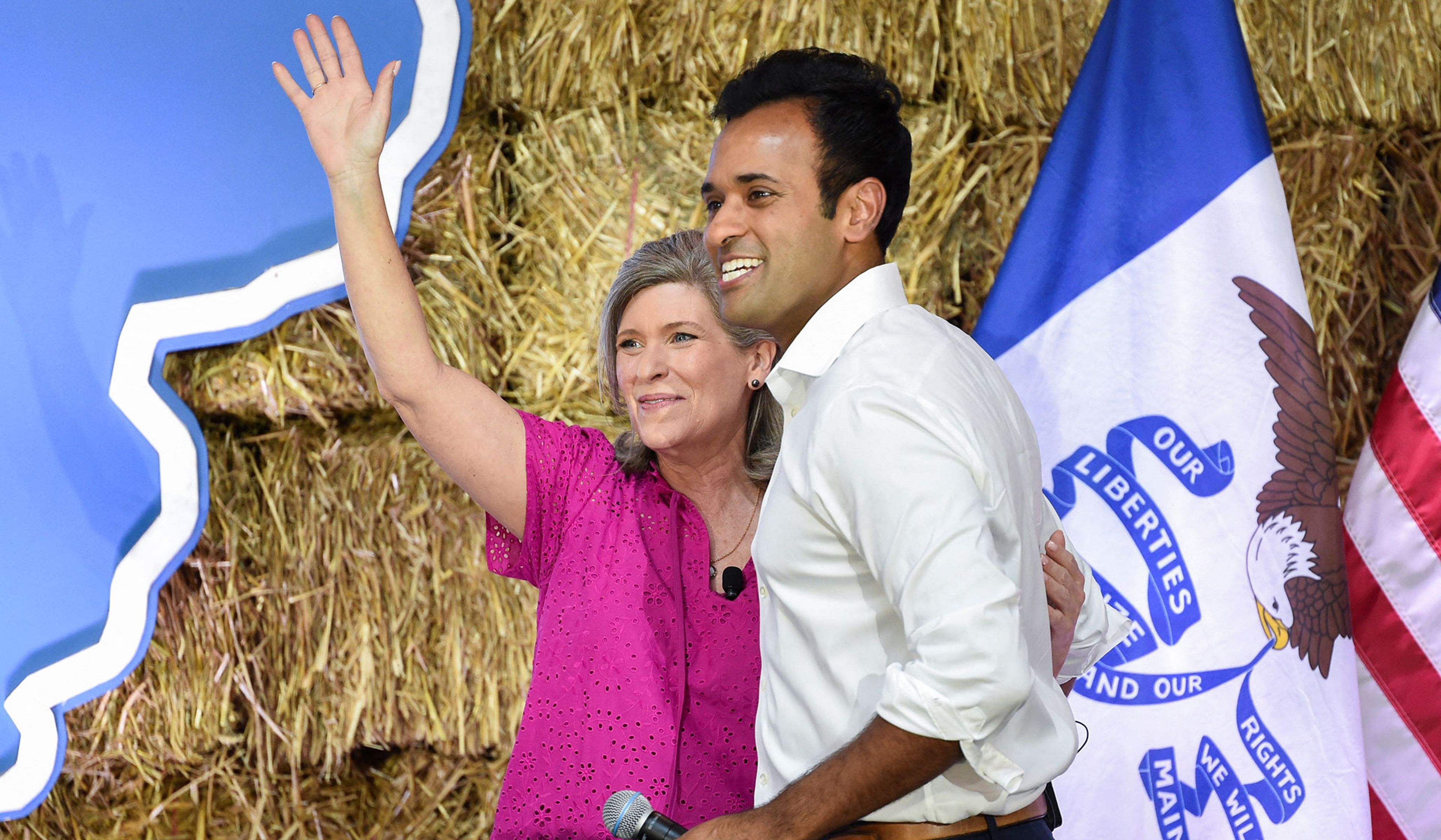
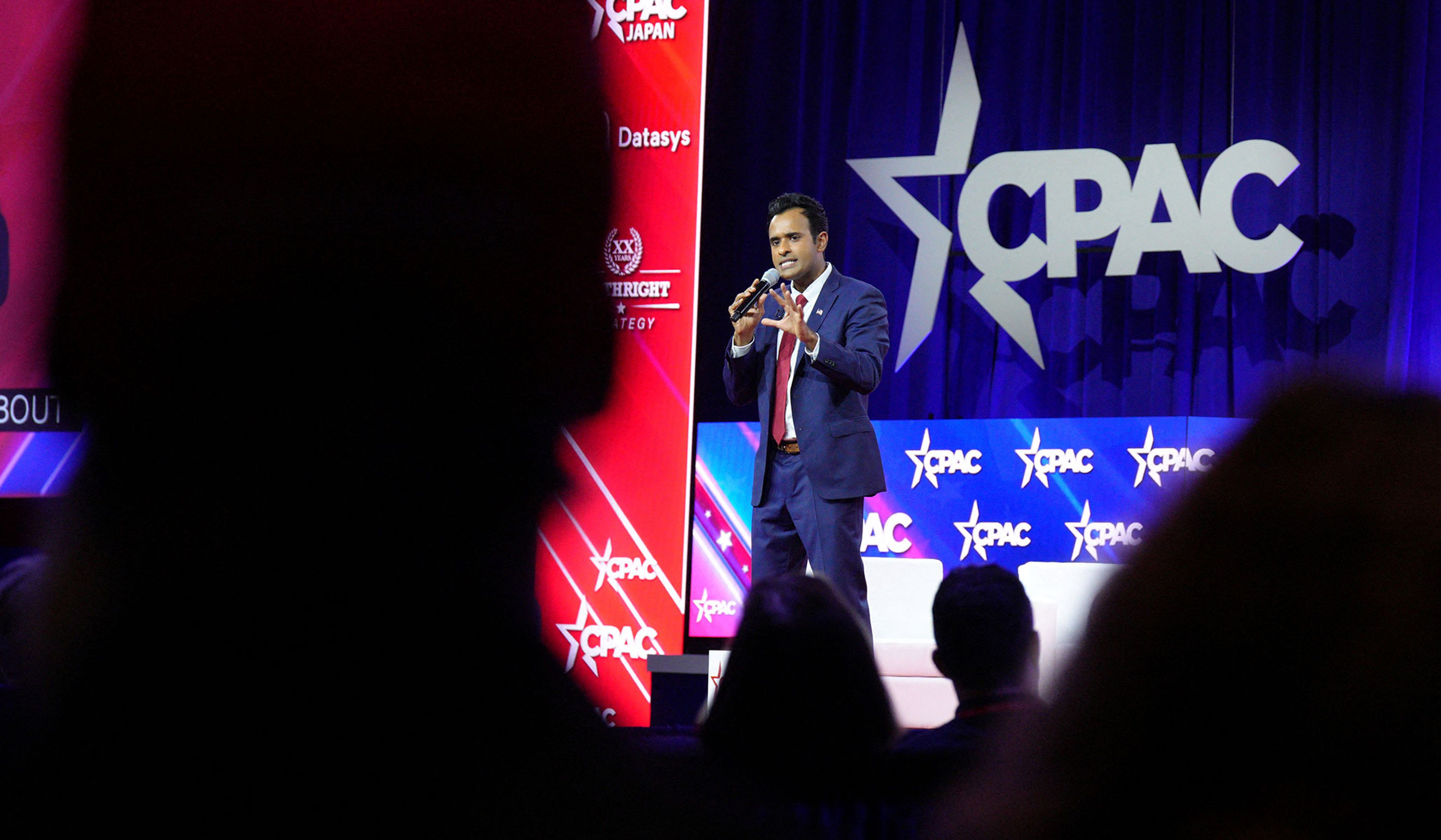
Republican presidential candidate Vivek Ramaswamy waves to the attendees at the Republican Party of Iowa’s Lincoln Day Dinner in Des Moines, Iowa, July 28, 2023.
Scott Morgan/Reuters
Ramaswamy hastens to add that the birth of his firstborn son also inspired him to vote for Trump in 2020: “Apoorva and I just had Karthik that year. And I think that changed my perspective, and revived my sense of civic engagement and duty and ability to reward someone for proving me wrong and being different than other politicians.” These are, obviously, the words of a man not trying to win the 2024 primary but auditioning to be Trump’s vice president or setting himself up for another presidential run in 2028.
He wasn’t always quite so obsequious toward Trump, even in recent years. “What Trump did last week was wrong. Downright abhorrent. Plain and simple,” Ramaswamy tweeted on January 12, 2021. When I ask him whether he still thinks Trump’s behavior before and on January 6 was abhorrent, he gives a spiel about how he would have handled the situation “very differently.” Although Ramaswamy wrote in a recent book that Pence did his constitutional duty on January 6, he now claims he would have refused to discharge that duty unless Congress first ushered in a package of nationwide voting-law reforms. He adds that Trump should have then announced his 2024 campaign on January 7.
After I ask Ramaswamy about his “downright abhorrent” comment, a campaign staffer insists we wrap the interview so the candidate has a couple of minutes to prepare for his fourth and final event of the day, another stump speech. Several days later, during an appearance on MSNBC, host Mehdi Hasan asks Ramaswamy four separate times to explain what exactly was abhorrent about Trump’s conduct, and four separate times Ramaswamy refuses to say.
Can Ramaswamy slingshot himself onto the 2024 ticket if Trump is the nominee? It’s anyone’s guess, but he has established himself as a relentless and articulate campaigner, who would seem to be more than pleased to serve as a cheerful attack dog for Trump. On the other hand, Trump in 2016 didn’t double down on MAGA. His campaign sought to broaden its appeal, first by making overtures to moderate Ohio governor John Kasich before settling on Pence, the Indiana governor and an Evangelical.
Ramaswamy has plenty of weaknesses. He has no national-security or foreign-policy experience and has gotten into hot water for shifting statements on aid to Israel, defending Taiwan, and the truth about 9/11. He now says he would keep aid to Israel, after suggesting he was open to cutting it. He suggested he’d abandon Taiwan after ending reliance on Taiwanese semiconductors in 2028, but now he says he’d merely switch back to the current posture of “strategic ambiguity.” He claimed that the Atlantic misquoted him about saying that it was legitimate to ask how many federal agents were on the planes on 9/11, but audio confirmed he had been quoted accurately. (“I think it is legitimate to say, How many police, how many federal agents were on the planes that hit the Twin Towers? Like, I think we want — maybe the answer is zero, probably is zero for all I know, right? I have no reason to think it was anything other than zero,” he said.)
On Ukraine, he’s the only GOP candidate who is categorically opposed to more military aid to help repel the Russian invasion. He says that, in exchange for our cutting off aid to Ukraine and ceding occupied territory to Russia, Vladimir Putin would abide an armistice and agree to exit a 2001 treaty with China, to end joint military exercises with it, and to abandon its military alliance with it. “It’s a no-brainer that Putin would take this, as we will reopen economic relations with the West, so that he doesn’t need to rely on China anymore,” he says. Putin, of course, threw away economic relations with the West when he invaded Ukraine in the first place.
In the hypothetical world in which this MAGA–Model U.N. deal came together, what would be the consequence if Putin reneged? Ramaswamy tells me that there would be a campaign of “maximum pressure” and “we can also put on the table instant admission of Ukraine to NATO.” Instant admission to NATO is not something that exists — for a new country to join, each member country must agree, and countries with border disputes are ineligible for NATO membership.
Ramaswamy says he doesn’t have any campaign staffer dedicated to foreign policy but that before he jumped into the race he had spoken with “the Pompeo types” as well as unnamed admirals and generals. “I’ve spoken, you know, to Colby Elbridge a couple times during this campaign,” he says, referring to Elbridge Colby, a Pentagon official in the Trump administration. “I have spoken to a wide range of voices — realists, neocons. . . . I’ve spoken to [Wisconsin congressman] Mike Gallagher recently on China-related issues.”
Ramaswamy seems committed to some steep but unspecified number of cuts to civilian jobs at the Department of Defense. He has pledged that, if elected, he’d cut the federal workforce by 75 percent. That promise “excludes troops but includes, across the entire federal government, any bureaucratic employee,” including civilians at the Defense Department, he tells me. There are about 2.2 million federal civilian employees, and about 34 percent of them work at Defense. Another national-security weakness: Ramaswamy is committed to pardoning Edward Snowden and Julian Assange for leaking highly classified information.
There are also electoral questions on a topic that Ramaswamy is asked about a lot on the campaign trail: his Hindu faith. His campaign events often feature a poster listing his “ten truths” for the 2024 campaign. “Your first line says, ‘God is real,’” an Iowan says to him at one campaign stop. “What God are we talking about?”
“We’re talking about the one true God,” Ramaswamy replies. “Now, I am Hindu, I’m not Christian. I would never pretend to be something else to please an audience. But I will tell you this: Our nation is founded on Judeo-Christian values.” Ramaswamy’s talk about values generally goes over well with voters. At a press gaggle after an event, he says that Hinduism, as is the case with other religions, has “many different schools of thought.” “I’m a monotheist,” he says. “I believe there’s one true God that resides in each of us.”
On the trail, Ramaswamy sounds almost like a revival preacher. He talks about a “God-sized hole” in each of our hearts and a similar void in the heart of the nation. “We are hungry for a cause,” he says. “We are starved for purpose and meaning and identity. At a time in our national history when the things that used to fill that hunger — faith, patriotism, hard work, family — these things have disappeared. And that leaves a moral vacuum, a black hole in our hearts.” He says we must “fill that void with American national identity that runs so deep that it dilutes the poison to irrelevance.”
Ramaswamy’s relentlessly on-message performance at the first GOP debate was memorably mocked by Chris Christie as ChatGPT come to life. But there are a sizeable number of voters who like Ramaswamy’s message, even if he isn’t their first choice. During a Q and A in Nevada, Iowa, one voter tells Ramaswamy, “I felt like Chris Christie’s barb about you being ChatGPT was humorous, but I felt like it was a compliment, in a way, about how intelligent you are.”
There is indeed some truth in this assessment. Whatever one thinks of Ramaswamy’s rhetoric, there is no denying that it is calibrated well for a deeply ambitious Republican politician who has calculated that Trump will dominate the GOP in 2024 no matter what. The question is what, if anything, Ramaswamy’s reward will be from Trump next year or from Trump’s supporters in 2028.












Comments