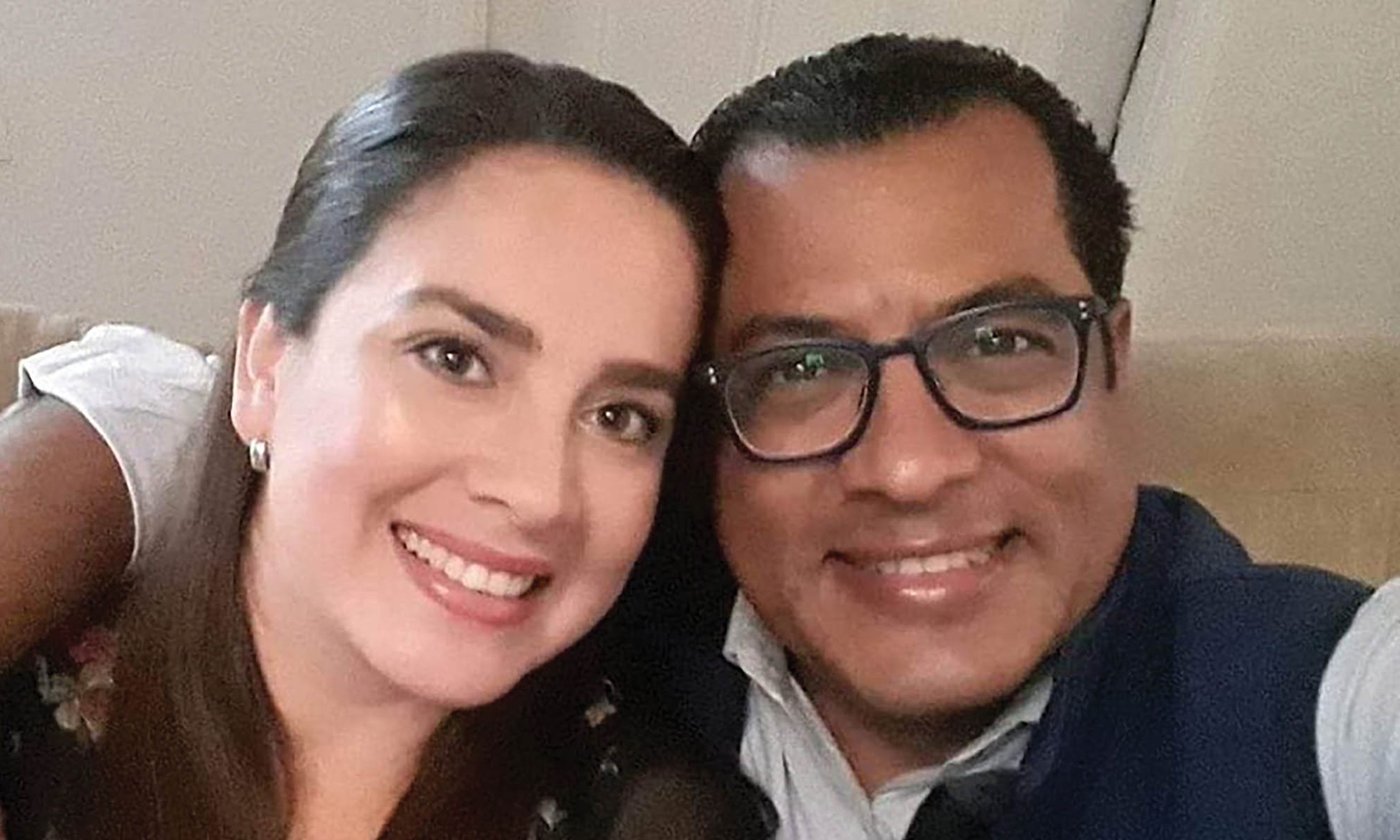
Last year, Berta Valle asked her daughter, then eight, “Do you know what your dad’s job is?” “Yes,” answered Alejandra. “My dad works saving Nicaragua.”
That is as good a description as any. Félix Maradiaga — husband of Berta, father of Alejandra — is a Nicaraguan academic, entrepreneur, and democracy activist. He attempted to run for president in 2021. Like other candidates, or would-be candidates, he was arrested and is now a political prisoner.
I interviewed him in 2019 and wrote about him in these pages. He has an air of nobility about him, as well as intelligence and warmth. In recent days, I have talked with Berta, an apt match for Félix. She was in New York for a session of the Oslo Freedom Forum.
She is a well-known TV journalist in Nicaragua, or from Nicaragua — she is now in exile, in the United States. The regime of Daniel Ortega has shut down all independent media. The last independent voice in Nicaragua was CNN en Español. The dictatorship blocked it last month.
Berta Valle is playing what I think of as the Avital Sharansky role — a very difficult role. Mrs. Sharansky spent from 1977 to 1986 appealing for her husband, Anatoly (later to be called “Natan”), who was a leading prisoner in the Soviet Gulag. She had been allowed to leave the Soviet Union for Israel.
“The biggest mistake the KGB made was letting Avital out,” Natan once told me.
Berta is doing all she can for Félix, and for her fellow Nicaraguans generally. They are being battered, as Ortega has turned their country into a full-blown totalitarian state — one in which political opposition and civil society, along with independent media, are banned.
When Berta was born, in 1984, the country was in civil war. Her parents fled to the United States, with Berta, ten months, in her mother’s arms. They entered illegally. For seven years, they lived in Pomona, Calif. Berta’s father worked cleaning theaters; her mother worked at a gas station. Husband and wife staggered their work shifts, so that one of them could look after their three children.
They returned to Nicaragua in 1991, when peace was taking hold, and democracy as well. Violeta Chamorro was the country’s first democratic president. Berta and her family lived in Ciudad Darío, named after Rubén Darío, the country’s most celebrated poet. (He lived from 1867 to 1916.) Every year, the city holds a contest, to crown La Musa Dariana — Darío’s Muse. That’s how Berta met Félix.
He was a judge; she was a contestant. The year was 2000, when Berta was 16. She and other contestants recited Darío’s poetry and displayed their general knowledge of the poet. Berta won, in a unanimous decision. Félix, however, gave her the lowest score. But he later had a defense (sort of): He had still given Berta a higher score than he had given any of the other contestants.
“What did you like about Félix?” I ask Berta. Everything, in short. “He was a very intellectual person, and very interesting to talk to. He was passionate about his values, and I share those values. He has a commitment to give to others, to serve others. Also, he is a very family-oriented man. I felt attracted to him because of that.”
“Did you sense that he could be dangerous? That he might, for example, wind up in prison?” More on that in a moment.
In 2003, Berta was in her third year of college, and taking public transportation — crammed, rickety buses. She was repeatedly being robbed, and she was sick of it. Her boyfriend, Félix, suggested that she enter a contest — another one. This was a contest to be crowned the Reina del Carnaval, the Queen of Carnival. The prize was a brand-new car: a Nissan Platina. Which Berta won.
No more buses and being robbed.
Something else came out of the contest, too: As the Reina del Carnaval, Berta was interviewed by several television stations, and the management of one station asked her to audition to be a morning-show host. Before she knew it, she was on air.
Eventually, the family that owned the station was forced to sell it, by the Ortega regime. That family is now in exile. Since 2018, around 400,000 Nicaraguans have been forced into exile. (The population of the country is about 6.5 million.) Some 200,000 are in Costa Rica, some 150,000 are in the United States — and the rest are scattered elsewhere.
Félix Maradiaga and Berta Valle were married in 2006. When Félix proposed, he told Berta that he would always be unfaithful to her — unfaithful with one woman, namely Nicaragua. She understood this, and accepted it. But she could not know, then, what it would entail. What sacrifices and horrors it would mean.
In April 2018, protests broke out across Nicaragua, and the regime cracked down, viciously. Félix had his teeth knocked out. Berta and Alejandra (born in 2013) have been in exile since June 2018. Félix went back and forth, between the U.S. and Nicaragua. The last time Berta and Alejandra saw Félix was in March 2020.
He knew he would be arrested, if he tried to run for president. He prepared his family for it, to the extent he could. He introduced Berta to his lawyer, or lawyer-to-be: Jared Genser, an American who has represented dissidents and political prisoners all over the world. Félix was arrested on June 8, 2021. Ortega arrested a great many critics and adversaries that month, in a terrible sweep, designed to clear out all opposition.
Many of the prisoners are held at El Chipote, a notorious prison, a place of torture, similar to Evin Prison in Tehran. Félix Maradiaga is one of those prisoners.
“Were you mad at him?” I ask Berta. She was, actually. “I was very mad.” She felt abandoned, saddled with the responsibility of caring for their daughter, making a living in a foreign country, campaigning for her husband’s release, campaigning for other political prisoners, trying to tell the world about Nicaragua . . .
But soon she felt nothing but admiration for him, both as a wife and as a Nicaraguan. “I am grateful for Félix’s commitment and his sacrifice. Also, this situation has given me the opportunity to put my own abilities into practice. Also, I have had to wake up to my values, our values — the values that made me fall in love with Félix in the first place. I now feel that we are closer than ever.”
Berta continues, “Our love is stronger. I feel very connected to him, and I know him better. I understand him more.”
The Ortega regime allows her no contact at all with Félix — not a phone call, not a letter, not anything. Two family members are able to see Félix, from time to time: his sister and her husband.
In February 2022, Félix and another would-be presidential candidate, Juan Sebastián Chamorro — nephew of Doña Violeta — were given a sham trial, behind closed doors. It was not held in a court of law but in El Chipote. The defense lawyers were forbidden to speak to their clients. The defendants were forbidden to speak at all. The charge against them: “conspiracy to undermine national integrity.” (In other words, they challenged the dictator.) Their sentence: 13 years.
Human-rights groups have reported on conditions in El Chipote: Prisoners are fed very little and are malnourished. They are denied medicine and reading material. Some are kept in cells with bright lights on, constantly. Some are kept in total darkness. Women, in particular, are kept in isolation. One prisoner, General Hugo Torres, died from abuse earlier this year (February 12).
Torres was once a hero of the Sandinista revolution. In fact, he led a daring raid in 1974 to free Daniel Ortega and other Sandinistas from prison. He succeeded. Later, Torres became a critic of Ortega, declaring the current dictatorship worse than the Somozas’ (1936–79). Almost 50 years after he freed Ortega from prison, Torres died a prisoner, at the hands of Ortega.
Since 2018, the dictatorship has shut down approximately 2,000 non-governmental organizations — even ones having nothing to do with politics, such as an accountants’ association. The point is to allow nothing to exist apart from the regime. As Mussolini said, “everything in the state, nothing outside the state, nothing against the state.” In May of this year, Ortega shut down the Nicaraguan Academy of Language, founded in 1928.
The last independent bastion — the last element of society with some breathing space — was the Catholic Church. Ortega took care of that in August, arresting Bishop Rolando Álvarez and several priests. They are in El Chipote.
This regime has many allies, birds of a feather — chiefly Cuba, Venezuela, and Russia. In June, Ortega invited Russian troops to train in Nicaragua. There are eight countries that, in 2014, recognized Russia’s annexation of Crimea. One is Nicaragua. The others are Syria, Cuba, Venezuela, Sudan, Zimbabwe, Bolivia, and North Korea.
Nicaragua is a classic “fear society,” to borrow a phrase from Natan Sharansky. Exiles such as Berta Valle are in touch with as many people in the country as they can be, and these people tell the exiles what they know. Everyone in the country is terrified, however–terrified of attracting the attention of state agents.
Here is something to consider: It is illegal to raise the national flag or to sing the national anthem in Nicaragua. Why? Because these are interpreted as anti-regime acts (correctly).
Berta is grappling with many challenges, one of which is “to keep hatred out of my heart,” as she says. She does not want to be like the other side. She does not want to be like the oppressors of her husband and other Nicaraguans. She wants her work to be motivated by love, not hatred. She did not ask for this work, necessarily. But she has accepted it — embraced it — and she is doing it very bravely and very well.











Comments