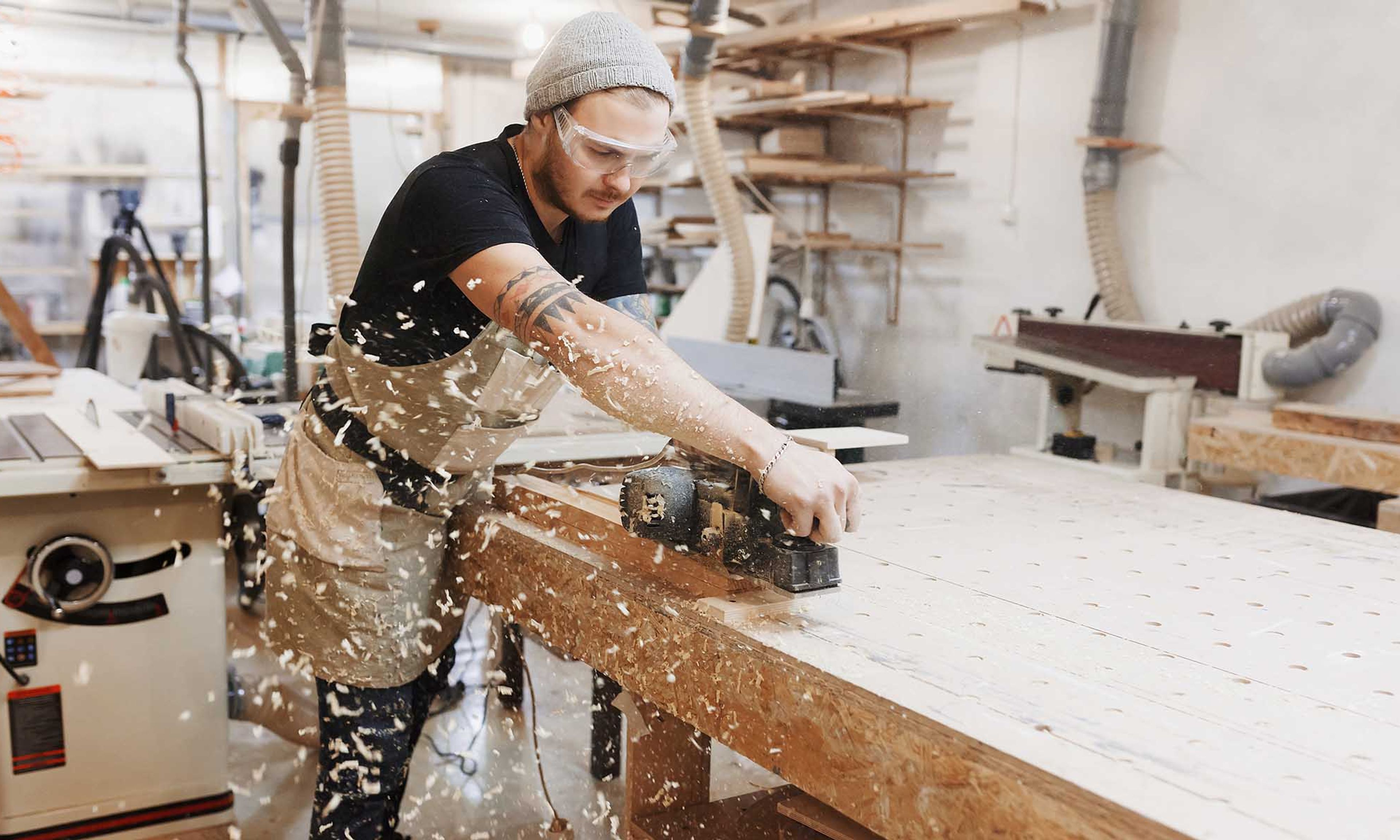
Vocational education is often framed as a second-best route to a stable life and career. College is the first choice, with vocational tracks as a fallback. In fact, vocational education isn’t just for students who won’t make it to college; it could be a better alternative for the one in three students who enroll in college but don’t have their degree by the six-year mark. College leaves these students worse off than their classmates who never made the attempt — mired in debt, with nothing to show for it.
For such students, vocational education can be an improvement over the “college for everyone” status quo. But if vocational classes become a more common alternative track, the college-bound will be shortchanged. Not everyone will be an auto mechanic, a plumber, or a tailor, but everyone benefits from basic literacy in these disciplines, as much as in biology. Vocational education and home-economics classes are powerful tools to create good citizens, whatever the career path they lead people to. Education in how to shape the physical world is education in how to reckon with reality — education sorely needed as Big Tech pushes us into the virtual and unreal.
It’s not just the “metaverse” dreams of Mark Zuckerberg or the revamped Ponzi schemes of “NFTs” (nonfungible tokens). Some Silicon Valley companies alienate us from the material world through the design of their hardware, not just their algorithms.
The shape of our tools is meant to make us feel powerless. Across the fields of the Midwest, John Deere tractors lock their users out of their systems, preventing farmers from making simple repairs to machines they ostensibly own. In many people’s pockets, an iPhone is held shut with proprietary pentalobe screws, an Apple-designed fastener intended to send a message — Don’t go where you’re not wanted. Apple has grudgingly rolled out a consumer home-repair kit that costs $49 to rent, weighs 79 pounds, and requires a $1,200 security deposit.
In effect, our goods are leased, not owned. Even if we’ve paid for them outright, they are designed to be beyond us and to require frequent recourse to the experts allowed inside. And, often, when we seek the experts, they tell us that repair is impossible or not cost -effective. The only solution is replacement. These experiences are an education in learned helplessness.
In contrast, a shop class, taught well, is an education in truth-telling. In Shop Class as Soulcraft, Matthew Crawford explains that he loves motorcycle repair because it cannot be faked. No matter how much you feel that you are owed a working machine at the end of repairs, the motorcycle can’t be argued or bullied into compliance. Crawford writes: “In any hard discipline, whether it be gardening, structural engineering, or Russian, one submits to things that have their own intractable ways. . . . The tradesman must reckon with the infallible judgment of reality, where one’s failures or shortcomings cannot be interpreted away.”
There’s a clarity to physical work that can be harder to achieve in the broader liberal arts. Repeated encounters with the “infallible judgment of reality” can help train away the squirmy impulse to hope, argue, or assert a falsehood into being true. In other classes, and in many white-collar jobs, the truth can seem secondary. You can succeed without solving the problem in front of you if you can instead tell a story about why the problem isn’t your responsibility. That is its own education and formation of character.
The potential for this kind of education isn’t limited to home economics and vocational programs. The Russian algebraist Mikhail Tsfasman sees math class as a similar kind of character formation, one that produced resiliency and resistance in the face of tyranny. Tsfasman, as quoted in Masha Gessen’s Perfect Rigor, said, “Mathematics is uniquely suited to teaching one to distinguish right from wrong, the proven from the unproven, the probable from the improbable. It also teaches us to distinguish that which is probable and probably true from that which, while apparently probable, is an obvious lie. This is a part of mathematical culture that the [Russian] society at large so sorely lacks.”
But few math classes are taught in this spirit. Instead of reckoning with a bedrock truth, students are frequently taught formulas without hearing the stories of their discovery or testing their logic. Instead of inheriting a set of tools and slowly mastering their use, the students learn math as a way of placating the teacher.
As a statistics professor, I saw math-anxious students try to ward me off by making random guesses when I called on them, without a second’s pause to reckon with the problem on the board. They didn’t believe they could do math — their goal was to convince me they’d put in an effort so that I would go away and bother someone else. They hoped (and must have learned from previous teachers to expect) that I would tell them they were wrong without any follow-up as to why.
In politics, the cheap way out is to deflect attention by pointing to someone else’s error. Pointing out how someone else is wrong or at fault is an incomplete response if the politician doesn’t make any real attempt to change an opponent’smind or offer any clear idea of what would be right. My students tried to fend me off with their errors; citizenship-reduced-to-callout-culture uses the errors of others to fend off a reckoning with errors of one’s own.
Citizens encounter political engineering designed to keep them out of real ownership of and responsibility for the choices that shape their community as definitely as any proprietary screw does. When political organizing and advocacy feel intractable, people who want to be stewards look elsewhere. What may start as a genuine zeal for justice, a wish to do something that matters, and a laudable urge to belong to something greater than yourself can lead you into the Grifter Industrial Complex, which has parasitically attached to both parties. As Jon Askonas wrote in the New Atlantis, these conspiratorial cultures turn political engagement into a virtual-reality game. Attention to policy and elections is replaced by Change.org petitions, contributions to one’s political prophet of choice, and dreams of indictments that will come any day now.
There’s a too-good-to-be-true element to these grifts in which you are always on the cusp of victory and just need to pay in a little more or unravel a few more clues before the present order is swept away. The practicality of physical work, in the shop class or the home-ec kitchen, is a partial inoculation against such fanciful cons. Nothing real works this way.
A graduate of a good home-economics class has learned the art of compromise: how far a budget can be stretched; what the cost of deferred maintenance is; whether something can be patched up with duct tape or a definitive change needs to be made. When a politician or a pundit promises everything for free, she or he knows that this contradicts prudence.
The development of individual character and discernment strengthens the whole country. As Danielle Dreilinger describes in The Secret History of Home Economics, home-ec classes began as a matter of national security. In 1917, U.S. Food Administration director Herbert Hoover telegrammed Flora Rose, asking her to leave her work in the home-economics program at Cornell University. “Food will win the war,” he had declared, and he ended his telegram, “WE NEED YOU NOW.” Rose became the deputy director of the New York division of the Food Administration, and she and other home economists helped homemakers do more with less. Rather than feeling the pinch of privation, the women they worked with were empowered by the responsibilities placed in their hands.
Politics is the art of making choices about what goods to pursue with limited resources. It requires us to make moral decisions as well as informed guesses about how we can grow the pool of resources so that the trade-offs are gentler next time. A clever argument might persuade the Supreme Court to side with you, but sooner or later the worth of a policy is judged by its fruits, not how well it can be spun.
Sending most of Congress out to work on simple acts of repair and home budgeting for a year might be a worthy vocational program of its own. Without C-SPAN cameras providing fodder for viral moments, they could spend more time trying to do good without an audience and without anyone to please but the broken object in front of them, yearning to be whole.
But we have a better shot at changing the attitudes of middle schoolers and high schoolers, who are exhausted and depressed by the demands of their phone’s algorithms and might find a relief in time spent with the real. Integrating vocational education and home economics into education for all students gives them the chance to see that there are measures that improve us rather than degrade us when we try to live up to them.
The more we take on the responsibilities of stewardship and see the fruit of our care, the more we learn to be citizens, not consumers. The more we take on bigger projects, which require coordinated work with others, the more prepared we are to organize for real change in our communities and the more we sense the emptiness of online virtue-signaling and the hollowness of grifters’ pitches. Hands-on, shared work teaches us that we can shape the world. With our appetites sharpened, we can then turn back toward the liberal arts to learn to see how.












Comments