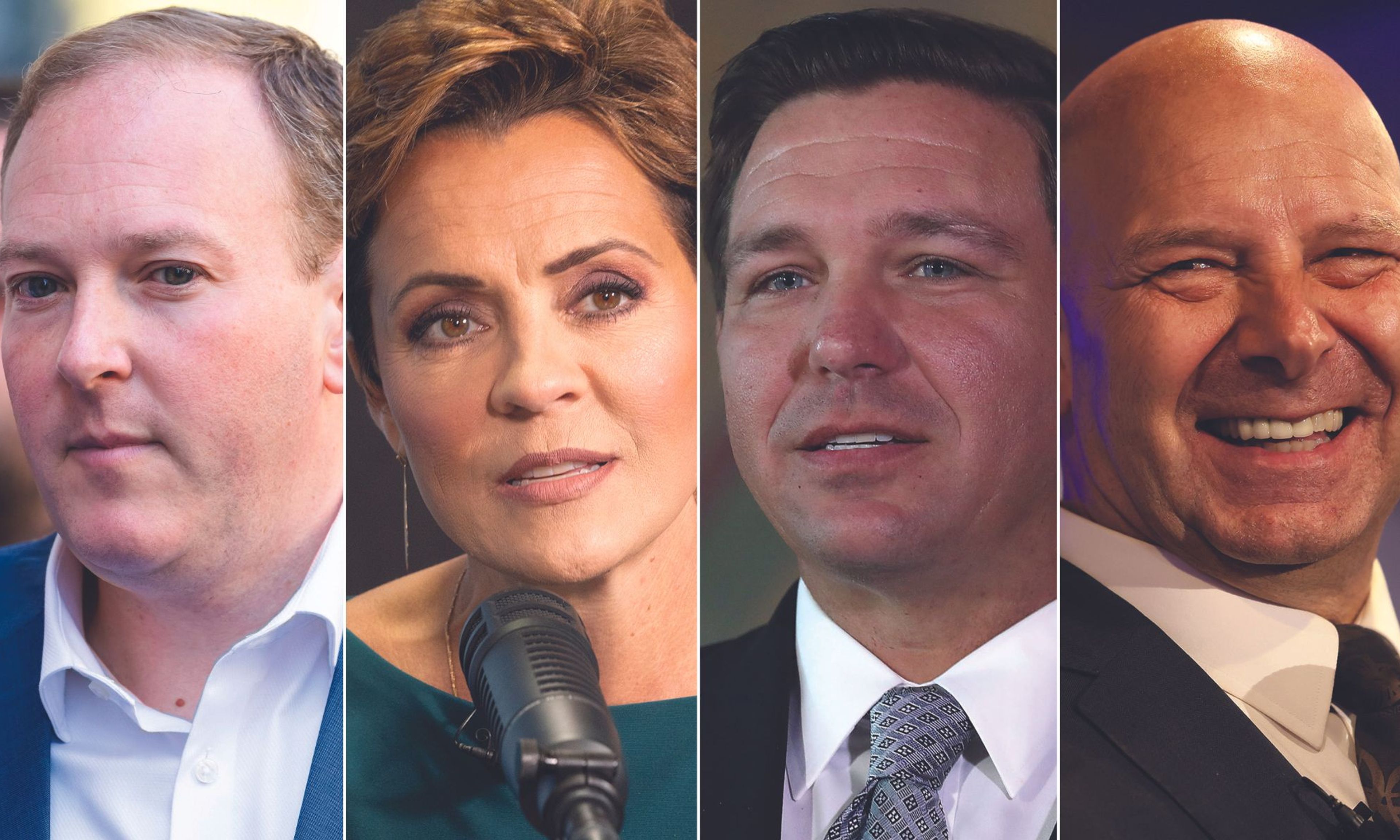
There are 36 elections for governor in 2022, featuring 15 Republican incumbents, 13 Democratic incumbents, five open Republican-held governorships, and three open Democrat-held governorships. The fate of these races will have major consequences for issues such as public safety after George Floyd, education after the pandemic, domestic energy production after $5/gallon gas, and abortion after Dobbs.
With Democrats holding the White House and both houses of Congress and the president’s approval rating still in the dumps (at this writing, under 43 percent in the RealClearPolitics poll average), this ought to be a good year for Republican candidates for governor. For the Republican incumbents, including big names such as Greg Abbott, Ron DeSantis, and Brian Kemp, it probably will be. It is likely that all 15 will be reelected, even deep-blue-staters such as Vermont’s Phil Scott and governors such as Oklahoma’s Kevin Stitt who are performing weakly in public polls.
It’s the other 21 races that are the problem. But if high hopes in the spring have been sobered by weak Republican candidates, a reenergized Democratic base, and massive spending advantages for Democrats in some key states, there are still enough states in play that the purple-and-blue-state blues of September may not be the last word.
Begin with some historical perspective. In the past four midterm elections under a new Democratic president — 1966, 1978, 1994, and 2010 — Republicans captured an average of ten governorships, while losing an average of three, for an average net gain of 7.5. The biggest wave came in 1994, when the GOP gained eleven governorships while losing only one, and that to an independent candidate. Three states have gone red in three of those four waves, and two are currently in Democratic hands: Pennsylvania, which has an open race, and New Mexico, which has a Democratic incumbent. Seven other states have gone red twice in those four midterms. Four of those have Democrat incumbents: Kansas, Wisconsin, Nevada, and Minnesota.
All six of those states should be big Republican targets this fall, along with open seats in Oregon and Hawaii, unelected governors facing the voters for the first time in New York and Rhode Island, and incumbents in Maine, Michigan, Connecticut, Colorado, and Illinois. But the GOP has struggled to get traction in several of those races.
First, knocking off incumbents is harder than capitalizing on vacancies. Since 2000, ten Democratic governors have lost reelection, but only four of those losses have come since 2008, despite some big Republican-wave years. In 2009, Jon Corzine lost to Chris Christie in New Jersey. In 2010, Chet Culver lost to Terry Branstad in Iowa, and Ted Strickland lost to John Kasich in Ohio. In 2014, Pat Quinn lost to Bruce Rauner in Illinois. Two of those were beaten by prize Republican recruits — Branstad was a former multi-term governor, and Kasich had been a prominent House Republican and cable-TV host — while Quinn was an accidental governor who barely survived 2010.
Of the six Democratic incumbents defeated between 2002 and 2004, by contrast, five were in the South (if one counts Missouri as the South), and the other (Mitch Daniels beating Joe Kernan in 2004) was a White House official winning while the Republican president was reelected.
Second, it remains to be seen how much the Dobbs decision will actually matter on Election Day, but the evidence from polls, special elections, and the Kansas abortion referendum all points to the abortion issue helping Democrats energize elements of their voting base that were dispirited earlier in the year. That matters more in bluer states, and it is likely to matter most in races for governor now that abortion is open to state bans or regulations.
How are things going on the ground? Among the five open Republican-held seats, two in red territory (Arkansas and Nebraska) seem safe, while two in blue territory (Maryland and Massachusetts) will almost certainly be claimed by the Democrats. Electing Republican governors for three consecutive terms in a deep-blue state is hard even in a good Republican year, but in Maryland, Republican voters made it much harder. They rejected Kelly Schulz — governor Larry Hogan’s handpicked successor — in favor of Dan Cox, a “stop the steal”–rally attendee backed by $1.16 million in Democratic spending. Cox trailed by 32 points in the most recent poll.
That leaves Arizona, where Republican primary voters chose another hard-edged candidate, former news anchor Kari Lake. But unlike many of the other candidates who won Donald Trump’s endorsement by backing his stolen-election claims only to face-plant in the general election, Lake has used her TV charisma to pull narrowly ahead in the polls against Arizona secretary of state Katie Hobbs, who led her in summertime polling. Lake leads by a point in the poll average, while Blake Masters, the Arizona Republican challenger for the Senate, trails by four. At a minimum, fears that Lake would be a drag on Masters now seem unfounded. But she has still run almost no TV advertising, relying on the Republican Governors Association to pulverize Hobbs.
Then there are the three open Democrat-held governorships: Pennsylvania, Oregon, and Hawaii. Pennsylvania, often a crucial bellwether, has been the major disappointment. Doug Mastriano defeated a divided opposition with 42.3 percent of the vote in the primary, with the backing of Donald Trump and help from $840,000 in spending by Democrats — more than twice what Mastriano spent on his own TV ads in the primary. The last six straight polls have shown Mastriano trailing by double digits. He didn’t even begin TV advertising until early October, whereas his opponent, Josh Shapiro, is expected to spend around $35 million.
Oregon is a brighter spot: Crime, drugs, and homelessness, especially in Portland, are giving Christine Drazan a real chance to become the first Republican elected governor since 1982; only neighboring Washington has a longer drought. Drazan has had a consistent, if narrow, lead in the polls against a Democrat who is a close ally of the hugely unpopular incumbent, Kate Brown. It’s an unstable race featuring a major third-party challenger, so anything can happen. Hawaii, on the other hand, has been written off by most election analysts, and there is no public polling.
Unpopular or untested Democratic incumbents presiding over troubled locales should present pickup opportunities in other blue states, such as New York, Connecticut, Rhode Island, Michigan, and Minnesota. But most of these have yet to show signs of being competitive. A recent poll showed Gretchen Whitmer’s lead down to six points in Michigan, but her opponent, Tudor Dixon, is being massively outspent and has run no TV advertising. Tim Walz in Minnesota looked vulnerable until Republicans picked Scott Jensen, who has lagged and is also being hugely outspent. In Illinois, Governor J. B. Pritzker and his allies spent a staggering $35 million to help choose the weaker Republican in the primary. In Maine, Paul LePage’s comeback effort has lagged in polls, but then, in his last election, in 2014, LePage won by five points despite trailing in most polls all the way to the end.
Trafalgar’s polls show a close enough race for Lee Zeldin against Kathy Hochul in New York that an upset would not be a total shock, but most other pollsters show a comfortable Hochul lead. The race neatly captures the parties’ national strategies. Zeldin is running a laser-focused campaign on crime and New York’s radical “bail reform” law, which triggered a massive red wave on Long Island in 2021. Hochul is running almost entirely on abortion and January 6 rather than her own record.
The best bets for Republicans toppling Democratic incumbents are in Kansas, Nevada, New Mexico, and Wisconsin. Crime is a major issue in Wisconsin and New Mexico, with Tim Michels pounding Tony Evers for his handling of the riots in Kenosha, and Mark Ronchetti trying to capitalize on record crime rates in Albuquerque. Ronchetti is the longest shot of the four, but Republicans have prioritized his race as part of an overall Southwest strategy targeting Hispanic voters. Those voters are one reason why the party’s hopes are high for unseating both Governor Steve Sisolak and Senator Catherine Cortez Masto in Nevada. Corruption and high gas prices have been major targets in Joe Lombardo’s race against Sisolak.
Unlike last year’s upset for Glenn Youngkin, education and cultural conflict have taken a back seat to pocket-book and safety concerns in 2022’s Republican campaigns. It’s that message that Republicans still hope will resonate. RGA communications director Jesse Hunt summarizes the closing argument: “Democrat governors have worked in lockstep with Joe Biden to promote policies that have caused twin crises on crime and inflation. Both have skyrocketed under Democrat control and voter dissatisfaction with how they have handled the issues will be a major reason Republicans are able to flip states from blue to red in November.”
Republicans are likely to succeed in some of those efforts, but it will be an upset if they match the historical average.





Comments