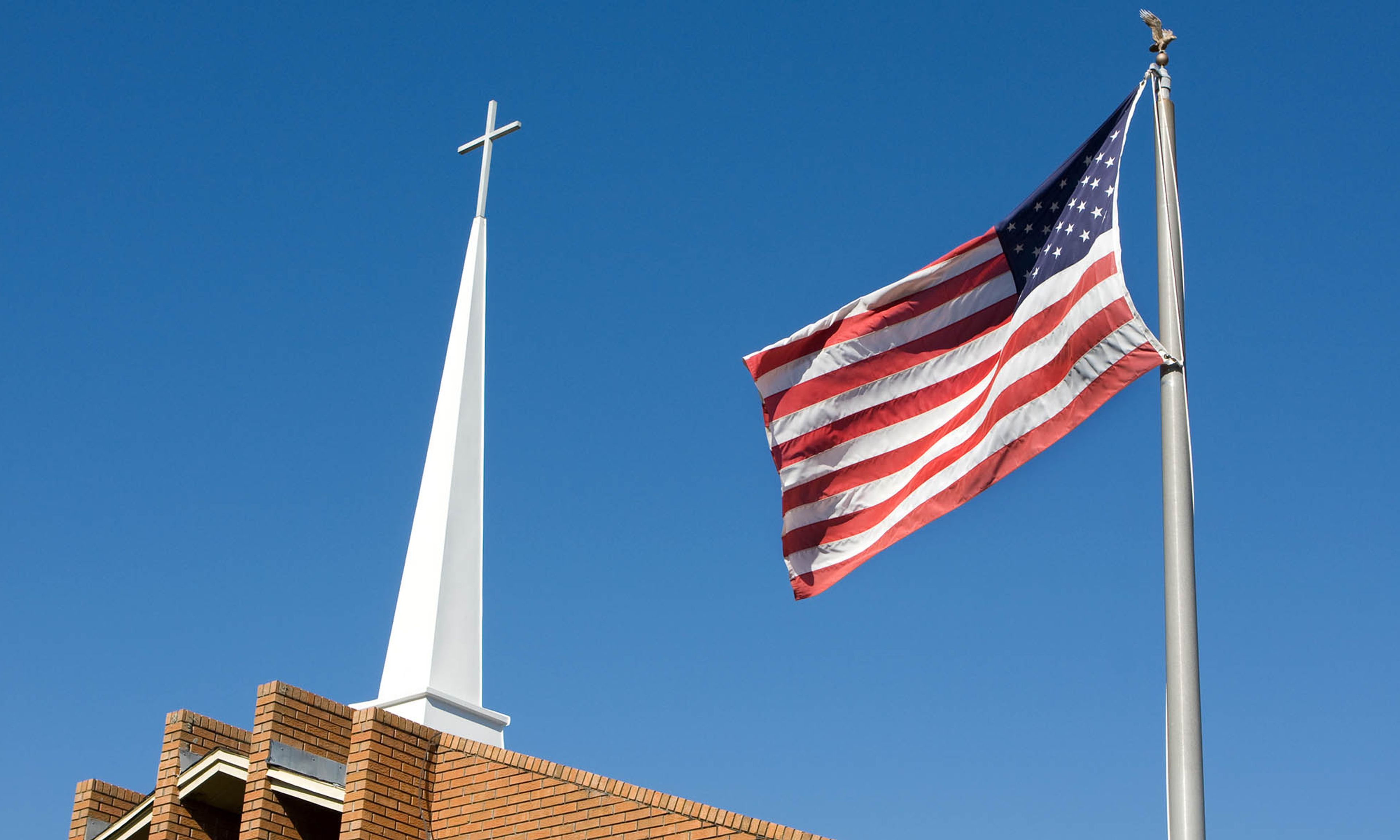
I recently discovered that I am a Christian nationalist. This came as a surprise, because I have never regarded myself as a nationalist of any sort. I am comfortable with religious diversity, and have moderate views on immigration. I find jingoistic, America First language distasteful. Nevertheless, I qualify as an “ambassador” of Christian nationalism, according to the metrics of leading sociologists in this field. After reading some worrisome things about the nefarious influence of Christian nationalism, I went ahead and answered the questions from the quantitative Christian-nationalism scale, used by Andrew Whitehead and Samuel Perry in their trend-setting book on the subject. I scored 18 points out of 24. That apparently places me in the most virulent bracket of nationalist, an industrial-strength Christian warrior bent on seizing the nation back for Christ.
It’s terribly confusing. The things I read assure me that Christian nationalism represents an existential threat to the entire nation. It is a racist, xenophobic, radical religious movement bent on installing a Handmaid’s Tale–like reign of despotic, patriarchal terror. It “has become intertwined with” white-replacement theory, cowering in fear of “a corrupt elite made up of Jews and Democrats.” It was apparently the driving force behind the January 6 Capitol riots. This exotic picture bears no resemblance to my religiously conservative community. None of my friends or relatives seem at all favorable to an Atwood-style despotic regime. I think a great many of them would broadly share my views on church and state, though. What’s going on here?
One reason this subject is so puzzling is that very few people, outside the offices of Representative Marjorie Taylor Greene, identify as Christian nationalists. Accordingly, critics have cheerfully taken on the task of defining the term. Whitehead and Perry took the lead here with their 2020 book, Taking America Back for God: Christian Nationalism in the United States. They used a six-question survey, conducted by Baylor University, in which respondents were invited to agree or disagree with a series of statements:
The federal government should declare the United States a Christian nation.
The federal government should advocate Christian values.
The federal government should enforce strict separation of church and state.
The federal government should allow the display of religious symbols in public spaces.
The success of the United States is part of God’s plan.
The federal government should allow prayer in public schools.
Reading over this list, one might immediately notice some curious things. Only two items on the list even mention Christianity, and it seems quite plausible that Jews or Muslims, for instance, might qualify as “Christian nationalists” on this scale, perhaps because they believe it should be acceptable for public monuments to bear the Star of David, or for Muslim students to perform their midday prayers while at school. Not a single question touches even obliquely on race or gender, though commentators quickly became comfortable referring to it as white Christian nationalism, and expounding on the tribe’s patriarchal commitments.
Fully half the questions ask about the appropriateness of the federal government policing the public square or interfering in more-local practices. It is possible that some people would acknowledge the imprudence of reintroducing prayer in public schools, or building overtly Christian public monuments, while still believing that the federal government’s constitutionally prescribed role in policing the public square is quite limited. Clearly, the survey is not sensitive to any of these nuances. Despite this (or perhaps because of it), Perry and Whitehead felt comfortable classifying 52 percent of Americans as either “accommodators” or “ambassadors” of Christian nationalism, meaning that “over half of the United States population embraces Christian nationalism to some extent.”
Looking ahead to the midterm elections, Yale’s sociology department hosted a conference this month to discuss the paranoid, exclusionary, megalomaniacal tendencies of Christian nationalists and the immediate threat they pose to American democracy.
No reasonable person doubts that faith and politics can combine in malignant ways. Corrupt and power-hungry people are often eager to claim the Mandate of Heaven, while political activists can easily persuade themselves that God is on their side. That belief can breed recklessness, as reformers come to think that they are beyond the reach of ordinary ethical or prudential reasoning. Approaching the question from another angle, some Christians are deeply concerned about the potential for a faith-infused politics to undermine the church itself. In their eagerness to enjoy some short-term victories, Christians may compromise themselves, allowing the kingdom of God to devolve down to the level of fallen men. There is plenty of evidence that those fears are justified. Sometime around the year 2016, for instance, many Christians rapidly changed their views on the importance of virtue in public officials. Those disturbing trends motivated Paul Miller, an Evangelical Christian, to write a book, The Religion of American Greatness, urging his coreligionists to draw clearer and more-principled lines between the kingdoms of God and men.
The most serious charge against Christian nationalism, however, is that it is exclusionary. It is simply a fact that the United States is and has always been “a Christian nation,” in the sense that most American citizens have always identified as Christians. It would be ludicrous to deny the immense impact that Christianity has had on American history and culture. But the United States also has a long tradition of respecting religious freedom. In our constitutional tradition, Christians are not meant to be politically privileged. People of all faiths (or none) should be able to participate fully in civic life. Building an inclusive, Christian-majority society has never been simple, and Americans have long struggled to discern the appropriate place for religious imagery on public monuments, religiously informed premises in public debate, and religious language in the speeches of elected officials. A free country should not force religious people to confine their faith to the cloisters, but pains must sometimes be taken to ensure that minorities are not marginalized.
Church-and-state debates are as old as the nation itself, but terms and conditions have shifted dramatically over the past half century, and those changes form the backdrop for the conversation about “Christian nationalism.” For most of American history, Christians have represented a substantial majority of the population, and most civic leaders, including the Left’s vaunted heroes, have been comfortable with some open expressions of faith. Abolitionists, the suffragettes, and civil-rights leaders all drew liberally on Christian texts in their public speeches. Woodrow Wilson and Abraham Lincoln publicly wrestled with agonizing questions about the place of the American people within God’s providential plan. Lyndon B. Johnson quoted the Bible regularly and nurtured friendships with Evangelical preachers such as Billy Graham. Franklin D. Roosevelt begged Americans to join him in praying to Almighty God that the Allies would prevail in Normandy. Even today, it’s hard to make the case that any American president has declined to “advocate Christian values” from a presidential podium, at some time or in some way.
Many other things have changed, though. In recent decades, American courts have become far more proactive about curbing public expressions of faith. Popular culture is more hostile to Christianity than in previous eras. Christians have also lost ground in demographic terms. Roughly 64 percent of Americans now identify as Christian; half a century ago it was upwards of 90 percent. If present trends continue, Christians will become a minority within the next few decades. Perhaps the federal government should declare the United States a once-Christian nation.
In the face of such rapid decline, some Christians may become desperate and look to rebuild their shining city through any available means. Sociologists’ writings on Christian nationalism may be histrionic, but their fears are not entirely fanciful. When Ron DeSantis urges supporters to put on “the full armor of God” before entering the political battlefield, that naturally occasions some alarm. It’s understandable that non-Christians get suspicious when the National Conservative Statement of Principles demands that schools and universities teach and prioritize the Bible as “first among the sources of a shared Western civilization.” The Bible indeed holds immense historical significance, but it also includes the most sacred Jewish and Christian texts. Does anyone really want public-school teachers entrusted with it? The imprudence of this recommendation is so obvious that one suspects that it must be part of the point. A quick skim of conference topics from the recent National Conservative convention suggests that pugnacious, theologically themed populism is in vogue, from Senator Josh Hawley’s “The Biblical Revolution” to Rod Dreher’s “Shadrach in American Babylon.” I like old-time religion, but it’s reasonable to worry that such zealous Christian culture warriors may be vulnerable to the errors mentioned above.
That’s just one part of a larger picture, however. Christians aren’t the only ones who are struggling to get perspective on changing times. No doubt sociologists like Whitehead and Perry would have some rejoinders to my criticisms. They did not tell me personally that I was a Christian nationalist; they merely classified people with my views as adherents to Christian nationalism. Comments about the racism or sexism of Christian nationalists have at least some grounding in data correlated from other studies. Also, it’s worth noting that a few sociologists have more recently made efforts to expand on Whitehead and Perry’s research, looking for more-nuanced ways to recognize the diversity within Christian nationalism. Perhaps later studies will be more helpful.
They have a long way to go. Fundamentally, Whitehead and Perry pathologize religious traditionalists, using vague statements to spread a wide net and then connecting everyone in it to obviously bad phenomena such as the January 6 Capitol riots. Their approach leaves no theoretical space for the possibility that some Christians might have principled, complex positions on church and state. For progressives this may be a fun exercise in confirmation bias, but they’ve probably revealed more about themselves than about the people they claim to be studying. I’m not a social scientist, just an armchair social critic with Christian-nationalist sympathies, but to my eyes this resolute see-no-good approach to religion speaks to some deeper leftist insecurities.
Just like Christians, secular progressives are struggling to discern their place in the stream of American history. It’s understandable. They are surely the least religious people ever to attempt large-scale cultural reform on this fruited plain. That’s a lonely place to be, and when difficult questions arise, it may be hard to know where to turn for insight. When Christians lose the plot in their cultural narratives, they can at least turn to wise forerunners who shared their core convictions. Progressives would probably feel compelled to cancel even their most admired historical figures if they set foot on a modern university campus. Perhaps they, the progressives, are the bitter clingers, desperately trying to retain meaningful ties to a past that is increasingly strange to them. By caricaturing religious traditionalists as prejudiced, panicked illiberals, they may make it easier to ignore how much has been lost.
If that’s true, then the challenge for religious traditionalists is to articulate a vision of the future that is appealing, unapologetic, and non-exclusionary. This will require us to answer some hard questions. Traditions normally help people to do that. It is more difficult than ever today to draw appropriate lines between church and state, but that’s all the more reason to be judicious and circumspect in our discussions of faith and freedom.












Comments