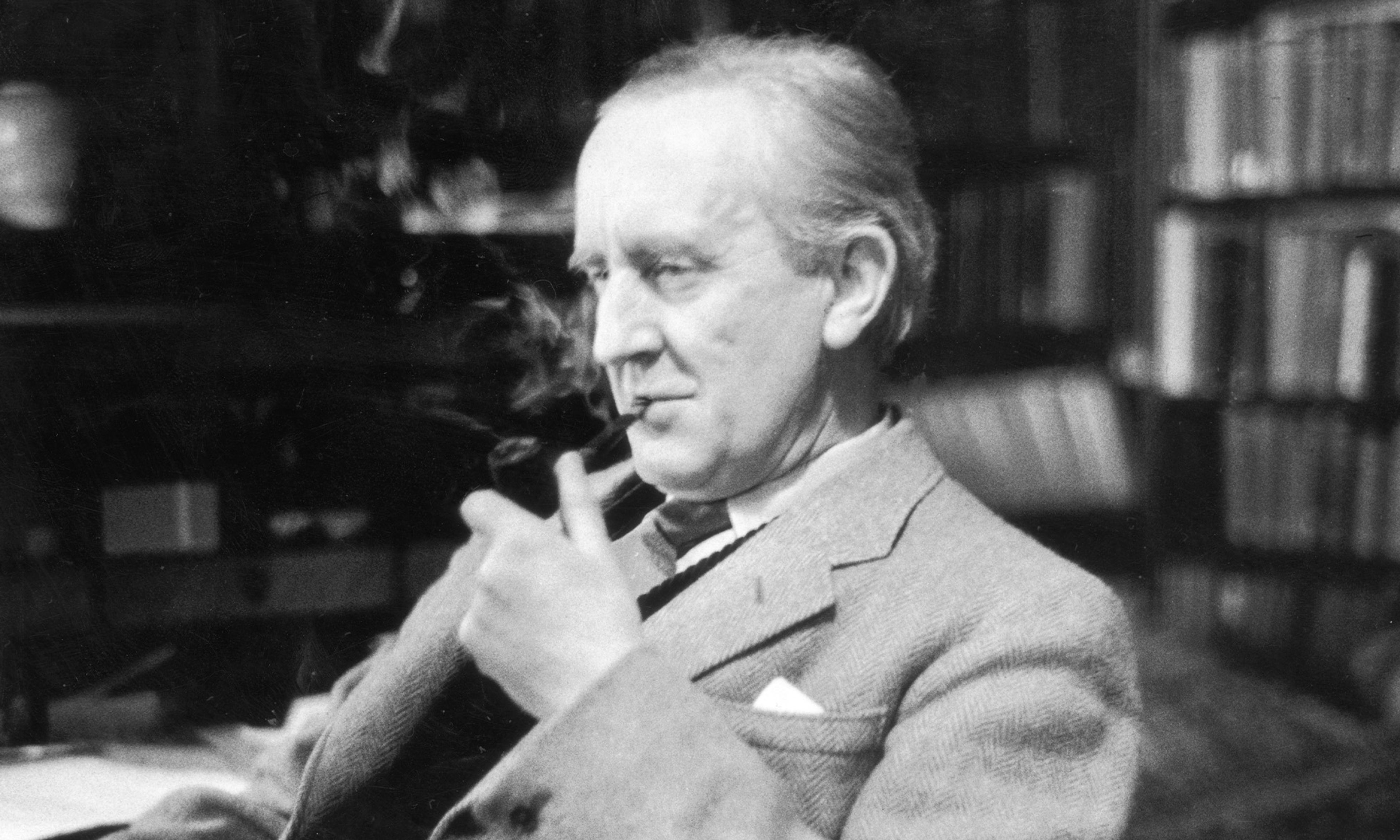
The year 2023 marked 50 years since the death of John Ronald Reuel Tolkien, and 2024 will mark 70 years since the publication of the first volume of The Lord of the Rings, which holds the title of the best-selling novel ever written. Fantasy and science-fiction authors mostly come and go, but Tolkien has endured. Why is this so? What is different about him?
For answers, we would do well to look at the recent work of Holly Ordway, whose 2023 biography Tolkien’s Faith constitutes a significant breakthrough in Tolkien scholarship. Tolkien has long been thought of as the “father of fantasy,” the Arch Dungeon Master who standardized the now familiar world of elves and dwarves and wizards and dragons. Tolkien didn’t mention there being a religion for this “Middle Earth” he created, and most of his fans saw little reason to look for one.
Tolkien’s reputation as a fantasy writer — as opposed to, say, a Christian writer — was destabilized by his close friendship with C. S. Lewis. Lewis’s biggest fans tend to be religious Christians, and the scholars among them began drawing Tolkien more clearly into the world of Lewisian Christian apologetics. While there are major differences between the celebrity Christian persona of Lewis and Tolkien’s rather quiet life of faith, Tolkien had in fact been one of the means of Lewis’s conversion to Christianity; and his whole life he had been known, as he himself put it, as “a Catholic. A devout Catholic.” Christian scholarly presses began minting Christian interpretations of Bilbo and Frodo and the rest of the hobbits — interpretations that, by the way, have generally held up well.
Tolkien’s Faith marshals the real-world evidence for these interpretations, and it makes for compelling reading. Tolkien’s mother, Mabel, belonged to a Unitarian family, though she became a practicing Anglican while married to Tolkien’s father, Arthur. After Arthur’s death — Tolkien’s father died when he was three and his younger brother just newly born — Mabel converted to Catholicism. Because she had “poped,” family on both sides withdrew financial support of the widow. Just a few years later, she would be dead, after unremitting toil and illness. Tolkien was an eleven-year-old altar boy. He considered her a martyr who had been killed by her society for her religion — and for her children’s. He said of her, she “killed herself with labour and trouble to ensure us keeping the faith.”
Tolkien passed out of his family and became an orphan under the guardianship of a priest of the Birmingham Oratory, Father Francis Morgan, until the age of 21. The Oratorians were known for their emphasis on liturgy, creativity, humor, and humility. All of these would figure prominently in the Christian life of Tolkien. In England the Oratorian banner was held aloft by Cardinal John Henry Newman, also a priest (before Tolkien’s time) at the Birmingham Oratory. (Newman had earlier chosen Morgan as his personal assistant.)
Ordway’s account of the Oratorian movement in Birmingham and its place in the intellectual life of England and of Oxford in particular — where Tolkien would go on to be a professor for decades — is one of the great strengths of her book. The Oratorians were founded by Saint Philip Neri, a Roman priest who was known for his hatred of personal pride and his belief that it warred with real sanctity. A painting of Saint Philip Neri in the Birmingham Oratory — which Tolkien saw daily at Mass (for he went every day) — bears the title Exaltavit Humiles. It is a phrase from the Magnificat, the prayer of Mary. “He has raised up the lowly.” “He hath exalted the humble.”
In Ordway’s hands, what is distinctive about Tolkien’s hobbits becomes apparent. Fantasy novels will typically feature a muscle-bound alpha with a bikini-clad babe on the cover. At the very least they will exalt the smart, or the fast, or the lucky. Tolkien’s hobbits aren’t like that at all: He celebrates small, decent folk. Frodo, the Ringbearer himself, doesn’t even really get to be extraordinary: At the end, he succumbs to temptation and fails in his quest, which is saved only by the mercy he has shown to Gollum, a creature even more miserable and lowly than himself. In other words, his premise is based on the Christian values of humility and mercy. As Tolkien himself wrote, “The Lord of the Rings is of course a fundamentally religious and Catholic work; unconsciously so at first, but consciously in the revision.”
There is more to Tolkien’s success, and for that we can look to Ordway’s previous book, Tolkien’s Modern Reading. In this book, she dismantles the contention that Tolkien was an escapist who refused to grapple with the modern world. She documents his lifelong engagement with the writings of his contemporaries, as a way of arriving at an important conclusion: Tolkien was not ignoring the modern world by writing of a world of handicraft, virtue, nature, friendship, and, ultimately, religion. He was saying that these represented the answers to our problems, the enduring and true answers. The Lord of the Rings is just as much about modern war, totalitarianism, global surveillance, and the dangers of technology — our “smartphones” grow daily more similar to the Ring in their power over us — as it is about the medieval world.
Modern thinkers such as Ayaan Hirsi Ali have recently made the case that without Christianity there will be no resistance to the forces of disintegration operating in our culture today. Those who are interested in this kind of resistance should look again to Tolkien, who manages to bring together conservatives and conservationists and Catholics and hippies all under one countercultural umbrella. And they would do well to take Holly Ordway along with them as a guide.












Comments