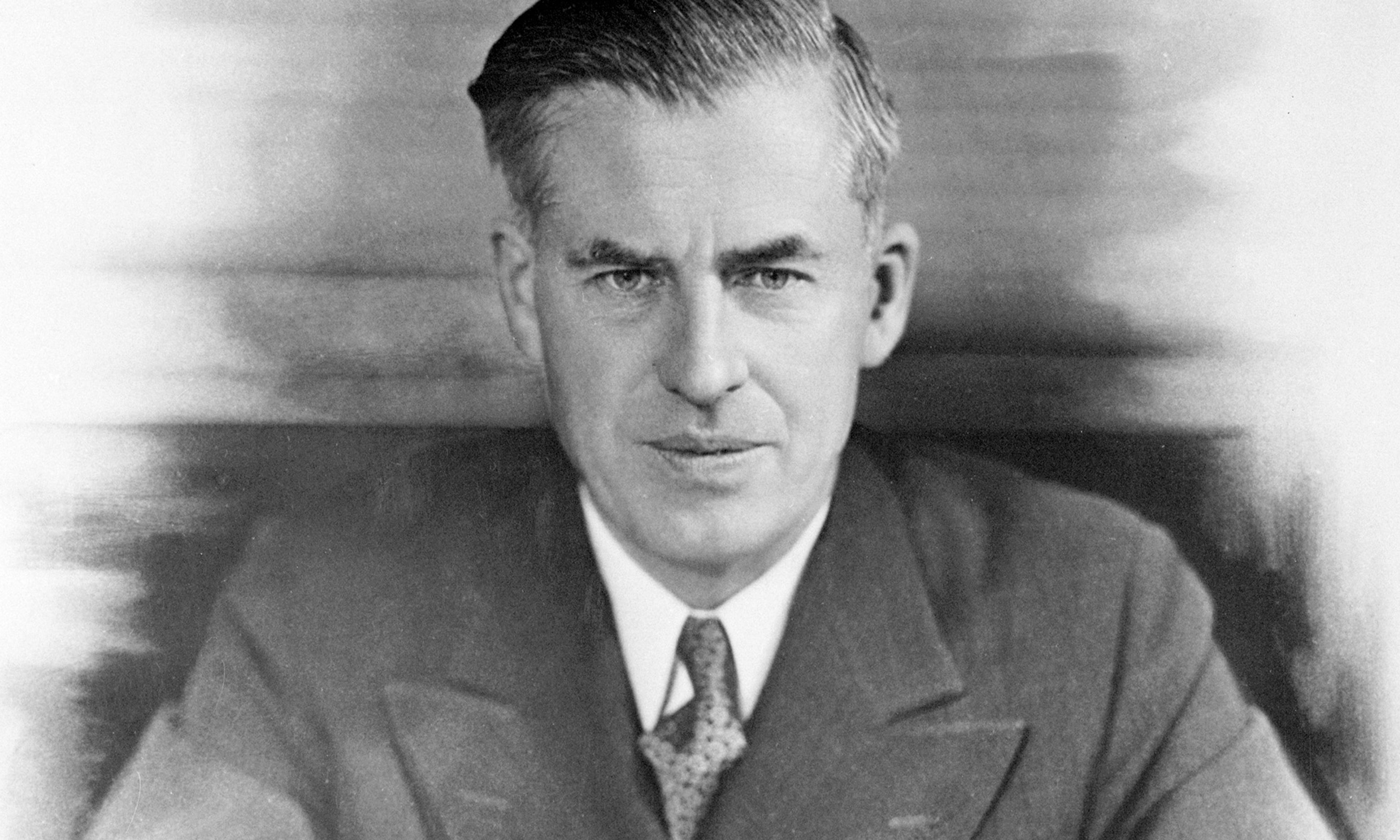
How very close the American Century came to being the Catastrophe Century becomes clear in Benn Steil’s new biography of one of the many also-rans of our past, Henry Agard Wallace. Steil captures the man who, from 1933 to 1948, ambled around the national stage as agriculture secretary, one-term vice president, commerce secretary, and Progressive Party presidential candidate.
Where Steil adds unusual value, however, is in documenting the breadth of the damage this also-ran wrought upon our polity. Steil also, unlike most of his predecessors, is willing to entertain the obvious counterfactual. What if the ailing Franklin Roosevelt had kept Wallace on the ticket in 1944 so that, when Roosevelt passed away the next year, it had been up to President Wallace to shape the post-war world order?
“With Henry Wallace in the White House,” argues Steil, “there would have been no Truman Doctrine. No Marshall Plan. No NATO. No West Germany.” Confronted with Steil’s solid research, the reader can only agree with him.
The Wallaces were Farm Belt royalty at a time when the Farm Belt mattered. From the turn of the century, the family newspaper, Wallaces’ Farmer, planted ideas like seeds in the minds of farmers. Henry A.’s father, Henry Cantwell Wallace, served as agriculture secretary to two Republicans, Presidents Warren Harding and Calvin Coolidge. Meanwhile, at home, Henry A. displayed a gift for agronomy. Seeds the younger Henry developed increased the yield of corn-farming dramatically, a fact that further elevated the Wallace name.
On the side, this agronomist developed an obsession with mysticism. He also waded around in Thorstein Veblen and William James, concluding that America required “some workable substitute” for the “marketplace as the governor of our economic system.”
In the 1920s, agriculture endured a depression before the Depression. Via Wallaces’ Farmer, Henry A. participated in the debate over low wheat prices. He blamed overproduction and advocated the “allotment system,” penalizing farmers who overproduced.
When the Depression hit the rest of the economy, the new president, Franklin Roosevelt, called for “bold, persistent experimentation” and tapped Henry A. Wallace as agriculture secretary.
Wallace promptly helped push through an emergency bill giving his department vast authority to take whatever action it felt like in the name of rescuing farmers. “Overnight,” as Steil notes, “farming — the American vocation most clearly associated with rugged independence — became an enormous national economic protectorate.”
Wallace celebrated with a thumping call not just for agriculture aid or supply management but “to reorganize agriculture”; he sought “the resettlement of America.” The speech bore the daunting title “Declaration of Interdependence.” Facilitating Wallace’s arrogant approach in those early New Deal days and after were high-handed officials under him, several of whom would later, sometimes much later, emerge as Soviet spies.
Wallace commenced his tenure by ordering a million farms to plow under their crops, a total of 10 million acres. This plan to drive up prices by curtailing supply, Steil writes, even farmers found “insane,” but the payments they received for the destruction, the equivalent of $23 billion today, stilled most of them — and set a precedent for agriculture subsidies that persist to this day. Six million pigs, many not even grown, were likewise slaughtered, against which citizens did speak out: “It just makes me sick all over to think how the government has killed millions of millions of little pigs,” wrote one correspondent to Wallace. Prices had risen so that “today we poor people cannot even look at a piece of bacon.”
Wallace, champion of precision, had overshot — or misfired. The secretary blamed the rise in pork prices on drought. As Steil notes, Roosevelt’s devaluation of the dollar also placed upward pressure on prices. It turned out there was no real need for the Great Piglet Massacre. The secretary garbed many other radical moves in uncontroversial terms. A poster for his Resettlement Administration advertised “A Mule and a Plow” and a “New Start” for farmers. In reality, the RA also herded migrants into government camps or collective farms such as that at Casa Grande. As Steil reports, federal agriculture policy threw 2 million farmworkers “off the land.” Thus did the New Deal contribute to the displacement John Steinbeck blames on capitalism in The Grapes of Wrath.
Professors loved this idealistic standard-bearer of progressivism. So did crowds. Democratic Party regulars, not so much. Protecting Wallace, though, was his new partner in mystical philosophizing, the president, a fellow Freemason. Together, the pair redesigned the dollar bill, introducing the pyramid topped by an eye. Wallace also tightened an old acquaintance with a group of occultists. Led by a White Russian exile, the artist Nicholas Roerich, this group worshiped a deity who communicated “clairaudiently.” Roerich aimed to establish “the Sacred Union of the East,” a new theocratic state in Central Asia. The cult crew dubbed Wallace “Galahad.”
So taken with the set was Galahad that he determined to use department resources to fund Roerich’s travel as leader of an otherwise humdrum seed-gathering expedition to the very parts of the world where the guru wanted to build his “Shambhala.” Roosevelt knew of Wallace’s friends — and looked away. To say that the plan surprised USDA botanists on the project is understatement.
Manchuria, a destination on the itinerary, was “the hottest diplomatic area on earth.” China, the Soviet Union, and Japan vied for control there. Not only did Roerich court the puppet emperor of Japanese-occupied Manchukuo, Pu-yi, but he also convinced Wallace to recall the USDA functionaries, whom he called in his diary “evil botanists.”
The misadventure faded until Roosevelt tapped his friend Henry for vice-presidential candidate in 1940. Then the correspondence between secretary and mystics was leaked to the Republican National Committee.
The “Guru Letters” make good reading. Code names for Roosevelt were “The Flaming One” and “The Wavering One.” The exchanges render undeniable the extent to which Wallace had lain in the cult’s thrall. “May the Glory of the flaming Chalices,” Galahad wrote, “shine even as the Star of the Hero in the last beautiful reproduction.”
Roosevelt decided to keep Wallace as his running mate anyhow. That fact alone should give us pause. As it happened, FDR possessed competing dirt on his Republican opponent: Wendell Willkie had a mistress. The president’s men and Republicans agreed to suppress media coverage of both stories, and succeeded.
You could do that in those days.
Vice President Wallace plunged directly into foreign affairs. After the U.S. allied itself with the Soviet Union, he declared the 20th century “the century of the common man.” He told the public that an international “people’s revolution” was under way.
In 1944, FDR dispatched the vice president on a goodwill trip to the Soviet Union. Claiming that the People’s Commissariat of State Security pulled the wool over Wallace’s eyes doesn’t capture it. Wallace pulled the wool down himself. Siberia was one great prison complex. Yet so bedazzled was the vice president by the fake displays mounted for him that he rated Siberia a model for Alaska, which, he told others, could never be settled “on an individualist basis.”
Democrats used Wallace’s absence to persuade a visibly ailing Roosevelt to drop him in the 1944 race. Roosevelt handed Wallace the consolation post of commerce secretary.
After Roosevelt’s death in 1945, the commerce secretary concentrated on distinguishing himself from the increasingly hawkish Truman, disloyally assailing the Marshall Plan. In 1946, when Wallace suggested that the U.S. should not meddle while Stalin locked up Eastern Europe, Truman concluded that Wallace had “absorbed some of the ‘Commy-Jesuit’ theory that the end justified the means” — and fired him.
In his 1948 bid for the presidency, Wallace more or less openly offered an American front to Moscow and privately informed Stalin he was ready to submit his own comments on Soviet–American relations to Stalin for pre-approval. (Steil reprints an encoded cable to Stalin containing Wallace’s approach, which came via Soviet diplomat Andrey Gromyko.)
During World War II, accepting Stalin’s regime as America’s ally seemed a necessary hypocrisy. If Wallace participated in that hypocrisy, he was only, the public could reason, demonstrating patriotism. In the Cold War years, progressive historians protected Wallace. Their advantage was that much of the evidence against him emerged only piecemeal: some in 1948, some when FBI files became public in the 1980s. Confirmation of the extent of Soviet spies’ penetration of his staff, and of Wallace’s dangerous diplomacy, came after 1989, when the Venona papers — an archive of Soviet intelligence work in the U.S. — became available.
At Wallace’s passing in 1965, most eulogized him as “the rustic idealist in the court of FDR,” as National Review characterized it. Though it felt, as National Review’s editors acknowledged, ungentlemanly to trash someone fresh in the grave, they nonetheless pointed out that “the most striking achievement of Wallace” was “his submission to the communists in 1946, 1947, and 1948.” All you can conclude is that rudeness was the right approach in this instance. With the New Deal enjoying a revival, The World That Wasn’t reminds us of an inconvenient truth. Your neighbor may be a benign fool. But a benign fool leading government — there’s no such thing.












Comments